Choose the right IR sensor by job
Start with the sensing job, not the brand. PIR and active IR are different product types: PIR senses motion from heat changes, while reflective and proximity sensors emit IR and read reflections. For line following, the TCRT5000 Reflective Sensor Module works at 1mm to 8mm with a 3mm sweet spot. The bare TCRT5000 reflective IR sensor peaks at 2.5mm and leaves the rest of the circuit to you. For obstacle triggering, the E18-D80NK IR proximity sensor gives an adjustable 3cm to 80cm digital trigger. If you need a distance value, the Sharp families split into 4cm to 30cm, 10 to 80 cm, 20cm to 150cm, and 100 to 550 cm bands. If black targets or strong sunlight matter more than fast IR response, compare ultrasonic sensors. New to line sensors? See how a reflective line sensor is wired and tuned.
| Need / What you want to detect |
Best-fit sensor family on this page |
Typical output style |
Useful range from supplied research/cards |
Main limitation to know before buying |
| Line following / black-white contrast |
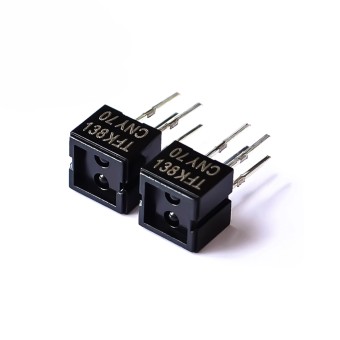
TCRT5000 reflective sensors |
Analog output + digital output on module; raw component needs your own circuit |
1mm to 8mm on the module, with 3mm optimal; bare component peaks at 2.5mm |
Near-contact reflective sensing only, not room-scale obstacle detection |
| Simple obstacle trigger |
GP2Y0D310K digital distance sensor or E18-D80NK adjustable proximity sensor |
Digital output |
Fixed 10cm for GP2Y0D310K with 8ms cycle; 3cm to 80cm adjustable for E18-D80NK |
Trigger only, not a direct distance reading |
| Adjustable proximity, better outdoors than raw IR pairs |
E18-D80NK IR proximity sensor or OMRON E3Z-D61 photoelectric sensor |
Digital / switching output |
3cm to 80cm for E18-D80NK; 5mm to 100mm for E3Z-D61 |
Real range still depends on target reflectivity and setup |
| Exact-ish analog distance over a specific band |
GP2Y0A41SK0F 4-30cm, GP2Y0A21YK0F 10-80cm, GP2Y0A02YK0F 20-150cm, or GP2Y0A710K0F 100-550cm |
Analog output |
4cm to 550cm depending on model |
Non-linear output, with a minimum-range dead zone |
| IR remote receive / transmit |
38KHz Infrared Receiver Module, 38KHz Infrared Transmitter Module, or 21-Key IR Transceiver Kit - 38KHz |
Digital remote-control signaling |
Several meters; the kit offers about 8m, while the transmitter module is 1–2m |
These are for remote-control style communication, not obstacle detection |
| People motion / occupancy |
HC-SR501 PIR motion sensor or SR602 PIR motion sensor module |
Digital trigger |
3 to 7 meters and 110° for HC-SR501; up to 5m for SR602 |
Detects motion from heat changes, not object distance |
| Non-contact temperature |
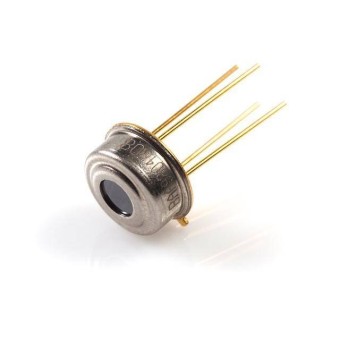
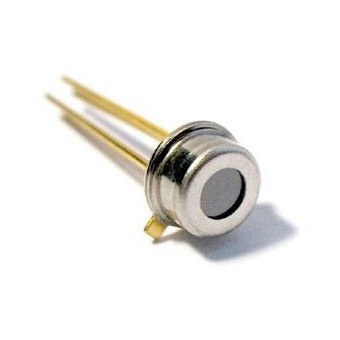
MLX90614-BAA IR temperature sensor |
PWM / SMBus |
-70 to 382.2°C |
Single-point thermopile reading, not thermal imaging |
| Low-resolution thermal mapping |
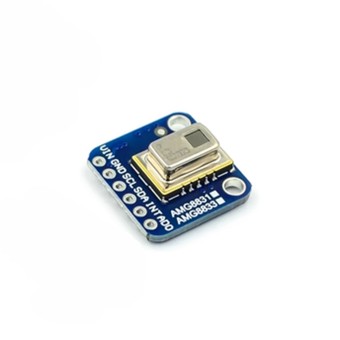
GY-AMG8833 8x8 thermal imaging module |
I2C |
8x8 matrix, 64 readings |
Presence blobs and heat mapping only, not camera-like detail |
| Flame detection |
IR infrared flame sensor module |
Adjustable digital HIGH/LOW |
Detects 760nm to 1100nm IR from flame sources |
Not a general motion or temperature sensor |
| Industrial photoelectric switching |
OMRON E3Z-D61 photoelectric sensor |
NPN open collector |
5mm to 100mm |
Industrial wiring style and fixed 2m cable, not a breadboard module |
Range, output, and environment: the shortest path to the right sensor family
Range is not a fixed number: real detection depends on target reflectivity, ambient light, and threshold setting. That matters as much as the headline max distance. A reflective module can be excellent at 3mm and useless at 30cm, while a long-range Sharp can miss anything inside its minimum band. Output type matters just as much. Digital output is the simplest choice for obstacle/no-obstacle logic, analog output suits relative distance, and I2C helps when you want cleaner digital integration. Most cheap IR sensors perform poorly in direct sunlight, while modulated families such as the E18-D80NK, Omron E3Z class, and 38kHz or 56kHz receivers handle sunlight better than raw IR pairs. Reflective IR also struggles on black or matte targets because it depends on returned light intensity. All IR sensing needs optical line of sight and generally does not work reliably through most glass or plastics. If your project depends on black-object detection or outdoor sun performance, look at ultrasonic options. If you need adjustable threshold switching, see how an adjustable proximity sensor is set up and tuned.
| Sensor family / example |
Output type |
Supported range from cards |
Adjustable? |
Sunlight tolerance from research |
Best fit |
| TCRT5000 Reflective Sensor Module |
Analog output + digital output |
1mm to 8mm |
Yes, via potentiometer |
Poor in direct sun |
Line sensing and very close reflectance checks |
| GP2Y0D310K 10cm digital distance sensor |
Digital high-level detect |
Fixed 10cm, 8ms cycle |
No |
Better than raw reflectance for simple switching, but still IR line-of-sight dependent |
Fast yes/no detection at one known trip point |
| GP2Y0A41SK0F 4-30cm |
Analog output |
4cm to 30cm |
No |
Indoor-oriented |
Short-range distance where 10cm minimum is too long |
| GP2Y0A21YK0F 10-80cm |
Analog output |
10 to 80 cm; output spans 3V to 0.4V |
No |
Indoor-oriented |
Common mid-range robotics distance sensing |
| GP2Y0A02YK0F 20-150cm |
Analog output |
20cm to 150cm |
No |
Indoor-oriented |
Longer-range measurement without moving to 100cm minimum |
| GP2Y0E03 4-50cm |
I2C + analog output |
4 to 50 cm |
No |
Indoor-oriented |
Short-range distance with digital bus integration |
| GP2Y0A710K0F long-range sensor |
Analog output |
100 to 550 cm |
No |
Indoor-oriented |
Long-distance sensing using triangulation |
| E18-D80NK IR proximity sensor |
Digital only |
3cm to 80cm |
Yes |
Better sunlight tolerance than raw IR pairs |
Adjustable binary obstacle sensing |
| OMRON E3Z-D61 photoelectric sensor |
NPN open collector, Light-ON/Dark-ON selectable |
5mm to 100mm |
Light-ON/Dark-ON selection |
Better suited to industrial and brighter environments |
Industrial switching with IP67 protection |
| 38KHz Infrared Receiver Module / TSOP34856 56KHz IR receiver |
Digital receiver output |
Remote-control distances; TSOP34856 up to 45m |
No |
Designed to reject ambient IR through modulation |
Remote decoding, not proximity sensing |
Board compatibility and required extras before you add to cart
- Nearly all modules work with Arduino at 5V, but ESP32 and Raspberry Pi need 3.3V-safe outputs or a level shifter before you connect them to GPIO.
- ESP32 and Raspberry Pi GPIOs are not 5V tolerant, so supply voltage alone is not a safety check. If your project target is 3.3V, start by comparing against ESP32 boards and verify the sensor output level.
- The GP2Y0A21YK0F 10-80cm and GP2Y0A02YK0F 20-150cm require a 4.5V to 5.5V supply, so they are not native 3.3V-supply parts.
- The MLX90614-BAA uses PWM and SMBus outputs, while the GY-AMG8833 module uses I2C and includes an integrated 3.3V regulator plus level shifting, which makes it easier in mixed-voltage setups.
- The CHQ1838 IR receiver with metal case is TTL and CMOS compatible and adds an internal pre-amplifier IC, IR filter, and shielding where noise or stray light are concerns.
- Bare parts such as the 3mm 940nm IR receiver, 5mm 940nm IR receiver, and 3mm 940nm IR transmitter are components, not plug-and-play modules.
- The raw TCRT5000 reflective IR sensor is not the same buying choice as the TCRT5000 module; the module adds digital and analog breakout plus sensitivity adjustment.
- Receiver modules often behave more reliably with a 10–100µF decoupling capacitor on the supply, especially when remote decoding gets erratic on noisy rails.
- Open-collector or floating outputs may need a 10kΩ pull-up resistor, especially on long cables or switch-style outputs such as industrial sensors.
- IR transmitter LEDs often need a transistor driver such as 2N2222 plus resistors if you want more than very short transmit range.
- There is no universal pin order across clones. Reversed VCC and GND can destroy a module immediately, so verify pinout before power-up.
- For remote-control projects, how a remote receiver/transmitter pair is wired with Arduino is the useful next step after choosing the hardware.
Which distance or line sensor should you pick?
If you already know you need line, obstacle, or distance sensing, the real choice is threshold style, range band, and mounting distance. For an ir line tracking sensor, the TCRT5000 module fits only when the sensor sits 1mm to 8mm from the surface, with 3mm as the practical target. Need multiple sensing points? The 4 Channel IR Line Tracking Module gives 4 independent channels, TTL output, and adjustable 1mm to 60cm range, but it uses a 6-wire interface and requires working current greater than 1A. For an infrared obstacle avoidance sensor, the E18-D80NK is the adjustable digital choice from 3cm to 80cm, while the GP2Y0D310K stays fixed at 10cm with an 8ms cycle. Among Sharp-style sensors, choose the shortest band that fully covers your distance. The GP2Y0E03 stands out when you want both I2C and analog instead of analog alone. Sharp analog outputs are non-linear, and below the minimum range they can behave unpredictably or appear to go backwards. If you need actual mm distance numbers rather than a threshold or non-linear analog voltage, ToF or LiDAR is the better upstream choice. Buyers choosing a Sharp IR sensor can see how a Sharp analog distance sensor is read and calibrated. If dark targets or changing light are likely, compare ultrasonic sensors before committing.
| Use case / constraint |
Best-fit product family on this page |
Why it fits |
What it does not do well |
| Single-point line following or reflectance check close to a surface |
TCRT5000 Reflective Sensor Module |
Dual analog/digital outputs, onboard potentiometer, optimized for 1mm to 8mm |
Not useful for stand-off obstacle sensing |
| Multi-point line tracking or wider obstacle coverage |
4 Channel IR Line Tracking Module |
Four channels in one module with TTL outputs |
Higher wiring and power demand, including >1A working current |
| Adjustable obstacle / no-obstacle switching |
E18-D80NK IR proximity sensor |
3cm to 80cm adjustable trigger, simple digital behavior |
Does not provide distance in centimeters |
| One fixed trip point at high switching speed |
GP2Y0D310K digital distance sensor - 10cm |
Fixed 10cm detection with 8ms cycle time |
No adjustment and no variable distance output |
| Tight-space distance sensing |
GP2Y0A41SK0F 4-30cm |
Starts at 4cm, where the 10cm-minimum models are too long |
Shorter max range than the mid-band Sharp parts |
| General-purpose mid-range robotics distance |
GP2Y0A21YK0F 10-80cm |
Covers the most common robotics band |
Dead zone below 10cm and non-linear analog output |
| Distance beyond 80cm without jumping to a 1m minimum |
GP2Y0A02YK0F 20-150cm |
Extends range to 150cm while keeping a shorter minimum than the long-range model |
Still analog and non-linear |
| Farthest IR distance option here |
GP2Y0A710K0F long-range distance sensor |
100 to 550 cm coverage using triangulation |
Minimum distance is too long for close obstacle work |
| Short-range distance with cleaner digital integration |
GP2Y0E03 4-50cm |
Combines 4 to 50 cm range with I2C and analog |
Still not a true mm-output ToF sensor |
Remote, temperature, flame, and motion: what these IR products can and cannot do
Most consumer remotes use 36–40kHz carriers, so the 38KHz Infrared Receiver Module is the default match for common NEC, Samsung, and Sony-class remote projects. If you want both sides of the link in one set, the 21-Key IR Transceiver Kit is the faster pick, with a transmitter and an HX1838 receiver in one 38kHz kit with about 8m transmission distance. The 38KHz transmitter module reaches only 1–2m, so it suits bench testing and short-range control, not room-scale blasting. The TSOP34856 56KHz IR receiver is a different part again: it is tuned to 56kHz, has 950nm sensitivity, and can operate up to 45 meters, so it fits specific 56kHz modulated links rather than serving as a generic replacement for 38kHz receivers. For non-contact temperature, the MLX90614-BAA is the single-point option, measuring -70 to 382.2°C with a 17-bit ADC and PWM/SMBus outputs, but it reads the average temperature of whatever fills its field of view. Standard expectation is about ±0.5°C under ideal conditions, while medical-grade DCI variants are ±0.2°C; skin temperature is still not core body temperature, and emissivity, distance, and self-heating can shift practical readings by 1–5°C. If you need a thermal imaging module for occupancy-style blobs or heat-source mapping, the AMG8833 8x8 thermal module provides 64 readings and supports human detection up to 7 meters, but it is not camera-like thermal detail. The IR flame sensor module detects 760nm to 1100nm with a 60-degree detection angle and adjustable digital HIGH/LOW output, so it belongs in open-flame projects rather than general heat or motion sensing. For motion-triggered lighting or occupancy logic, use PIR: the HC-SR501 reaches 3 to 7 meters and needs a 10–60 second calibration period, the SR602 reaches up to 5m on 3.3V to 15V, and the HC-SR505 reaches 3m with under 60uA static current. If you need contact or ambient air temperature rather than non-contact IR measurement, shop temperature and humidity sensors instead. For remote projects, how 38kHz IR remote parts are decoded and transmitted covers the next step.
FAQs on Infrared Sensors
Will this IR sensor work with Arduino, ESP32, or Raspberry Pi?
Nearly all modules work with Arduino at 5V, while ESP32 and Raspberry Pi need 3.3V-safe outputs or a level shifter because their GPIOs are not 5V tolerant. Check the sensor’s output voltage before wiring, not just the supply range printed on the module.
What’s the difference between a PIR motion sensor and an active IR obstacle sensor?
PIR detects motion from changes in body heat, while active IR sensors emit IR light and detect reflection. For example, the HC-SR501 detects 3 to 7 meters, the TCRT5000 works at 1mm to 8mm, and the E18-D80NK covers 3cm to 80cm. That difference determines the whole product family: room motion needs PIR, while obstacle and line tasks need active IR.
How far can an infrared obstacle or distance sensor actually detect?
TCRT5000 modules work at 1mm to 8mm, the E18-D80NK adjusts from 3cm to 80cm, the GP2Y0A21YK0F covers 10 to 80 cm, and the GP2Y0A02YK0F covers 20cm to 150cm. Actual range still changes with target reflectivity, ambient light, and how the threshold is set.
Why do IR sensors struggle with sunlight or black objects?
Reflective IR depends on returned light, so black surfaces absorb IR and may not reflect enough, and most cheap IR sensors also perform poorly in direct sunlight. Modulated families such as E18-D80NK, Omron E3Z-class sensors, and 38kHz receivers tolerate sunlight better than raw IR pairs.
Can I read distance in centimeters directly from the analog output?
No direct cm mapping is built in: the GP2Y0A41SK0F, GP2Y0A21YK0F, and GP2Y0A02YK0F all use non-linear analog output. Below the minimum range, readings can invert or appear to go backwards, so you need a conversion curve or calibration.
Can I use MLX90614 to measure body temperature?
MLX90614 can measure non-contact surface temperature from -70 to 382.2°C, but skin temperature is not core body temperature and standard expectation is about ±0.5°C only under ideal conditions. In hobby builds, field of view, emissivity, distance, and self-heating can shift readings by 1–5°C.
Is AMG8833 a thermal camera?
No: the AMG8833 is an 8x8 thermal array with 64 readings and supports human detection up to 7 meters, but it does not produce camera-like thermal detail. It is better suited to presence sensing and heat-source mapping than image-style thermal inspection.
Glossary
- Active IR sensor
- A sensor that emits its own infrared light and reads the reflection, which is why it suits obstacle and line sensing but depends heavily on surface reflectivity.
- PIR (Passive Infrared)
- A motion sensor that detects changes in heat radiation from people or animals rather than sending out IR light.
- Carrier frequency (38kHz)
- The modulation rate used by most consumer IR remotes, and the receiver must match it closely to decode signals reliably.
- Analog output
- A changing voltage rather than a simple HIGH/LOW signal, useful for relative distance but not the same as direct centimeter readings.
- Dead zone / minimum range
- The close-up distance where a sensor cannot measure correctly, which is why some Sharp sensors behave unpredictably below their minimum range.
- FOV (Field of View)
- The viewing cone the sensor averages across, which strongly affects MLX90614 and AMG8833 readings.
- Emissivity
- A surface property that affects how much thermal radiation it emits, so shiny or light surfaces often read low on non-contact temperature sensors.
- Modulation
- Rapid pulsing of the IR signal so the receiver can distinguish it from ambient light, which is why modulated sensors handle sunlight better than raw IR pairs.



Please complete your information below to login.
Sign In
Create New Account