Choose the right pump or valve by job, lift, and fail state
Start with the job, not the form factor. Decide first whether you need to move water, dose small measured amounts, switch an existing flow on or off, or move air. Then check actual head height and whether the pump can sit in water, because flow drops as head increases and reaches zero at max head. NC means shut when unpowered; choose NC when power-loss should stop flow. If you are building controller-based watering or dosing, this is also the point to decide whether the project will run from an ESP32 board before you choose voltage and switching hardware.
| Need / setup |
Best-fit family or supplied product |
Why it fits |
Watch-out before buying |
| Tiny intermittent water transfer in a tight space |
DC 3-5V Micro Water Pump |
A compact mini water pump for narrow spaces, with 80-120L/H flow and 40-110cm lift for small low-voltage builds |
Max flow and max head never occur together, so vertical lift cuts flow quickly; not for continuous use |
| 24/7 circulation or cooling with more lift margin |
12V Mini Brushless Pump - 350L/h |
350L/h and 2m max lift make it a better fit for continuous circulation where more head margin is needed; amphibious mounting allows submersible or inline-style placement close to the reservoir |
Do not run it dry, and keep fluid temperature at 45°C or below |
| Measured dosing, sampling, or above-reservoir liquid transfer |
Peristaltic Water/Liquid Pump |
Peristaltic is the correct family for measured small doses because it offers ml-level accuracy and a tube-only fluid path; this version is self-priming to 0.5m and reversible |
Better for dosing and calibrated transfer than general high-flow circulation |
| On/off shutoff on a pressurized water line |
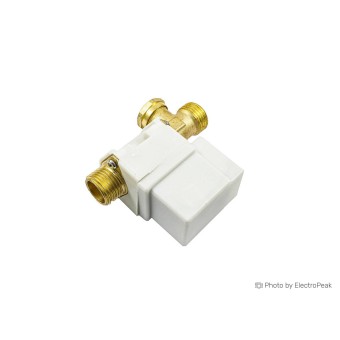
12V Water Solenoid Valve |
A normally closed solenoid valve is the standard fail-shut choice when power loss should stop flow |
This valve lists a 0.02Mpa to 0.8Mpa pressure range, so it is pressure-dependent rather than a zero-pressure universal valve |
| Gravity feed, rain barrel, or very low-pressure shutoff |
Direct-acting NC solenoid or motorized ball valve |
Pilot-operated valves often need minimum inlet pressure, and gravity provides only about 1.3 psi per 3 ft |
Avoid pilot-operated valve types here, including low-cost 12V options that only click without opening |
| Small mains-powered circulation with no DC PSU |
220v AC Mini Brushless Water Pump |
Direct 220V AC input with EU plug, available in 2W (160L/H) or 5W (350L/H) variants for small aquariums, fountains, and cooling systems |
Better suited to non-MCU setups than low-voltage automation |
| Air for aquarium aeration or air-pushing projects |
6V Miniature Air Pump |
This is for air, not water, with 0.6 L/min flow rate and 350 mmHg pressure |
It is not a substitute for a water pump |
If your project is plant watering rather than general transfer, see how an automatic watering build combines pump, sensor, and controller after you narrow the pump family.
Pump comparison matrix: voltage, flow, lift, mounting, and duty-fit
Compare voltage first. Then look at mounting style, flow and lift, and whether the pump suits intermittent or continuous duty. That matters more than the headline L/h alone, especially when you are choosing between a USB-scale mini water pump, a 12V water pump for automation, or a direct-mains option for simple circulation. If the pump is part of a controller build, match it with the Arduino board you plan to switch it from so voltage and driver parts stay aligned.
| Product |
Voltage |
Flow |
Lift / priming |
Mounting style |
Continuous-use fit / limitation |
Notable constraint |
| DC 3-5V Micro Water Pump |
DC 3-5V |
80-120L/H |
40-110cm lift |
Vertical or horizontal; brushless DC magnetic driving |
Short continuous working life, ≥ 200 hours; not recommended for continuous use |
Best for USB-scale or low-voltage micro builds, not main circulation |
| 12V Mini Brushless Pump - 350L/h |
12V DC |
350L/h |
2m max lift |
Amphibious: submersible or land use |
Better fit for circulation than the 3-5V micro option |
Do not operate without water; fluid temperature must not exceed 45°C; includes white speed test wire |
| Peristaltic Water/Liquid Pump |
6V / 12V / 24V motor options |
— |
Self-priming to 0.5m |
Above-reservoir transfer or dosing; reversible flow direction |
— |
PWM speed control; operating humidity must be below 80% |
| 220v AC Mini Brushless Water Pump |
220V AC, EU plug |
2W version: 160L/H; 5W version: 350L/H |
— |
Small circulation pump |
Best for small aquariums, fountains, and cooling systems powered directly from mains electricity |
No DC PSU needed |
Before you buy a pump or valve: control, power, tubing, and siphon mistakes that cause most returns
A pump or solenoid valve needs a few supporting parts and a couple of layout checks before it will work reliably.
- Arduino and ESP32 pins provide only about 20-40 mA, while pumps commonly draw hundreds of mA, so never power a pump or valve directly from GPIO.
- Every pump and valve here needs a relay, MOSFET, or driver. Do not wire the load straight to the controller pin.
- Use a separate supply that matches the device voltage and is sized above the running draw with margin for startup surge, or you can get weak actuation or no start at all.
- A flyback diode is required on inductive loads such as pumps and solenoids to protect the controller from kickback.
- Match tubing ID to the barb OD. If the fit is slightly tight, one common trick is using tubing one size up and warming it to fit.
- Use a check valve whenever a siphon could drain the tank through the line on power loss, unless the pump sits above the waterline.
- Add a filter or strainer before the pump or valve where possible, because grit can jam impellers and hold valve diaphragms open.
- Float switch protection matters in ATO and watering systems for both dry-run protection and flood prevention.
- For aquarium aeration, skipping the check valve is a common mistake, especially when the 6V Miniature Air Pump sits below the waterline.
If you are planning Wi‑Fi control, pair the plumbing parts with an ESP8266-based controller or similar only after you have allowed for the separate PSU, driver, and protection parts. For a parts-level example, see the extra components an automatic watering build needs besides the pump.
When to choose a solenoid valve, and when not to
A solenoid valve is the right choice when you already have water under pressure and need electrical on/off control. Normally closed means shut when unpowered, and it opens with power. Choose NC when power loss should stop flow; choose NO only when flow should continue during outages.
Many low-cost 12V valves are pilot-operated and need minimum inlet pressure to open. That is why a valve can click on the bench but fail in a gravity-fed system. Gravity feed often gives only about 1.3 psi per 3 ft, which is too low in many cases. The 12V Water Solenoid Valve listed here has a 0.02Mpa to 0.8Mpa pressure range and is restricted to liquid water or other specifically suitable non-corrosive liquids.
| Setup |
Choose |
Why |
| Pressurized line and fail-shut behavior wanted |
Normally closed solenoid valve |
Standard on/off flow control when pressure is already available |
| Gravity feed or rain-barrel line |
Direct-acting NC solenoid or motorized ball valve |
Works without depending on line pressure |
| Flow should continue during a power outage |
Normally open valve |
Fail-open behavior is the point |
Flow-direction marking and port or thread size are important valve checks before ordering, especially if you are adapting into existing plumbing, but no supported dimensions are available here, so those values should be confirmed before purchase. If your system pressure is uncertain, check it with a pressure measurement sensor before choosing a pilot-operated valve.
FAQs on Pump & Valve
What does head height mean when choosing a water pump?
Head height is the vertical height the pump pushes water, and flow drops as head rises until it reaches zero at the pump’s max head. Measure the vertical lift first instead of shopping by max L/h or GPH alone, because the headline flow number applies at zero head.
Can I power a pump or solenoid valve directly from an Arduino or ESP32 pin?
No—GPIO pins typically supply about 20-40 mA, while pumps draw hundreds of mA, so you need a separate power supply plus a relay or MOSFET and a flyback diode. That is true for both small DC pumps and 12V valve coils.
Do I need a self-priming pump?
If the pump must sit above the water source, yes: most small centrifugal or submersible pumps are not self-priming, while peristaltic and diaphragm pumps are, and the Peristaltic Water/Liquid Pump is self-priming to 0.5m. If the pump can stay submerged or flooded, a non-self-priming pump is often fine.
Do I need a check valve with an aquarium air or water line?
Yes—use a check valve whenever a siphon could drain the tank through the line during a power loss, especially if the line or air pump sits below the waterline. Putting the pump above the waterline reduces the risk, but it does not replace good backflow planning in every layout.
Which is better for dosing: a peristaltic pump or a cheaper diaphragm-style alternative?
A peristaltic pump is the right choice for repeatable ml-level dosing because the fluid stays in the tube and output can be calibrated. Diaphragm options cost less, but they pulse more and drift more, so they suit approximate transfer better than livestock-critical dosing.
Is a 220V AC mini water pump better than a 12V water pump?
A 12V water pump is the better fit for automated or splash-prone DIY projects, while a 220V AC water pump is the better fit when you want direct wall power and no DC adapter. The supplied 220v AC Mini Brushless Water Pump comes in 2W (160L/H) and 5W (350L/H) versions.
Can a mini air pump be used as a water pump?
No—the two pump families are not interchangeable; the 6V Miniature Air Pump is rated at 0.6 L/min and 350 mmHg for moving air, not circulating water. Use it for aeration or air-pushing tasks, not liquid transfer.
Glossary
- Head height
- The vertical height a pump can push water, which is why real flow must be judged at your lift height rather than by max L/h alone.
- Self-priming
- A self-priming pump can pull liquid into itself from dry, which decides whether it can sit above the reservoir.
- Normally closed (NC)
- A normally closed valve is shut when unpowered and opens when energized, making it the usual fail-shut choice.
- Pilot-operated
- A pilot-operated valve uses line pressure to help open, so it may not work on gravity-fed or very low-pressure systems.
- Dry run
- Dry run means operating without water in the pump, a condition that quickly damages many small water pumps.
- PWM
- PWM is electronic speed control by rapid switching, useful when you want to vary output on a compatible DC pump such as the peristaltic model.




Please complete your information below to login.
Sign In
Create New Account