How to choose the right stepper motor for your project
Start with the job, then narrow by wire count, driver, torque class, and physical fit. NEMA 17 is a mounting standard, not a power rating or single model, so even with the same 42 mm faceplate size, you still need to compare length, current, shaft, and connector.
| Use case |
Best-fit motor family/product example |
Why it fits |
Main limit / what to check next |
| Arduino learning, tiny displays, indicators |
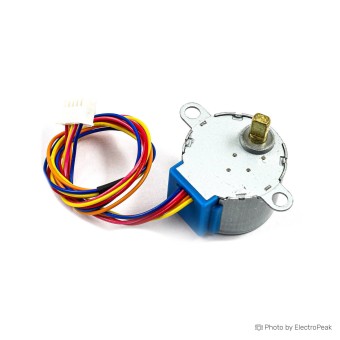
28BYJ-48 4-phase 5-wire stepper motor |
The 28BYJ-48 is a 4-phase, 5-wire geared stepper with a ULN2003-style driver path, suited to slow, light tasks such as dials, indicators, and small turntables |
It is not for wheels, arms, or lifting, and it pairs with ULN2003-class drivers rather than A4988, DRV8825, or TMC2209; see how 28BYJ-48 motors are usually driven with a ULN2003 board |
| 3D printer replacement |
BYGH403 1.65A motor for 3D printers or 42BYGH40 2-phase 4-wire stepper motor |
Both sit in the common 40 mm NEMA 17 replacement class, where most printer and small-CNC needs land in roughly the 40–60 N·cm range |
Check body length, current, shaft, and connector before assuming any replacement is drop-in |
| DIY 3D printer X/Y |
BYGH403 1.65A NEMA 17 |
A standard 1.8° motor in the 40 mm class is the default, and 4-wire motors are the standard bipolar choice for A4988, DRV8825, and TMC2209 drivers |
Faster axes benefit from low inductance and 24 V systems; 0.9° motors need 2× step rate and give less torque per amp |
| 3D printer Z |
42BYGH40 1.68A stepper motor or NEMA 17HS8401 1.7A stepper motor |
Low-speed Z axes tolerate higher inductance better, so a standard or longer-body NEMA 17 is the right call when space allows |
Verify weight and length if the mount is tight; longer motors add mass even when the torque is useful |
| Small CNC or light precision motion |
NEMA 17HS8401 1.7A, 48 mm motor |
Need more torque without leaving NEMA 17? This is the longest and highest-torque listed option here at 48 mm, 1.7A, and 52N.cm |
Holding torque is still a zero-speed spec, so check whether your speed target is realistic |
| Heavy CNC or cutting loads |
NEMA 23 family, typically with TB6600-class drivers |
Heavy CNC axes with real cutting forces usually move beyond NEMA 17, and TB6600 is common once you step up to larger 4-wire bipolar motors |
NEMA 23 is not a default upgrade from NEMA 17; a long NEMA 17 can out-torque a short NEMA 23, so frame size alone is not the rule |
| Upgrade path from a motor that feels too weak or too slow |
17HS4401 0.84A stepper motor if current is limited, otherwise a 40 mm or 48 mm NEMA 17 |
If you have outgrown a 28BYJ-48, moving to a 4-wire NEMA 17 with A4988, DRV8825, or TMC-class control gives a real speed and torque jump |
The 17HS4401 is the low-current option here at 0.84A and 41.5 mm, so it suits tighter electronics limits but is not the same class as the 1.65–1.7A replacements |
Replacement fit checklist for NEMA 17 printer and CNC motors
- “Any generic NEMA 17 works” is mostly true only after you confirm mechanical and electrical fit.
- NEMA 17 means a 42 mm faceplate and bolt pattern, not identical torque, current, shaft, or connector details.
- Compare body length first: the common replacement shorthand is 34 mm, 40 mm, or 48 mm, and length tracks torque class.
- Check shaft fit next. Typical NEMA 17 expectation is a 5 mm shaft, often with a D-flat, while shaft length commonly varies around 20–24 mm.
- Match current per phase to the stock driver as closely as practical. The BYGH403 1.65A model is 40 mm long and rated 1.65A, which keeps it near the usual stock replacement class. For a deeper example, see a worked setup using the BYGH403 motor.
- If connector style matters, the 42BYGH40 1.68A version is 40 mm long, rated 1.68A, and includes an XH wire-end connector.
- The 17HS8401 1.7A motor is 48 mm long and 350g, so it offers more torque but is larger and heavier than standard 40 mm units.
- The 17HS4401 0.84A motor is 41.5 mm long but only 0.84A, so it is not a like-for-like current match for the common 1.5–1.7A class.
- Do not buy based on wire colors. Coil colors are not standardized, even across the same nominal model.
- Inspect connector family and pin order before checkout. A plug can fit physically but still need recrimping or flipping to match coil order.
Stepper motor spec matrix: wire count, current, length, torque, and connector differences
Use this table to separate driver compatibility from torque class and fit. The product cards mix torque units — 3.5kg.cm, 4.4Kg.cm, 0.45N.m, and 52N.cm — so compare carefully instead of assuming different notation means different size classes.
| Product name |
Family/type |
Wire count / phase |
Step angle |
Rated current |
Rated voltage |
Body length |
Holding torque |
Connector / fit note |
Best-fit use |
| 28BYJ-48 4-Phase 5-Wire Stepper Motor |
Geared stepper motor |
5-wire / 4-phase |
5.625° |
— |
5V/12V DC |
— |
— |
64:1 gear ratio |
Beginner, light-duty, slow motion tasks |
| BYGH403 1.65A Stepper Motor |
42BYGH403, NEMA 17 |
— |
1.8° |
1.65A |
2.4V DC |
40 mm |
3.5kg.cm |
Common 40 mm replacement class |
3D printer and light CNC replacement use |
| 42BYGH40 2-Phase 4-Wire Stepper Motor |
42BYGH40, 2-phase stepper motor |
4-wire / 2-phase |
— |
1.68A per phase |
12V DC |
40 mm |
0.45N.m |
XH wire-end connector; 6000-hour service life limitation |
Shoppers prioritizing connector style in a 40 mm NEMA 17 |
| NEMA 17HS8401 1.7A Stepper Motor |
17HS8401, NEMA 17 |
— |
— |
1.7A |
12-24V DC |
48 mm |
52N.cm |
350g weight |
Highest-torque listed NEMA 17 here |
| 17HS4401 2-Phase Stepper Motor |
17HS4401, 2-phase stepper motor |
— / 2-phase |
— |
0.84A per phase |
4.83V |
41.5 mm |
4.4Kg.cm |
Lower-current NEMA 17 class |
Projects with tighter driver current limits |
| Aluminium L-Bracket for NEMA17 |
NEMA 17 mounting bracket |
— |
— |
— |
— |
— |
— |
50x50mm, 5mm thick aluminium; fits 42 mm stepper motors |
Stable mounting for custom NEMA 17 installations |
Driver and power matching for stepper motors: what the voltage and wire count really mean
Rated current is the number to size the driver around. Rated voltage is what confuses most first-time buyers. With chopper drivers, NEMA-class motors are commonly run from 12–24 V even when the coil voltage printed on the motor is much lower. That is why the BYGH403 1.65A motor can list 2.4V DC and still belong with a current-limiting stepper driver, and why the 17HS4401 motor at 4.83V and 0.84A is a different current class from the 1.65–1.7A motors.
For a 4-wire NEMA 17, the usual pairing is A4988, DRV8825, or TMC2209. For a 5-wire 28BYJ-48, the correct pairing is ULN2003. NEMA 17 motors should not run directly from Arduino or USB power, while 28BYJ-48 can run in a beginner setup from USB through ULN2003, though a separate 5 V supply is still the better choice. If you are choosing a bipolar path, see how a 4-wire NEMA 17 is typically driven with an A4988.
Quick checks before you buy:
- Set driver current from the motor’s rated current, not its rated voltage; a common starting point is about 70–85% of motor rated current.
- 4-wire motors are the standard bipolar choice for A4988, DRV8825, and TMC-class drivers.
- 28BYJ-48 is a 5-wire unipolar motor for ULN2003-class drivers.
- Plan on a separate 12–24 V supply for NEMA 17 systems.
- Once you move into heavy NEMA 23 and larger systems, TB6600 or DM542-class external drivers are more typical.
Common stepper motor buying mistakes to avoid before you choose
- Do not buy on holding torque alone. Holding torque is the zero-speed, full-current headline spec, not the torque you get at speed.
- Torque falls with speed, and pull-out torque curves are the honest spec even though hobby listings rarely include them.
- Size from the load and geometry with a 2× margin instead of guessing. Most printer and small CNC builds end up in roughly the 40–60 N·cm class.
- Do not buy by frame size alone. NEMA 17 is often enough, and bigger motors add heat, weight, and cost, especially on moving axes and direct-drive extruders.
- Do not buy by rated voltage. A 2.4V or 4.83V label does not mean you need a matching low-voltage supply.
- Do not treat wire colors as a compatibility feature. They do not reliably identify coil pairs.
- Do not expect a 28BYJ-48 to handle mechanical loads. Its practical ceiling is around 10–17 RPM, and it is easily hand-stalled.
- Do not assume 0.9° is an automatic accuracy upgrade. 1.8° is the standard default; 0.9° mainly trades more native resolution for lower torque per amp and 2× step-rate demand.
- If a NEMA 17 setup skips steps, the cause is often acceleration, driver current, power supply, or mechanical binding rather than frame size alone. If that is your likely issue, start with setting up a higher-performance bipolar stepper driver before jumping to a larger motor.
- On Z axes, belt systems can backdrive when power is off, while lead-screw pitch often prevents dropping.
FAQs on Stepper Motors
Will any NEMA 17 work as a replacement for my printer or small CNC?
NEMA 17 is a 42 mm mounting standard, not a single motor model, and you should still check body length, commonly 34 mm, 40 mm, or 48 mm, plus current rating near stock, shaft fit, and connector or pin order. If those match closely, a generic replacement is fine.
Can I run a NEMA 17 stepper motor directly from Arduino or USB power?
No — NEMA 17 motors should not be run directly from Arduino or USB, and they typically need a dedicated stepper driver plus a 12–24 V supply; 28BYJ-48 via ULN2003 is the beginner exception. Direct logic power does not provide the current control or supply headroom a NEMA 17 system needs.
Is the 28BYJ-48 good enough for robotics or motion projects?
28BYJ-48 is suitable for slow, light jobs such as dials, indicators, and small turntables, but its practical speed ceiling is about 10–17 RPM and it is too weak for wheels, arms, or lifting. It is a good first motor when simplicity matters more than speed or torque.
What’s the difference between 4-wire and 5-wire stepper motors?
4-wire motors are bipolar and usually use A4988, DRV8825, or TMC-class drivers, while 5-wire motors like 28BYJ-48 are unipolar and use ULN2003-class drivers. Wire count is not a minor detail; it decides the driver family.
Why does a stepper motor vibrate or buzz but not turn?
The two most common causes are misidentified coil pairs and trying to start at too high a step rate, and wire colors are unreliable; on 28BYJ-48, there is also a known IN1-IN3-IN2-IN4 pin-order bug. If the motor only buzzes, check coil pairing and wiring order before assuming the motor is defective.
Why is my stepper motor rated at 2.4V or 4.83V if people run it on 12–24V?
Rated voltage is coil resistance math, while rated current is the practical selection spec; the BYGH403 example is rated 2.4V and the 17HS4401 is rated 4.83V, yet both still belong with current-limiting stepper drivers. In chopper-driven systems, the higher supply voltage helps the motor build current quickly enough to keep torque at speed.
Is a 48 mm NEMA 17 always better than a 40 mm one?
Longer-body NEMA 17 motors usually provide more torque, but they also add weight and heat; the 17HS8401 is 48 mm, 52N.cm, and 350g, while the BYGH403 and 42BYGH40 represent the 40 mm class. The longer motor is the right call only when your load needs the extra torque and your mount has the space.
Glossary
- NEMA 17
- A 42 mm mounting standard for stepper motors, not a single model or guaranteed torque level.
- Holding torque
- The motor’s maximum torque at standstill with full current, which is why it does not predict torque at running speed.
- Rated current
- The per-phase current the driver should be sized and set around for normal operation.
- Rated voltage
- A derived coil figure, not the supply voltage you should buy for a chopper-driven NEMA motor.
- Bipolar / 4-wire
- The standard NEMA 17 wiring style that pairs with A4988, DRV8825, and TMC-class drivers.
- Unipolar / 5-wire
- The wiring style used by 28BYJ-48 motors, which is why they pair with ULN2003-class drivers instead.
- Step angle
- The degrees moved per full step, such as 1.8° for 200 steps per rev or 0.9° for 400 steps per rev.
- D-flat shaft
- A shaft with one flat side, used so pulleys and couplers can grip more securely with a set screw.



Please complete your information below to login.
Sign In
Create New Account