Choose by output: tilt switch, directional sensor, or true angle measurement
Start with the output you need: a switch event, a direction, or an angle value.
| Need |
Best-fit sensor type |
In-category example |
What you get |
What you do not get |
| Tilted / not tilted |
Tilt switch |
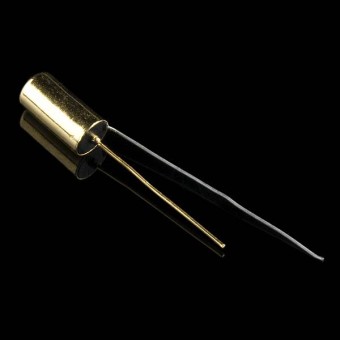
AT407 ball tilt sensor |
Simple contact switching when the part passes its threshold |
Exact degrees; ball tilt switches are binary and do not output angle values |
| Vibration or shake trigger |
Tilt/vibration switch |
SW-520D tilt/vibration switch pack |
Normally Closed (NC) switching for tilt or vibration events |
Precision angle measurement or stable readings on continuously moving platforms |
| Up / down / left / right orientation |
4-direction tilt sensor |
GP1S036HEZ 4-direction tilt sensor |
4-direction detection through 2 outputs across a ±90-degree sensing range |
A single on/off contact or a direct degree readout |
| More detailed orientation logic |
Optical angle/orientation sensor |
RPI-1031 4DOF optical angle sensor |
Pitch, roll, and yaw sensing with 360-degree measurement range and 0.3-degree accuracy |
Drop-in simplicity; output changes across four quadrants and needs logic to determine orientation |
| Shaft rotation |
Rotary position sensor |
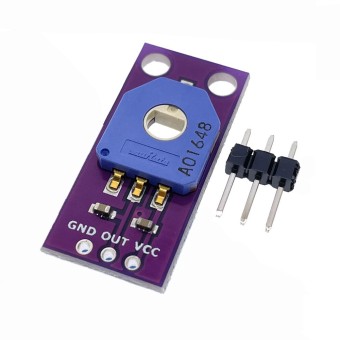
SV01A103AEA01R00 dust-proof rotary sensor |
Analog voltage output for 0° to 333.3° continuous rotation |
Gravity-referenced tilt; this is a rotary position sensor, not an inclinometer |
| Exact angle in degrees |
Accelerometer or true inclinometer |
See accelerometer modules for angle-in-degrees projects |
Continuous values you can convert to angle |
The simplicity of SW-520D- or AT407-class threshold switches |
The practical split is straightforward: a tilt switch changes state past a threshold, an accelerometer gives continuous values you can convert to pitch or roll, and a gyroscope alone drifts so it cannot hold an absolute gravity reference. If the project needs a number in degrees, choose an accelerometer or true inclinometer rather than SW-520D or AT407 class switches. For shaft angle instead of gravity tilt, the rotary angle sensor is the correct part family.
Quick product fit table for this category
These are mostly sensor components rather than handheld digital inclinometer tools.
| Product name |
Sensor family |
Output style |
Key supported spec |
Best for |
Main limitation |
| AT407 ball tilt sensor |
Discrete tilt switch |
Contact switching |
24VDC max, <6mA power, 1Ω contact resistance, >50,000 cycles |
Simple low-current tilt detection in electronics and robotics |
Binary state change only; not for precision angle measurement |
| GP1S036HEZ 4-direction tilt sensor |
Miniature PWB mount directional tilt sensor |
Phototransistor output |
4-direction detection, ±90-degree sensing range, 2 outputs, 3.35x4.6x5 mm |
Compact directional sensing where up/down/left/right matters |
You must interpret two separate outputs to identify direction |
| SV01A103AEA01R00 dust-proof rotary sensor |
Resistive rotary position sensor, SMD |
Analog voltage output |
0° to 333.3° continuous rotation, ±2% linearity, 10k resistance, dust-proof surface mount design |
Shaft position and rotary control projects |
Not gravity tilt, and the range stops at 333.3° rather than full 360° |
| RPI-1031 4DOF optical angle sensor |
Optical 4DOF attitude sensor |
Quadrant-based optical outputs |
360-degree measurement range, 0.3-degree accuracy, pitch/roll/yaw, dual photosensitive transistors with optical ball/shield mechanism |
Higher-precision orientation sensing |
Output state changes across four quadrants and needs specific logic |
| SMD tilt sensor switch series |
SMD tilt switch |
Contact switching |
Multiple models from X8 to X3228, 10mA maximum contact current, 1.8V to 5.0V depending on model |
Compact low-current designs with tight space limits |
Datasheet not available; voltage and current vary by sub-model, so confirm the exact model before design-in |
| SW-520D tilt/vibration switch - 10 pack |
Metal ball tilt/vibration switch |
NC contact switching |
Normally Closed, >±15 degree differential angle, 20V DC / 0.3A, dustproof and waterproof encapsulation, 10 pieces |
Simple vibration or tilt switching in small-current circuits |
Static conditions are required to restore the open state after shaking |
If a switch-only part is too limited and you need measured-angle alternatives when a switch event is not enough, compare the accelerometer category.
Wiring and controller compatibility: what works with Arduino, ESP32, and Raspberry Pi
Most compatibility questions come down to output type, not board brand.
- Bare switches such as the AT407 tilt sensor and SW-520D switch are just contacts, so they are effectively voltage-agnostic from a logic-reading perspective and can be read by Arduino boards, ESP32, or Raspberry Pi inputs with the right pull-up arrangement.
- A standard wiring method is one leg to a digital pin, the other to GND, with INPUT_PULLUP enabled, or the same circuit with an external 10kΩ pull-up resistor.
- Skip the pull-up or pull-down, and the input can float and produce random or unstable readings.
- The AT407 is a discrete ball contact switching part, so treat it as a contact-closure input rather than an analog angle source.
- The SW-520D is an NC switch, so its default state is the opposite of a normally open part.
- The GP1S036HEZ directional sensor uses phototransistor output with 2 outputs, so you read and decode two signals rather than one simple contact.
- The SV01A103AEA01R00 rotary sensor has analog voltage output and 10k resistance, which suits analog input workflows rather than digital threshold-only wiring.
- DO and AO advice from common Arduino breakout modules does not apply equally here, because these products are not all breakout boards with both pins exposed.
For a simple contact-type part, see this example of basic Arduino wiring for a simple tilt switch.
What causes false triggers: bounce, vibration, and mounting orientation
Simple tilt angle sensor parts do not behave like filtered measuring instruments. Contact bounce is normal in ball switches, so unstable or random readings are often switch chatter rather than a defective part. That is especially true with the AT407 ball tilt sensor and SW-520D vibration switch, which are mechanical threshold devices.
For debounce, use either a 50–75ms software delay or a 0.1µF hardware capacitor. One caution: if your code depends on delay() alone, it can miss short pulses, which matters when the part is being used as a vibration switch rather than a slow tilt detector.
SW-520D-class parts are also direction-dependent. In practice they often trigger roughly 30–45° off vertical depending on orientation and the individual unit, even though the product spec lists >±15 degree differential angle. Bench-test before permanent mounting.
Check these before buying:
- Expect chatter under vibration from ball switches; for moving platforms that need stable angle readings, compare accelerometer sensors instead.
- Mount ball-switch styles to a true vertical reference surface.
- Mount MEMS-style or orientation-sensing parts to a flat, true horizontal reference surface.
- Bench-test trigger behavior before fixing the final position.
- Do not assume the same trigger angle in every direction.
If you are using SW-520D for event detection, this example debounce and vibration-trigger setup with SW-520D shows the typical approach.
When not to buy from this category
- If you need exact angle in degrees, choose accelerometer options when you need angle values instead of a switch event rather than a ball tilt switch.
- If the platform moves and dynamic acceleration is part of the job, an IMU is the better fit than a simple tilt sensor, because static switches and gravity-only readings become unreliable in motion.
- If you are considering a gyro-only solution, compare a gyroscope sensor with care: a gyroscope alone drifts and is not suitable for static tilt.
- If your job is shaft angle, hinge position, or rotary control, the SV01A103AEA01R00 rotary sensor is for 0° to 333.3° rotation with analog output, not gravity-referenced tilt.
- If you only need a casual one-off check, a smartphone inclinometer app can be good enough for roughly ±2–4° use, but reported errors of 2–6° and mounting problems make it a poor choice for tighter tolerances or safety-relevant work.
FAQs on Inclinometer Sensor
Can a tilt sensor tell me the exact angle in degrees?
No — ball tilt switches such as the AT407 and SW-520D are binary threshold devices, and if you need angle values in degrees you should choose an accelerometer or a true inclinometer instead. These parts switch state when tilted past a threshold, which is useful for trigger events but not for angle readout.
Will these sensors work with Arduino, ESP32, or Raspberry Pi?
Yes — bare tilt switches are read with INPUT_PULLUP or an external 10kΩ resistor, and that makes them straightforward to use with Arduino, ESP32, or Raspberry Pi inputs. The main difference is output style: contact switches wire like simple digital inputs, while analog voltage output or phototransistor output parts need different input handling.
Why do simple tilt switches give unstable or random readings?
Contact bounce and missing pull-up or pull-down resistance are the two most common causes, and the usual fixes are INPUT_PULLUP or an external 10kΩ resistor plus debounce in software or with a 0.1µF capacitor. Mechanical switch contacts do not change state cleanly, so one physical movement can appear as many rapid transitions.
What does “4-direction tilt sensor” mean?
The GP1S036HEZ detects up, down, left, and right across a ±90-degree sensing range using 2 outputs, so direction is identified by interpreting both outputs together rather than reading one simple threshold pin. It is the right fit when orientation matters, but it requires more logic than a one-bit tilt switch.
Is SW-520D a good choice for vibration or motion detection?
SW-520D is a Normally Closed switch rated at 20V DC / 0.3A with >±15 degree differential angle, and vibration can make it chatter. It suits simple vibration-trigger or tilt-alarm jobs, but static conditions are required to restore the open state after shaking, so it is not a stable motion-angle sensor.
What’s the difference between a tilt sensor and a rotary angle sensor?
The SV01A103AEA01R00 measures shaft rotation from 0° to 333.3° with analog voltage output, while a tilt sensor reports orientation relative to gravity. Shaft angle and tilt angle are not interchangeable, even when both are described as angle sensing.
Are these parts waterproof for outdoor use?
Waterproof claims should be backed by an IP rating, and you should not assume outdoor protection without one. Bare components are not protected, while the SW-520D product card states dustproof and waterproof encapsulation but does not provide an IP rating.
Glossary
- Tilt switch
-
An on/off threshold device that changes contact state when tipped, rather than measuring angle in degrees.
- Accelerometer
-
A sensor that outputs continuous values tied to gravity, which is why it is the usual choice when you need angle values.
- Gyroscope
-
A sensor that measures rotation rate rather than absolute tilt, so it drifts if used alone for static angle.
- Debounce
-
A hardware or software method that filters the rapid chatter from mechanical switch contacts.
- INPUT_PULLUP
-
A microcontroller input mode that applies an internal pull-up resistor so a bare switch does not leave the pin floating.
- Phototransistor output
-
An output type that behaves like a light-controlled transistor, which is why parts such as GP1S036HEZ need signal interpretation rather than simple contact wiring.
- Normally Closed (NC)
-
A switch state where the circuit is closed by default until tilt or motion changes it.
- Rotary position sensor
-
A sensor that measures shaft rotation rather than tilt relative to gravity.



Please complete your information below to login.
Sign In
Create New Account