Need Help? +44 (0) 123 4567
You can add your content here.

Headers

Filters
Featured
Popularity
Date
Set Ascending Direction
View as Grid List
Items 1-24 of 44
24
36
48
60

A pin header is a simple board connector used to bring signals or power on and off a PCB. Choose by pitch first, then gender, then row count and orientation. 2.54mm (0.1") is the standard used for breadboards, Arduino, and Raspberry Pi GPIO selections; 2mm and 1.27mm headers are not interchangeable with 2.54mm parts. Breadboard use points to male headers, while receiving existing male pins points to female headers.

  1. 141234
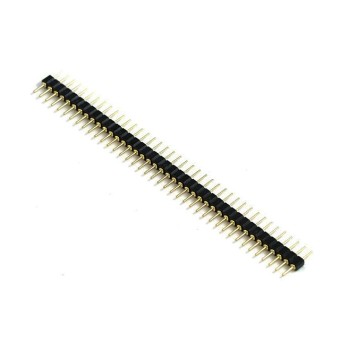
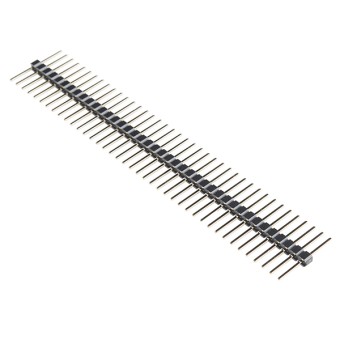
    1x40 Pin Male Header - 2.54mm Pitch
    SAVE
    As low as $0.0300
    Rating:
    99%
Page
24
36
48
60

How to choose the right pin header in 4 checks

Need What to check first Header style to look for Example product family in this category Common mistake to avoid
Breadboard or female Dupont jumper connection Measure pitch center-to-center between adjacent pins first; breadboards, Arduino, and Raspberry Pi commonly use 2.54mm (0.1") Straight male pin header in single row 1x40 Male Header - 2.54mm Pitch Ordering a 2.0mm or 1.27mm strip because it looks similar in photos
Receiving existing male pins on a module or board Match the mating side: female header receives male pins Straight female pin header in the needed count 1x40 Female Header - 2.54mm Pitch Buying only male strips and having nothing compatible to plug into
Raspberry Pi GPIO footprint Check row format before pin count; Raspberry Pi GPIO uses a 2×20 dual-row footprint Straight or right-angle 2×20 header 2x20 Male Header - 2.54mm Pitch or 2x20 Female Header - 2.54mm Pitch for Raspberry Pi boards Buying a single-row 1×40 because the listing also says “40 pin”
Compact board that measures 2mm pitch Confirm the board is truly 2.0mm; that family is separate from 2.54mm 2.0mm single-row or dual-row header 1x40 Male Header - 2mm Pitch or 1x40 Female Header - 2mm Pitch Confusing 2.50mm JST XH with 2.54mm header spacing, or treating 2.0mm as close enough
Fine-pitch board that measures 1.27mm Check pitch carefully; 1.27mm is its own family 1.27mm male or female strip 1x40 Male Header - 1.27mm Pitch or 1x40 Female Header - 1.27mm Pitch Ordering standard 2.54mm parts for a fine-pitch footprint
Side-entry or low-clearance layout Decide from cable approach and enclosure space Right-angle header 1x40 Right Angle Male Header - 10mm Pin or 2x20 Right Angle Female Header Assuming straight and right-angle parts are interchangeable for breadboard use

Male header is the usual choice for female Dupont jumpers and breadboards. Female header is the one to choose when the board already has exposed male pins. Arduino R3 boards translate to separate single-row pieces in 6-pin, 8-pin, and 10-pin counts, while ESP32 devkits usually use two single rows, often 15–20 pins each. That is why breakaway single-row stock is usually the practical fit for ESP32 boards. Straight headers suit breadboards and vertical stacking. Right-angle parts fit side-entry or low-clearance layouts.

Reference matrix: pitch, layout, length, and rating by header family

Product family Pitch Row format Orientation Length or body-height detail Electrical rating if stated Best-fit use
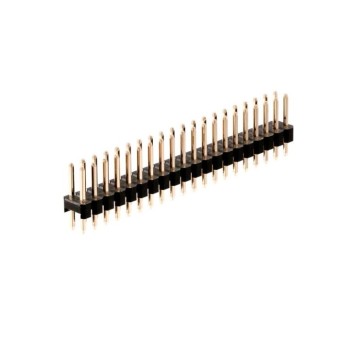
1x40 Male Header - 2.54mm Pitch 2.54mm 1×40 single row Straight — — Baseline 2.54mm header connector for breadboard and general prototyping
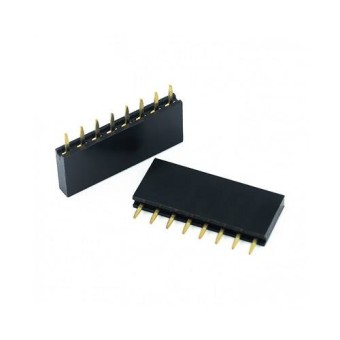
1x40 Female Header - 2.54mm Pitch 2.54mm 1×40 single row Straight — — Baseline receiving socket for standard male pins
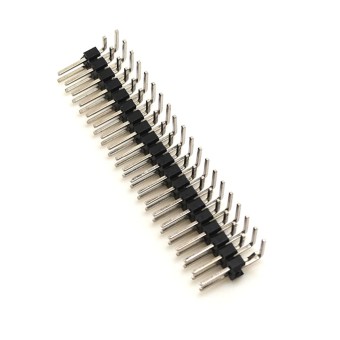
1x40 Right Angle Male Header - 10mm Pin 2.54mm 1×40 single row Right-angle Approx. 10mm pin length — Side-entry layouts using a right angle pin header
1x40 Male Long Header - 21mm Pin 2.54mm 1×40 single row Straight 21mm pin height — Extra vertical clearance or temporary breadboard/PCB connections
1x40 Male Long Centered Header - 15mm Total 2.54mm 1×40 single row Straight 15mm total length, 6.25mm each side — Balanced reach above and below the board
1x6 Female Long Header - 11mm Pin 2.54mm 1×6 single row Straight 11mm pin length 3A current rating Taller female option for compact board connections
1x6 Female Long Header - 3mm Pin 2.54mm 1×6 single row Straight 8.5mm plastic body height, 3mm pin length 550V AC Low-profile 1×6 female option where extra reach is not needed
1x8 Female Long Header - 11mm Pin 2.54mm 1×8 single row Straight 11mm pin length 3A current rating Board-to-board connections needing more height
1x8 Female Header - 2.54mm Pitch 2.54mm 1×8 single row Straight 8.5mm plastic body height, 3mm pin length — Lower-profile female connection points
1x10 Female Long Header - 11mm Pin 2.54mm 1×10 single row Straight 11mm pin length — Longer single-row female runs where 10 positions are needed
2x3 Female Long Header - 11mm Pin 2.54mm 2×3 dual row Straight 8.5mm body height, 11mm pin length — ICSP and debug-style 2×3 footprints
2x20 Male Header - 2.54mm Pitch 2.54mm 2×20 dual row Straight — — Common 40-position dual-row format for Raspberry Pi and similar layouts
2x20 Female Header - 2.54mm Pitch 2.54mm 2×20 dual row Straight — — Dual-row receiving socket in the common 40-position format
2x20 Right Angle Female Header 2.54mm 2×20 dual row Right-angle 40 total positions — Side-access dual-row layouts
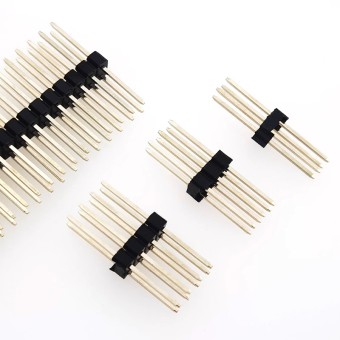
2x40 Male Header - 2.54mm Pitch 2.54mm 2×40 dual row Straight 80 total pins — High pin-count dual-row boards at standard pitch
1x40 Male Header - 2mm Pitch 2mm 1×40 single row Straight — — Compact boards that specifically require 2.0mm spacing
1x40 Female Header - 2mm Pitch 2mm 1×40 single row Straight — 250V AC/DC 2.0mm receiving socket with stated electrical rating
2x40 Male Header - 2mm Pitch 2mm 2×40 dual row Straight 80 total pins — Dual-row 2.0mm layouts where pin count matches 2.54mm options but pitch does not
1x40 Male Header - 1.27mm Pitch 1.27mm 1×40 single row Straight Compact footprint — Fine-pitch board interfaces
1x40 Female Header - 1.27mm Pitch 1.27mm 1×40 single row Straight — 1A rated current Fine-pitch receiving socket where dense spacing matters
1x40 Machine Pin Female Header - Gold Plated 2.54mm 1×40 single row Straight Machine pin construction Half gold-plated surface technology Premium female pin header for cleaner repeated mating
1x40 Machine Round Pin Male Header - Press-fit 2.54mm 1×40 single row Straight Machine round pins, press-fit insertion Gold-plated finish Alternative to standard stamped strips when no-solder press-fit insertion is the priority

When standard headers are the right choice — and when to switch connector family

  • Choose standard unshrouded headers when the connection needs to stay removable for prototyping, module swapping, or breadboard work. A basic 1x40 Male Header - 2.54mm Pitch or 1x40 Female Header - 2.54mm Pitch is the normal fit here.

  • Solder wires directly only when the build is final and will never change. That removes the connector entirely and saves height, but it also removes serviceability.

  • Move to screw terminal blocks for power, motors, relays, outdoor installs, or permanent wiring where tug resistance matters more than compactness. Plain headers are not the best choice for exposed wiring that will be pulled, vibrated, or left unprotected outside the enclosure.

  • Move to JST XH or another keyed/latching family when polarity protection and better retention matter. Just keep the pitch straight: 2.50mm JST XH is not 2.54mm header spacing.

  • IDC ribbon with a shrouded box header makes more sense when many signals need one keyed plug instead of a row of individual Dupont jumpers.

  • If the board already ships with populated headers, doing nothing may be the right answer. That is common on many Arduino boards and many Raspberry Pi boards, aside from headerless variants.

  • Machine-pin options are the step-up choice when repeated maintenance or cleaner repeated mating matters more than cost. The machine pin female header with half gold-plated contacts and the machine round-pin male header with press-fit insertion are the specialized options here.

Common fit mistakes that cause “these headers don’t fit”

  • “40 pin” does not always mean the same footprint: Raspberry Pi GPIO needs 2×20, not single-row 1×40.

  • Treat 2.54mm, 2.0mm, and 1.27mm as separate families even when the headers look almost identical in product photos. A 1x40 Male Header - 2mm Pitch will not replace a 1x40 Male Header - 2.54mm Pitch, and neither replaces a 1x40 Male Header - 1.27mm Pitch.

  • Standard through-hole headers require soldering for reliable electrical and mechanical connection. Simply pushing pins through the holes is not a dependable connection.

  • Male breakaway strips snap between pins. Female strips do not cut the same way and usually cost one sacrificed position when trimmed from a long strip.

  • Choose right-angle headers for side-entry layouts, not as automatic substitutes for straight headers in breadboards. A 1x40 Right Angle Male Header - 10mm Pin or 2x20 Right Angle Female Header solves cable direction, not every fit problem.

  • Breadboard compatibility depends on both 2.54mm pitch and enough usable pin length below the plastic, not pitch alone. That matters especially when you are choosing header stock for ESP32 boards or ESP8266 boards that arrive headerless or partially populated.

FAQs on Pin Headers

How do I know whether I need 2.54mm, 2mm, or 1.27mm headers?

Measure the center-to-center distance between adjacent pins; breadboards, Arduino, and Raspberry Pi commonly use 2.54mm (0.1"), while 2mm and 1.27mm are separate non-interchangeable families. If the spacing is not exactly the same across the row, do not guess from photos or from total pin count.

Should I put male or female headers on my board?

Male headers go on boards when you need breadboard use or female Dupont jumpers, while female headers receive existing male pins. The default convention is male on the PCB and female on cables because it keeps the socket side on the replaceable wiring rather than on the board.

Will a 2.50mm JST XH connector fit a 2.54mm pin header?

No — JST XH is 2.50mm and standard pin headers are 2.54mm. Very low pin counts may be forced, but the spacing error builds across the row and should not be treated as proper compatibility.

Can I use right-angle headers in a breadboard?

Only if the part still has enough usable pin length below the plastic; standard breadboard use expects 2.54mm pitch and about 6mm or more of pin length, while many right-angle parts are chosen instead for side-entry layouts. Check the pin-length detail, not just the pitch and the photo.

Do I have to solder a through-hole header, or can I just push it into the board?

Standard through-hole headers need soldering for both electrical and mechanical connection. Pushing the pins through the holes without solder typically causes intermittent or no contact.

What does “40 pin” mean on a header listing?

“40 pin” can mean single-row 1×40 or dual-row 2×20. Raspberry Pi GPIO specifically needs 2×20, while many generic breakaway strips are single-row 1×40.

When should I choose machine-pin headers instead of standard square-pin strips?

Choose machine-pin headers when repeated maintenance, repeated mating, or cleaner premium socketing matters; the machine pin female option is half gold-plated, and the machine round-pin male option is gold-plated with press-fit insertion. Standard stamped square-pin strips remain the practical default for everyday breadboard and general PCB work.

Glossary

Pitch
The center-to-center distance between adjacent pins, and the first measurement to check before buying.
Male header
A strip of exposed pins that plugs into breadboards, female headers, and female Dupont jumpers.
Female header
A strip of sockets that receives male pins, even though the solder tails may still be visible underneath.
Breakaway header
A long strip intended to be cut or snapped into shorter lengths, with male strips cutting more easily than female strips.
Right-angle header
A 90-degree header used to route the connection out to the side instead of straight up from the board.
Machine pin
A round-pin header style used when smoother repeated mating or a more premium socketing fit matters more than cost.
To Top
Help
Shop
Account
0 Cart