Choose the right DC motor by project type
| Project type |
Best-fit motor type on this page |
Best product example |
Why it fits |
Main trade-off / warning |
| School demos, tiny fans, simple toys, propellers |
Bare brushed DC motor |
Mini DC Hobby Motor - 3V |
Optimized for 3V and suited to small robots, moving models, small pumps, toys, and propeller connections |
Best for “just spin” jobs; bare motors spin fast with low torque |
| First robot with measured wheel motion |
Small gearmotor with encoder |
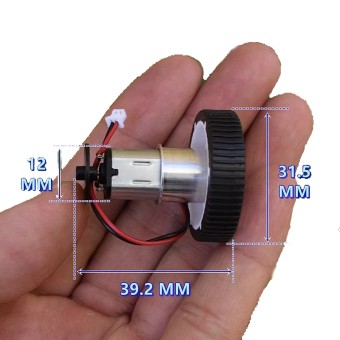
N20 motor with encoder and 31.5mm wheel |
Includes a 4-pulse encoder, attached 31.5mm wheel, and 3V–6V operation, so it is a straightforward small mobile robot choice |
Uses a plastic gear system, so it is compact and simple but not the right pick for shock-heavy drivetrains |
| Higher-voltage robot or automation build with feedback |
Encoder-equipped 365-series motor |
DC Motor 365 with Encoder |
Integrated encoder, 12V–24V range, and 8000 RPM rated speed suit feedback control at higher system voltage |
Datasheet is not available |
| Mini 4WD racing |
Race-specific Dash motor |
Tamiya Ultra Dash Motor |
Built for Mini 4WD use, with 24,000-27,500 RPM and 18mN-m torque |
This is a racing motor, not a general robot-wheel default |
| High-power DIY tools and heavy-load builds |
775-series brushed motor |
Mabuchi 775-8514 300W motor |
775-series form factor, up to 300W output, 22,000 RPM, and a 5mm shaft suit demanding spindles, tools, and heavy builds |
Very high current demand; listed stall current is 130A |
| Appliance or replacement-style builds |
Mid-size bare motor matched by voltage and shaft |
Johnson 395 motor - 24V |
Wide 5V–24V range and 2.3mm output shaft help when you are replacing a motor in an existing mechanism |
Still a bare motor, so wheel-drive torque usually needs gearing elsewhere |
| Need easy position control instead of continuous rotation |
Off-category: servo or stepper |
For angle or step-based motion, when a servo or stepper is easier than a regular DC motor |
A regular DC motor without feedback is the wrong tool when the project needs easy position control |
If you need angle control, do not buy a plain DC motor and plan to solve it later |
Robot motors: geared, encoder, and voltage choices that actually move the load
Required wheel torque should be based on load force × wheel radius, then divided across the motors, with roughly a 2–3× safety factor. That matters more than no-load RPM, especially on carpet, ramps, or heavier robots.
| Need / robot type |
Choose this product family |
Voltage range |
Feedback included? |
Why buy it |
Watch out for |
| Very light beginner robot where cost matters more than precision |
Bare compact motor |
5.0V–12V 310-series motor |
No |
Compact 18mm x 24.2mm size and 8300 RPM at 12V make it a simple fit for small 12V robotics where feedback is not required |
Two identical DC motors do not naturally match speed under changing load |
| Small robot that needs measured motion |
N20 gearmotor with encoder |
3V–6V |
4-pulse encoder |
The N20 encoder motor with attached wheel includes a 4-pulse encoder and 31.5mm wheel, making it the clearest small-robot option here for odometry and PWM speed control |
Plastic gears suit light, beginner-scale robots better than abuse-heavy drivetrains |
| Higher-voltage robot or automation build with feedback |
365-series encoder motor |
12V–24V |
Integrated encoder |
Need feedback at 12V or 24V? The 365 motor with built-in encoder fits that job, with 8000 RPM rated speed |
Bigger system demands than small 3V–6V robot builds |
| Unsure whether feedback will matter later |
Encoder version now |
3V–6V or 12V–24V |
Yes |
Encoder feedback is what makes straight driving, odometry, and PID practical when battery sag and changing load would otherwise push the motors apart |
Buying the no-encoder version first and wanting feedback later is a common mistake because retrofitting is rarely practical |
For small brushed robot motors, the driver choice matters as much as the motor. This walkthrough on driving small robot motors with a low-loss driver is the right next step.
Voltage, driver, and supply fit: avoid the classic motor-control failures
- An MCU pin only supplies about 20–40 mA, while even tiny motors draw hundreds of mA and can draw amps at stall. Do not connect a motor directly to an Arduino pin.
- If you are building around an Arduino, plan the board and motor system together: Arduino boards still need a proper motor driver between the MCU and the motor.
- Small motors such as the Mini DC Hobby Motor - 3V, R130 micro DC motor, or N20 motor with encoder and wheel are better matched to TB6612FNG or DRV8833 than to L298N.
- L298N drops 2–5 V internally; with a 6 V supply the motor may only see about 3–4 V. That is why low-voltage brushed DC motor for projects feel weak or fail to start on an L298N, and why many builders move to a better low-voltage alternative to L298N.
- Match driver continuous current to motor stall current at roughly 0.6–1× or higher, and make sure the driver voltage rating covers the motor rating. This matters far more than matching by frame size alone.
- The Mabuchi 775-8514 lists 130A stall current. That rules out beginner H-bridge assumptions and calls for a much heavier power and control path than small robot motors.
- The Tamiya Ultra Dash racing motor is described as high current at 4-5A and cannot reach full potential with standard alkaline batteries, so battery choice is part of the purchase.
- Weak USB supplies and 9V smoke-detector batteries are poor choices for motor loads because startup and stall current cause voltage sag, brownouts, and resets.
- For one-direction-only loads such as pumps or fans, a logic-level MOSFET plus flyback diode is simpler and more efficient than an H-bridge.
- If your build also has sensors or a microcontroller, 100 nF ceramic capacitors across the motor terminals, a 470–1000 µF bulk capacitor at the driver, twisted motor wires, and separate or star grounds help prevent resets and sensor glitches.
Quick spec matrix: shaft size, voltage range, speed, and standout constraints
Use this matrix to screen shaft diameter, operating voltage, and feedback before opening product pages. For very small motors and lightweight toy or robot builds, this overview of small dual-motor control for lightweight toy and robot builds can help with driver selection.
| Product name |
Family / type |
Voltage |
Speed |
Shaft / wheel |
Encoder |
Standout note |
| Mini DC Hobby Motor - 6V |
DC hobby motor |
3V–6V |
— |
2mm shaft; 25mm length; 21mm diameter |
— |
Simple low-voltage fit check for compact builds |
| R130 Micro DC Motor |
R130 micro DC motor |
3V rated |
8000 RPM at 3V |
20x15x25mm body |
— |
0.35-0.4A reference current helps compare toy-motor class options |
| Mini DC Hobby Motor - 3V |
Mini DC hobby motor |
Optimized for 3V |
8000 RPM at 3V |
25x15x20mm body |
— |
0.35-0.4A current; suited to small robots, toys, pumps, and propellers |
| Colorful Micro DC Motor - High Speed |
Micro DC motor |
2.4V, 3.2V, or 3.7V variants |
Up to 59,000 RPM |
— |
— |
10g high-speed option; cannot be used with ordinary dry batteries due to high current requirements |
| DC Motor 300 with Metal Gear |
300-series DC motor |
3V–12V |
2,000-20,000 RPM |
— |
— |
Metal gear design with carbon brush construction |
| DC Motor 310 - 12V High Torque |
310-series DC motor |
5.0V–12V |
8300 RPM at 12V |
18mm x 24.2mm size |
— |
Compact 12V-capable option for simple robotics |
| Tamiya Ultra Dash Motor |
Tamiya Dash series motor |
— |
24,000-27,500 RPM |
— |
— |
18mN-m torque, 4-5A current, and carbon brushes mark it as a race-specific motor |
| Johnson 395 Motor - 24V |
Johnson 395 series motor |
5V–24V |
10,500 RPM at 24V |
2.3mm output shaft |
— |
112g weight and wide voltage range suit higher-RPM replacement or DIY builds |
| Mabuchi 775-8514 High Power Motor |
Mabuchi 775-series motor |
6V–20V, 18V nominal |
22,000 RPM |
5mm shaft |
— |
Up to 300W output, 130A stall current, and 383g weight put it in a different power class |
| DC Motor 365 with Encoder |
365-series motor with encoder |
12V–24V |
8000 RPM rated |
— |
Integrated encoder |
60g weight; datasheet is not available |
| N20 Motor with Encoder and Wheel |
N20-series gearmotor |
3V–6V |
— |
Attached 31.5mm wheel |
4-pulse encoder |
Plastic gear system is convenient for small robots but less durable under shock loads |
Tamiya and high-power builds: when a specialty motor is worth it
Mini 4WD buyers should choose by class legality first, then by track style. Common guidance puts Torque-Tuned in the balanced camp, Hyper Dash as much faster, Light Dash in the middle, and Ultra Dash as a higher-end option allowed in some classes. The Tamiya Ultra Dash Motor is rated at 24,000-27,500 RPM, 18mN-m torque, and 4-5A current, so it fits race-specific builds rather than general-purpose robotics; it also cannot reach full potential with standard alkaline batteries.
Frame numbers like 775 are size classes, not fixed performance ratings, and windings and build quality vary by maker. The genuine Mabuchi 775-8514 motor is listed at up to 300W output, 22,000 RPM, and 130A stall current, which is a very different proposition from a generic “775.” Need wide voltage range and high RPM without stepping all the way up to full 775-class power? The Johnson 395 24V motor offers 5V–24V operation, 10,500 RPM at 24V, and a 2.3mm shaft. If you are still learning the wiring basics of brushed motors, this overview of common brushed motor driver wiring is useful context.
FAQs on DC Motors
Can I connect a DC motor directly to Arduino?
No — an MCU pin typically supplies about 20–40 mA, while even tiny motors draw hundreds of mA and can draw amps at stall. Use a proper motor driver such as TB6612FNG or DRV8833 for small motors, and move to much heavier drivers for larger motors.
Why does my motor run on a battery but not through an L298N driver?
L298N drops 2–5 V, so a 6 V supply can leave only about 3–4 V at the motor. That is often not enough for a small low-voltage motor under load, which is why TB6612FNG or DRV8833 is the usual fix for compact brushed motors.
Can I run a 6V motor on 12V if I use 50% PWM?
50% PWM gives roughly 6 V average speed behavior, but peak current and peak voltage still hit 12 V conditions. That means more heat and shorter brush life, so if you choose to overvolt, add current limiting and a fuse.
Do I really need an encoder for a robot?
You only need an encoder if you care about speed feedback, odometry, distance, balancing, or straight-line correction. The N20 motor with encoder and wheel uses a 4-pulse encoder for small measured-motion builds, while the 365 encoder motor is the higher-voltage option here with integrated feedback.
What shaft size should I check before buying wheels or couplers?
Are all 775 motors basically the same?
No — 775 is a frame size, not a performance rating. Windings and quality vary by maker, and the Mabuchi 775-8514 shows why the actual specs matter, with listings of up to 300W output, 22,000 RPM, and 130A stall current.
What power supply should I use for a DC motor project?
The supply must survive startup and stall current, not just no-load current. Weak USB sources and 9V smoke-detector batteries commonly fail, and high-current motors such as the Mabuchi 775-8514 high power motor need far more headroom than small toy motors.
Glossary
- Frame size (130, 300, 365, 775)
- The number refers to the motor body size class, not a guaranteed power or speed level.
- Stall current
- The maximum current a motor draws when starting or jammed, and the number that should guide driver and power-supply sizing.
- Gearmotor
- A gearmotor combines a motor and gearbox so the output turns slower but with more usable torque for wheels and lifting.
- Encoder
- An encoder reports shaft rotation so you can measure speed, distance, or direction instead of just powering the motor open-loop.
- PWM
- PWM controls average motor speed by switching full voltage on and off quickly, but it does not remove full-voltage stress during each pulse.
- Voltage drop
- Voltage drop is the amount of supply voltage lost inside the driver, which is why modules like L298N can leave a low-voltage motor underpowered.



Please complete your information below to login.
Sign In
Create New Account