
Product added to cart

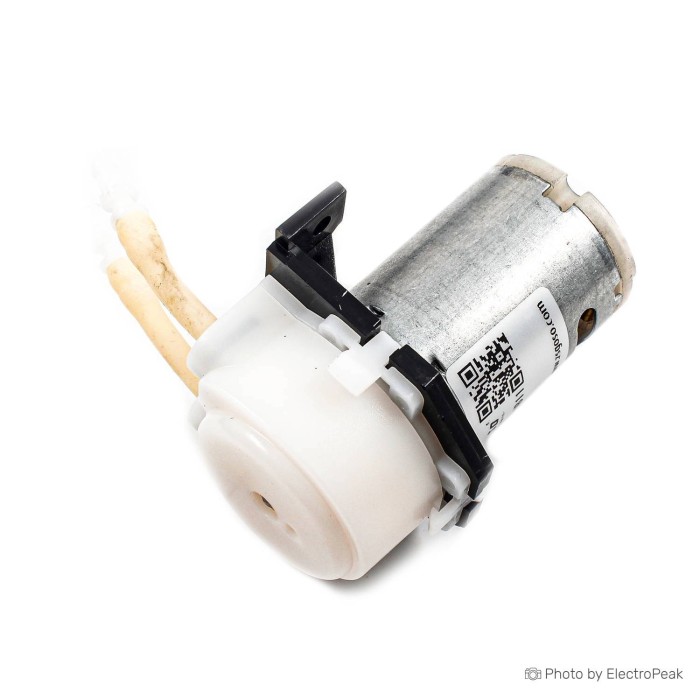
Peristaltic Water/Liquid Pump
SAVE
As low as $6.9500
In stock
Only %1 left
SKU
misc-05-013
Ships in 2-3 business days, then:
Free delivery in 12-15 days by Tracked Economic Shipping on orders over $100.
Free delivery in 7-10 days by Express Shipping on orders over $300.
More shipping info

Shop with confidence Learn More

Peristaltic Water/Liquid Pump review
The Peristaltic Water/Liquid Pump uses a geared-down DC motor and a clover-pattern roller head to move fluids through flexible tubing. As the rollers compress the tube, they trap and push fluid forward without exposing it to impellers, valves, or internal seals. This positive-displacement design keeps the liquid entirely within the tube path, making it suitable for low-volume liquid transfer, sampling, dispensing, and automated dosing experiments where cross-contamination inside the motor housing must be avoided.
The pump needs no manual priming and self-primes with water up to half a meter. Reverse the motor electrical polarity to reverse fluid flow, while pulse-width modulation (PWM) motor speed control changes the flow rate. For makers building benchtop prototypes with an Arduino, ESP32, or Raspberry Pi, it offers a straightforward way to meter small fluid volumes. It is intended for projects where output can be measured and calibrated empirically; it does not carry certifications for regulated fluids, food contact, or medical use, and it does not provide the high volumes needed for bulk water circulation. Browse other mechanical configurations in our pumps and valves collection.
Specifications of Peristaltic Water/Liquid Pump
- Motor voltage: 6V
- Motor voltage: 12V
- Motor voltage: 24V
- Motor current: 200mA ~ 300mA
- Power: 7.5W
- Flow rate: 0 ~ 200mL/min
- Speed: 1 ~ 500 rpm
- Mounting holes: 2.7mm diameter
- Mounting holes center-to-center distance: 50mm
- Pump tube inner diameter: 2mm
- Pump tube outer diameter: 4mm
- Operating temperature: 0„ ~ 40„
- Operating humidity: <80%
- Size: 27.6mm x 37.9mm
Peristaltic Water/Liquid Pump specifications explained
These physical and electrical specifications matter when planning a benchtop assembly. Choose one of the three motor voltage configurations: 6V, 12V, or 24V. Each version needs a dedicated DC power supply matched to its specific operating voltage.
| Specification | Listed Value | Why it matters |
|---|---|---|
| Motor voltage | 6V / 12V / 24V options | Select the version that matches your available DC power rail. The voltage options are distinct hardware variants, not an auto-switching wide-input range. |
| Motor current & Power | 200mA ~ 300mA / 7.5W | The current rating reflects typical operating draw, while the 7.5W figure aligns primarily with higher-voltage operation (24V at roughly 0.3A). Size your power supply and motor driver with extra current headroom for motor startup surges. |
| Flow rate & Speed | 0 ~ 200mL/min / 1 ~ 500 rpm | The 0 to 200mL/min range represents the full theoretical span across motor speeds. Delivered flow varies with the selected voltage option, liquid viscosity, suction height, and tube backpressure, so calibration must be measured. |
| Pump tube dimensions | 2mm ID x 4mm OD | Internal diameter (2mm) dictates the volume displaced per roller pass, while the 1mm wall thickness determines compression against the rollers. Measure the received tube before buying barbed joiners or replacement hose. |
| Mounting layout | 2.7mm holes, 50mm center-to-center | Enables secure panel or chassis mounting using standard M2.5 screws. Rigid mounting is essential because the rotating roller head creates minor cyclic vibration during operation. |
| Operating envelope | 0°C ~ 40°C, <80% humidity | Specifies the ambient operating conditions. The unit carries no ingress protection (IP) rating, so protect the motor housing from liquid splashes and condensation. |
| Dimensions | 27.6mm x 37.9mm | Reflects cross-sectional dimensions rather than total envelope depth. Leave extra enclosure clearance behind the motor terminals and in front of the tubing ports for bend radiuses. |
Peristaltic pump PWM and reverse-flow control
Microcontrollers such as the Arduino, ESP32, and Raspberry Pi cannot power this pump motor directly from their GPIO pins. A logic pin provides 3.3V or 5V at a few tens of milliamperes, while this DC motor draws 200mA to 300mA continuously and has higher startup inrush currents. Place an external switching stage or motor driver between the microcontroller and the pump's dedicated DC power supply.
Adjust flow by applying a PWM signal to the motor driver. Changing PWM duty cycle alters the effective voltage delivered to the motor, changing rotational speed between 1 and 500 rpm. At very low PWM duty cycles, static friction can cause the DC motor to stall rather than produce ultra-slow flow. Flow is not linear, either. System backpressure and fluid drag mean that doubling duty cycle does not precisely double output volume, so software calibration is essential.
Driver topology determines directional control. For simple unidirectional dispensing, a one-direction pump switching module or a logic-level MOSFET provides reliable on/off control. Reversing fluid direction requires reversing electrical polarity across the motor terminals. For withdrawing fluid, backflushing lines, or alternating between filling and draining, use an H-bridge driver such as the reversible DC motor driver. Confirm that the selected driver is rated for the pump voltage version you intend to deploy.
Peristaltic Water/Liquid Pump limitations and calibration
This pump is built for open-loop maker projects, so plan for several engineering trade-offs before using it in an automated setup. The documentation does not provide per-variant flow curves, startup current spikes, pressure limits, continuous-duty runtime ratings, or expected tubing lifespan. Its self-priming capability is rated for water up to half a meter of lift; do not treat it as a high-pressure delivery pump or rely on it to push fluids against significant vertical head.
Tubing wear is inherent to all peristaltic mechanisms. Constant roller compression eventually fatigues the flexible tube wall, reducing elasticity and flow rates before causing tube failure. The supplied tube's material formulation is not documented, so it cannot be verified for food contact, medical purity, aggressive solvents, or volatile chemicals. In automated reservoirs where fluid dry-out could leave the motor running unattended, a reservoir level monitoring device provides an essential hardware interlock.
Step-by-step calibration procedure
- Assemble the physical fluid circuit using the final tube lengths, reservoir heights, and discharge routing planned for the build.
- Submerge the inlet tube in clean water and route the outlet tube into a graduated cylinder or a container resting on a digital scale.
- Power the motor using your regulated DC supply and driver at your intended operational PWM duty cycle.
- Run the pump for a fixed period (for example, 60 seconds) and record the collected liquid volume in milliliters.
- Repeat the run three times to calculate an average volume per second for that specific PWM setting and supply voltage.
- Recalibrate the system whenever you change fluid viscosity, alter tubing lengths, replace the pump tube, or adjust vertical lift.
Peristaltic Water/Liquid Pump uses for dosing and liquid transfer
This pump suits benchtop automation that needs positive fluid isolation and modest transfer rates. In hobbyist plant-management setups, it can meter nutrients into irrigation lines, particularly alongside an automatic watering pump setup. In chemistry or photography experiments, it supports timed liquid dispensing, sample transfer, and dye introduction while keeping fluids separate from the pump's mechanical components.
Its bidirectional operation also suits automated sampling systems where a line must be pre-filled, a liquid sample drawn into a test cell, and remaining fluid flushed back into the source. Pair it with a dosing reservoir level sensor so the controller can halt dispensing before air enters the fluid lines. Aquarium circulation, decorative fountains, and rapid drainage need liters of fluid per minute. Those workloads exceed the capacity of a peristaltic roller mechanism and call for continuous circulation hardware.
Peristaltic Water/Liquid Pump alternatives for circulation and transfer
Choose the pump type based on whether the design needs volumetric isolation or continuous bulk fluid movement. If peristaltic action is not the right approach, consider these alternatives:
- R385 6-12V Diaphragm Pump: Projects needing higher delivery volume and vacuum self-priming without a roller head can use this 6–12V diaphragm pump alternative, an economical option for basic water transfer.
- DC 3-5V Micro Pump: For ultra-low-voltage microcontrollers or battery-powered enclosures that need basic water movement rather than reversible dosing, consider this 3–5V micro water pump alternative.
- 12V Solar Hot Water Circulation Pump: Systems with high-temperature fluid lines up to 100°C and a need for up to 10Bar static pressure handling call for this specialized hot-water circulation pump, engineered specifically for thermal circulation.
- JT180A 12V Brushless Pump 350L/h: For long-term continuous fluid circulation without tube wear, this continuous water-circulation pump delivers 350 liters per hour with a rated brushless motor life exceeding 20,000 hours.
- JT-500 12V Submersible Pump: Rapid tank draining, garden irrigation, and high-volume delivery up to 10 liters per minute against a 5-meter head are better suited to this high-flow submersible water pump when submerged operation is acceptable.
Compare these and other functional designs across our full catalog to browse pump alternatives for your mechanical layout.
Peristaltic Water/Liquid Pump FAQ
Which Peristaltic Water/Liquid Pump voltage option should I order: 6V, 12V, or 24V?
Order the voltage option that matches your project's existing DC motor power supply. The listing provides distinct 6V, 12V, and 24V hardware versions rather than a universal wide-voltage input. Electrical draw and speed depend on that specific motor winding, so verify your supply rails before ordering.
Does this peristaltic pump really deliver 200mL/min?
Not under all operating conditions. The listed 0 to 200mL/min figure is an upper-envelope rating at optimal motor speed with zero backpressure. In real installations, suction lift, fluid viscosity, and tubing length reduce delivered output, so calibrate it empirically on your test bench.
Can I connect this peristaltic pump directly to Arduino or ESP32?
No. Connecting the motor directly to microcontroller logic pins will likely damage the board. The pump draws between 200mA and 300mA during operation and significantly more when starting under load. Use a logic-level transistor, relay, or motor driver module to switch power safely.
Can PWM control the Peristaltic Water/Liquid Pump flow rate?
Yes, PWM modulation of motor voltage changes rotational speed and adjusts fluid flow. Motor friction creates a non-linear response at low duty cycles, so map software PWM values to measured fluid volumes instead of assuming linear mathematical scaling.
Can this peristaltic dosing pump run in reverse?
Yes. Reversing electrical polarity at the motor terminals makes the roller head spin in the opposite direction and pull fluid backward. For programmed directional control from a microcontroller, connect the motor through an H-bridge such as the pump reverse-flow driver.
What replacement tube fits this peristaltic pump?
The pump uses tubing specified at 2mm inner diameter and 4mm outer diameter. Manufacturing tolerances across commodity roller pumps can vary, so measure the installed tube with calipers before buying bulk replacement silicone tubing.
Is this peristaltic pump food-safe, medical-grade, or chemical-resistant?
No, it is not certified for those uses. No documentation is provided for tubing material formulation, biocompatibility, food-contact compliance, or solvent resistance. Use this pump only for non-critical maker projects, water transfer, or non-hazardous prototyping.
How high can the Peristaltic Water/Liquid Pump lift water?
The pump self-primes with water up to half a meter vertically. It is not designed to generate high output pressure or pump fluid against significant discharge head, so keep the fluid reservoir and pump reasonably close to the dispensing point.
Does the pump include tubing, fittings, a driver, or a power supply?
No accessories are confirmed in the packaging. Plan to supply your own external tubing, barbed adapters, mounting hardware, DC power supply, and external motor driver.
What should I choose for high-flow water circulation instead?
Peristaltic pumps are intended for low-volume metering, not continuous bulk circulation. For continuously moving liters of water in aquariums, sumps, or cooling loops, choose a dedicated utility unit such as the high-flow water circulation alternative.
Peristaltic Water/Liquid Pump purchase decision summary
Ideal for: Makers, students, and prototypers who need low-volume liquid transfer, timed fluid dispensing, or reversible fluid flow with an Arduino, ESP32, or benchtop DC power supply. It suits projects where output can be measured empirically and fluid must remain completely isolated within the tube.
Maybe for: Small-scale automated plant watering, liquid nutrient dispensing, or non-critical dye transfer, provided you have verified tube compatibility with your liquid, budgeted for a separate motor driver, and can calibrate dosing volumes on the bench.
Avoid if: You need guaranteed flow precision out of the box, food-safe or medical-grade fluid contact, chemical and solvent handling, continuous 24/7 duty cycles, or high-volume fluid circulation such as aquariums, fountains, or drainage.
Peristaltic Water/Liquid Pump buying checklist
- Confirm whether your power rail requires the 6V, 12V, or 24V motor version.
- Ensure you have a dedicated DC motor driver or relay rated for at least 300mA continuous current.
- Select an H-bridge driver if your application requires automated bidirectional fluid movement.
- Budget for external fluid tubing, joiners, and mounting screws, which are not included.
- Verify that your intended fluid is non-hazardous and compatible with uncertified tubing.
- Plan physical space for an external DC power supply, driver board, and enclosure clearance.
- Have a graduated cylinder or precision scale ready to calibrate delivered volume against motor runtime.
Write Your Own Review

Please complete your information below to login.
Sign In
Create New Account