Arduino Uno R3 specifications and buying notes
Arduino Uno R3 is the classic ATmega328P-based board for learning, prototyping, and straightforward embedded control work. It runs at 5V, uses the standard Uno pin layout, and supports the interfaces most Arduino projects expect: UART, I2C, and SPI.
This board is a good fit when you want the familiar Uno workflow, broad tutorial coverage, and compatibility with the common Uno shield ecosystem. Read more closely if your project needs built-in wireless, more memory, or verified official Arduino provenance from this version. If you are still comparing families, the Arduino Buying Guide: How to Choose the Right Arduino For Your Project and our Arduino Boards category are useful next steps.
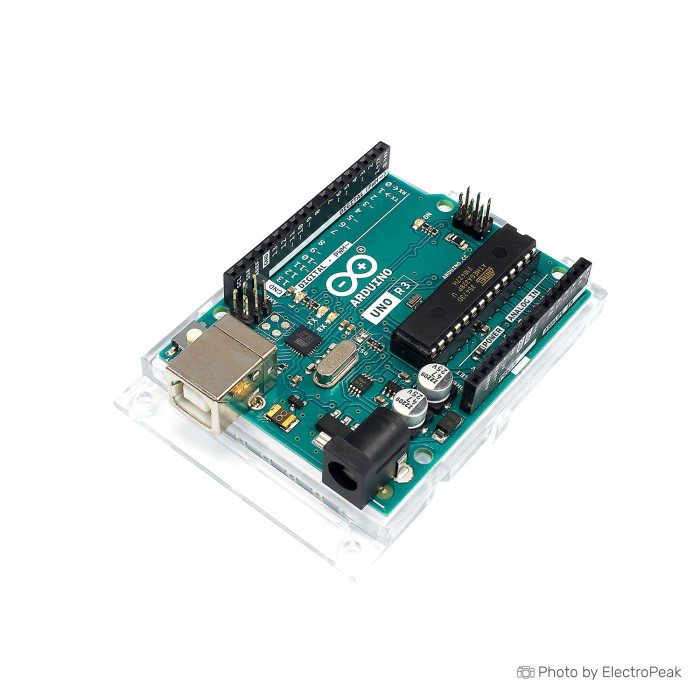
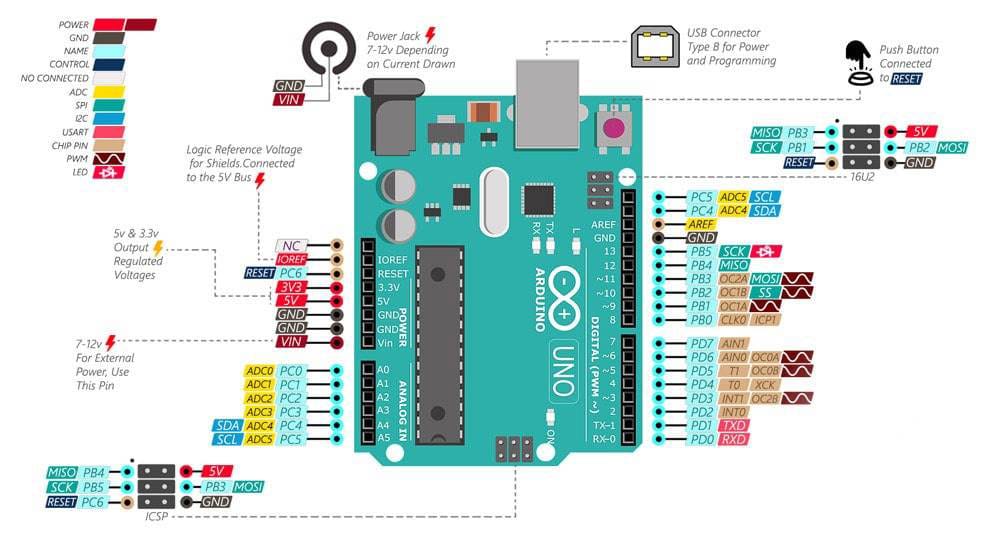
The board includes a USB connection, a power jack, an ICSP header, and a reset button. You can power it from USB, an AC-to-DC adapter, or a battery. For USB setup, the matching cable is the USB A to USB B Cable for Arduino Uno/Mega.
Specifications of Arduino Uno R3
- Microcontroller: ATmega328P
- Operating Voltage: 5V
- Input Voltage (recommended): 7-12V
- Input Voltage (limit): 6-20V
- Digital I/O Pins: 14
- PWM Digital I/O Pins: 6
- Analog Input Pins: 6
- DC Current per I/O Pin: 20 mA
- DC Current for 3.3V Pin: 50 mA
- Flash Memory: 32 KB
- Flash Memory Used by Bootloader: 0.5 KB
- SRAM: 2 KB
- EEPROM: 1 KB
- Clock Speed: 16 MHz
- Dimensions: 80mm x 60mm x 25mm
- LED_BUILTIN: 13
- RX (D0) and TX (D1): Serial Communication (UART)
- SDA (A4) and SCL (A5): I2C
- MISO (D12), MOSI (D11), SCK (D13), and SS (D10): SPI
- A0 to A5: Analog-to-Digital Converter (ADC)
- D3, D5, D6, D9, D10, D11: PWM
- D2 (interrupt 0) and D3 (interrupt 1): External Interrupts
- 5V: Regulated 5V power output
- 3V: Regulated 3.3V power output
- GND (Ground): Ground pins
Arduino Uno R3 clone vs original buying question
The main buying caution here is board identity. This version is named Arduino Uno R3, but the available product information does not clearly confirm whether the shipped unit is an official Arduino-manufactured board or a compatible clone.
That matters because official-vs-compatible boards can differ in the USB interface chip, driver behavior, board markings, regulator choice, reset circuitry, and overall component consistency. Those differences do not change the basic Uno programming model, but they can change what happens when you first plug the board into a computer.
What you can conclude with confidence is that this board is intended to follow the classic Uno R3 pattern built around the ATmega328P. What you cannot conclude from this page alone is the exact USB bridge chip, the exact manufacturer, or whether official Arduino provenance is verified for this version.
If you want the compatible-board path stated plainly, Arduino Uno R3 Clone is the equivalent option presented openly as a clone. If you specifically want the CH340 route, Arduino UNO with CH340G makes that USB path explicit.
Arduino Uno R3 memory, I/O, and power limits explained
For simple control projects, the Uno R3 still has a very usable resource set. You get 14 digital I/O pins for switches, LEDs, relays through driver stages, and digital sensors; 6 PWM pins for dimming LEDs or controlling motor drivers and servos; and 6 analog inputs for reading potentiometers and analog sensors.
The limits show up as a project grows. With 32 KB of flash, 2 KB of SRAM, and 1 KB of EEPROM, this board handles basic sketches comfortably, but larger display libraries, big buffers, and more complex code can run into memory pressure quickly.
The 16 MHz clock and 8-bit AVR architecture are part of why the Uno is easy to learn and well supported. They are also why it is not the right choice for heavier processing, larger communications stacks, or projects that need more headroom for future expansion.

| Specification |
Why it matters |
| 14 digital I/O pins |
Enough for many beginner and classroom projects, but pin count becomes tight once you add displays, multiple sensors, buttons, and actuators together. |
| 6 PWM pins: D3, D5, D6, D9, D10, D11 |
PWM lets the board simulate variable output for LED dimming, speed control through a driver, and servo-style control. It is not a true DAC analog output. |
| 6 analog inputs: A0 to A5 |
Useful for potentiometers and analog sensors. If you need more analog channels in a smaller footprint, Nano Clone offers 8 analog inputs. |
| 32 KB flash / 2 KB SRAM / 1 KB EEPROM |
Good for basic sensor, logic, and interface work. More demanding sketches can outgrow SRAM first, especially when using display libraries, strings, or communication stacks. |
| 16 MHz clock speed |
Fine for standard Arduino learning and many control tasks, but modest beside newer 32-bit boards. |
| Operating Voltage: 5V |
This matches many classic Arduino shields and 5V modules. It also means many 3.3V-only peripherals need level shifting on signal lines. |
| Input Voltage (recommended): 7-12V |
This is the practical external supply range for the barrel jack or VIN. It gives the onboard regulation room to work without treating the limit range as everyday guidance. |
| Input Voltage (limit): 6-20V |
This is a limit, not a preferred operating range. Running near the high end can create regulator heat, while going below the recommended range can leave the 5V rail out of spec. |
| DC Current per I/O Pin: 20 mA |
This is an electrical limit for a logic pin, not a reason to power motors, relays, or LED strips directly from the board. |
| DC Current for 3.3V Pin: 50 mA |
The 3.3V pin is a limited auxiliary output for light loads, not a general-purpose 3.3V supply rail for current-hungry peripherals. |
If you already know you will need many more pins, larger memory, or multiple hardware serial ports, Mega 2560 R3 is the better fit. If you want more flash, more RAM, and a 32-bit board while staying in the Uno form factor, UNO R4 Minima is the cleaner upgrade path. For external power away from USB, the matching supply is the 9V 1A DC Power Supply Adapter for Arduino.
For a broader board comparison before you decide, see the Arduino Buying Guide: How to Choose the Right Arduino For Your Project.
Arduino Uno R3 shield compatibility and project fit
The classic reason to buy an Uno R3 is platform fit. The board exposes the standard Uno-style buses and headers that most beginner tutorials, many classroom labs, and a large number of shields and modules are built around.
For communication, D0 and D1 are the hardware UART pins, A4 and A5 carry I2C, and D10 through D13 handle SPI. The board also includes an ICSP header. That matters for some shields and lower-level programming tasks.
That layout suits straightforward projects such as Blink, button and potentiometer exercises, small I2C displays, SPI modules, RTC boards, simple alarms, motion sensing, and basic servo control through proper driver circuitry. It is also a sensible board for prototyping a 5V shield-based design before moving to a custom PCB.
One practical note: if you attach a peripheral to D0 or D1, uploads can fail because those same pins handle serial communication with the computer. That is normal behavior on the Uno layout, not a board fault.
Need the Uno coding style in a smaller package? Nano Clone is the more compact option, though it is not compatible with most standard Uno shields. If you are running out of pins or need several serial devices at once, Mega 2560 R3 is the more suitable board.
For shield-style prototyping, the Arduino UNO Proto Shield Prototype Expansion Board with Breadboard is a practical add-on. You can also browse the wider Arduino Boards range if you are still matching board format to project type.
Arduino Uno R3 limitations and common mistakes
This board is straightforward, but it is easy to buy it for the wrong job. No built-in Wi-Fi or Bluetooth is stated here, so it is not an IoT board by itself. If wireless is a core requirement, that should drive the board choice from the start.
Another common misunderstanding is output capability. The Uno has PWM pins, but PWM is not real analog output from a DAC. It also has logic pins, not power-driver outputs, so motors, relays, and LED strips need a proper transistor, MOSFET, relay module, or motor driver stage.
Power is another place buyers get tripped up. The board can accept external input, but the recommended range is 7-12V. The 6-20V figure is a limit range, and using high input voltage can create unnecessary regulator heat.
Mixed-voltage projects need care too. The board operates at 5V logic, and the 3.3V pin is limited to 50 mA, so many 3.3V-only sensors are not safe to connect directly to 5V signal lines without level shifting.
Upload problems are often self-inflicted.
- Leaving a module connected to D0 or D1 during programming is a common first-time issue.
- Using a charge-only cable can block uploads.
- Assuming every Uno-family board behaves the same over USB can also cause trouble.
- If you are building on a breadboard, the Breadboard Jumper Wire Kit - 140 Pieces is the basic wiring set most buyers end up needing.
If your project really needs onboard wireless, a different path is UNO R4 WiFi, Uno+WiFi with ESP8266, or Uno D1 R32 ESP32. If the main limitation is memory and newer processing rather than connectivity, UNO R4 Minima is the better fit.
For a wider overview of where each Arduino family fits, see the Arduino Buying Guide: How to Choose the Right Arduino For Your Project.
Arduino Uno R3 quick start and first upload check
Day-one verification is simple. Install the Arduino IDE, connect the board with a USB A-to-B data cable, select Arduino Uno in the IDE, choose the correct port, and upload the Blink example.
The expected result is a successful upload and the built-in LED on pin 13 blinking. That confirms the board powers correctly, the computer sees it, the upload path works, and the basic toolchain is set up properly.
- Install the Arduino IDE.
- Connect the board to your computer with a USB A-to-B data cable.
- Select Arduino Uno in the IDE and choose the correct port.
- Open the Blink example and upload it.
- Confirm that LED_BUILTIN on pin 13 blinks.
If no port appears, start with the obvious checks first: cable type, port selection, and anything connected to D0 or D1. Disconnect UART peripherals during upload attempts. Because the USB interface chip is not identified for this version, driver expectations depend on the actual shipped board.
If you want the CH340 route stated clearly, Arduino UNO with CH340G is the equivalent listing that makes that path explicit. If you still need a cable, use the USB A to USB B Cable for Arduino Uno/Mega.
For software setup, use How to Install Arduino IDE on Windows & MAC. If you move into deeper upload or bootloader recovery work, Use Arduino as ISP to Burn Bootloader on AVR Microcontrollers is the relevant next step.
Arduino Uno R3 alternatives for more I/O, USB, or wireless
Choose an alternative only when the project requirements clearly point away from the classic Uno R3. If bench space is tight, Nano Clone keeps the ATmega328P approach in a much smaller footprint, but it is not aimed at the standard Uno shield ecosystem.
For builds that interact heavily with a computer as a USB device, Leonardo ATmega32U4 is the better fit because it has built-in USB communication without a secondary processor. For larger builds with many peripherals, Mega 2560 R3 gives you far more I/O, more analog inputs, and four UARTs.
When the Uno form factor is right but AVR-era memory and performance are not, UNO R4 Minima is the cleaner modern step up. If integrated wireless is the real requirement, the more suitable paths are UNO R4 WiFi, Uno+WiFi with ESP8266, or Uno D1 R32 ESP32.
For a broader board selection framework, the Arduino Buying Guide: How to Choose the Right Arduino For Your Project covers where each family fits.
Accessories
Required
Recommended
Optional
FAQs
Is this an original Arduino Uno R3 or a clone?
The page does not fully resolve that. The board is named Arduino Uno R3, but the available product information does not clearly verify official Arduino manufacturer provenance for this version, so buyers who specifically need that should confirm the board markings and manufacturer before purchase.
Does this board use CH340, or does it avoid CH340 driver setup?
The USB interface chip is not identified here. Official Uno R3 boards commonly use one USB path, while many compatible boards use CH340 or CH341, so driver expectations depend on the actual shipped board.
Does it include a USB cable?
Cable inclusion is not stated. The board is meant to connect by USB, and the matching cable is the USB A to USB B Cable for Arduino Uno/Mega.
Can I power it from USB, a battery, or an adapter?
Yes. The board can be powered by USB, an AC-to-DC adapter, or a battery.
Can I use 12V or 20V input?
12V is within the recommended 7-12V range. 20V is part of the stated limit range, not the preferred operating range, and high input voltage can increase regulator heat.
Does it have built-in Wi-Fi or Bluetooth?
No built-in wireless is stated for this board. If integrated connectivity is required, the supplied alternatives are UNO R4 WiFi, Uno+WiFi with ESP8266, and Uno D1 R32 ESP32.
Can it drive a motor, relay, or LED strip directly?
No, not directly as a load driver. The I/O pins are logic pins, and the 20 mA per-pin figure plus the 50 mA 3.3V figure are not a substitute for a proper transistor, MOSFET, relay module, or motor driver.
Does it have real analog output?
No native DAC analog output is stated. It has 6 PWM digital I/O pins and 6 analog input pins, and PWM is not the same as a true analog output.
Will standard Arduino shields and modules work?
Many standard Uno-family shields and modules are a good fit. The board provides the expected Uno-style UART, I2C, SPI mapping and an ICSP header, though you still need to check voltage compatibility and pin conflicts for your specific shield.
Is this board enough for larger projects?
It depends on the project size. The 32 KB flash, 2 KB SRAM, and 1 KB EEPROM are fine for basic control and sensor work, but larger libraries, bigger buffers, and heavier code can outgrow the board quickly.
Why does the board power up but not show a port on my computer?
The usual causes are a charge-only cable, wrong port selection, or a USB bridge that needs the correct driver on some compatible boards. Also disconnect anything attached to D0 or D1 while checking uploads.
Purchase decision summary
- Ideal for: Learning Arduino, prototyping with standard 5V Uno shields and modules, classroom use, and simple sensor, display, and control projects that fit within ATmega328P limits.
- Maybe for: Maintaining older Uno projects, keeping a familiar AVR workflow, or pairing the board with external wireless modules and shield-based expansions.
- Consider another option if: You need built-in Wi-Fi or Bluetooth, larger memory, more serial ports, a smaller footprint, or confirmed official Arduino authenticity for this exact version.
Buying checklist
- ✓ Do you specifically want the classic ATmega328P Uno platform?
- ✓ Is 5V logic the right fit for your sensors and modules?
- ✓ Will 14 digital I/O, 6 PWM, and 6 analog inputs cover your project?
- ✓ Will your sketch fit comfortably in 32 KB flash and 2 KB SRAM?
- ✓ Do you need built-in Wi-Fi or Bluetooth? If yes, choose a wireless alternative.
- ✓ Do you need more than one hardware UART or a much higher pin count? If yes, consider Mega 2560 R3.
- ✓ Do you already have a USB A-to-B data cable?
- ✓ Do you also need a breadboard, jumper wires, or a starter kit?
- ✓ Will you power the board from USB or from a suitable 7-12V supply?
- ✓ Are you expecting an official Arduino-manufactured board? If yes, verify that before ordering.








Please complete your information below to login.
Sign In
Create New Account