
Product added to cart

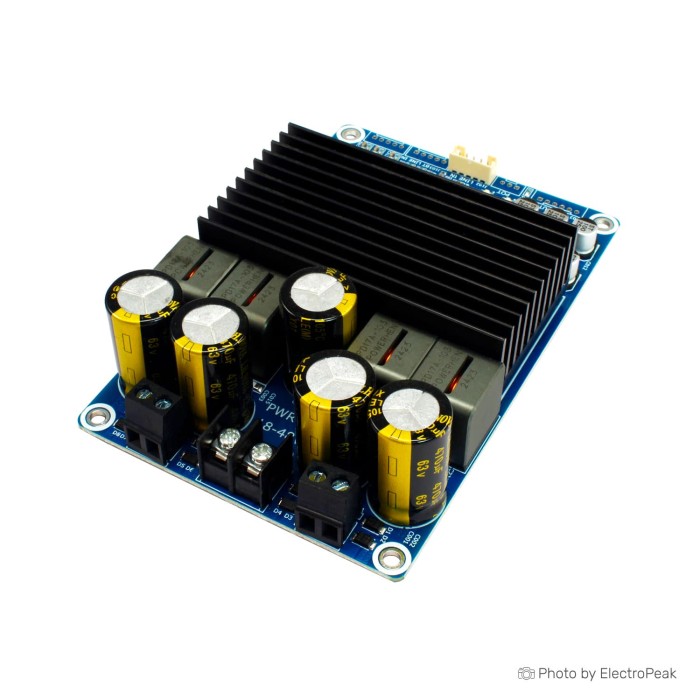
BDM8-A TPA3255 2x300W HIFI Class D Amplifier Board
$25.9500
In stock
SKU
MOD-04-018
Volume discounts:
- +10 4 % $25.0400
- +25 5 % $24.5900
- +50 7 % $24.1300
- +100 9 % $23.6800
- +300 10 % $23.2300
Ships in 2-3 business days, then:
Free delivery in 12-15 days by Tracked Economic Shipping on orders over $100.
Free delivery in 7-10 days by Express Shipping on orders over $300.
More shipping info

Shop with confidence Learn More
 CS4344 24Bit DAC Converter Stereo Audio Module Previous
BDM8-A TPA3255 Amplifier Board Review
The BDM8-A is a dedicated 2-channel Class D stereo power stage based on the Texas Instruments TPA3255 IC. It is specified for 300W + 300W output into 4-ohm loads, operates from an external 24–48V DC power source, and accepts an analog line-level signal through a 3.5MM input. This bare circuit board is intended for DIY audio builders supplying their own DC power supply, speakers, wiring, enclosure ventilation, and upstream volume control. It is not an enclosed consumer unit and does not include a built-in Bluetooth receiver.
For custom audio installations, related sound-player and audio-module browsing options help place dedicated power amplifier boards alongside line-level playback hardware.
Specifications of BDM8-A TPA3255 2x300W HIFI Class D Amplifier Board
- Model: BDM8-A
- IC: TPA3255
- Operation Voltage: 24-48V DC
- Audio Input: 3.5MM signal input
- Output Channel: 2 Channels
- Output Power: 300W + 300W (4ohm)
- Frequency Response: 20Hz - 20kHz
- Dynamic Range: >100 dB
- Signal-to-Noise Ratio (SNR): >111 dB
- Work Efficiency: >90%
- Dimensions: 121.9 x 91.44 mm
BDM8-A TPA3255 Specifications Explained
Using the BDM8-A TPA3255 HIFI amplifier board in practice means relating its listed electrical figures to the enclosure, power supply, and speaker requirements of the build.
| Specification | Listed Value | Why It Matters |
|---|---|---|
| Output Power & Channels | 300W + 300W (4ohm), 2 Channels | This is the board's rated peak capability into a 4-ohm load. Real continuous output depends directly on supply voltage, power supply current capacity, distortion limits, speaker impedance, and heat dissipation. Official board documentation records 2 × 150 W at 36 V into 4 Ω under stated test conditions, and one independent test reported roughly 120 W per channel before significant distortion. |
| Operation Voltage | 24-48V DC | The board requires a regulated single-rail DC power supply. Higher voltages allow greater dynamic headroom and output power, but also increase heat generation and thermal-management demands. Official manufacturer literature references an 18–48V range, but the authoritative specification for this board is 24–48V DC. |
| Signal-to-Noise Ratio (SNR) & Dynamic Range | SNR >111 dB, Dynamic Range >100 dB | These figures reflect the low noise floor of the underlying TPA3255 IC architecture under optimal lab conditions. Specific board-level test conditions for these listing figures are not published; official manufacturer documentation measures roughly 95 dB A-weighted SNR under a 2 × 150 W test load. |
| Frequency Response | 20Hz - 20kHz | Covers the full audible spectrum flatly, making the module suitable for full-range passive bookshelf speakers, floor-standing speakers, or active studio monitors. |
| Work Efficiency | >90% | High Class D efficiency minimizes wasted energy as heat compared with Class AB designs. Actual efficiency varies by output level and operating voltage; official test logs note approximately 85% efficiency at 2 × 150 W under 36 V into 4 Ω. |
| Dimensions | 121.9 x 91.44 mm | A compact footprint for custom builds. When sizing a project box or 3D-printed chassis, verify physical clearances against your hardware batch, as official mechanical drawings cite 120 × 80 × 27.5 mm, which may differ depending on how terminals and heatsinks are measured. |
For an installation built around this form factor and power tier, consider another TPA3255 2x300W module listing as an alternate sourcing option for dual-channel Class D power.
BDM8-A Power, Cooling and Speaker Compatibility
Reliable BDM8-A operation depends on matching it with the correct external power hardware, passive speakers, and enclosure environment.
| System Interface | Design Requirement | Practical Recommendation |
|---|---|---|
| DC Power Input | 24-48V DC regulated supply | Exact continuous PSU current and wattage requirements are not specified on the board. For initial bench testing or moderate listening levels, a 24 V regulated DC power supply provides a stable supply within the safe operational window. Sustained high-output builds approaching rated limits require a higher-voltage supply with substantial current reserves. |
| Speaker Loads | 4 Ω rated (3 Ω minimum) | Connect one passive speaker to the Left (+/-) terminals and one to the Right (+/-) terminals. Do not use common-ground wiring: the outputs are bridged, so speaker negative terminals must never be connected together or tied to power ground. While 8-ohm speakers operate safely at reduced maximum output, loads below 3 ohms must be avoided. |
| Thermal Management | Heatsink installed (>90% efficiency) | Class D amplifiers generate heat under load. Never operate the board inside a sealed, unventilated enclosure. A seller revision notice reported the addition of a cooling fan on certain production batches after May 2025, but fan inclusion is not guaranteed for every shipment. For hard use inside a compact chassis, add a supplementary heatsink for custom enclosure cooling or an active chassis fan after verifying physical clearances. |
| Control Switch | Hardware input toggle | The board includes a small selector switch with labeled positions including "L" and "BT_L". On the BDM8-A, this switch must remain set to "L". The "BT_L" setting is intended for related wireless variants and will prevent normal analog audio output. |
For lower-power systems running from 12V or 24V utility supplies, a lower-voltage stereo board with master volume control may be simpler to integrate when maximum wattage is not required.
BDM8-A Limitations: No Bluetooth, No Volume Control and Revision Checks
The BDM8-A is strictly a power stage. It does not include consumer convenience features, and several operational boundaries need to be accommodated before ordering:
- No Integrated Bluetooth: The board has no onboard wireless receiver, antenna, or pairing circuitry. Wireless streaming requires an external Bluetooth receiver feeding the analog inputs.
- No Onboard Volume Knob: There is no potentiometer on the board. Seller documentation also confirms that add-on potentiometer accessories engineered for related boards are not supported on the BDM8-A. Volume must be managed upstream through a DAC, preamplifier, mixer, or mobile device output. If your design needs onboard adjustment, consider a stereo amplifier board with independent channel controls instead.
- Input Connector Ambiguity: Although listed with a 3.5MM signal input, official board documentation describes a 5-pin analog line-input header. Shipped boards may feature a female 3.5 mm jack, a pin header, or a loose breakout adapter. Check physical listing photos to verify connector hardware and confirm whether an input cable is supplied.
- Operating Environment: Official manufacturer specifications rate the hardware for DIY-level integration within an ambient temperature range of 0–40 °C. It is not rated for harsh industrial environments.
BDM8-A vs BDM8 and Other Amplifier Board Options
The right amplifier module depends on your power rail, channel configuration, and need for integrated volume knobs or wireless connectivity.
| Module | Architecture | Operating Voltage | Stated Output | Volume Control | Input Type |
|---|---|---|---|---|---|
| BDM8-A | 2.0 Stereo (TPA3255) | 24-48V DC | 300W + 300W (4Ω) | None (External required) | Analog (3.5mm / header) |
| BDM8 (Unlinked related model) | 2.0 Stereo (TPA3255) | 18-48V DC | 300W + 300W (4Ω) | Optional plugin accessory | Bluetooth + Analog |
| TPA3255 Stereo Module (2x500W / 2x600W) | 2.0 Stereo (TPA3255) | 12-60V / 12-70V DC | Up to 2x600W | Onboard protection / Pot | Analog line-in |
| IRS2092 500W Mono Amplifier | 1.0 Mono (IRS2092S) | ±55V to ±80V DC (Dual) | 500W (4Ω) | None (External required) | Analog line-in |
| IR2092 1000W Mono Amplifier with Fan | 1.0 Mono (IR2092) | ±55V to ±80V DC (Dual) | 1000W (4Ω) | None (External required) | Analog line-in |
| Sinilink XY-AP100H Bluetooth 2x100W Module | 2.0 Stereo (TPA3116D2) | 5-26V DC | 100W + 100W (4Ω) | Onboard knob + App | Bluetooth, AUX, USB |
| TDA7498E 2.1-Channel Bluetooth 5.0 Board | 2.1 Stereo + Sub (Dual TDA7498E) | 12-32V DC | 160W x 2 + 220W Sub | Onboard Master, Sub, Bass | Bluetooth 5.0 + AUX |
The key difference between the BDM8-A and the unlinked BDM8 Bluetooth-equipped related board is source handling: the BDM8 integrates wireless connectivity, while the BDM8-A is dedicated strictly to analog line inputs. For single-channel subwoofers using dual-rail split supplies, a high-power mono amplifier board or a fan-cooled high-power mono amplifier is a dedicated architectural alternative. For an all-in-one wireless tabletop receiver, an integrated Bluetooth receiver and stereo amplifier module or a Bluetooth 2.1 amplifier board with subwoofer output avoids the need for external preamplifiers and breakout wiring.
BDM8-A Setup and First-Power Test
Normal analog operation requires no firmware flashing, software installation, driver setup, or Bluetooth discovery. Use this procedure to verify basic board functionality before enclosing it in a custom chassis.
- Inspect Hardware: Verify board silk-screening, check for visual solder anomalies, and confirm whether your revision includes a factory-installed fan on the heatsink.
- Check Selection Switch: Confirm the hardware selector switch is in the "L" position. Leaving it in "BT_L" will mute the analog path.
- Wire Speakers: Connect two passive 4-ohm to 8-ohm speakers to the Left (+/-) and Right (+/-) screw terminals. Keep wire strands neatly twisted to prevent shorts between adjacent terminals.
- Attach Signal Source: Connect an analog line-level signal from your DAC, phone, mixer, or preamplifier to the 3.5 mm jack or input header.
- Set Source Level Low: Turn your external source volume down to zero to prevent loud pops or clipping upon startup.
- Connect Regulated Power: Connect a 24–48V DC power supply to the positive and negative power terminals, double-checking polarity. Reverse polarity will destroy the driver IC.
- Power On and Evaluate: Apply DC power, then slowly increase source volume. Confirm clear audio from both channels. Verify that the heatsink remains within reasonable temperatures and that any installed fan spins smoothly.
If there is no audio, immediately disconnect power. Verify that the selector switch is on "L", check DC supply voltage and polarity, and confirm that the upstream source is actively playing into the input terminals.
BDM8-A TPA3255 Amplifier Board FAQ
Does the BDM8-A have Bluetooth?
No, the BDM8-A does not have Bluetooth. It is an analog-only Class D power amplifier board. For wireless streaming, feed it with an external Bluetooth receiver or choose an integrated board such as the Sinilink XY-AP100H Bluetooth 2x100W Module.
Is the BDM8-A really 300 W per channel?
The 300W + 300W specification is the manufacturer's rated maximum power into 4-ohm loads under high rail voltage. Clean continuous output depends heavily on supply current, operating voltage, and thermal design. Official documentation lists 2 × 150 W at 36 V into 4 Ω under stated test conditions, while independent testing observed roughly 120 W per channel before significant harmonic distortion emerged.
What power supply does the BDM8-A need?
The board requires an external, regulated single-rail DC power supply between 24V and 48V. Exact continuous current recommendations are not published by the manufacturer, so current sizing must match your desired listening volume and dynamic range.
Can I use a 48 V power supply?
Yes, 48 V is within the board's listed 24–48V DC operating range. Running at 48 V delivers the highest dynamic output, but it also produces the greatest thermal load and requires robust enclosure ventilation.
Can I use 8-ohm speakers?
Yes, 8-ohm speakers work safely with the BDM8-A. Maximum achievable output power will be lower than the headline 300 W figure, which is specifically rated into 4-ohm loads.
Can I use 2-ohm speakers?
No, do not use 2-ohm speakers. Official manufacturer documentation rates the board for a 4 Ω typical load with a strict 3 Ω minimum. Driving 2-ohm loads risks overcurrent shutdown or thermal failure.
Does the BDM8-A have a volume knob?
No, there is no volume knob on the BDM8-A. Manufacturer documentation also states that potentiometer breakout accessories designed for related boards cannot be added to this model. Volume must be controlled at the source or through an upstream preamplifier.
Does the BDM8-A include a heatsink or cooling fan?
The board comes standard with an aluminum heatsink installed. Certain production batches after May 2025 were updated by the manufacturer to include a cooling fan, but fan inclusion is not guaranteed across every retail batch and should be verified from current product photos.
What should the BDM8-A selection switch be set to?
The onboard switch must remain in the "L" position. Setting it to "BT_L" routes signal paths for wireless configurations found on related models and can silence the BDM8-A entirely.
Is a 3.5-mm audio cable included?
No audio input cable is guaranteed in the package. Depending on the production batch, the input connection may be a standard 3.5 mm stereo jack or a small pin header requiring an adapter cable.
Does the BDM8-A need software or drivers?
No, the board does not require software, drivers, or firmware. It is an entirely hardware-based analog amplification circuit.
Is the BDM8-A a complete amplifier?
No, it is an exposed circuit board module. A functioning stereo setup requires a DC power supply, passive speakers, an enclosure, audio cabling, and an analog audio source with volume adjustment.
Purchase Decision Summary
- Ideal for: DIY stereo amplifier builders with 4-ohm passive speakers who already have a high-current 24–48V DC supply, an upstream preamp or DAC with volume control, and a ventilated enclosure.
- Maybe for: Portable battery-powered PA systems, active-speaker retrofits, or workshop audio setups where the builder can handle custom wiring and thermal testing.
- Consider another option if: You need an all-in-one consumer unit with a volume knob, built-in Bluetooth pairing, USB decoding, an included power brick, or certified industrial ratings.
Buying Checklist
- Confirm you have an external regulated 24–48V DC power supply.
- Confirm your speakers are rated between 4 Ω and 8 Ω (never below 3 Ω).
- Confirm your audio source provides an analog line-level signal with its own volume adjustment.
- Confirm that you do not require onboard Bluetooth, or plan for an external Bluetooth receiver.
- Confirm the speaker outputs will be wired as independent pairs without shared grounds.
- Confirm the selection switch is set to "L" before initial power-on.
- Plan adequate enclosure ventilation to keep the TPA3255 heatsink below its thermal threshold.
| Interface Type | Analog |
|---|---|
| Operating Voltage (V) | 24-48V DC |
| Dimensions (mm) | 121.9 x 91.44 mm |
| Mounting Type | Screw holes |
| Audio Function | Amplifier |
| Output Power | 300W + 300W |
| Speaker Impedance (Ω) | 4Ω |
| Input Types | 3.5mm jack |
| Bluetooth Ver. | No |
| Output Type | Analog |
| Channels | 2-channel |
| Chipset | TPA3255 |
| Signal-to-Noise Ratio (SNR) | >111 dB |
| Frequency Response | 20Hz - 20kHz |
Write Your Own Review

Please complete your information below to login.
Sign In
Create New Account