
Product added to cart

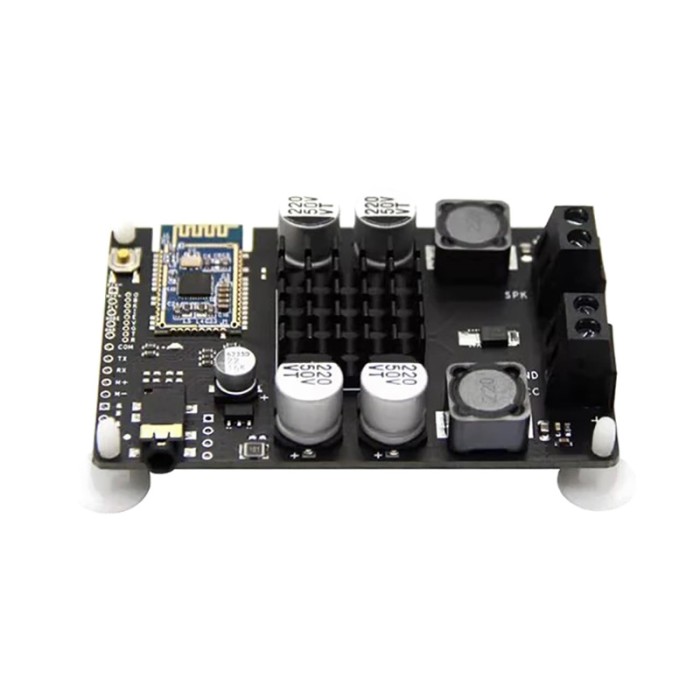
TWS 100W Bluetooth 5.2 Mono Power Amplifier Board
$12.1200
In stock
SKU
MOD-04-019
Volume discounts:
- +25 3 % $11.7200
- +50 5 % $11.5100
- +100 7 % $11.3100
- +300 8 % $11.1100
- +500 10 % $10.9100
Ships in 2-3 business days, then:
Free delivery in 12-15 days by Tracked Economic Shipping on orders over $100.
Free delivery in 7-10 days by Express Shipping on orders over $300.
More shipping info

Shop with confidence Learn More
 BDM8-A TPA3255 2x300W HIFI Class D Amplifier Board Previous
TWS 100W Bluetooth 5.2 Mono Power Amplifier Board review
The TWS 100W Bluetooth 5.2 Mono Power Amplifier Board is a compact single-channel audio module for standalone mono speaker projects and paired two-board wireless setups. It accepts an 8–24V DC input and combines onboard pushbuttons for playback, volume, and EQ adjustment with a dedicated one-key True Wireless Stereo (TWS) link button and a TTL serial interface. It suits builders who need a straightforward wireless driver for custom speaker enclosures and are browsing sound-player and audio modules.
The board offers a practical set of wireless-audio features, but its documentation has clear limits. The stated 100W and 80W output figures do not include test conditions such as total harmonic distortion (THD) or speaker impedance loads. Plan driver and power-supply selection conservatively rather than assuming continuous, unclipped power delivery into standard speaker loads.
Specifications of TWS 100W Bluetooth 5.2 Mono Power Amplifier Board
- Bluetooth Version: 5.2
- Output Power: 100W at 24V6A, 80W at 21V5A
- Power Supply: 8-24V with reverse connection protection
- Dimensions: 78 x 52 mm
- Fixing Hole Distance: 73 x 47 mm
- Serial Port Configuration: TX, RX, GND; 9600, N, 8, 1
- TWS Pairing: One-key TWS pairing
- AUX Support: AUX insertion support with TWS
- TWS Status: LED indicators for TWS status
- Volume: Volume synchronization and maximum default volume
- P/V- Button, short press: Skip to the next track
- P/V- Button, long press: Decrease the volume
- N/V+ Button, short press: Go to the previous track
- N/V+ Button, long press: Increase the volume
- PLAY Button, short press: Play/pause
- PLAY Button, double-click: Switch ShareMe
- PLAY Button, long press for 3 seconds: Reject/re-pair the phone (host only)
- TWS Button, short press: One-button TWS pairing
- TWS Button, double-click: Switch EQ (9-band EQ loop switching)
- TWS Button, long press for 3 seconds and release: Trigger a warning sound
- TWS Button, long press for 6 seconds: Clear the pairing list and restore EQ to default
TWS 100W Bluetooth amplifier power, supply, and mounting specifications
The published electrical figures are 100W at 24V 6A and 80W at 21V 5A. Its operating range spans 8V to 24V DC, covering standard bench supplies, battery packs, and laptop power adapters. Built-in reverse connection protection helps protect the internal circuitry from accidental supply-polarity inversion. Speaker impedance, including 4Ω or 8Ω, and distortion thresholds are not stated alongside the power figures, so these values should not be treated as continuous RMS ratings.
Power-source current capacity directly affects available dynamic headroom. A 24V DC supply option rated for 5A remains comfortably within the 8–24V operating window. Its 5A rating is slightly below the 24V 6A condition associated with the maximum 100W output claim.
The 78 x 52 mm footprint and 73 x 47 mm center-to-center corner fixing-hole spacing simplify mechanical planning. Overall vertical clearance, including the height of the inductors, capacitors, and terminal blocks, is not specified. Allow generous internal overhead in custom enclosures. For verified stereo output instead of a bridged mono topology, the stereo output with app control and listed USB Soundmax input is a documented alternative delivering up to 2x100W into 4Ω loads across an 8–26V input range.
TWS 100W Bluetooth amplifier TWS pairing and control functions
Four tactile pushbuttons handle onboard control through dedicated short-press, long-press, and double-click actions. Track navigation and output volume share two dual-function buttons: short presses on P/V- and N/V+ skip tracks, while holding them lowers or raises the output level. The board starts at maximum volume and maintains volume synchronization with paired host devices.
The primary controls cover system states and wireless linking:
- PLAY Button: A single press toggles play and pause. A double-click alternates ShareMe audio broadcasting modes. Holding the button for 3 seconds rejects or re-pairs the connected smartphone on the host unit.
- TWS Button: A momentary press initiates one-key TWS pairing between two compatible boards. Double-clicking cycles through a 9-band internal EQ loop. Holding for 3 seconds sounds an audio warning tone, while a 6-second hold clears the paired device list and resets the equalizer to default settings.
- Status Indicators: Dedicated LED indicators show current TWS operating states and verify synchronization between master and slave boards.
The physical audio input supports AUX insertion alongside TWS pairing, allowing wired sources to be shared across a wireless link. Bluetooth 5.2 handles the wireless interface, though codec profiles such as aptX or AAC and open-air transmission distances are not stated. Direct USB flash-drive playback is not supported on this board. The 3-pin serial interface, TX, RX, and GND, operates at 9600 baud, 8 data bits, no parity, and 1 stop bit (9600, N, 8, 1), but command strings and configuration registers are unlisted. For miniature single-cell designs rather than high-voltage rails, consider a low-power Type-C lithium-battery TWS amplifier operating from 3.5–5V.
TWS 100W Bluetooth amplifier limitations and buying cautions
Several engineering details remain undocumented. Most importantly, the output-power figures lack test parameters: without impedance curves, THD limits, or thermal dissipation curves, actual clean acoustic output into common 4Ω or 8Ω drivers cannot be calculated directly from the manufacturer data. The underlying amplifier chip model, Bluetooth processor, logic levels for the TTL header, and complete package contents are also unstated.
The module shares physical traits with generic board families including the ZK-1001B, ZK-1001U, and XY-1001W. Control interfaces vary significantly across these versions; some use rotary encoders, while others use different button routines. Follow the button map documented on this page rather than borrowing firmware steps or wiring diagrams from third-party generic guides.
Thermal management deserves attention during enclosure design. Class D amplifiers in small, unventilated enclosures can accumulate heat during continuous operation at higher supply voltages. A dedicated heatsink for enclosure cooling and chassis ventilation slots help prevent heat buildup during extended listening sessions. Where factory-integrated active thermal management is required, the stereo amplifier board with active cooling includes a built-in cooling fan and a 10–18V operating range.
TWS 100W Bluetooth amplifier alternatives: mono, stereo, and wired options
Choose the board architecture around enclosure count, power delivery, source requirements, and whether wireless streaming is required. The table below compares this mono TWS module with stereo, battery-powered, and wired alternatives.
| Model | Channels | Stated Output | Input Voltage | Connectivity | Key Features |
|---|---|---|---|---|---|
| TWS 100W Bluetooth 5.2 | Mono (1.0) | 100W @ 24V 6A / 80W @ 21V 5A | 8–24V DC | Bluetooth 5.2, AUX with TWS | One-key TWS pairing, 9-band EQ loop, reverse polarity protection |
| Sinilink XY-AP100H | Stereo (2.0) | 2x100W @ 24V 4Ω | 8–26V DC | Bluetooth, AUX, USB Soundmax | App configuration, TPA3116D2 core, 3.5mm audio jack |
| XH-A394 | Stereo (2.0) | 2x50W | 10–18V DC | Bluetooth 5.0 (20m) | Integrated active cooling fan, manual control knob |
| XH-M548 | Stereo (2.0) | 2x60W (120W total) | 12–24V DC | Bluetooth 4.2 | Dual-channel TPA3116D2 platform, dedicated wireless input |
| 5W TWS Mono Type-C | Mono (1.0) | 3W to 10W | 3.5–5V DC | Bluetooth, TWS | 3.7V lithium battery support, Type-C charging port |
A conventional two-channel output from one board does not need the extra wireless-link overhead. The 12–24V stereo Bluetooth amplifier provides a self-contained 2x60W layout. If Bluetooth pairing is unnecessary and analog signals arrive through external DAC, preamplifier, or microcontroller wiring, a dedicated wired mono amplifier approach such as the TPA3118 PBTL module provides 60W of single-channel amplification across an 8–26V range without wireless overhead.
TWS 100W Bluetooth amplifier setup, power supply, and cooling accessories
A working speaker system needs matching accessories based on its operating requirements:
Required Hardware
- DC Power Supply: Use an 8–24V DC power source. The full published 100W figure requires 24V at 6A.
- Compatible 24V Supply: The 24V DC supply option supplies up to 5A. It stays within the safe voltage range but falls slightly below the 6A threshold needed for peak listed power.
- Speaker Driver: Use a single mono loudspeaker driver. Specific impedance minimums and recommended driver wattages are not listed, so begin testing at moderate volume.
Recommended Hardware
- Thermal Management: An heatsink for enclosure cooling adds surface area for heat dissipation in enclosed projects.
- Ventilated Enclosure: Include passive airflow slots adjacent to heat-generating board components.
- Heavy-Gauge Wiring: Use suitable stranded copper wire for the DC power input and speaker terminals to prevent line losses.
Optional Accessories
- Low-Power Bench Driver: A small low-power test speaker helps verify board power-on, Bluetooth pairing, and control logic on a workbench before final enclosure mounting.
- AUX Signal Cable: Use a standard 3.5mm audio patch cable with the listed AUX input and TWS.
- TTL-to-USB Serial Adapter: This applies only to builders probing the 9600-baud serial pins who have equipment to analyze unlisted TTL data.
Initial Setup Sequence
- Confirm that the DC power source provides an output voltage between 8V and 24V. Verify terminal polarity before tightening connections.
- Attach the speaker leads firmly to the output terminals, ensuring no stray wire strands cause bridging.
- Apply DC power. Confirm power delivery and observe that the board initializes.
- Open the Bluetooth menu on an audio source, locate the board, and establish pairing.
- Begin audio playback at a low volume setting to confirm clean output.
- Test playback controls: short-press PLAY to pause, then test volume attenuation with a long press on P/V-.
- For a two-board stereo pair, apply power to both boards and short-press the TWS button on the designated primary board.
- To clear pairing, press and hold the TWS button for 6 seconds until the memory resets.
TWS 100W Bluetooth amplifier FAQ and purchase checklist
Frequently Asked Questions
Can I use a 12V adapter with the TWS 100W Bluetooth amplifier board?
Yes. A 12V supply is fully supported because the board accepts DC input from 8V to 24V. Output power scales with supply voltage, however, so the board delivers significantly less than its stated 100W maximum on a 12V rail.
Does the TWS 100W Bluetooth amplifier board provide 100W RMS output?
No RMS rating is specified. The listing states 100W at 24V 6A, but does not provide RMS conditions, continuous duty cycles, speaker load impedance, or total harmonic distortion. Do not interpret these figures as standard continuous RMS audio power.
Can one TWS 100W Bluetooth amplifier board run a stereo speaker pair?
No. This is strictly a single-channel mono amplifier board. A two-channel left and right stereo pair requires two identical boards wirelessly paired through the onboard TWS function.
Does the TWS 100W Bluetooth amplifier board support USB music playback?
No, USB playback is not supported on this board. Audio input is handled through Bluetooth 5.2 or the AUX input terminal.
How do I reset TWS pairing on the TWS 100W Bluetooth amplifier board?
Press and hold the TWS button for 6 seconds. This clears stored device pairings and resets the 9-band EQ settings to factory defaults.
Can I configure the TWS 100W Bluetooth amplifier board through TTL serial?
The board exposes TX, RX, and GND pins operating at 9600, N, 8, 1. No official command set, software GUI, or register documentation is provided.
Do I need a heatsink for the TWS 100W Bluetooth amplifier board?
A heatsink is recommended for high-volume playback or sealed enclosures. Running Class D boards near upper voltage limits generates heat that must be dissipated to maintain component life.
Can I use AUX while TWS is active?
Yes, the board lists AUX insertion support with TWS. Specific routing behavior, including audio mixing or master/slave prioritization, is not documented.
Purchase Decision Summary
- Ideal for: Builders assembling high-voltage mono boomboxes or paired two-enclosure wireless stereo systems with 8–24V supplies who prefer hardware buttons over smartphone apps.
- Maybe for: Projects using existing 12V–20V supplies where conservative power output is acceptable and undocumented serial commands are not required.
- Avoid if: You need a single-board stereo solution, verified RMS ratings at specific speaker loads, USB thumb-drive playback, or an active software configuration app.
Pre-Purchase Checklist
- Confirm that your project needs single-channel mono output, or order two units for a TWS stereo configuration.
- Ensure that your DC power supply outputs between 8V and 24V with adequate current capability.
- Verify that Bluetooth 5.2 or wired AUX meets your input needs, noting that USB file playback is absent.
- Verify chassis clearance for the 78 x 52 mm board footprint and 73 x 47 mm mounting-hole spacing.
- Plan adequate enclosure ventilation or supplemental passive heatsinking for sustained high-volume operation.
- If app-controlled equalization or integrated stereo outputs are mandatory, review the stereo output with app control and listed USB Soundmax input.
- For installations requiring guaranteed cooling in high-ambient environments, inspect the stereo amplifier board with active cooling.
- For ultra-compact, lithium-powered handheld builds, consider the low-power Type-C lithium-battery TWS amplifier instead.
| Interface Type | UART, Wireless |
|---|---|
| Operating Voltage (V) | 8-24V |
| Operating Current (mA) | 6000 |
| Dimensions (mm) | 78 x 52 mm |
| Mounting Type | Screw holes |
| Audio Function | Amplifier |
| Output Power | 100W at 24V6A, 80W at 21V5A |
| Input Types | AUX, Bluetooth |
| Bluetooth Ver. | 5.2 |
| Output Type | Analog |
| Channels | 1-channel |
Write Your Own Review

Please complete your information below to login.
Sign In
Create New Account