
Product added to cart

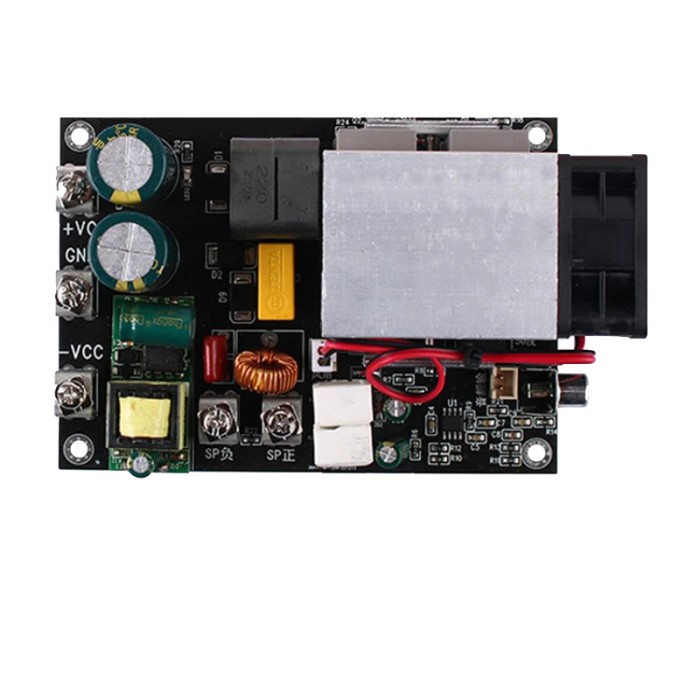
IR2092 Mono HIFI Digital Power D-Class Amplifier Board 1000W
$31.9500
In stock
SKU
MOD-04-014
Volume discounts:
- +10 4 % $30.7300
- +25 6 % $30.1100
- +50 8 % $29.5000
- +100 10 % $28.8900
- +300 11 % $28.2800
Ships in 2-3 business days, then:
Free delivery in 12-15 days by Tracked Economic Shipping on orders over $100.
Free delivery in 7-10 days by Express Shipping on orders over $300.
More shipping info

Shop with confidence Learn More
 TPA3255 High Power Dual Channel 2*300W Amplifier Module Previous
IR2092 1000W Amplifier Board Review
At $31.95, the IR2092 Mono HIFI Digital Power D-Class Amplifier Board 1000W is a bare mono Class D power stage for experienced builders assembling high-output audio projects such as subwoofers or PA systems. It uses high-voltage dual-rail operation and requires an external dual-polarity power supply. As an unhoused module, it is not a plug-and-play home audio amplifier.
For buyers browsing related sound modules, this board is strictly a raw amplification stage rather than an integrated media module. It has no Bluetooth streaming, USB decoding, or onboard volume knobs. You will need to install it in a larger enclosure with suitable input gear and power hardware.
Specifications of IR2092 Mono HIFI Digital Power D-Class Amplifier Board 1000W
- Operation Voltage: +/-55V to +/-80V
- Output Power: Maximum 1000W @ 4Ω, 500W @ 8Ω
- Dimensions: 125x100x43mm
- Weight: Approximately 292g
- Input Audio Signal: RCA lotus socket or 2.54 socket
- Cooling System: Mouth-shaped heat sink with temperature-controlled fan
- Mounting: Screw holes around the board with a 5mm distance from the edge
IR2092 Mono Amplifier Power Supply and Compatibility
The defining requirement of this IR2092 mono amplifier board is its split-rail power connection. It needs three separate DC connections: +VCC, GND, and -VCC, within a +/-55V to +/-80V operating window. A standard setup uses a dedicated 1KW switching power supply with DC +75V, 0V, and -75V rails. Single-output power supplies—including standard 12V automotive sources, 24V industrial bricks, and single 48V supplies—will not operate this board and cannot be wired across two terminals to run it.
Audio enters exclusively as a low-level analog signal through either the onboard RCA lotus socket or the 3-pin 2.54mm pitch socket. This is a single mono channel. A standard stereo setup requires two individual boards and duplicate wiring. For single-rail DC operation from standard supplies, consider a lower-voltage stereo Class D alternative operating on DC 19V–55V, or a stereo board with direct 3.5mm input operating between DC 24V and 48V.
| Parameter | Specification & Compatibility Details |
|---|---|
| Amplifier Format | Mono Class D power stage; one board per channel |
| Power Supply Interface | +/-55V to +/-80V DC; requires +VCC, GND, and -VCC connections |
| Nominal Supply Example | DC +75V, 0V, and -75V switching supply rated at 1KW |
| Single-Rail / 12V Compatibility | Incompatible; cannot run on single-rail 12V, 24V, or car batteries |
| Audio Inputs | Analog only: standard RCA lotus socket or 2.54mm header socket |
| Digital / Wireless Audio | None; no onboard Bluetooth, optical, coaxial, or USB audio decoding |
| Speaker Loads | Outputs rated for 4Ω and 8Ω speakers; 2Ω loads are not documented |
| Cooling Architecture | Extruded mouth-shaped heat sink with automatic temperature-controlled fan |
Quick Start: Safe Initial Verification
- Disconnect all AC mains power from your dual-rail DC power supply before making any connections.
- Use a multimeter to verify that the power supply provides genuine +V, 0V (GND), and -V output rails between 55V and 80V DC.
- Securely connect the positive, ground, and negative supply leads to the +VCC, GND, and -VCC screw terminals, checking polarity carefully.
- Run a heavy-gauge speaker cable from the output terminals to a verified 4Ω or 8Ω load capable of handling high wattage.
- Connect an analog line-level signal cable to either the RCA lotus socket or the 2.54 socket, with your audio source volume fully attenuated.
- Power on the dual-rail supply, check the board for stable idling, then slowly raise the input volume while confirming that the cooling fan and heat sink have unobstructed airflow.
IR2092 1000W Amplifier Board Specifications Explained
Reviewing the mechanical and thermal specifications of the IR2092 mono amplifier board helps prevent common assembly bottlenecks before you fabricate a chassis.
| Specification | Value | Why It Matters for Your Build |
|---|---|---|
| Operating Voltage | +/-55V to +/-80V | Demands a dual-rail supply capable of providing split polarity; exceeding +/-80V risks device breakdown, while dropping below +/-55V prevents proper gate drive operation. |
| Output Power | Maximum 1000W @ 4Ω, 500W @ 8Ω | Specifies headline peak ratings under low impedance; continuous clean wattage depends directly on power supply rail stiffness and total harmonic distortion thresholds. |
| Dimensions & Weight | 125x100x43mm, ~292g | Defines internal chassis height requirements, requiring at least 50mm of vertical clearance to allow adequate intake air over the cooling fan. |
| Cooling Assembly | Mouth-shaped heat sink with fan | Provides active forced-air cooling over the switching MOSFETs; listing data specifies fan activation above 50°C and automatic shutdown below 50°C. |
| Over-Temperature Cutoff | 85°C switch activation | Protects output silicon from thermal runaway under prolonged high-output usage by shutting down drive when the heat sink hits 85°C. |
| Mounting Footprint | Edge screw holes (5mm inset) | Requires standoffs placed at least 5mm from board edges to prevent accidental grounding against chassis walls or surrounding metalwork. |
| Audio Inputs | RCA socket or 2.54 socket | Enables direct hookup of standard consumer interconnects or internal shielded wiring harnesses without requiring custom input soldering. |
If you need a different stated output tier while retaining the same +/-55V to +/-80V split-rail topology, the lower-tier IRS2092 mono amplifier option provides 500W mono output with fixed 50x amplification.
IR2092 1000W Amplifier Board Limitations and Safety
The maximum 1000W at 4Ω headline reflects peak capability, not verified continuous clean output. Independent measurements of sibling boards across the broader IRS2092S design family show that clean output before hard clipping is substantially lower than unrated peak figures. Do not buy this board expecting 1000 watts of continuous, low-distortion, full-bandwidth audio. It is a workhorse stage better suited to subwoofer duty, bass cabinets, or PA applications where high sound pressure matters more than ultra-low distortion bench figures.
Safety matters here. Operating voltages up to +/-80V create a total rail-to-rail differential of 160V DC across the board, presenting dangerous shock hazards at exposed solder points. A fully enclosed, non-conductive or properly earth-grounded chassis is mandatory. Reversing polarity at the +VCC, GND, and -VCC terminals will destroy switching components immediately, so pre-power multimeter checks are essential.
Component-level protection on this bare module remains limited. The board lists an 85°C heat-sink thermal cutoff, but integrated DC-offset speaker disconnect relays, startup mute delays, and short-circuit crowbar circuits are not specified. If an output MOSFET fails shorted, direct rail voltage can pass through to the speaker voice coil. Builders who need integrated speaker protection should consider the stereo module with delayed-on/off relay protection, which includes onboard relay disconnects for transducer safety.
IR2092 vs TPA3255 and IRS2092 Amplifier Boards
Power supply infrastructure, channel requirements, and output expectations determine the right high-power Class D module. The matrix below compares this board with other bare modules in the catalog.
| Module | Channels | Operating Voltage | Stated Output | Input Format | Protection Features |
|---|---|---|---|---|---|
| IR2092 1000W Mono Board | 1 (Mono) | +/-55V to +/-80V DC (Dual) | 1000W @ 4Ω / 500W @ 8Ω max | RCA, 2.54mm socket | 85°C thermal switch, active fan |
| IRS2092 500W Mono Amplifier | 1 (Mono) | +/-55V to +/-80V DC (Dual) | 500W mono | Analog terminal | Heat sink dissipation, fixed 50x gain |
| TPA3255 2x300W Amplifier Module | 2 (Stereo) | DC 19V–55V (Single) | Up to 315W/ch @ 4Ω | Analog header | Low distortion (>111dB SNR) |
| BDM8-A TPA3255 2x300W Board | 2 (Stereo) | DC 24V–48V (Single) | 2x300W @ 4Ω | 3.5mm jack | Heatsink cooling |
| TPA3255 2x500W/2x600W Stereo Module | 2 (Stereo) | DC 12V–60V or 12V–70V | 2x500W or 2x600W | Analog header | Horn relay protection with delay |
For an integrated sound system rather than a raw power stage, an integrated Bluetooth 2.1 amplifier approach combines wireless connectivity, stereo channels, and a dedicated subwoofer stage on one board powered by standard DC supplies.
IR2092 Mono Amplifier Accessories and Build Requirements
A functional amplifier built around this board requires several essential external components. This is an unbundled power module, so include these additions in your project budget.
Required Components (Not Included)
- Dual-rail DC power supply: Use a switching or linear power supply providing split-rail DC outputs between +/-55V and +/-80V (e.g., +75V, GND, -75V) rated at 1KW. Single-output supplies, including standard 24V single-rail industrial power supplies, cannot drive this board.
- High-power speaker load: Use a 4Ω or 8Ω loudspeaker or subwoofer system built to withstand high wattage. Small testing drivers, such as 10W utility speakers, will be damaged instantly by this board.
- Heavy-gauge wiring: Use high-current hookup wire for the +/- rail inputs and speaker outputs to minimize resistive losses and prevent conductor overheating.
- Analog interconnects: Use shielded audio cabling terminating in an RCA plug or 2.54mm connector to prevent noise pickup from the high-voltage switching stage.
Recommended Hardware
- Insulated enclosure: A rigid chassis that fully encloses the board, prevents contact with the high-voltage rails, and provides intake and exhaust paths for the fan.
- DC rail fuses: In-line fuses on both positive and negative DC feeds to prevent catastrophic board damage in the event of an output short.
- External speaker protection: An independent speaker-protection board with delayed startup and DC-offset sensing to protect your drivers from failure transients.
- Preamplifier or active crossover: A low-noise source preamplifier or active low-pass crossover to control volume and limit the frequency band when driving subwoofers.
Optional Accessories
- Chassis binding posts: Optional external speaker connection hardware such as 4mm banana plugs can simplify connecting heavy speaker cables to the exterior chassis.
IR2092 1000W Amplifier Board FAQ
Is the IR2092 Mono HIFI Digital Power D-Class Amplifier Board really 1000W?
The 1000W specification is a maximum peak rating into a 4Ω load, not a verified continuous clean rating. Family measurements on sibling IRS2092-based boards show that clean power before heavy waveform clipping is significantly lower than 1000W. Continuous clean wattage depends directly on power supply voltage stability and thermal dissipation.
What power supply does the IR2092 1000W amplifier board need?
This board needs a dual-rail DC power supply operating between +/-55V and +/-80V with three separate terminals: +VCC, GND, and -VCC. For full output capacity, a dedicated 1KW audio switching power supply providing +75V, 0V, and -75V is recommended.
Can I run this IR2092 amplifier board from 12V, 24V, a car battery, or a normal single-output power supply?
No. The board cannot operate from single-ended supplies or low voltages such as 12V or 24V. Applying single-rail power across the terminals does not meet the minimum voltage threshold and lacks the negative rail connection required by the switching architecture.
Is this IR2092 board stereo?
No. This is strictly a mono amplifier board that drives one channel. Stereo operation requires two separate boards, identical dual-rail power feeds, and a dual-channel preamplifier.
Does the IR2092 1000W amplifier board have Bluetooth, USB, optical, or digital audio input?
No. All inputs are analog, using either an RCA lotus socket or a 3-pin 2.54mm header. The terms "digital power" and "Class D" refer only to the pulse-width-modulated switching method used by the output transistors, not digital audio signal processing.
Can this board drive a 2Ω speaker?
Operation at 2Ω is not documented in the board specifications, which list outputs only at 4Ω and 8Ω. A 2Ω load increases current demand and thermal stress on the switching MOSFETs and is not recommended.
Does the board include speaker protection?
The board includes an 85°C thermal switch to protect against heat-sink overheating, but it does not specify an onboard speaker relay or DC-offset detection circuit. An external speaker-protection module is recommended to guard against turn-on thumps or DC fault conditions.
When does the fan run?
The onboard fan operates automatically through a thermal switch. It remains idle during cold operation, turns on when heat-sink temperature exceeds 50°C, and turns off once temperatures drop below 50°C.
What should I choose if I need Bluetooth or a complete stereo/2.1 amplifier?
For built-in streaming and consumer convenience, choose a Bluetooth-enabled stereo amplifier approach that integrates wireless pairing, USB playback, and auxiliary inputs on a single pre-assembled board.
Purchase Decision Summary
- Ideal for: Experienced audio hobbyists building high-output mono subwoofers, bass-bins, or PA drivers who already possess or plan to purchase a high-voltage +/-55V to +/-80V dual-rail DC power supply.
- Maybe for: Advanced DIYers assembling a high-power dual-monoblock stereo system using two separate boards housed in an actively cooled custom enclosure.
- Avoid if: You need a finished, plug-in audio receiver, run strictly on 12V/24V or vehicle power, require wireless inputs, need guaranteed 2Ω support, or expect 1000W of low-distortion continuous continuous power without clipping.
Pre-Purchase Buying Checklist
- I need one mono channel, or I am purchasing multiple boards for multi-channel use.
- I have a high-voltage split-rail DC power supply providing between +/-55V and +/-80V (+V, GND, -V).
- I understand that single-output supplies (12V, 24V, 48V single-rail) cannot power this board.
- My speaker cabinet presents a 4Ω or 8Ω nominal impedance and handles high wattage.
- I understand that the 1000W rating is a maximum figure rather than continuous clean output.
- My audio signal is available as an analog line-level feed via RCA or bare header wire.
- I have the tools and hardware to construct an insulated, well-ventilated enclosure with adequate fan clearance.
- I have planned for proper circuit fusing and multimeter polarity verification before initial power-up.
| Operating Voltage (V) | +/-55V to +/-80V |
|---|---|
| Dimensions (mm) | 125x100x43mm |
| Mounting Type | Screw holes |
| Audio Function | Amplifier |
| Output Power | 1000W @ 4Ω, 500W @ 8Ω |
| Speaker Impedance (Ω) | 4Ω, 8Ω |
| Weight (g) | 292 |
| Input Types | 2.54 socket, RCA lotus socket |
| Bluetooth Ver. | No |
| Output Type | Analog |
| Channels | 1-channel |
| Chipset | IR2092 |
Write Your Own Review

Please complete your information below to login.
Sign In
Create New Account