
Product added to cart

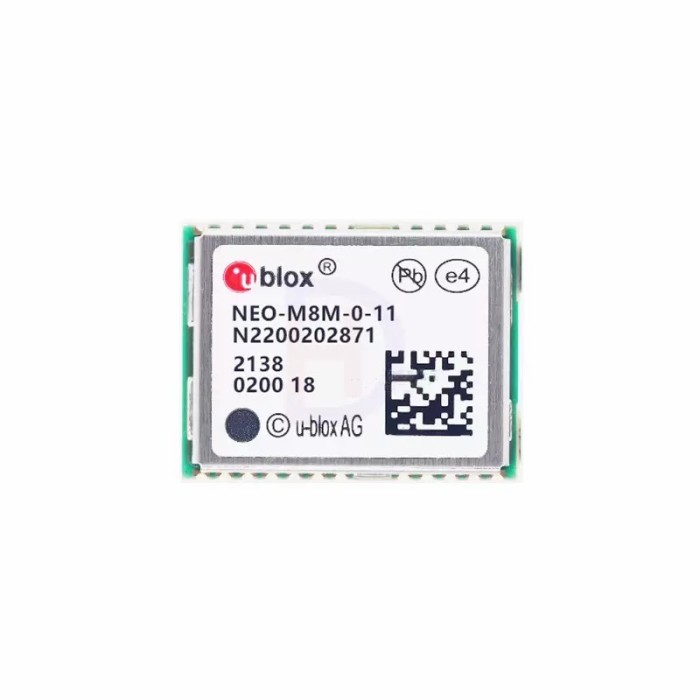
UBLOX GPS chip NEO-M8N-0-10
$9.5000
In stock
SKU
SEN-15-017
Volume discounts:
- +25 4 % $9.1200
- +50 6 % $8.9200
- +100 8 % $8.7300
- +300 10 % $8.5400
- +500 12 % $8.3500
Ships in 2-3 business days, then:
Free delivery in 12-15 days by Tracked Economic Shipping on orders over $100.
Free delivery in 7-10 days by Express Shipping on orders over $300.
More shipping info

Shop with confidence Learn More
 UBLOX GPS chip NEO-6M-0-001 Previous
NEO-M8N GPS Module Review: GNSS Integration Requirements
The UBLOX NEO-M8N-0-10 GPS Module is a compact multi-constellation receiver for 2.7V to 3.6V embedded navigation, mobile tracking, and robotics systems. The u-blox M8 architecture supports multi-system satellite tracking across GPS, GLONASS, Galileo, and BeiDou, but this unit requires careful hardware planning. Physical format specifications do not establish whether the receiver arrives as a bare surface-mount leadless chip carrier (LCC) or mounted on a populated carrier board. Direct 5V power tolerance, pre-soldered pin headers, an integrated USB port, and an included antenna are not specified, so verify these details before wiring it into a project.
Engineers choosing from our wider range of GNSS and positioning modules should assess their power rails and assembly capabilities before purchase, especially where standard 0.1-inch breadboard prototyping is required.
Specifications of UBLOX GPS chip NEO-M8N-0-10
- Positioning systems: GPS, GLONASS, Galileo, BeiDou
- Operating voltage: 2.7V to 3.6V
- Power consumption: Low
- Interfaces: UART, USB, I2C, SPI
- Dimensions: 12.2x16x2.4mm
- Sensitivity: High
- Accuracy: Precise positioning with fast time-to-first-fix and high update rates
NEO-M8N GPS Module Specifications Explained
Evaluating this module means translating catalog-level electrical and RF characteristics into practical engineering trade-offs. The receiver architecture supports modern satellite constellations, but system designers still need to account for hardware-level integration constraints.
| Specification | Stated Value | Why It Matters to Your Design |
|---|---|---|
| Positioning systems | GPS, GLONASS, Galileo, BeiDou | Access to multiple satellite networks improves coverage in obstructed outdoor environments. While the module supports all four networks, the u-blox M8 core architecture generally tracks up to three constellations concurrently, depending on active firmware and profile settings. |
| Dimensions | 12.2x16x2.4mm | The compact footprint matches standard surface-mount GNSS form factors for space-constrained PCB designs. Note that distributor height references cite up to 2.6 mm maximum seated height; verify vertical clearances when designing enclosed enclosures. |
| Operating voltage | 2.7V to 3.6V | Designed specifically for regulated 3.3V battery and logic rails. Connecting standard 5V logic or power without an intermediary regulator or level shifter risks permanent hardware damage. |
| Power consumption | Low | Nominal operation is optimized for portable systems. Exact current draw depends on configuration, while family benchmarks indicate approximately 23 mA continuous tracking at 3.0V and roughly 5 mA in cyclic 1 Hz power-save tracking. |
| Interfaces | UART, USB, I2C, SPI | Offers flexible microcontroller connectivity. In bare-chip implementations, protocol selection such as SPI requires dedicated pin biasing (D_SEL), while USB functionality requires dedicated VDD_USB power routing. |
| Sensitivity & Accuracy | High sensitivity; Precise positioning | Delivers standard civilian navigation accuracy under open skies. Numeric metrics for horizontal precision, time-to-first-fix (TTFF), and maximum update rates depend on active antenna gain, local RF noise, and satellite visibility. |
For applications requiring guaranteed simultaneous tracking across all four global constellations, consider the UBLOX MAX-M10 Multi-GNSS Module. It explicitly supports concurrent reception of GPS, GLONASS, Galileo, and BeiDou on an ultra-compact footprint.
NEO-M8N GPS Module Voltage and Interface Compatibility
Operating voltage is strictly rated from 2.7V to 3.6V. The module specifications do not include onboard voltage regulation or 5V logic level shifting. Supplying 5V directly to the power pins, or driving serial communication lines with 5V signals from traditional development boards, can damage the internal silicon. Logic level conversion or dedicated 3.3V power rails are mandatory when interfacing with standard 5V microcontrollers.
Communication protocol support includes UART, USB, I2C, and SPI at the silicon level. Which of these interfaces are physically exposed depends entirely on the delivered board format. When using SPI or native USB, the supporting hardware must provide the required pull-ups, bus selection pins, and power filtering. In ESP32 or 3.3V Arduino workflows, UART is the standard connection method. For serial NMEA parsing details, refer to our reference on interfacing a NEO-8M GPS module with Arduino.
For pre-assembled breakout convenience, these alternatives provide ready-to-use power and interface hardware:
- Need a plug-in 4-pin UART setup with onboard battery retention? Evaluate the GY-NEO-6M V2 with Battery & EEPROM.
- For systems running on 5V logic that need a robust screw-on antenna port, choose the NEO-7N with SMA Antenna Connector, which includes integrated 3.3V to 5V regulation.
- Direct PC configuration and rapid testing over a single USB cable are supported by the Goouuu Tech GT-U7 with Micro USB, which provides an accessible USB-to-UART bridge and 3.6V to 5V input support.
Standard prototyping with a Breadboard Jumper Wire Kit - 140 Pieces is practical only when the delivered receiver is mounted on a carrier board equipped with 0.1-inch male header pins.
NEO-M8N GPS Module Limitations and Setup Risks
The main purchasing consideration is package ambiguity. Because the NEO-M8N-0-10 designation identifies an LCC surface-mount package, bare modules cannot be placed directly on a breadboard. A bare module requires custom PCB layout, reflow soldering, controlled 50-ohm RF trace routing, antenna DC bias circuitry, and proper bypass decoupling before it can function.
The RF input is another major limitation. Satellite positioning depends heavily on antenna performance. This product entry does not confirm the inclusion of an external antenna, an onboard ceramic patch, or a specific connector such as U.FL or SMA. If connecting an external active antenna, such as a GPS Active Antenna SMA Male Plug, verify that your hardware design provides the necessary RF matching and DC bias voltage.
Claims of precise positioning indicate consumer-grade navigation, not centimeter-level accuracy. The module does not provide Real-Time Kinematic (RTK) positioning or multi-band carrier phase tracking. Expect typical open-sky horizontal positioning accuracy within 1.5 to 2.5 meters. Testing indoors or under dense foliage will lead to high dilution of precision (DOP) or failure to obtain a valid position fix.
For high-precision indoor tracking rather than outdoor satellite tracking, browse our GPS and location sensor category for local RF alternatives. Ultra-Wideband (UWB) solutions provide decimeter-level localization by measuring time-of-flight between local anchors:
- With local anchor infrastructure, the Decawave DWM1000 UWB Module delivers 10 cm indoor positioning accuracy.
- The Anxinke BU01 DW1000 Module provides an integrated PCB antenna for ranging and Time Difference of Arrival (TDOA) applications.
- For modular prototyping, the Qorvo DWM3000 Arduino Shield UWB Module mounts directly onto standard microcontroller dev boards for local positioning experiments.
NEO-M8N GPS Module Quick Start and First Fix Check
Verify basic receiver functionality before writing complex parsing code to avoid confusing hardware issues with software bugs. Follow this systematic initial checkout:
- Examine Delivered Hardware: Confirm whether you have a bare LCC module or a populated carrier board. Identify accessible power pins, ground pads, and the RF input interface.
- Provide Stable 3.3V Power: Connect a clean 2.7V to 3.6V DC source. Ensure common ground between the module, power supply, and your microcontroller or serial interface.
- Establish Serial Connections: If using UART, connect receiver TX to host RX and receiver RX to host TX. Ensure logic levels on the serial lines do not exceed 3.6V.
- Provide Clear Sky View: Place the connected antenna outdoors with an unobstructed view of the horizon. Testing indoors next to a window frequently prevents sufficient satellite lock.
- Monitor Raw Serial Output: Open a terminal program at the default communication speed, typically 9600 baud for standard NMEA output. Confirm that formatted text strings ($GNGGA, $GNRMC, or $GNVTG) stream continuously.
- Inspect via u-center: If strings do not appear or contain non-standard binary characters, connect through a 3.3V USB-to-UART adapter to the u-blox u-center software. Inspect port settings, active baud rates, and whether output protocols are configured for UBX binary instead of standard NMEA.
For an out-of-the-box solution that connects directly to a computer without manual wiring, the Goouuu Tech GT-U7 with Micro USB supports immediate serial analysis through a standard USB cable. When developing Arduino firmware for u-blox hardware, our tutorials on interfacing the NEO-8M with Arduino and interfacing the NEO-6M with Arduino provide established code examples for parsing standard NMEA sentences.
NEO-M8N GPS Module Accessories and Integration Needs
This receiver requires external support hardware. Verify which supporting components your build needs based on whether you are working with bare silicon or an integrated carrier.
Required Integration Components
- Carrier Board or Custom PCB: If the unit arrives as a bare surface-mount LCC package, an external PCB layout with suitable pads and ground planes is required.
- Regulated 3.3V Power Rail: Use a stable power source operating strictly within the 2.7V to 3.6V range.
- External GNSS Antenna: A functional RF reception path is required. If your hardware provides a standard threaded RF connector, pair it with an external GPS Active Antenna SMA Male Plug.
Recommended Diagnostic Hardware
- 3.3V USB-to-UART Bridge: Useful for connecting the module's serial lines directly to a PC to inspect NMEA sentences and configure registers.
- u-center Evaluation Software: Essential desktop software for setting custom update rates, disabling unneeded satellite sentences, and checking signal-to-noise ratios.
- RTC Backup Supply: Use a 1.5V to 3.6V coin-cell or supercapacitor circuit connected to the backup supply pin to retain ephemeris data for rapid warm starts.
Optional Prototyping Gear
- Prototyping Platform: If your module is mounted on a carrier with pre-soldered pin headers, mount it directly to an 830 points Breadboard using a Breadboard Jumper Wire Kit - 140 Pieces.
- Microcontroller Parser Libraries: Software packages such as TinyGPS++ or custom serial parsers decode coordinate data into application-level variables.
NEO-M8N GPS Module FAQ
Is the NEO-M8N-0-10 a bare module or a ready-to-use GPS board?
The NEO-M8N-0-10 part number specifies an LCC surface-mount integrated circuit module. Product specifications do not confirm the presence of an underlying carrier breakout board, pin headers, onboard voltage regulator, or USB ports. If you need a verified ready-to-wire board with headers and 5V power regulation, consider the NEO-7N with SMA Antenna Connector.
Can I power this NEO-M8N GPS module from 5V Arduino power?
No. The module is strictly rated for 2.7V to 3.6V operation. Connecting 5V directly to the supply pins will damage the unit unless an intermediate 3.3V voltage regulator is used. Serial lines driven by 5V logic also require resistive dividers or bidirectional level shifters to protect the receiver's inputs.
Does the NEO-M8N use GPS, Galileo, GLONASS, and BeiDou at the same time?
The receiver supports all four constellations, but the underlying M8 architecture typically tracks up to three constellations simultaneously. Operating profiles must be selected through firmware configuration commands based on regional satellite availability. For verified four-constellation concurrent reception, evaluate the newer MAX-M10 generation.
Does this NEO-M8N GPS module include an antenna?
Antenna inclusion is not specified for this product entry. Supply an external passive patch or active antenna separately. If your carrier board exposes a standard SMA female interface, pair it with an external GPS Active Antenna SMA Male Plug. For a bundled antenna and direct PC connectivity, consider the Goouuu Tech GT-U7 with Micro USB.
Can I use the NEO-M8N with Arduino or ESP32?
Yes, provided the power rails and logic levels meet the 3.3V requirement. The ESP32 interfaces directly through standard 3.3V hardware serial pins. An Arduino Uno requires a regulated 3.3V power feed and level conversion on the TX/RX communication lines. For implementation details and sample code, review our guide on interfacing the NEO-8M with Arduino.
Why does my NEO-M8N work in u-center but not in an Arduino sketch?
This mismatch usually results from baud-rate or protocol-configuration errors. Software libraries often default to 9600 baud NMEA, while the module may be configured for a different speed or set to output binary UBX protocol packets rather than standard ASCII text strings. Also verify that common ground is connected and that host RX lines connect to module TX pins.
Is the NEO-M8N GPS module centimetre accurate?
No. The NEO-M8N is a standard single-band civil navigation receiver providing typical positioning accuracy between 1.5 and 2.5 meters under clear skies. It does not support RTK carrier-phase tracking, base-station correction data, or centimeter-level survey positioning.
What current does the NEO-M8N draw?
Catalog specifications list consumption as low, but exact current depends on operating mode and RF design. Family reference benchmarks cite approximately 23 mA at 3.0V for continuous tracking, while cyclic 1 Hz power-saving modes can reduce current consumption to around 5 mA.
NEO-M8N GPS Module Purchase Decision Summary
| Suitability | Profile | Key Reason |
|---|---|---|
| Ideal for | Embedded hardware designers & engineers | Building a custom 3.3V PCB layout that incorporates native surface-mount components, custom RF antenna traces, and specialized serial routing. |
| Maybe for | Experienced hobbyists & drone builders | Developers comfortable verifying delivered pinouts, providing clean 3.3V regulation, adding level shifters, and attaching appropriate external antennas. |
| Avoid if | Beginners seeking plug-and-play prototyping | Users expecting pre-soldered breadboard pins, direct 5V Arduino power compatibility, an included antenna, USB-C connectors, or RTK precision. |
NEO-M8N GPS Module Buying Checklist
- Voltage Rail Verified: Confirm that your host system provides a clean, regulated supply between 2.7V and 3.6V.
- Logic Levels Matched: Ensure your microcontroller operates at 3.3V logic or incorporate level-shifting hardware between 5V microcontrollers and the receiver.
- Hardware Format Planned: Account for the physical form factor; bare LCC packages require a dedicated carrier board or custom PCB.
- Antenna Sourced: Confirm that you have an appropriate active or passive GNSS antenna matching your receiver's RF connector and bias voltage.
- Accuracy Requirement Confirmed: Verify that standard civil navigation accuracy (1.5–2.5 meters) meets your project goals rather than RTK-level centimeter precision.
- Configuration Tools Prepared: Have a 3.3V USB-to-serial adapter and u-center software ready to configure serial output rates and active NMEA sentences.
| Interface Type | USB, UART, I2C, SPI |
|---|---|
| Operating Voltage (V) | 2.7V to 3.6V |
| Operating Temp (°C) | -40 to 85 |
| Dimensions (mm) | 12.2x16x2.4 |
| Mounting Type | SMD (Surface Mount) |
| GNSS Systems | Galileo, GLONASS, GPS, BeiDou |
| Position Accuracy (m CEP) | 2.5m |
| Channels | 72-channel |
| Update Rate (Hz) | 10Hz |
| Power Mode | Configurable power management |
| Chipset | NEO-M8N-0-10 |
Write Your Own Review

Please complete your information below to login.
Sign In
Create New Account