
Product added to cart

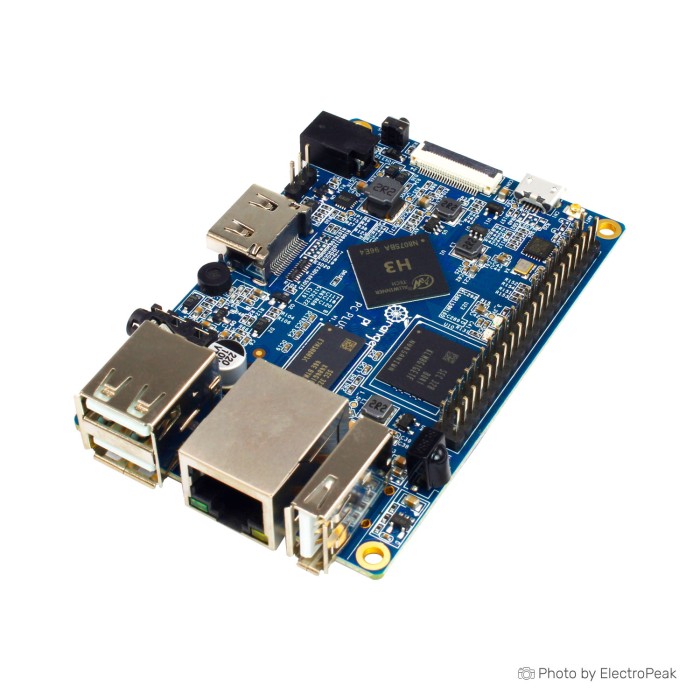
Orange Pi PC Plus H3 Quad-core Development Board
$41.2500
In stock
SKU
MIN-02-005
Volume discounts:
- +10 1 % $40.8300
- +25 2 % $40.6100
- +50 2 % $40.4000
- +100 3 % $40.1900
- +300 3 % $39.9800
Product Variations:


Add an Accessory:


Ships in 2-3 business days, then:
Free delivery in 12-15 days by Tracked Economic Shipping on orders over $100.
Free delivery in 7-10 days by Express Shipping on orders over $300.
More shipping info

Shop with confidence Learn More
 Orange Pi Lite H3 Quad-core Development Board Previous
Orange Pi PC Plus H3 Review: Legacy eMMC SBC for Lightweight Linux and GPIO Projects
The Orange Pi PC Plus H3 is a compact Allwinner H3 single-board computer for embedded developers and experienced makers who need integrated flash storage alongside physical connectivity. With an onboard 8GB eMMC module, integrated Wi-Fi, 10/100 Ethernet, HDMI, and a 40-pin GPIO header, it suits dedicated headless utilities, legacy Linux builds, and sensor interfaces in an 85mm x 55mm footprint. It is well suited to targeted 32-bit deployments where avoiding external SD cards adds reliability, but it is not intended for modern 64-bit operating systems, high-throughput network transfers, heavy multitasking, or drop-in Raspberry Pi software compatibility.
If you are comparing the wider Orange Pi single-board computers catalog, verify model designations carefully. The standard Orange Pi PC H3, for example, shares the same fundamental SoC platform but differs in its storage and networking setup. Check the exact board configuration before selecting an operating image.
Specifications of Orange Pi PC Plus H3 Quad-core Development Board
- Processor: Allwinner H3 system-on-chip (SoC). Quad-core ARM Cortex-A7 CPU and a Mali-400MP2 GPU @600MHz, supports OpenGL ES 2.0
- Memory: 1GB of DDR3 RAM
- Storage: MicroSD cards + onboard 8GB eMMC flash storage
- Networking: Ethernet (10/100Mbps) and Realtek RTL8189ETV Wi-Fi (802.11 b/g/n)
- USB Ports: Three USB 2.0 HOST, one USB 2.0 OTG
- Video Output: HDMI and DSI output (Max. 1080p)
- Video Input: A CSI input camera connector (Max. 1080p 30fps)
- Audio Output: 5mm audio jack for audio output, HDMI audio output
- Audio Input: Onboard microphone
- GPIO Pins: 40-pin GPIO (General Purpose Input/Output) header (compatible with Raspberry Pi)
- I2C, SPI, UART: Various communication protocols for connecting to sensors and other devices
- Operating System: Compatible with various Linux distributions and Android
- Buttons: Power Button(SW4)
- LED: Power led & Status led
- Other: IR input, IPX Wifi Antenna socket
- Form Factor: 85mm x 55mm
- Power Supply: 5V/2A DC input
Orange Pi PC Plus H3 Specifications Explained
The practical value of this board comes down to what its hardware can handle day to day. The Allwinner H3 quad-core ARM Cortex-A7 CPU, paired with the Mali-400MP2 GPU, has enough compute capacity for local automation scripts, basic web interfaces, and fixed-function appliances. With 1GB of DDR3 RAM, it remains suitable for headless Linux daemons, an MQTT broker, or lightweight desktop tasks. Contemporary web browsing and heavy containerized workloads will saturate that memory quickly.
| Specification | Technical Value | Why It Matters to Your Build |
|---|---|---|
| Processor Architecture | Allwinner H3 (4x Cortex-A7 @ up to 1.2GHz, 32-bit) | Limits operating system and package choices to 32-bit ARM (armhf). Capable for lightweight Linux utilities, but unsupported by modern 64-bit-only binaries. |
| System Memory | 1GB DDR3 | Shared between the CPU and GPU. Provides stable operation for headless background services, basic local kiosks, or lightweight scripts, but caps multitasking. |
| Onboard Storage | 8GB eMMC + MicroSD slot | Onboard eMMC provides faster, more durable storage than bare flash cards, eliminating the need to run primary root filesystems off removable media. |
| Wired & Wireless Networking | 10/100M Ethernet + 802.11 b/g/n Wi-Fi (RTL8189ETV) | Sufficient for sensor telemetry, SSH management, and light HTTP requests. Throughput caps make high-bandwidth local file transfers slow. |
| USB Connectivity | 3x USB 2.0 Host, 1x USB 2.0 OTG | Allows direct connection of human input devices, flash storage, or external serial bridges without requiring an immediate powered external hub. |
| Video Output | HDMI and DSI (Maximum 1080p) | While the Allwinner H3 architecture includes hardware-level H.265 4K decoding codecs, display output on this board tops out at 1080p resolution. |
| Physical Dimensions | 85mm x 55mm | Standard credit-card form factor allows integration into standard project boxes, though component layout differs from standard Raspberry Pi footprints. |
The networking and I/O design reflects the platform's legacy focus. Its 10/100Mbps Ethernet interface and USB 2.0 bus restrict sustained throughput, so this board is ill-suited to a high-performance network attached storage node or multi-stream media transcode server. For ultra-compact, display-free embedded designs where space is limited, the 40x40mm NanoPi NEO2 H5 offers a smaller headless footprint with a 64-bit architecture, while sacrificing display interfaces for compact integration. Among compact Orange Pi board options, the PC Plus stands out for combining full-sized external ports, integrated Wi-Fi, and onboard eMMC flash.
Orange Pi PC Plus H3 eMMC, Storage and Boot Limitations
The integrated 8GB eMMC flash module is the main reason developers choose the PC Plus over standard microSD-only single-board computers. Onboard eMMC flash offers noticeably better read and write endurance than typical consumer microSD cards, helping protect unattended automation controllers from file-system corruption caused by constant logging. You can flash operating systems directly to eMMC storage, allowing the board to run without an external card once initialized.
Software and batch variations still call for a cautious deployment workflow. Users across community Linux distributions have documented occasional eMMC detection and boot failures on specific production runs or with unaligned U-Boot configurations. Before installing the board inside an inaccessible enclosure, flash a boot image to a reliable microSD card such as the SanDisk Micro SD Memory Card - 32GB, boot the system, and confirm that the onboard eMMC block device, typically /dev/mmcblk1, is recognized by the operating system before migrating the root filesystem.
Keep a configured microSD card available as a recovery mechanism if local bootloaders become corrupted. External hard drives can expand storage through the three USB 2.0 host ports, but transfer rates remain limited by the USB 2.0 bus architecture and the 100Mbps local network link. Projects that require sustained transfer throughput or 64-bit compute for larger disk arrays are better served by the Orange Pi PC2 (64-bit H5), which provides Gigabit Ethernet for substantially higher bandwidth capacity.
Orange Pi PC Plus H3 GPIO and Camera Compatibility
The board carries a 40-pin GPIO header that physically mirrors the standard single-board computer layout. It provides access to hardware buses including I2C, SPI, and UART, along with digital I/O lines. A dedicated 3-pin serial debug console header near the DC jack also provides immediate low-level boot diagnostics through a serial terminal.
Physical compatibility does not mean software or electrical interchangeability. The pin multiplexing, base memory addresses, and internal pull-up resistor behavior of the Allwinner H3 differ entirely from Broadcom-based silicon. Standard Raspberry Pi libraries such as RPi.GPIO cannot communicate directly with H3 processor registers without board-specific translation layers such as OPi.GPIO. HATs that depend on proprietary kernel overlays, on-board EEPROM auto-detection, or specialized timing clocks will not work out of the box. Observe level shifting carefully: all digital I/O lines operate strictly at 3.3V logic levels, and applying 5V signals will damage the SoC pins.
Verify pin arrangements thoroughly before routing signals away from the board. An Orange Pi 26P GPIO Extension Cable requires careful confirmation before use because its ribbon format matches older 26-pin interfaces rather than the full 40-pin header populated on this board.
For imaging projects, the board includes a dedicated CSI camera ribbon connector rated for video streams up to 1080p at 30 frames per second. This connector relies on specific parallel CSI sensor support in the H3 Linux kernel. Compatible camera hardware is largely limited to documented sensor families such as the GC2035 and OV5640. Standard Raspberry Pi Camera Modules, including the v1, v2, and HQ cameras, use different ribbon pinouts and driver pipelines and are not compatible with this connector. Projects that depend on plug-and-play Python scripts, mainstream educational HATs, and official camera accessories are better matched to a standard Raspberry Pi 3 Model B, which provides the necessary ecosystem standardization.
Orange Pi PC Plus H3 Legacy Software and Setup Limitations
The Orange Pi PC Plus H3 belongs to an older hardware generation, and its software support reflects that stage of its lifecycle. The quad-core ARM Cortex-A7 processor uses a 32-bit instruction set, ARMv7-A. Modern Linux software stacks, toolchains, and pre-built container packages increasingly target 64-bit ARM, ARMv8 / AArch64, architectures exclusively. This board is not suitable for projects that depend on modern container platforms, machine-learning edge libraries, or current 64-bit enterprise software.
Official vendor images, including older Android, Debian, and Ubuntu builds, are largely historical snapshots with older kernel baselines. Modern usability relies on community-maintained distributions such as Armbian. Select an operating system image configured specifically for the target board identifier: orangepi-pc-plus. Flashing a standard image compiled for the base "Orange Pi PC" can result in a non-booting board, broken internal Wi-Fi drivers, or missing eMMC storage nodes because of device-tree differences.
Internal peripherals often require device-tree overlay edits, board-specific module compilation, or initialization-script debugging through the serial console. If your application requires a contemporary mainline kernel distribution with continuous security patches, inspect newer Orange Pi board options or move to a 64-bit platform such as the Orange Pi PC2 (64-bit H5). That choice can save considerable development overhead.
Orange Pi PC Plus H3 Power and First Boot Check
Power delivery causes the most confusion during initial setup. The Orange Pi PC Plus H3 specifications require a regulated 5V DC input rated at 2A or greater through its dedicated DC barrel jack. The micro-USB OTG port is wired strictly for data transmission and peripheral interfacing; it does not supply power to the main board rails. Powering the board through the micro-USB port will prevent it from booting, and injecting 12V DC into the barrel jack will cause immediate, irreversible board damage.
Use this concise sequence to verify hardware functionality before permanent deployment:
- Verify Hardware Identifiers: Check the silkscreen on the board to confirm it reads "Orange Pi PC Plus", and verify the physical presence of the 8GB Samsung or equivalent eMMC IC alongside the IPX antenna socket.
- Prepare Boot Media: Flash a verified operating system image specifically labeled for
orangepi-pc-plusonto a class-10 microSD card, such as a SanDisk Micro SD Memory Card - 32GB, using a verified imaging utility. - Attach Display and Peripherals: Connect your monitor to the full-size HDMI port, attach your keyboard to a USB host port, and connect an Ethernet patch cable if network access is needed.
- Connect Regulated Power: Plug a dedicated, regulated 5V 2A power adapter into the DC barrel connector.
- Observe Status LEDs: Check the onboard LEDs. The red power LED should illuminate steadily. After several seconds, the green status LED should begin flickering as the Linux kernel mounts root storage and initializes services.
- Verify Interfaces: Log into the operating system terminal. Run storage diagnostics, such as
lsblk, to confirm that the 8GB onboard eMMC is visible; verify IP acquisition over Ethernet or the onboard RTL8189ETV Wi-Fi module; and inspect system temperatures under load.
Orange Pi PC Plus H3 Accessories and Required Setup
Reliable operation requires specific external components that are not packaged with the bare development board.
Required Equipment
- Power Supply: Use a dedicated, regulated 5V 2A power adapter with the appropriate DC barrel connector. Standard USB chargers or micro-USB cables will not power the system.
- Removable Boot Media: A dependable class-10 microSD card, such as the SanDisk Micro SD Memory Card - 32GB, is necessary for initial image flashing, diagnostic boot runs, and eMMC recovery tasks.
- Flashing Workstation: A secondary computer with an SD card reader is needed to flash board-specific operating system images.
- Local Display Setup (Optional for headless installs): A standard HDMI cable and a 1080p-capable computer monitor or television.
Recommended Protection and Thermal Management
- Protective Enclosure: The ABS Protective Case for Orange Pi PC Plus protects bare PCB traces from accidental shorts, physical damage, and dust accumulation in workshop environments.
- Cooling Components: Under sustained processor and GPU loads, the Allwinner H3 SoC generates substantial heat and will throttle CPU frequencies. Passive aluminum heatsinks or a 5V cooling fan help maintain sustained compute performance.
Optional and Project-Specific Peripherals
- External Wi-Fi Antenna: The onboard Realtek RTL8189ETV radio requires an external antenna connected to the IPX socket for stable signal reception. Package contents vary, so verify antenna availability before setting up wireless links.
- Breakout Cabling: For ribbon breakout cables, verify pinout spacing and pin count. The Orange Pi 26P GPIO Extension Cable is configured for legacy 26-pin interfaces and will not span the full 40-pin header of this board.
Orange Pi PC Plus H3 vs Orange Pi PC2 and Raspberry Pi Alternatives
The right single-board computer depends on whether your workload prioritizes integrated storage, network throughput, physical size, or software community depth. The table below outlines concrete architectural differences across relevant alternatives.
| Feature | Orange Pi PC Plus H3 | Orange Pi PC2 | Raspberry Pi 3 Model B | NanoPi NEO2 H5 |
|---|---|---|---|---|
| Processor Architecture | Allwinner H3 (4x Cortex-A7, 32-bit) | Allwinner H5 (4x Cortex-A53, 64-bit) | Broadcom BCM2837 (4x Cortex-A53, 64-bit) | Allwinner H5 (4x Cortex-A53, 64-bit) |
| System RAM | 1GB DDR3 | 1GB DDR3 | 1GB LPDDR2 | 512MB DDR3 |
| Onboard Storage | 8GB eMMC + MicroSD | MicroSD + 2MB NOR Flash | MicroSD only | MicroSD only |
| Ethernet Speed | 10/100 Mbps | 10/100/1000 Mbps (Gigabit) | 10/100 Mbps | 10/100/1000 Mbps (Gigabit) |
| Wireless Interfaces | 802.11 b/g/n Wi-Fi (No Bluetooth) | None onboard | 802.11 b/g/n Wi-Fi + Bluetooth 4.1 / BLE | None onboard |
| Display Output | HDMI (1080p max), DSI | HDMI | HDMI, DSI | None (Headless only) |
| Form Factor | 85mm x 55mm | 85mm x 55mm | 85mm x 56mm | 40mm x 40mm |
For 64-bit software compatibility and gigabit wired networking, the Orange Pi PC2 (64-bit H5) provides a direct upgrade path within the same physical board outline. The NanoPi NEO2 H5 suits minimal embedded installations where video display ports are unnecessary, offering gigabit networking in an ultra-compact footprint. If software stability, out-of-the-box HAT compatibility, Bluetooth connectivity, and extensive documentation matter more than onboard flash storage, the Raspberry Pi 3 Model B remains the mainstream baseline. For a direct replacement in an existing H3 design without eMMC, inspect the base Orange Pi PC H3 listing carefully before purchasing.
Frequently Asked Questions
Is the Orange Pi PC Plus H3 a 64-bit board?
No. It is a 32-bit board. Its Allwinner H3 system-on-chip includes a quad-core ARM Cortex-A7 CPU that uses the 32-bit ARMv7-A instruction set. Operating system distributions and compiled binaries must target 32-bit ARM (armhf) architecture.
Does the Orange Pi PC Plus H3 include onboard eMMC storage?
Yes, the board includes an onboard 8GB eMMC flash memory module alongside the standard microSD slot. Detection and boot behavior can vary across production batches and custom Linux kernels, so verify that the eMMC block device is recognized before placing the board into permanent service.
Can the Orange Pi PC Plus H3 output 4K video over HDMI?
No. Display output is limited to a maximum of 1080p. Although the Allwinner H3 hardware video processing engine supports H.265/HEVC 4K decoding codecs internally, the physical HDMI and DSI display pipelines on this board deliver a maximum resolution of 1920x1080.
What power supply is required for the Orange Pi PC Plus H3?
The board requires a regulated 5V DC power source capable of at least 2A through the dedicated DC barrel connector. The micro-USB OTG port cannot power the board, and connecting a 12V power supply will permanently damage the circuitry.
Does the 40-pin GPIO header work with Raspberry Pi HATs and code?
Not directly. Although the physical pin layout mechanically mirrors the Raspberry Pi header, the register addresses, base pin numbers, and internal controllers belong to the Allwinner H3 SoC. Software must use Orange Pi-specific GPIO libraries, and standard HATs requiring auto-detection EEPROMs or dedicated Broadcom overlays will not function without custom configuration.
Which camera modules work with the CSI connector?
The onboard CSI interface is engineered for specific parallel camera sensors, most notably the GC2035 and OV5640 modules. Standard Raspberry Pi camera boards use different pinouts and driver architectures and cannot be connected directly to this port.
Is the board suitable for a home NAS or Plex streaming server?
It is suitable only for low-demand, basic local file sharing. Ethernet speeds top out at 10/100Mbps, and storage expansion relies on USB 2.0, so network throughput will bottleneck file transfers. The 32-bit Cortex-A7 architecture and 1GB RAM also lack the processing power required for live Plex video transcoding.
Does the board include Wi-Fi, and does the package include an antenna?
The board includes an onboard Realtek RTL8189ETV 802.11 b/g/n Wi-Fi chip connected to an IPX antenna socket. Whether an external antenna is included in the retail packaging varies by batch, so verify package contents before ordering if wireless connectivity is mandatory.
Why will a generic Orange Pi PC image fail to boot properly?
The base Orange Pi PC lacks onboard eMMC storage and integrated Wi-Fi circuitry. Images compiled for the base model lack the device-tree nodes and driver configurations required to initialize the RTL8189ETV wireless radio and the eMMC bus on the PC Plus. Always use images built specifically for the orangepi-pc-plus target.
Is this board recommended for beginners?
No. It is better suited to experienced hobbyists and developers. Running the board smoothly requires familiarity with flashing board-specific Linux images, using serial debugging consoles, configuring community device trees, and troubleshooting 32-bit dependencies.
Purchase Decision Summary
| Suitability | Target Use Cases | Key Considerations |
|---|---|---|
| Ideal For |
|
Provides dependable eMMC flash endurance and three full-size USB ports without the cost of high-end SBCs. |
| Maybe For |
|
Requires technical patience to select the correct community distribution and verify eMMC recognition. |
| Consider Another Option If |
|
Platforms like the Orange Pi PC2 or Raspberry Pi 3 Model B offer stronger compute, faster networking, or broader software ecosystems. |
Buying Checklist
- Confirm that the product silkscreen and listing designate the Orange Pi PC Plus rather than the standard PC or Plus models.
- Verify that your project requirements are fully compatible with a 32-bit ARM Cortex-A7 (armhf) software architecture.
- Ensure you have a regulated 5V DC, 2A or greater power supply with the correct barrel connector; remember that micro-USB will not power this board.
- Procure a high-quality microSD card for initial image preparation, testing, and emergency boot recovery.
- Check with the supplier to verify whether an external IPX Wi-Fi antenna is included in the package.
- Confirm that your intended camera module uses supported sensors (such as GC2035 or OV5640) rather than standard Raspberry Pi camera hardware.
- Plan to download an operating system image explicitly configured for the orangepi-pc-plus hardware target.
- If your project requires 64-bit architecture or Gigabit wired networking, select the Orange Pi PC2 instead.
| Processor (SoC) | AllWinner H3 |
|---|---|
| CPU | H3 Quad-core Cortex-A7 |
| Architecture | ARM Cortex-A7 |
| RAM | 1GB |
| RAM Type | DDR3 |
| Storage Support | microSD, eMMC, SATA |
| Storage Capacity | 8GB eMMC Flash |
| GPU/VPU | Mali400MP2 GPU @600MHz |
| Ethernet | 100 Mbps |
| Wi-Fi | WiFi 4 |
| Bluetooth | No |
| USB Ports | 1x USB OTG, 3x USB 2.0 Host |
| Video Output | HDMI |
| Hardware Interfaces | CSI (Camera), UART |
| GPIO Pins | 40-pin header |
| Camera/Display | CSI (Camera) |
| Power Input | DC input, USB OTG input |
| PCIe | No |
| Dimensions (mm) | 85mm × 56mm |
| OS Support | Ubuntu, Raspberry Pi OS, Debian, Android |
| Weight (g) | 50g |
Write Your Own Review

Please complete your information below to login.
Sign In
Create New Account