
Product added to cart

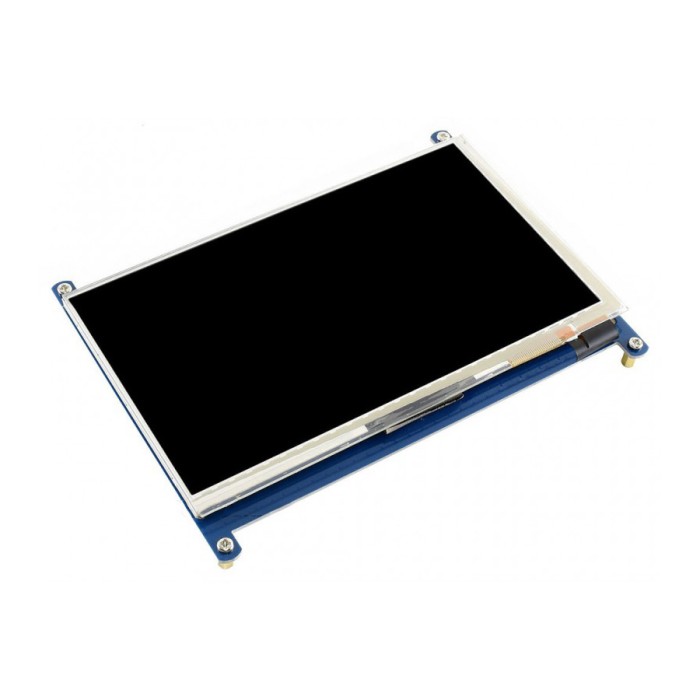
Waveshare 7inch 1024x600 IPS HDMI LCD Type C
$42.9500
In stock
SKU
LCD-01-074
Volume discounts:
- +10 3 % $41.6300
- +25 5 % $40.9600
- +50 6 % $40.3000
- +100 8 % $39.6400
- +300 9 % $38.9800
Ships in 2-3 business days, then:
Free delivery in 12-15 days by Tracked Economic Shipping on orders over $100.
Free delivery in 7-10 days by Express Shipping on orders over $300.
More shipping info

Shop with confidence Learn More
 Waveshare 10.1" 1024x600 HDMI LCD Type H With Case Previous
Waveshare 7 inch HDMI LCD (C) review
The Waveshare 7 inch HDMI LCD (C) is a compact display module with a 7-inch 1024 x 600 IPS panel and capacitive USB touch input. Built for single-board computers, robotics, and desktop monitoring dashboards, it accepts standard HDMI video output while handling touch through a separate USB connection. It suits applications needing a responsive interface without using host GPIO pins, but builders must plan for dual-cable routing, dedicated 5V power, and potential display timing configuration on Linux hosts. If your setup needs a different screen footprint or panel type, see the wider LCD display category.
Specifications of Waveshare 7 Inch 1024x600 IPS HDMI LCD Type C
- Display Size: 7 inches
- Touch Technology: Capacitive
- Resolution: 1024 x 600 pixels
- Aspect Ratio: 16:9
- Brightness: 300 cd/m^2 (Max)
- Contrast Ratio: Typically 800:1
- Refresh Rate: 60 Hz
- Touch Panel Interface: USB
- Display Interface: Standard HDMI
- Operating Voltage: 5V
- Operating Current: Varies depending on usage
- Operating Temperature: -20°C to 70°C
- Viewing Angle: 170° horizontal, 170° vertical
- Supported Operating Systems: Raspbian for Raspberry Pi, Ubuntu Mate, Windows 10 IoT, Single-Touch Android (via OTG), Win7/8/8.1/10 (Touch supported-No need to install any drivers), Single-Touch Mac OS X.
- Compatibility: Raspberry Pi 4B/3B+/3B/2B/B+/A+/Zero W/Zero, BB Black, Banana Pi
- Dimensions: 165mm x 107mm x 8mm
- Display Area: 21(H)x85.92(V)
- Weight: Approximately 300g
Waveshare 7 inch HDMI LCD specifications explained
An embedded screen choice comes down to physical footprint, pixel density, and interface constraints. Here is how the hardware specifications affect real-world deployment.
| Specification | Value | Why it matters |
|---|---|---|
| Panel & Resolution | 7-inch IPS, 1024 x 600 pixels | Provides sharp text rendering and wide 170° viewing angles across both axes, avoiding color inversion when viewed off-center. Design user interfaces strictly for the native 1024 x 600 resolution. |
| Brightness & Contrast | 300 cd/m² (Max), 800:1 typical contrast | Suited to indoor ambient lighting, dashboards, and lab bench use. Without high-nit output, optical bonding, or anti-glare coatings, it is not built for direct sunlight or outdoor environments. |
| Display & Touch Interfaces | Standard HDMI video, USB capacitive touch | Separates video decoding from input sensing. The host drives video through HDMI, while the USB connection manages multi-point touch events as a standard HID device. |
| Physical Dimensions | 165mm x 107mm x 8mm | These are the outer edge-to-edge PCB boundaries for enclosure integration. As a bare module without an integrated bezel, front-panel mounting cutouts must account for side connectors. |
| Operating Voltage | 5V DC | Runs on standard logic-rail power, though current draw fluctuates with backlight brightness. It requires a clean, regulated 5V source to maintain image stability. |
This hardware is an open-frame module without protective housing or toughened glass. For tabletop prototyping, an adjustable temporary display stand keeps cable stress off the ports during software development. For smaller dimensions, enclosed designs, or alternative interfaces, evaluate the broader LCD display category.
Waveshare 7 inch HDMI LCD Raspberry Pi setup and compatibility
This screen needs two host connections: standard HDMI for the image and USB for capacitive touch input and logic power. Manufacturer documentation identifies the onboard connection point as a micro-USB port. Before powering the host system, make sure the mechanical backlight switch on the rear of the board is set to ON.
On Windows 7, 8, 8.1, and 10, the display operates without secondary driver installations and supports up to five-point touch input. In multi-monitor desktop configurations, map touch events to this specific panel through the Tablet PC Settings tool in the Windows Control Panel. Otherwise, gestures may be redirected to your primary monitor. The listing also notes compatibility with Windows 10 IoT, single-touch Android via OTG, and single-touch Mac OS X.
Single-board computer setups—including the Raspberry Pi 4B, 3B+, 3B, 2B, B+, A+, Zero, and Zero W, plus BB Black and Banana Pi—rely on custom HDMI timings. Raspberry Pi OS installations using a TF card image process do not always negotiate 1024 x 600 natively over EDID. If the screen boots to a distorted image or black screen, manually declare the display resolution in the boot configuration settings:
- Connect the display with an HDMI cable for video output and connect the USB port to the host for touch.
- Ensure the rear backlight switch is set to ON.
- Provide a stable 5V power supply to the host and display.
- Define native 1024 x 600 custom HDMI timings in the operating system boot configuration when required.
- Boot the system and confirm that the desktop renders edge-to-edge without overscan, then test touch registration through the USB interface.
Waveshare 7 inch HDMI LCD limitations and revision checks
Long-term builds need to account for this display module's electrical and physical constraints. Power delivery is the most frequent source of commissioning issues. Insufficient host USB current can cause panel flickering, startup loops, faint ghosting, or red-tinted artifacts along the active display boundaries. An external, regulated 5V supply avoids common brownout behavior.
Waveshare has produced several revisions of the 7-inch LCD (C) family over time, so certain capabilities vary by hardware batch. Across the product history, revisions have used different touch controllers, firmware drive circuitry, and touch protocols. USB-based brightness adjustment commands, for example, are tied to specific board revisions. Check the silkscreen markings on the rear PCB of your unit to identify its specific revision before applying specialized scripts. Waveshare explicitly notes that unauthorized clones exist on the market, making board-level inspection and genuine branding checks essential for predictable behavior.
Touch protocol handling also differs by operating system. Five-point multitouch is supported on desktop Windows, while Android via OTG and macOS are specified for single-touch operation. Historical community reviews of older revisions also noted occasional image retention when static high-contrast frames remained active for prolonged durations. This does not indicate a uniform defect in current production runs, but display sleep timers are good practice for static dashboard applications.
Waveshare 7 inch HDMI LCD vs Type B and HDMI/VGA alternatives
The right display depends on existing UI layouts, enclosure space, and interface requirements. The table below compares this 7-inch IPS capacitive unit with other panels in the lineup.
| Model | Panel Type | Resolution | Touch Type | Video Inputs | Key Trade-Off |
|---|---|---|---|---|---|
| Waveshare 7" LCD (C) | 7-inch IPS | 1024 x 600 | Capacitive (USB) | Standard HDMI | Bare module; requires dual HDMI and USB cabling and 1024 x 600 timing configuration. |
| 800 × 480 Type B alternative | 7-inch Standard | 800 x 480 | Capacitive (USB) | Standard HDMI | Lower native resolution and narrower viewing angles due to non-IPS panel structure. |
| Larger resistive-touch alternative | 10.1-inch IPS | 1024 x 600 | Resistive (Single-touch) | Standard HDMI | Larger display area, but touch functionality is disabled when connected as a PC monitor. |
| HDMI/VGA and audio alternative | 7-inch IPS | 1024 x 600 | Capacitive (USB) | HDMI and VGA | Adds legacy VGA input and a 3.5mm audio jack, though VGA cables are not bundled. |
The 7-inch LCD (C) is the right fit when you need a compact IPS screen with capacitive touch over HDMI. If your software pipeline was built specifically around lower pixel counts, the 800 × 480 Type B alternative avoids scaling issues. For stylus-driven shop interfaces, the larger resistive-touch alternative provides more surface area. For legacy equipment that requires analog video feeds, the HDMI/VGA and audio alternative supports mixed-signal inputs.
Waveshare 7 inch HDMI LCD cables, power and mounting
Package contents can vary across production lots, so plan to source essential connection accessories separately rather than assuming they are included in the box. This screen needs an HDMI video source, an interface cable, a USB cable compatible with the display's micro-USB touch port, and a clean 5V power arrangement.
For bench assembly and display testing, an adjustable temporary display stand keeps the assembly upright and prevents trace flexing. Use an HDMI cable for video output to route video from standard host ports. Smaller boards such as the Raspberry Pi Zero series and Raspberry Pi 4B require host-specific adapters, such as mini-HDMI or micro-HDMI adapters.
Maintain power delivery at a steady 5V. Underpowered USB ports on older host hubs frequently cause panel reset cycles. In those cases, use an external regulated 5V power supply capable of delivering 2A to isolate display draw from the host logic board. Never power this 5V screen with a 12V adapter, as overvoltage will cause unrepairable damage to the controller circuitry. Permanent installations require a custom enclosure, front bezel, and cable strain relief to protect the exposed PCB and connector solders from mechanical fatigue.
Waveshare 7 inch HDMI LCD FAQ
Does “LCD (C)” or “Type C” mean this is a USB-C monitor?
No. The designation “(C)” is a Waveshare model suffix, not an indication of a USB-C interface. The display receives video over standard HDMI and routes power and touch data through a separate micro-USB port. It does not support single-cable USB-C video or power delivery.
Does HDMI carry touch input on the Waveshare 7 inch HDMI LCD?
No. The HDMI connection transmits audio and video signals only. Touch input is handled exclusively through the USB port, which must be connected to the host alongside the HDMI line for touch recognition.
Can I use the Waveshare 7 inch HDMI LCD with Raspberry Pi?
Yes, it supports models ranging from the Raspberry Pi Zero through the Raspberry Pi 4B running Raspberry Pi OS or Raspbian. Because the 1024 x 600 native resolution is rarely negotiated automatically over HDMI EDID, manual resolution parameters must be entered in the boot configuration.
Will the Waveshare 7 inch HDMI LCD work with Raspberry Pi 5?
The listing does not specify Raspberry Pi 5 compatibility. While standard HDMI video and HID touch protocols generally apply across hardware generations, review confirmed setup procedures for specific board revisions before ordering for a Pi 5 installation.
How much power does the display need?
The panel operates at 5V DC, with current consumption varying by usage and backlight levels. While typical consumption is approximately 500mA, an external 5V/2A power supply is recommended if the host USB port cannot deliver sufficient continuous current.
Does it support five-point touch?
Five-point touch is supported on Windows 10, 8.1, 8, and 7 systems operating as standard PC monitors. Other environments, including Android via OTG and macOS, are documented for single-touch interaction, while Linux touch-point behavior depends on the underlying kernel drivers and desktop environment.
Does the Waveshare 7 inch HDMI LCD need touchscreen drivers on Windows?
No driver installation is required for Windows 7, 8, 8.1, or 10. The display functions through standard HID protocol, though secondary-monitor setups require mapping touch input to the correct display surface using Windows Tablet PC settings.
Is the native 1024 × 600 panel true 16:9?
No. Mathematically, a 1024 x 600 resolution yields an aspect ratio of approximately 1.707:1, which is slightly wider than a standard 16:9 (1.777:1) display. Build graphical layouts and application interfaces directly to 1024 x 600 dimensions to avoid image stretching.
Does it include HDMI cables, USB cables, a case, or mounting hardware?
Package contents are not confirmed for this module. Be prepared to source an HDMI cable for video output, a micro-USB touch cable, mounting standoffs, and protective enclosures independently.
What should I choose if I need VGA or audio output?
The standard LCD (C) module has only an HDMI video interface and no audio jack. If your setup needs analog inputs or onboard sound, choose the HDMI/VGA and audio alternative, which provides both input types alongside a 3.5mm audio port.
Is this display suitable for outdoor or unattended industrial use?
No. This bare module has a maximum brightness rating of 300 cd/m² and lacks optical bonding, weather sealing, and tempered front glass. It is intended for indoor maker projects, enclosures, and test bench deployments rather than direct-sunlight or ruggedized industrial tasks. For alternate form factors, see the full LCD display category.
Purchase decision summary
- Ideal for: Builders wanting an indoor 7-inch IPS display with responsive capacitive touch for Raspberry Pi, desktop PC monitoring, or custom maker kiosks who can provide separate HDMI and USB cabling alongside a stable 5V rail.
- Maybe for: BeagleBone Black, Banana Pi, Android OTG, or macOS projects where single-touch limits are acceptable and the user is comfortable confirming hardware revision requirements.
- Consider another option if: You need a single-cable USB-C display, out-of-the-box plug-and-play Raspberry Pi setup without config edits, legacy VGA input, outdoor sunlight visibility, or a rugged, enclosed monitor.
Buying checklist
- Confirm your host computer features an available HDMI port and an active USB port for touch input.
- Ensure you have a regulated 5V power supply on hand (do not connect 12V adapters).
- Verify whether your installation requires host-specific video adapters (such as micro-HDMI or mini-HDMI).
- Plan an enclosure, panel bezel, or mounting plate to secure the bare PCB module.
- Be prepared to edit boot configuration timing files when deploying on Raspberry Pi OS.
- Design graphical interfaces directly for native 1024 x 600 pixel boundaries.
| Model | 7inch HDMI LCD (C) |
|---|---|
| Platform | Raspberry Pi 3, Raspberry Pi 4 |
| Display Size | 7 inches |
| Display Size Range | 7 inch to 10 inch |
| Display Resolution | 1024x600 |
| Display Interface | HDMI |
| Panle Type | IPS |
| Display Color Type | Full Color |
| Touchscreen Type | Capacitive |
| Backlight Type | White LED |
| Viewing Angle (°) | 170° (H/V) |
| Operating Temp (°C) | -20 to 70 |
| Operating Voltage (V) | 5V |
| Dimensions (mm) | 165mm x 107mm x 8mm |
| Brightness | 300 cd/m^2 (Max) |
Write Your Own Review

Please complete your information below to login.
Sign In
Create New Account