
Product added to cart

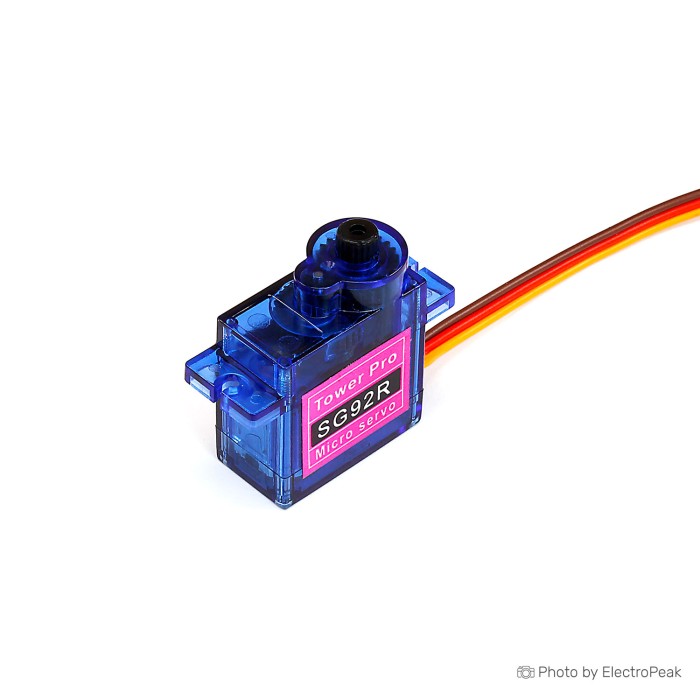
SG92R Servo Motor
$1.4700
In stock
SKU
MTR-06-008
Volume discounts:
- +50 3 % $1.4200
- +100 5 % $1.4000
- +300 7 % $1.3700
- +500 8 % $1.3500
- +1000 10 % $1.3200
Ships in 2-3 business days, then:
Free delivery in 12-15 days by Tracked Economic Shipping on orders over $100.
Free delivery in 7-10 days by Express Shipping on orders over $300.
More shipping info

Shop with confidence Learn More
 MG996R Full-Metal High Torque Digital Servo Previous
SG92R Servo Motor Review
The SG92R Servo Motor is a 9 g TowerPro micro positional servo for angular position control in lightweight RC models, Arduino builds, desktop robotics, and small mechanical linkages. It provides approximately 180 degrees of travel (90 degrees in each direction) through standard three-wire pulse-width modulation (PWM) control, working like a standard-size servo in a compact package.
With a rated holding torque of 2.5kg/cm at 4.8V, an attached 25 cm lead, and included mounting hardware, this servo suits light articulation tasks such as camera pan brackets, automated lids, sensor sweeps, and small latches. Documentation varies across production runs on exact upper voltages, gear composition, and precise casing dimensions. This motor is not intended for high-shock installations, continuous stalling, or dimension-critical industrial designs. For broader form factors and torque ratings, see our servo motor options.
Specifications of SG92R Servo Motor
- Micro Servo: Like a Standard Servo but Smaller!
- Genuine TowerPro Product
- Carbon Fiber Gears and Control Arms
- Holding Torque: 2.5kg/cm @ 4.8V
- Operating Voltage: 3.0 to 7.2 Volts - Optimal 4.8V
- Operating Speed: 60/0.1 degree/second (No Load @ 4.8V)
- Temperature Range: -30? to 60?
- Dead Band Width: 10us
- Included: 25cm Wire, Servo Arms & Screw
- Weight: 9g
SG92R Servo Specifications Explained
Assessing how the SG92R performs in a real mechanism means looking beyond the raw numbers. Small differences in arm geometry, operating voltage, and lead routing dictate whether an actuator moves reliably or binds.
| Specification | Listed Value | Why It Matters in Practice |
|---|---|---|
| Weight | 9g | Keeps mass minimal on weight-sensitive airframes, small pan-tilt assemblies, and lightweight walking robots. However, the 9 g class designation does not guarantee exact mounting tab dimensions across different production runs. |
| Holding Torque | 2.5kg/cm @ 4.8V | Torque is rotational force, not direct lift capacity. At a 1 cm radius from the shaft center, the servo holds up to 2.5 kg at 4.8V at stall; at a 2 cm radius, holding capacity drops to 1.25 kg. This is a stall-style rating, not a safe threshold for continuous, sustained loads. |
| Operating Speed | 60/0.1 degree/second (No Load @ 4.8V) | Representing an unloaded transit speed of approximately 0.10 seconds per 60 degrees of rotation at 4.8V. Under physical mechanical load, friction and linkage inertia reduce travel speed considerably. |
| Lead Length | 25cm Wire | Sufficient for breadboards and compact desktop chassis. When routing through larger RC wings, robotic arms, or distributed enclosures, you may need a Female-Female Servo Extension Cable - 20cm to bridge the distance to your controller. |
| Dead Band Width | 10us | Defines the minimum change in control pulse width required to produce movement. Because published documentation across SG92R variants varies between 1 µs and 10 µs, do not rely on this figure for high-precision positioning. |
For mechanisms exceeding this micro servo's load limit or requiring confirmed standard mounting patterns, the TowerPro SG-5010 Standard Servo provides a higher 5.5 kg.cm torque rating at 4.8V in a standard servo footprint. Exact mounting tab geometry, casing dimensions, and output horn spline pitch are not standardized across all micro clones, so verify clearances physically before committing to rigid CAD enclosures.
SG92R Servo Wiring and Power Requirements
The SG92R uses a standard 3-pin S-type female header connector compatible with Futaba, JR, GWS, Cirrus, Blue Bird, Blue Arrow, Corona, Berg, Spektrum, and Hitec receiver layouts. Its connector carries three dedicated lines: ground, positive DC power, and the PWM control signal.
The operating voltage is listed at 3.0 to 7.2 Volts with 4.8V optimal. Technical documentation across suppliers shows conflicting limits, with some sheets rating the unit strictly for 4.8V to 6.0V. Power the servo from a regulated 4.8V to 5.0V source during initial testing. Operating above 6V without verified manufacturer confirmation risks overheating the internal driver circuitry.
Never power the SG92R directly from a microcontroller 3.3V or 5V GPIO pin. GPIO pins provide logic signals, not the current required to drive an inductive motor load. Even unloaded movement causes current spikes that can reset an Arduino or brown out a development board. When using an external power supply, connect the power supply ground directly to the microcontroller ground to maintain a common signal reference.
For single-servo setups, standard microcontroller libraries, such as the built-in Arduino Servo library, generate the standard 50 Hz PWM waveform directly. Controlling several servos at once? Offload signal timing to a dedicated PCA9685 16-Channel 12-bit PWM/Servo Driver to prevent pulse jitter and simplify power distribution. Step-by-step wiring instructions appear in our guide on interfacing the PCA9685 PWM driver with Arduino.
For robotics builds requiring bidirectional feedback, addressable multi-drop wiring, and absolute position tracking rather than standard PWM pulses, consider a smart serial bus actuator such as the Waveshare ST3215-HS Serial Bus Servo. It provides UART bus control and real-time telemetry over a 6V to 12.6V range.
SG92R Servo Limits: Voltage, Travel and Gear Claims
Before integrating the SG92R into an assembly, account for its mechanical travel, gear construction, and structural limits. That prevents damage during initial setup.
- Positional Travel vs Continuous Rotation: This unit is an approximately 180° positional servo, moving roughly 90° clockwise and 90° counter-clockwise from center. The market contains different variations under the SG92R label, including 270° and 360° continuous-rotation variants. Confirm positional behavior before mounting.
- Software Endpoint Calibration: Never assume a code range of 0° to 180° safely corresponds to the physical limits of every individual motor. Command the servo to 90° (center, approximately 1.5 ms pulse) before installing linkages. Gradually adjust pulse limits (typically 500 µs to 2500 µs) in software to prevent the internal gear train from colliding with hard physical end stops, which causes continuous buzzing, high current draw, and stripped teeth.
- Gear Train Construction: The specifications list carbon fiber gears and control arms. Across market iterations, gear compositions range from carbon-fiber-reinforced polyoxymethylene (POM) plastics to hybrid sets with a metal primary gear. Do not treat this servo as an all-metal gear actuator; it does not offer the shock and impact resistance of an all-brass or steel gear train.
- Authenticity and Tolerances: Clone and variant units are widespread in the micro-servo category. Although labeled as genuine TowerPro, inspect housing case embossing, wire exit molding, and horn fit on your specific batch before deploying it in critical assemblies.
- Duty Cycle and Stalling: This servo is not built for sustained holding loads near its 2.5kg/cm stall rating, high vibration environments, or safety-critical applications.
Need standard dimensions, traditional nylon gearing, or a platform suitable for manual continuous-rotation modification? The S3003 Standard Servo is a practical alternative.
SG92R vs SG90 and Standard Servo Alternatives
Choosing between micro and standard servos means balancing physical envelope constraints, required mechanical torque, and control interface requirements.
| Servo Model | Form Factor | Rated Torque | Gear Type | Control Interface | Primary Application Fit |
|---|---|---|---|---|---|
| TowerPro SG92R | 9 g Micro | 2.5kg/cm @ 4.8V | Carbon fiber / composite | Standard PWM | Lightweight linkages, small pan-tilts, automated bin lids, and mini robots needing compact torque. |
| TowerPro SG-90 (Plastic Gear) | 9 g Micro | 1.2 kg/cm @ 4.8V | Full plastic | Standard PWM | Cost-sensitive educational models, lightweight RC planes, and simple indicators where lower torque is sufficient. |
| S3003 Standard Servo | Standard | 3.2–4.1 kg.cm | Nylon | Standard PWM | Model cars, boats, and mechanical linkages that accommodate standard chassis cutouts or continuous-rotation mods. |
| TowerPro SG-5010 Standard Servo | Standard | 5.5 kg.cm @ 4.8V | Plastic | Standard PWM | Larger robotic joints, heavy steering linkages, and mechanisms demanding elevated stall torque. |
| Waveshare ST3215-HS Serial Bus Servo | Standard Bus | 20kg.cm @ 12V | Metal gear | UART Serial Bus | Advanced multi-joint kinematics requiring daisy-chained wiring, 360° magnetic encoding, and position feedback. |
Against the standard plastic-gear SG-90, the SG92R lists a higher torque rating: 2.5kg/cm versus 1.2 kg/cm in the same 9 g footprint. A standard-size servo such as the SG-5010 provides significantly more holding strength, but requires greater weight and volume. To compare form factors, see our range of servo motor classes.
SG92R Servo Accessories and First Test
Each unit includes an attached 25 cm lead, a selection of servo arms (horns), and a mounting screw. Exact arm styles and counts depend on factory packaging. Operating the servo requires a suitable PWM signal source and an independent, regulated DC power supply.
Pre-Installation Bench Test Procedure
- Connect Power and Signal: Wire the servo connector to a regulated 4.8V to 5.0V power source. Connect the ground wire to both the power supply ground and your signal generator ground. Connect the signal wire to your PWM output pin or tester.
- Command Center: Before attaching any output arm, send a neutral 1500 µs pulse (90 degrees). The motor shaft rotates to its center position. A dedicated Servo Motor Tester lets you center the output shaft instantly without writing code.
- Mount the Horn: Press the plastic arm onto the output spline as close to your desired neutral mechanical angle as the splines permit, then secure it lightly with the included center screw.
- Sweep Across a Narrow Range: Command small angular shifts, such as 80° to 100°, to verify direction and smooth operation without mechanical linkage attached.
- Calibrate Endpoints: Slowly expand the pulse limits toward the 0° and 180° targets. If the motor begins to buzz loudly, draws excessive current, or gets warm, it has reached an internal physical stop. Back off the software limits immediately to establish a safe operating range.
For longer signal runs in larger RC frames or robot bases, use a Servo Extention Cable - Female/Female, 70cm to prevent tension on the factory wire harness. As a project expands to multiple articulated joints, see our guide on expanding from one servo to multiple PWM channels using an external I2C driver.
SG92R Servo FAQ and Buying Checklist
Frequently Asked Questions
Is this SG92R a 180° positional servo or a 360° continuous-rotation servo?
This unit is an approximately 180° positional servo. It rotates roughly 90 degrees in each direction from center to hold commanded angles. Same-name variants on the market offer 270° or 360° continuous rotation, so test your motor's response to standard PWM pulses before completing mechanical installation.
Can I run the SG92R Servo Motor from 7.2V?
No. Keep initial bench testing strictly to 4.8V to 5.0V. While the specifications list an operating range of 3.0 to 7.2 Volts with 4.8V optimal, external documentation for the SG92R family conflicts on maximum voltage tolerances. Running at 7.2V without batch-specific verification risks thermal damage.
Can an Arduino, Raspberry Pi, ESP32, or Pico control this SG92R micro servo?
Yes. Any controller capable of outputting a 50 Hz PWM signal can position this servo. For Arduino boards, the standard built-in Servo library handles pulse generation directly. The development board provides only the logic signal; the motor power rails must receive power from an external regulated supply.
Can I power the SG92R from an Arduino 5V pin or a Raspberry Pi GPIO pin?
No, do not power the motor from a controller board's power pins under load. Microcontroller regulator rails cannot reliably handle the inductive current spikes drawn by moving or stalled servo motors, leading to controller resets and jitter. Use an external 5V power supply and share a common ground with the controller.
How much can a 2.5kg/cm SG92R servo lift?
The 2.5kg/cm rating is a stall torque measurement at 4.8V, not a direct payload weight. At a 1 cm arm radius, the maximum holding force before stalling is 2.5 kg. At 2 cm, that force is cut in half to 1.25 kg. For reliable long-term operation, size linkages so normal operating loads remain well below this stall threshold.
Are the SG92R gears metal?
No, this unit features carbon fiber and composite gears, not an all-metal gear train. While more resilient than standard plain plastic gears, they cannot withstand the shock loads or physical jams that full brass or steel gearboxes endure.
What is included with the SG92R Servo Motor?
The package includes the micro servo with an attached 25 cm lead, a set of control arms (horns), and a mounting screw. Frame mounting hardware, brackets, and external wiring extensions are not included.
Do I need a servo tester or PCA9685 driver?
Neither is strictly required, but both simplify development. A Servo Motor Tester centers shafts and checks travel endpoints instantly without writing software. A PCA9685 driver is recommended if your controller runs low on PWM-capable pins or struggles with timing jitter while managing multiple servos.
Purchase Decision Summary
- Ideal for: Lightweight RC models, automated bin lids, small camera pan-tilt units, educational robotics, and small latches requiring standard PWM control and approximately 180° travel in a 9 g envelope.
- Maybe for: Upgrading an existing SG90 mechanism where additional torque is required, provided the power supply can support loaded motor current and exact mounting hole tolerances are not critical.
- Avoid if: Your mechanism requires continuous 360° wheel rotation, full all-metal gear durability under heavy impacts, certified industrial compliance, continuous stall operation, or direct 7.2V battery bus power. If your calculated mechanical load exceeds micro-servo ratings, consider the standard-size TowerPro SG-5010 Standard Servo instead.
Pre-Purchase Verification Checklist
- Confirm your project needs an approximately 180° positional actuator, not continuous rotation.
- Calculate mechanism torque at your specific horn radius; keep operating load comfortably under 2.5kg/cm.
- Plan an external regulated 4.8V to 5.0V power supply rather than driving motor current from development board headers.
- Ensure your circuit ties external power supply ground and microcontroller ground together.
- Verify whether the included 25 cm lead reaches your receiver or if an extension cable is needed.
- Budget software testing time to center the output shaft and calibrate safe PWM endpoints before attaching mechanical stops.
- If you require other physical sizes, torque classes, or smart bus options, review our complete line of servo motors.
| Weight (g) | 9 |
|---|
Write Your Own Review

Please complete your information below to login.
Sign In
Create New Account