
Product added to cart

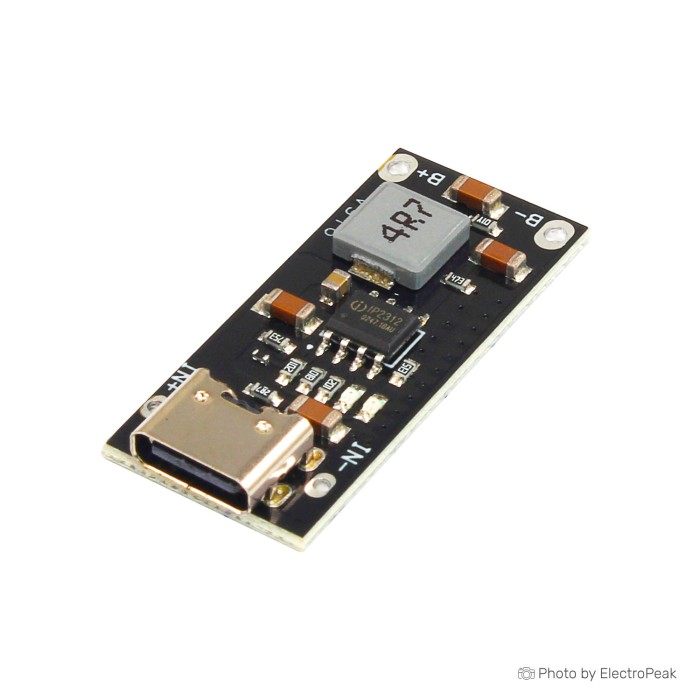
IP2312 Lithium Battery Fast Charging Module - 3A
$0.5000
In stock
SKU
BAT-16-009
Volume discounts:
- +100 4 % $0.4800
- +500 6 % $0.4700
- +1000 8 % $0.4600
- +5000 10 % $0.4500
- +10000 14 % $0.4300
Ships in 2-3 business days, then:
Free delivery in 12-15 days by Tracked Economic Shipping on orders over $100.
Free delivery in 7-10 days by Express Shipping on orders over $300.
More shipping info

Shop with confidence Learn More
 Universal Fast Charger Module with 2 Output Previous
IP2312 3A Charging Module Review and Specifications
The IP2312 3A charging module is a dedicated single-cell lithium-ion charging board for projects powered by a 4.5V to 5.5V DC source. Built around the IP2312 main chip, it supports resistor-adjustable charging current up to 3A, making it significantly faster than standard linear chargers when paired with capable cells. It includes no battery protection function or capacity indicator, so safety cutoff and cell matching remain entirely your responsibility.
This module suits intermediate makers building 1S Li-ion or LiPo charging circuits who can verify cell limits and cut-off voltages correctly. If your application requires integrated discharge protection, guaranteed enclosure dimensions, or a confirmed termination voltage without physical verification, browse our broader selection of charging modules for an all-in-one alternative.
Specifications of IP2312 Lithium Battery Fast Charging Module - 3A
- Main Chip: IP2312
- Input Voltage: 4.5V to 5.5V
- Charge Cut-off Voltage: 4.2V
- Charge Cut-off Voltage: 4.35V
- Charging Current: Adjustable up to 3A
- Current Adjustment: By resistor
- Indicator Light: RED
- Indicator Light: Blue
- Battery Protection: No battery capacity indicator or protection function
- Conversion Efficiency: 3A: 93%
- Conversion Efficiency: 2A: 94%
- Conversion Efficiency: 1A: 95%
IP2312 Charging Current, Efficiency and Cut-off Voltage Explained
The module’s central feature is charging current adjustable up to 3A through an onboard resistor. In lithium battery charging, “up to 3A” is an electrical ceiling, not an operating default suitable for every cell. A typical standard-drain 18650 cell often specifies a standard charge rate between 0.5A and 1.5A. Subjecting smaller or lower-rated cells to a full 3A charge current risks severe overheating and shortened cycle life. Before applying power, verify the installed resistor value on your board against the target cell's permitted charge rate.
The specification lists both 4.2V and 4.35V for the charge cut-off voltage. Standard lithium-ion and lithium-polymer cells use a 4.2V termination voltage, whereas high-voltage chemistry cells rely on 4.35V. Generic board revisions may be configured permanently for 4.2V, permanently for 4.35V, or switchable via solder jumper pads. Visually inspect the board traces and resistor configuration before connecting your cell. Connecting a standard 4.2V chemistry cell to a 4.35V charger risks overcharging the battery.
| Specification | Listed Value | Why It Matters |
|---|---|---|
| Charging Current | Adjustable up to 3A (by resistor) | Allows faster replenishment on high-capacity or high-C-rate cells; requires matching the resistor to the cell's maximum allowed continuous charge current. |
| Charge Cut-off Voltage | 4.2V / 4.35V | Determines charge termination. Standard Li-ion cells require 4.2V, while specialized cells use 4.35V; mismatching risks undercharging or damaging the chemistry. |
| Conversion Efficiency | 93% (3A), 94% (2A), 95% (1A) | Reflects typical switching converter efficiency. Higher efficiency minimizes thermal dissipation on the small PCB compared to linear regulators. |
| Input Voltage | 4.5V to 5.5V | Matches standard 5V regulated supplies. Voltages outside this narrow operating window risk unstable charging or module damage. |
IP2312 device documentation describes standard constant-current/constant-voltage (CC/CV) operation with trickle charging for deeply depleted cells. The listed efficiency figures, ranging from 93% at 3A to 95% at 1A, come from its switching architecture and generate far less waste heat than linear alternatives. For projects where standard 1A charging is preferred and current adjustment is unnecessary, the fixed-rate TP4056 5V 1A Charging Module is an established lower-current alternative.
IP2312 No-BMS Safety and Battery Accessories
This board is purely a battery charger, not a battery management system (BMS). It regulates incoming voltage and current into a single cell but includes no battery capacity indicator or protection function. There is no under-voltage cutoff to prevent over-discharging during load use, no over-current cutoff for high discharge draws, and no short-circuit load protection.
When connecting a bare, unprotected cell directly to this board and drawing power from that same cell, provide a separate 1S protection circuit or use cells with integrated protection circuits. Reverse-polarity protection is not included on the battery pads; connecting a cell backward can permanently damage the switching circuitry. Double-check polarity and terminal voltages with a digital multimeter before soldering.
For cylindrical battery builds, an external 18650 single-18650 battery holder can provide mechanical retention when wired to the module outputs. The board also requires a stable 4.5V to 5.5V power supply and a matching input cable. Physical connector types vary across manufacturing batches, so inspect the board on arrival before selecting the appropriate input cable.
For a build that needs both charging regulation and system load power from one unit, the TP4056 Type-C Charger/Discharger with Boost Converter includes integrated charge and discharge protection with an adjustable step-up output up to 5W.
IP2312 vs TP4056 1A Charging Module
Makers selecting a 1S charging solution often compare the IP2312 with the ubiquitous TP4056 platform. Both connect to standard 5V-class power supplies (4.5V to 5.5V), but their underlying architectures serve different power tiers.
| Feature | IP2312 3A Charging Module | TP4056 5V 1A Charging Module |
|---|---|---|
| Charging Architecture | Switching mode buck regulator | Linear regulator |
| Charge Current | Adjustable up to 3A (resistor-set) | Fixed 1A nominal |
| Cut-off Voltage | 4.2V or 4.35V (version-dependent) | 4.2V fixed |
| Input Voltage Range | 4.5V to 5.5V | 4.5V to 5.5V |
| Thermal Performance | High conversion efficiency (93%–95%) | Burns excess voltage as heat |
| Integrated Protection | None (no BMS / no discharge cutoff) | None (charger-only version) |
The IP2312’s main advantage is charge speed and thermal dissipation. Community tests show that IP2312-family modules generate noticeably less heat at higher currents because their switching design converts 5V input down to battery voltage efficiently. Linear TP4056 modules, by comparison, dissipate excess voltage directly as heat, effectively capping practical charge current at 1A on small PCBs. For lower-capacity cells where charging at 1A is ideal, the TP4056 5V 1A Charging Module remains a standard choice that avoids accidental high-current cell stress.
IP2312 3A Charger Board Setup and Status LEDs
Use these steps to configure and verify the board safely before deployment in an enclosure:
- Check the Cut-off and Current Configuration: Inspect the onboard current-setting resistor and voltage jumpers. Confirm the resistance corresponds to your cell's safe continuous charge current, and verify whether the board is configured for 4.2V or 4.35V.
- Verify Input Supply: Ensure your external power supply delivers a clean DC output strictly between 4.5V and 5.5V.
- Confirm Battery Polarity: Measure your cell with a multimeter to verify positive and negative leads. Connect the battery leads to the designated positive and negative battery pads on the board.
- Apply Power: Connect the input supply and observe the indicator lights.
The module has onboard RED and Blue indicator lights for operational status. Verify the LED logic against your delivered unit, though standard IP2312 implementations use the RED indicator during active charging and switch to the Blue indicator once cut-off voltage is reached and charging finishes. If no status lights illuminate, or the chip heats up rapidly without a connected cell, immediately disconnect power and check for incorrect input voltage or reversed cell polarity.
IP2312 Charging Module FAQ
Does the IP2312 charging module need a BMS?
Yes, if your battery pack does not already have an integrated protection circuit. This board does not include discharge cutoff, over-current, or short-circuit protection. It only regulates charging current and termination voltage. For self-contained projects that need integrated protection with an adjustable boosted rail, consider the TP4056 Type-C Charger/Discharger with Boost Converter.
Can this IP2312 module charge an 18650 battery?
Yes, provided the 18650 cell chemistry matches the module's cut-off voltage and supports the configured charging current. High-drain cells can handle higher charge rates, but standard-drain cells require reducing the onboard resistor setting to avoid exceeding manufacturer charge ratings.
Is this IP2312 charger board 4.2V or 4.35V?
Both 4.2V and 4.35V versions exist for the IP2312 platform. Generic modules may arrive configured for either voltage, so inspect the PCB surface markings and solder jumper pads to confirm the exact termination voltage before wiring a cell.
How is the IP2312 charging current set?
Charging current is configured by changing an onboard surface-mount resistor connected to the IP2312 controller chip. Replacing or adjusting this resistor scales the maximum charging current up to 3A.
Do the RED and Blue LEDs show charging status?
Yes, the onboard RED and Blue indicator lights display operational state. In typical configurations, RED illuminates while actively delivering current, and Blue illuminates when the battery reaches full charge.
Does this board include a battery capacity display?
No, there is no battery capacity indicator. The LEDs show only whether charging is active or complete; they do not report intermediate fuel gauge states or percentage levels.
Should I choose this IP2312 board or the TP4056 5V 1A Charging Module?
Choose the IP2312 when your single-cell application safely supports charging rates above 1A and benefits from high switching efficiency. Choose the TP4056 when your battery capacity mandates a gentle 1A charge rate and your design calls for a fixed, simple linear regulator.
IP2312 3A Charger Board Buying Checklist
Use this purchase-criteria summary to confirm that the module fits your system requirements:
- Ideal for: Makers charging compatible 1S Li-ion or LiPo cells at rates up to 3A who can modify or verify onboard configuration resistors and cut-off voltages.
- Maybe for: Custom DIY power banks, router backup supplies, and robotics where external BMS protection and output voltage regulators are already present in the circuit design.
- Avoid if: You need an all-in-one BMS with low-voltage discharge cutoff, a battery fuel gauge display, multi-cell series charging, or guaranteed physical dimensions prior to receiving the board.
Pre-Purchase Verification:
- Confirm your battery is a single-cell (1S) Li-ion or LiPo chemistry.
- Verify whether your cell requires 4.2V or 4.35V termination.
- Ensure your cell's manufacturer datasheet approves the target charging current.
- Check that your 5V power supply operates strictly between 4.5V and 5.5V.
- Confirm that you have a separate protection board or protected cell to guard against over-discharge.
- Verify input connector requirements on arrival before selecting cables or designing rigid enclosures.
For projects requiring multi-cell configurations, integrated protection switches, or alternative charging topologies, explore our full catalog of charging modules to select the correct power architecture.
| Compatible With | Lithium-ion batteries |
|---|---|
| Chipset | IP2312 |
| Function | Battery Charger |
| Charging Voltage (Pack) | 4.2V / 4.35V |
| Supported Battery Type | Li-ion |
| Overcharge Detection Voltage (per Cell) | 4.2V / 4.35V |
| Cell Count | 1 |
| Input Voltage (V) | 4.5V to 5.5V |
| Output Voltage (V) | 4.2V / 4.35V |
| Output Current (A) | 3A |
| Max Charging Current | 3A |
| Protection | No |
| Efficiency (%) | 93% - 95% |
| Indicator LEDs | RED,Blue |
| Operating Temp (°C) | -40 to 85 |
Write Your Own Review

Please complete your information below to login.
Sign In
Create New Account