
Product added to cart

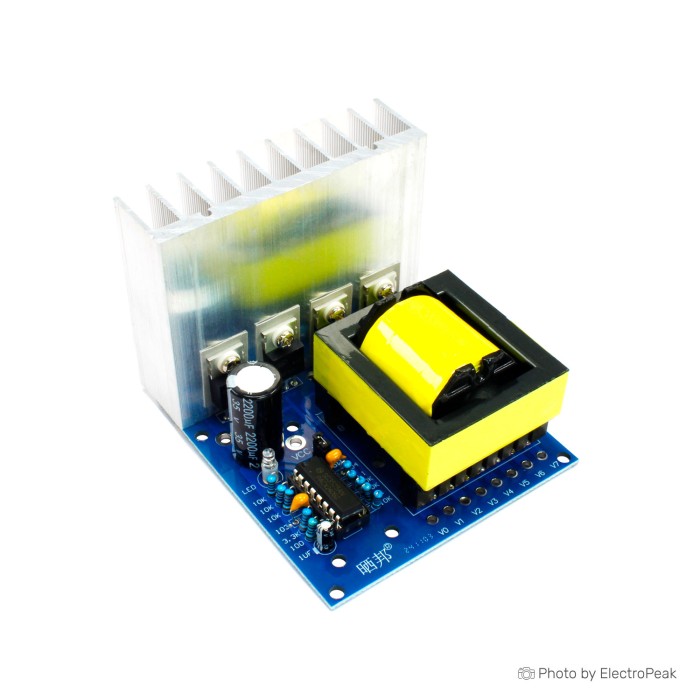
DC/AC Step-Up Inverter Module - 500W, 12V to 220V
$8.9500
In stock
SKU
BAT-17-001
Volume discounts:
- +25 4 % $8.6100
- +50 6 % $8.4400
- +100 8 % $8.2600
- +300 10 % $8.0900
- +500 12 % $7.9200
Ships in 2-3 business days, then:
Free delivery in 12-15 days by Tracked Economic Shipping on orders over $100.
Free delivery in 7-10 days by Express Shipping on orders over $300.
More shipping info

Shop with confidence Learn More
 EGS005 Pure Sine Wave Inverter SPWM Driver Board Previous
500W 12V to 220V Inverter Module Review and Specifications
This 500W inverter is an open-frame step-up board that converts a 12V DC input into high-voltage AC output. Built around an onboard high-frequency transformer and basic switching stage, it provides multiple output taps, including AC 18V and stepped ranges up to 380V. It is intended for custom electronic assemblies and off-grid benches where an unhoused power-conversion stage can be integrated directly into an enclosure.
This board demands direct technical attention. Its output waveform is an approximately 20kHz high-frequency square wave, and it has no onboard protection against overload, short circuits, or thermal runaway. It is not a plug-and-play replacement for an enclosed household AC inverter. It is for experienced builders working within our broader selection of DC-AC inverter modules who can engineer their own fusing, thermal management, and wiring infrastructure. Package contents, pricing, safety certifications, and continuous-power test data are not supplied.
Specifications of DC/AC Step-Up Inverter Module - 500W, 12V to 220V
- Power: 500W
- Input Voltage: 12V DC
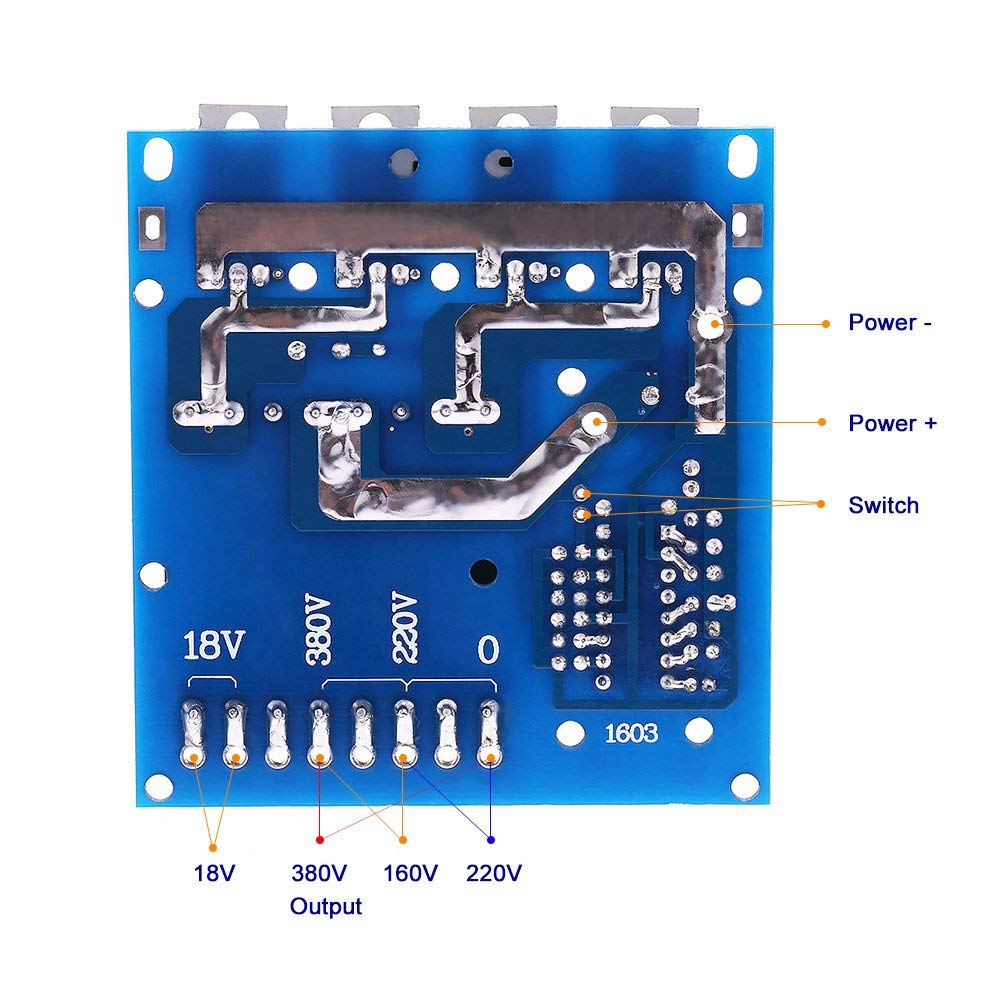
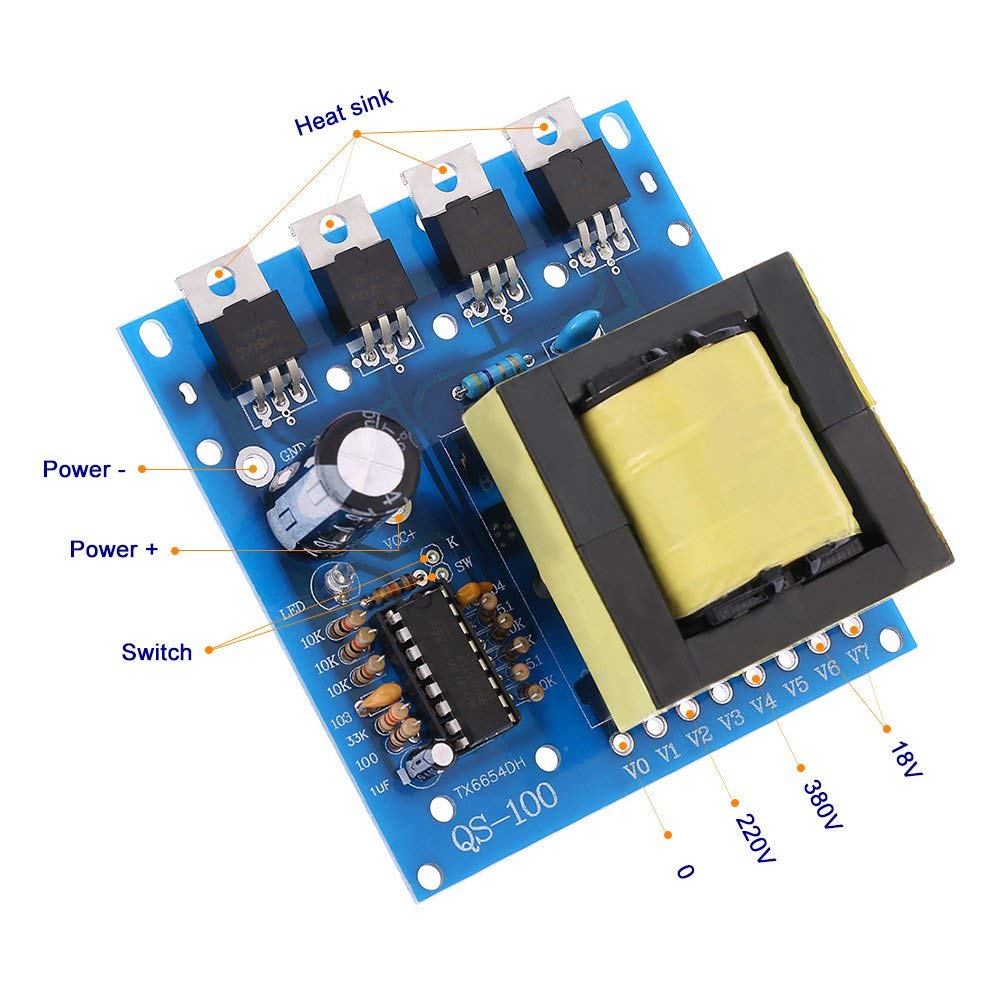
- Output Voltage: AC 0-160V-220V-380V and AC18V
- Static Load Current: About 0.35A
- Output Frequency Waveforms: About 20KHZ, high frequency square wave
- Protection: No protection
- Dimensions: 80x75x67mm
- Applications: Suitable for lamps, non-inductive household appliances, small electric cookers, and various electronic products such as energy-saving lamps, soldering irons, switching power supplies, satellite TV receivers, LED lamps, DVD players, TVs, laptops, computer monitors, and chargers.
500W Inverter Module Waveform and Power Limits
The primary consideration when evaluating this module is its output waveform. The board delivers an approximately 20kHz high-frequency square wave rather than standard 50Hz or 60Hz utility power. Mains-powered equipment designed around low-frequency sinusoidal voltage often relies on inductive reactance or specific input filtering that can behave unexpectedly with a 20kHz square wave. Conventional iron-core transformers can rapidly overheat or saturate, while line-filter capacitors may draw excessive reactive current.
The stated 500W figure is a nominal design rating, not an independently verified continuous thermal capacity. Thermal dissipation curves, efficiency percentages across varying loads, and safe continuous derating margins are not supplied. At 500W from a 12V source, primary DC current draw can exceed 40A to 50A depending on internal conversion losses. Heavy-gauge wiring, low-resistance terminals, and active airflow across the heatsinks are critical before approaching higher loads.
With no onboard protection, an overcurrent event, output short circuit, or thermal spike will directly damage the power switching transistors. Safe bench operation requires external fusing on the positive 12V rail, appropriately rated connection points, and active current monitoring. For designs that need a standard sinusoidal profile or certified continuous power delivery for sensitive gear, the 500W pure sine wave inverter module provides a dedicated 50Hz pure sine wave alternative.
500W 12V to 220V Inverter Module Uses and Load Compatibility
Knowing which loads operate reliably on a high-frequency square wave helps prevent hardware damage and component stress. Purely resistive loads are the most straightforward match for this inverter board. Basic incandescent lamps, small heating elements, soldering irons, and non-inductive electric cookers convert electrical power to heat without depending on line frequency or sinusoidal voltage symmetry.
Modern electronic devices using switch-mode power supplies (SMPS)—including laptops, television monitors, DVD players, and small chargers—rectify incoming AC into high-voltage DC internally. These power stages can accept square-wave energy, but input filtering components, bridge rectifiers, and snubber networks may run hotter than normal under 20kHz high-frequency excitation. Connect these loads only after bench-testing their thermal response under measured operating conditions.
Avoid inductive machinery with AC motors entirely. Refrigerator compressors, bench fans, water pumps, and power tools rely directly on 50Hz or 60Hz sinusoidal alternation to maintain rotational torque and regulate motor impedance. High-frequency square-wave power will cause high inductive losses, failure to spin, and immediate overheating. The module also provides no specified output voltage regulation across shifting input voltages or changing loads, so it should not be paired with equipment sensitive to voltage variance. Projects requiring adjustable frequency or standard mains profiles are better served by an adjustable variant such as the 600W modified sine wave inverter module.
500W Inverter Module vs Pure Sine and Modified Sine Modules
Selecting an inverter board means balancing waveform purity, output flexibility, and internal protection against circuit complexity. This bare 500W square-wave module offers high power density and multi-tap output voltages, but leaves all safety and regulation systems to the user.
| Module | Output Power | Waveform & Frequency | Input Voltage | Key Features & Constraints |
|---|---|---|---|---|
| 500W Step-Up Module | 500W | ~20kHz square wave | 12V DC | Multi-tap outputs (18V, 160V, 220V, 380V); no onboard protection; unverified continuous limits. |
| 150W Step-Up Inverter Module | 150W | ~20kHz square wave | 12V DC | Selectable taps (110V, 175V, 200V, 220V); compact footprint; lacks overload protection. |
| 500W Pure Sine Wave Inverter Module | 600W real / 1000W peak | Pure sine wave, 50Hz | 12V, 24V, or 48V DC | Clean AC for sensitive electronics; requires lead-acid battery for startup; no charging function. |
| 600W Modified Sine Wave Inverter Module | 600W | Modified sine wave, 50–60Hz | 12V DC | Adjustable voltage (110–220V); adjustable frequency (50–60Hz); stepped waveform. |
| 300W Modified Sine Wave Inverter Module | 300W | Modified sine wave, 50–60Hz | 12V DC | Adjustable voltage (180–220V); adjustable frequency; lower power profile for basic electronics. |
For engineers building an inverter power stage from the ground up rather than using a preassembled board, a dedicated driver board can control custom power MOSFETs or IGBTs. A custom pure sine inverter control board provides precision Sinusoidal Pulse Width Modulation (SPWM) generation and dead-time control, though it requires separate external bridge switches, gate drive stages, and iron-core magnetic components.
500W 12V to 220V Inverter Module Setup and Accessories
Safe operation of this open-frame module requires a complete set of external support hardware. Standard implementation calls for a clean 12V DC power source, an external fuse or DC breaker placed close to the source terminal, appropriately sized heavy-gauge cabling, insulated board standoffs, and a shielded high-voltage enclosure. The module generates lethal AC potentials on bare solder contacts. Physical isolation is mandatory.
For lower-current bench testing, an external power connector option, such as an XT60 pair, can provide secure DC connections if the drawn amperage remains strictly within the connector and cable thermal ratings. Dedicated current ratings for this specific module assembly are not supplied.
Use an orderly sequence for initial bench verification:
- Perform a thorough physical inspection of the board, solder joints, transformer windings, and heatsink mountings. Ensure no debris bridges exposed traces.
- Isolate all power. Fasten the board inside an electrically non-conductive enclosure or onto insulated standoffs.
- Connect the 12V DC source through an inline fuse sized conservatively for your planned initial load. Observe strict input polarity.
- Apply DC power without a load connected. Measure the selected output pins with an appropriately rated high-frequency or true-RMS multimeter to confirm voltage presence across the taps. Use the supplied inverter top layout reference and inverter bottom trace reference for visual terminal arrangements.
- Power down, connect a small known-good resistive test load, such as a 20W incandescent bulb or small soldering pencil, and reapply power.
- Monitor heatsink temperature, wiring warmth, and output voltage under load. If abnormal thermal rise or voltage droop occurs, disconnect power immediately.
- Do not attach complex switching supplies or higher loads until low-power thermal and electrical stability is established.
500W 12V to 220V Inverter Module FAQ
Is this a pure sine wave inverter?
No. Its output is an approximately 20kHz high-frequency square wave, not a 50Hz or 60Hz pure sine wave or modified sine wave.
Does this 500W inverter module have overload, overheat, or short-circuit protection?
No. Protection is explicitly specified as "No protection." Users must add their own external inline fusing, monitor working temperatures, and manually prevent overcurrent conditions.
Can this 12V to 220V inverter module power a laptop, charger, TV, monitor, or LED light?
Some electronic devices with switch-mode supplies tolerate high-frequency square-wave inputs, but they can experience elevated internal heating or filter stress. Individual testing and temperature monitoring under load are required. For sensitive electronics, a 500W pure sine wave inverter module is the safer choice.
Can this inverter run a fridge, fan, pump, compressor, or other motor?
No. AC motors, refrigeration compressors, and inductive pumps require a standard low-frequency sine wave to run. The 20kHz square-wave output will cause severe overheating and motor stalling.
What do AC 0-160V-220V-380V and AC18V mean?
These values correspond to specific transformer secondary taps on the circuit board. Output regulation data, simultaneous tap ratings, and load-dependent voltage droop characteristics are not specified.
What is included with the inverter module?
Package contents are not stated. Assume the board is supplied bare, without cabling, external fuses, plugs, connectors, or an enclosure.
What do I need to use this module safely?
You need a stable 12V DC power supply or high-capacity battery, an inline DC fuse or breaker, heavy-gauge wire, an insulated enclosure, and electrical test meters. Connectors such as an XT60 pair can be used if validated against your specific current draw.
Why choose the 500W Pure Sine Wave Inverter Module instead?
That module supplies a standard 50Hz pure sine wave for sensitive appliances and inductive devices. However, it requires a lead-acid battery for startup, requires base-plate insulation, and does not provide an internal battery charging circuit.
500W 12V to 220V Inverter Module Buying Decision
This 500W module is an open-frame step-up board for specific technical applications. Its usefulness depends heavily on whether your load tolerates high-frequency square-wave power.
- Ideal for: Experienced electronics builders needing a bare 12V-to-high-voltage board to drive verified resistive loads, small soldering irons, or bench experiments with external fusing and active cooling.
- Maybe for: Testing switch-mode electronic supplies where internal components can be verified and thermally monitored during square-wave bench evaluation.
- Avoid if: You need standard mains utility power for motors, fans, refrigerators, medical gear, audio systems, or sensitive equipment requiring 50Hz/60Hz pure sine wave energy.
Buying Checklist
- Confirmed 12V DC power source capable of supplying high primary current.
- External DC fuse or circuit breaker sized for your wiring and expected draw.
- Heavy-gauge supply cabling and secure screw-down connections.
- Intended load verified as resistive or tolerant of a 20kHz square wave.
- No AC induction motors, fans, pumps, or compressors in the power chain.
- Clear understanding that continuous power at 500W is unverified and requires thermal management.
- Multimeter and thermal probe available for initial low-power checkout.
- Insulated enclosure ready to shield exposed high-voltage AC contacts.
For a custom inverter design built from the discrete component level up, consider a pure sine inverter driver board or a PWM driver board for a custom inverter circuit with your own output bridge and magnetic stages.
Write Your Own Review

Please complete your information below to login.
Sign In
Create New Account