
Product added to cart

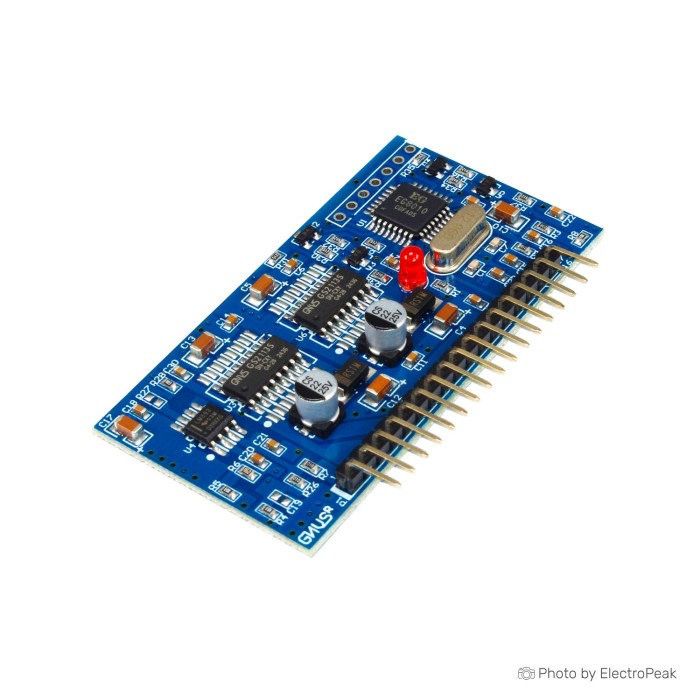
EGS002 Pure Sine Wave Inverter SPWM Driver Board
$3.5000
In stock
SKU
BAT-02-100
Volume discounts:
- +25 4 % $3.3600
- +100 6 % $3.2900
- +300 8 % $3.2200
- +500 10 % $3.1500
- +1000 12 % $3.0900
Ships in 2-3 business days, then:
Free delivery in 12-15 days by Tracked Economic Shipping on orders over $100.
Free delivery in 7-10 days by Express Shipping on orders over $300.
More shipping info

Shop with confidence Learn More
 Pulse High Voltage Inverter Arc Generator- 400KV Previous
EGS002 SPWM Inverter Board Review
The EGS002 Pure Sine Wave Inverter SPWM Driver Board is a low-voltage control and gate-driver board for intermediate-to-advanced builders developing custom 50Hz or 60Hz pure sine wave inverters. It is not a standalone power supply. Instead, it generates the Sinusoidal Pulse Width Modulation (SPWM) drive signals and monitoring logic needed to switch an external power stage. If your project needs a finished, enclosed DC-to-AC converter that connects directly to a battery and provides AC output out of the box, browse our DC-AC inverter module options or choose an assembled unit such as the 150W Step-Up Inverter Module.
An EG8010 dedicated SPWM controller ASIC sits at the center of the board, paired with high-voltage half-bridge gate drivers. Together, they provide precision dead-time generation, soft-start ramping, and real-time analog feedback protection for overvoltage, undervoltage, overcurrent, and overtemperature conditions. Solder jumpers provide power-electronics builders with direct control of fundamental inverter timing parameters, without requiring custom timing firmware on a general-purpose microcontroller.
The trade-off is system complexity. An EGS002 inverter requires an external MOSFET or IGBT H-bridge, a properly sized low-frequency power transformer or high-voltage DC bus, an LC reconstruction filter, analog feedback routing, and thermal management. It gives you control over power-stage component selection, but it also requires strict bench safety and power-electronics design experience.
Specifications of EGS002 Pure Sine Wave Inverter SPWM Driver Board
- Input voltage range: 5V & 12V power supply
- Output Frequency: Adjustable output frequency, commonly ranging from 50Hz to 60Hz, to match the standard frequency of AC power systems.
- Control Method: Utilizes Sinusoidal Pulse Width Modulation (SPWM) technique for waveform generation, along with lineage control. Has voltage, current and temperature feedback
- PWM carrier frequency: 23.4KHz
- Protection Features: Built-in overvoltage, under voltage, overcurrent, overheating protection circuit
- Control Interface: Has serial communication to adjust the output voltage, frequency and other parameters
- Operating Temperature: 0°C to 50°C
EGS002 Pure Sine Wave Inverter Specifications Explained
To interpret an inverter controller's specifications, separate the low-voltage control circuitry from the external high-power switching bus. The EGS002 handles signal generation and protection monitoring, while system-level behavior depends on the design and filtering of the external power stage.
| Specification | Nominal Value | Why It Matters to Your Inverter Build |
|---|---|---|
| Input Voltage Range | 5V & 12V power supply | The board requires two independent low-voltage rails: 5V powers the EG8010 digital logic and LCD interface, while 12V powers the high-side and low-side gate drivers. High-voltage battery banks or DC buses must never connect directly to the EGS002 supply headers. |
| Output Frequency | 50Hz / 60Hz selectable | Permits configuration for regional mains standards via onboard jumpers. Because switching is controlled by dedicated hardware states, output frequency remains stable under varying loads. |
| Control Method | SPWM with feedback | Generates complementary high-side and low-side switching signals that reconstruct a pure sine wave after passing through an external LC filter. Dedicated feedback inputs dynamically regulate output voltage and monitor fault thresholds. |
| PWM Carrier Frequency | 23.4KHz | Operating above human hearing eliminates audible hum from the switching stage. This carrier frequency dictates the inductance and capacitance values needed in the output reconstruction filter to strip away switching ripple. |
| Protection Features | Overvoltage, undervoltage, overcurrent, overheating | The EG8010 shuts down gate-drive outputs when preset voltage, current-sense, or thermistor thresholds are breached, protecting switching silicon from destructive faults. |
| Control Interface | Serial communication | Provides internal registers for reading operating status and adjusting parameters via UART. For standard builds, physical jumper links remain the primary configuration interface. |
| Operating Temperature | 0°C to 50°C | Defines the ambient operating window for the control silicon. Gate drivers and switching silicon running near continuous capacity require active enclosure airflow and heat sinking. |
The 23.4KHz switching frequency is above the audible threshold, which simplifies output-filter design compared with low-frequency choppers. Higher switching speeds also introduce switching losses in the external power MOSFETs or IGBTs. Keep those switching devices cool with properly matched thermal hardware, such as a 20x15x10mm Aluminum Heatsink for intermediate power levels or larger extruded sinks for high-draw systems.
No maximum wattage appears in the specification block. The EGS002 does not deliver load power directly; it supplies low-impedance gate-drive signals to external switches. A build using small TO-220 MOSFETs on a 12V bus might deliver 200W, while a high-voltage bridge using TO-247 devices on a 380V bus can deliver several kilowatts with the exact same driver board. Review full technical pinout details and internal timing diagrams in the official EGS002 user manual and documentation.
EGS002 Jumper Settings and Frequency Selection
The EGS002 uses nine onboard solder jumpers, designated JP1 through JP9, to configure operating modes. These jumpers establish fundamental operating parameters at startup. Never short jumpers within the same functional group simultaneously, as this creates conflicting logic levels on the EG8010 configuration pins.
| Jumper Pair / Group | Configuration State | Functional Behavior |
|---|---|---|
| Frequency Selection | JP1 shorted (JP5 open) JP5 shorted (JP1 open) |
Sets AC fundamental output to 60Hz. Sets AC fundamental output to 50Hz (Factory Default). |
| Soft-Start Mode | JP2 shorted (JP6 open) JP6 shorted (JP2 open) |
Enables a 3-second soft-start output voltage ramp (Factory Default). Disables soft start; output reaches target voltage immediately. |
| Dead-Time Selection | JP7 & JP8 shorted JP3 & JP8 shorted JP4 & JP7 shorted JP3 & JP4 shorted |
300ns dead time (Factory Default; fast MOSFETs). 500ns dead time. 1.0µs dead time (Standard MOSFETs / fast IGBTs). 1.5µs dead time (Large gate capacitance / slower IGBTs). |
| Display Backlight | JP9 shorted JP9 open |
Enables LCD backlight power on compatible display headers. Disables LCD backlight. |
The standard board configuration leaves JP5, JP2, JP7, and JP8 shorted from the factory, establishing 50Hz output, active 3-second soft start, and 300ns dead time. Dead time matters. It creates a blanking period during which both high-side and low-side switches in an H-bridge arm remain off, preventing destructive cross-conduction (shoot-through) currents. If your external bridge uses large switching devices with substantial gate capacitance and slower turn-off characteristics, set the jumpers for 1.0µs or 1.5µs to protect the bridge.
Standard EGS002 boards do not use jumpers to select output voltage. External hardware sets output voltage: the step-up transformer turns ratio in low-frequency transformer topologies, or the high-voltage DC-bus voltage, together with the resistive divider network feeding the VFB feedback pin. For applications requiring continuously variable frequency instead of fixed 50Hz or 60Hz utility standards, the SG3525 LM358 Inverter Driver Board is an adjustable-frequency inverter-driver option better suited to custom variable-rate switching.
EGS002 Inverter Board Compatibility and Build Requirements
Building a functional power inverter around the EGS002 requires external power-electronics hardware, isolation, and signal conditioning. The board serves exclusively as the control center.
| System Domain | Requirement | Implementation Details |
|---|---|---|
| Control Power | Regulated 5V and 12V DC | Separate 5V (logic/display) and 12V (gate drivers) rails. Must be derived from a clean auxiliary buck converter or linear regulator, isolated from power-stage inductive spikes. |
| Switching Power Stage | External full-bridge (4 switches) | Four N-channel MOSFETs or IGBTs rated for the peak DC-bus voltage and load current, equipped with gate resistors and gate-source pull-down resistors. |
| Output Transformer / Bus | Mains-frequency or High-Voltage DC | Either a low-frequency center-tapped transformer driven by a low-voltage bridge (e.g., 12V/24V to 230V) or a regulated 350V–400V DC bus feeding a high-voltage full bridge. |
| Harmonic Reconstruction | External LC low-pass filter | Inductor and non-polarized AC film capacitor placed across the bridge output to attenuate the 23.4KHz carrier, passing only the fundamental 50Hz/60Hz sine wave. |
| Voltage Feedback (VFB) | Scaled analog feedback | A sample of the AC output voltage stepped down (via an auxiliary transformer winding or optoisolated divider) to an analog signal centered around the EG8010 internal reference. |
| Current Feedback (IFB) | Low-side shunt or CT | A current-sensing resistor or sensor providing a 0V to 0.5V proportional signal to trigger overcurrent shutdown during short circuits or heavy overloads. |
| Thermal Feedback (TFB) | Negative Temperature Coefficient (NTC) thermistor | A 10k thermistor bonded to the main power-stage heatsink, pulling the TFB pin low if heatsink temperatures exceed safe limits. |
Build Accessories and External Components
To turn the driver board into an operational inverter, source external components appropriate for your target power level:
- Required (Unlinked): Full H-bridge switching silicon (MOSFETs or IGBTs), main power transformer or high-voltage DC bus, LC reconstruction filter components (iron-silicon/powder-core inductor and AC film capacitor), isolated feedback transformers or divider resistors, auxiliary 5V and 12V regulated power supplies, and DC-side input fuses.
- Required (Unlinked): Current-sensing resistor (shunt) and 10k NTC thermistor for builders implementing hardware overcurrent and overtemperature protections.
- Recommended: For battery-powered setups, use high-current, low-resistance DC connectors such as the XT60 Connector Male-Female Pair for wiring runs up to 30A continuous.
- Recommended: Add dedicated heat sinking for the external switches, such as a 20x15x10mm Aluminum Heatsink for low-power prototypes or large finned extrusions with active fans for multi-hundred-watt stages.
- Optional (Unlinked): A compatible parallel or I2C LCD board (typically 1602 or 12832 character displays compatible with EG8010 pinouts) for monitoring real-time voltage, current, and fault codes.
For applications that simply need to step up 12V DC into high-voltage AC for non-inductive loads, including basic lighting, switch-mode laptop adapters, or heating elements, an assembled 500W Step-Up Inverter Module provides a standalone square-wave alternative without requiring an external bridge design.
Pre-Power Verification Sequence
- Inspect the driver board visually to verify gate-driver markings and confirm that all header pins are straight and clean.
- Select your target AC frequency by ensuring either JP1 (60Hz) or JP5 (50Hz) is shorted. Verify that the opposing jumper is fully open.
- Select dead time (JP3, JP4, JP7, JP8) to match the gate capacitance and turn-off time of your external switching devices.
- Connect regulated 5V and 12V auxiliary power supplies to the board supply pins without the high-voltage DC bus connected to the external bridge.
- Verify SPWM gate-drive signals using an oscilloscope across the high-side and low-side gate outputs before applying high voltage to the H-bridge.
- Connect the external bridge, LC filter, feedback loops, and a resistive test load. Review all wiring against the safety instructions in the EGS002 user manual and documentation before connecting mains-potential loads.
EGS002 Protection Limits and Inverter Build Considerations
The EGS002 includes multiple hardware protection loops, but builders need to understand their operating limits. The board responds to system faults by pulling gate-drive outputs low, yet it cannot prevent component destruction when the external power stage is poorly laid out or under-specified.
Output-voltage feedback (VFB) is a common operational challenge. The EG8010 expects an analog feedback voltage proportional to the AC output to regulate output amplitude. If this feedback loop is disconnected, improperly phased, or poorly filtered, the controller detects an undervoltage fault and halts gate-drive outputs after a few seconds. Before assuming the board is damaged, check the VFB voltage level when troubleshooting an immediate shutdown.
Overcurrent protection (IFB) reads the voltage drop across a low-side shunt resistor. The EG8010 has an overcurrent threshold of approximately 0.5V, so excessive parasitic inductance in ground traces can cause spurious trips during high-inrush loads, such as motor starts or charging input capacitors. Keep current-sense PCB traces short, tightly paired, and well shielded from the output inductor's magnetic field.
The EGS002 is an open-architecture module family produced across different manufacturing batches, so board revisions may have minor bill-of-materials variations. Common gate-driver ICs include the IR2110S, IR2113, or EG2113. These driver chips share compatible pinout layouts on the daughterboard, but gate-drive source/sink currents can vary slightly between models. Inspect the IC markings on your received board before sizing gate resistors.
Pure sine wave inverter builds involve lethal AC voltages and energy-dense DC bus capacitors. Always discharge filter capacitors through a power resistor and verify 0V with a multimeter before touching power terminals. For systems requiring three-phase generation rather than single-phase power, consider the EGS031/032 Three-Phase Inverter Driver, which uses a dedicated EG8030 three-phase controller architecture.
EGS002 vs Inverter Driver Boards and Step-Up Modules
The right power module depends on whether your project needs custom pure sine wave generation, high-frequency PWM switching, three-phase power, or an off-the-shelf step-up converter.
| Product | Primary Role | Output Topology | Configuration Interface | Best For |
|---|---|---|---|---|
| EGS002 SPWM Driver Board | Single-Phase SPWM Inverter Driver | Pure sine wave (requires external bridge & LC filter) | Hardware jumpers (50/60Hz, dead time, soft start) | Custom 50Hz/60Hz single-phase pure sine wave inverters. |
| SG3525 LM358 Inverter Driver Board | Adjustable PWM Controller Board | Square-wave / Push-pull drive | Onboard potentiometers | Push-pull converters, DC-DC step-up stages, and variable-frequency drivers. |
| EGS031/032 Three-Phase Inverter Driver | Three-Phase SPWM Driver Board | Three-phase pure sine wave (requires power backplane) | Fixed three-phase timing / backplane interface | Three-phase motor drives, industrial backup power, and rotary equipment. |
| 150W Step-Up Inverter Module | Complete Step-Up Converter | High-frequency square wave (multi-voltage taps) | Hardware output taps (110V–220V) | Low-power non-inductive electronics, camping lights, and DC-to-DC pre-stages. |
| 500W Step-Up Inverter Module | Complete Step-Up Converter | High-frequency square wave (~20 kHz) | Terminal block wiring taps | Higher-power resistive heating, lighting, and emergency field power supplies. |
The EGS002 is built for low-distortion utility-grade AC generation. In contrast, the standalone 150W and 500W step-up modules produce ~20 kHz high-frequency square waves directly at their terminal blocks. They are compact and convenient for switch-mode power supplies, but cannot drive AC induction motors, audio amplifiers, or sensitive transformer-coupled equipment. For finished systems and complete converters, browse our DC-AC inverter module options.
EGS002 SPWM Inverter Board FAQ
Is the EGS002 a complete pure sine wave inverter?
No. The EGS002 is an inverter control and gate-driver daughterboard, not a finished inverter. It generates low-power SPWM gate-drive signals and monitors system feedback. You must provide an external H-bridge (MOSFETs or IGBTs), main transformer or DC bus, LC reconstruction filter, heat sinks, and wiring to create a functional inverter.
What power supplies does the EGS002 board need?
The board requires dual low-voltage DC inputs: 5V for logic processing and 12V for the gate-driver stage. Never connect your high-voltage DC bus or main battery bank directly to the EGS002 power pins.
How do I choose 50Hz or 60Hz on the EGS002 SPWM inverter board?
Solder JP5 closed and keep JP1 open for 50Hz output. For 60Hz output, solder JP1 closed and keep JP5 open. Never short JP1 and JP5 at the same time, as this forces conflicting logic states on the controller chip.
Is the EGS002 PWM carrier frequency adjustable?
No. The PWM carrier frequency is fixed at 23.4KHz on standard EG8010-based boards. The selectable jumpers adjust the fundamental AC output frequency, 50Hz or 60Hz, rather than the high-frequency PWM switching carrier.
Does the EGS002 board set the inverter’s wattage rating?
No, the driver board has no fixed wattage limit. The continuous output power of your completed inverter is determined entirely by the external switching silicon, DC-bus voltage, transformer current rating, filter components, and heatsink cooling efficiency.
Does this EGS002 board have a 110V/220V selection jumper?
No, this board does not feature a 110V/220V selection jumper. Output voltage is determined by the external transformer winding ratio or DC-bus voltage, regulated through the resistive voltage divider connected to the board's VFB pin.
Can I configure the EGS002 through serial communication?
The EG8010 ASIC contains internal UART registers for reading parameters, but standard EGS002 boards route primary settings through PCB solder jumpers. On some board batches, accessing the serial interface may require soldering leads directly to unpopulated pads or specific controller pins.
Can the EGS002 be used for solar or UPS inverter projects?
Yes, the EGS002 is widely used in DIY off-grid solar inverters and backup uninterruptible power supplies (UPS). Suitability depends on properly engineering the external battery charger, transfer switching, feedback isolation, and output circuit protection around the driver board.
Purchase Decision Summary
| Profile | Recommendation | Key Rationale |
|---|---|---|
| Ideal For | Intermediate-to-advanced DIY inverter builders & power-electronics students | Provides dedicated 50Hz/60Hz SPWM generation, integrated gate drivers, dead-time configuration, and hardware protections without firmware programming. |
| Maybe For | Prototypers developing custom off-grid power stages | Permits bench testing of diverse MOSFET and IGBT configurations, provided you have oscilloscope access and high-voltage bench safety experience. |
| Consider Another Option If | Beginners, plug-and-play buyers, or variable-frequency projects | Avoid if you need an enclosed, certified AC outlet converter ready to plug into a battery, or if you need native continuously variable frequency control. |
Buying Checklist
- Confirm you need a gate-driver and control board, not a finished, enclosed AC power inverter.
- Verify your bench can supply regulated 5V and 12V DC auxiliary power rails for board logic and gate drivers.
- Ensure you have sourced or designed an external H-bridge power stage with appropriate MOSFETs or IGBTs.
- Prepare an LC output reconstruction filter (choke inductor and AC film capacitor) calculated for a 23.4KHz carrier.
- Confirm that your external transformer ratio or DC bus matches your target AC output voltage (110V or 230V).
- Plan the analog feedback circuit for the VFB pin to prevent undervoltage shutdown trips during startup.
- Inspect the delivered board to confirm jumper configurations (JP5 for 50Hz or JP1 for 60Hz) before powering the circuit.
- Ensure you have proper power-electronics safety equipment, including capacitor discharge tools, isolation equipment, and protective eye gear.
| Interface Type | UART |
|---|---|
| Operating Voltage (V) | 5V |
| Operating Temp (°C) | 0 to 50 |
| Mounting Type | Pin Header |
| IP Rating | None |
| Converter Type | Inverter (DC-AC) |
| Input Voltage (V) | 5V-12V |
| Output Voltage (V) | Adjustable |
| Efficiency (%) | High Efficiency |
| Cooling | Proper cooling |
| Protection | Overvoltage,Under voltage,Overcurrent,Overheating |
| Application | off-grid power systems,backup power supplies,solar energy systems,motor control applications |
| Vout Adjustable | Yes |
| Component Type | Inverter |
| Model Number | EGS002 |
Write Your Own Review

Please complete your information below to login.
Sign In
Create New Account