Product added to cart

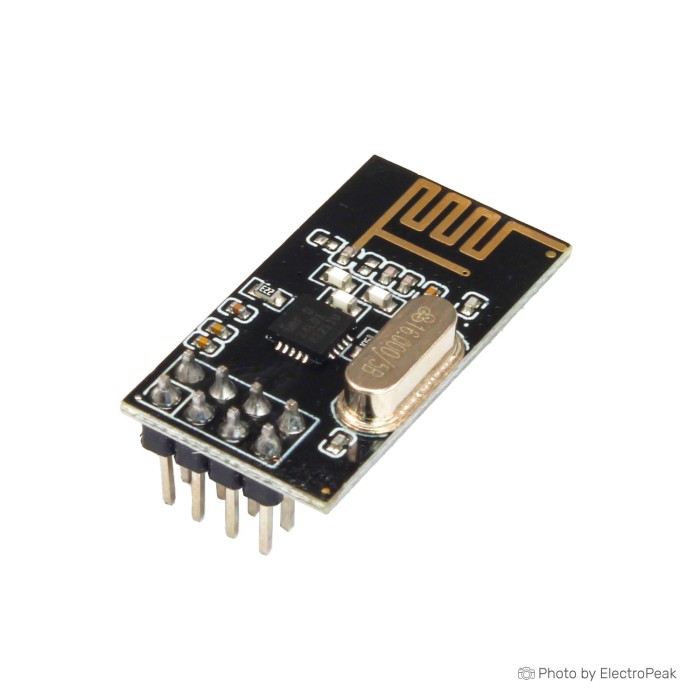
The effective range of the nRF24L01 module is influenced by factors like power supply voltage, antenna design, and environmental conditions. Typically, it can achieve reliable communication within a range of 20 to 100 meters.

Creating an account has many benefits: check out faster, keep more than one address, track orders and more.

We offer free shipping on all orders over $100and under 2kg.
Please note that free shipping is only available for orders under 2kg.
DHL is a renowned shipping courier known for its global reach and reliable delivery services. With a vast network and advanced logistics capabilities, DHL offers fast and secure shipping solutions for international shipments.
For the majority of countries, DHL provides an estimated delivery time of 5 to 7 days.
In certain instances, DHL may not be available for shipments to EU countries. In such cases, we may opt to ship your order using FedEx instead of DHL. Rest assured, FedEx offers a comparable estimated time of arrival (ETA) and your package should typically arrive within 5-7 days.
The base shipping cost for DHL is $35. You can see the final shipping amount on the checkout page. If your order is over $300and less than 2kg, you will qualify for free shipping through DHL Express.
Economy Shipping is a cost-effective international delivery option using a network of trusted logistics partners. Depending on the destination country, the carrier may vary to ensure the most efficient and reliable delivery.
Estimated delivery time is typically 10–15 business days in most cases; But may take up to 20 days. Orders over $100 and under 2kg qualify for free Economy Shipping.
All shipments include tracking. You will receive a tracking number along with a tracking link after dispatch. Most shipments can be tracked via 17TRACK.
Our shipping term is FOB Shenzhen, which does not cover any customs fees. It is important to note that you may be responsible for paying any charges imposed by your country's government, such as duties, taxes, and additional fees imposed by the courier company.

The NRF24L01 module has 8 pins as you can see in the picture below.

The nRF24L01 transceiver module is versatile and finds application in various projects that require wireless communication in the 2.4 GHz frequency band. Here are some common use cases:
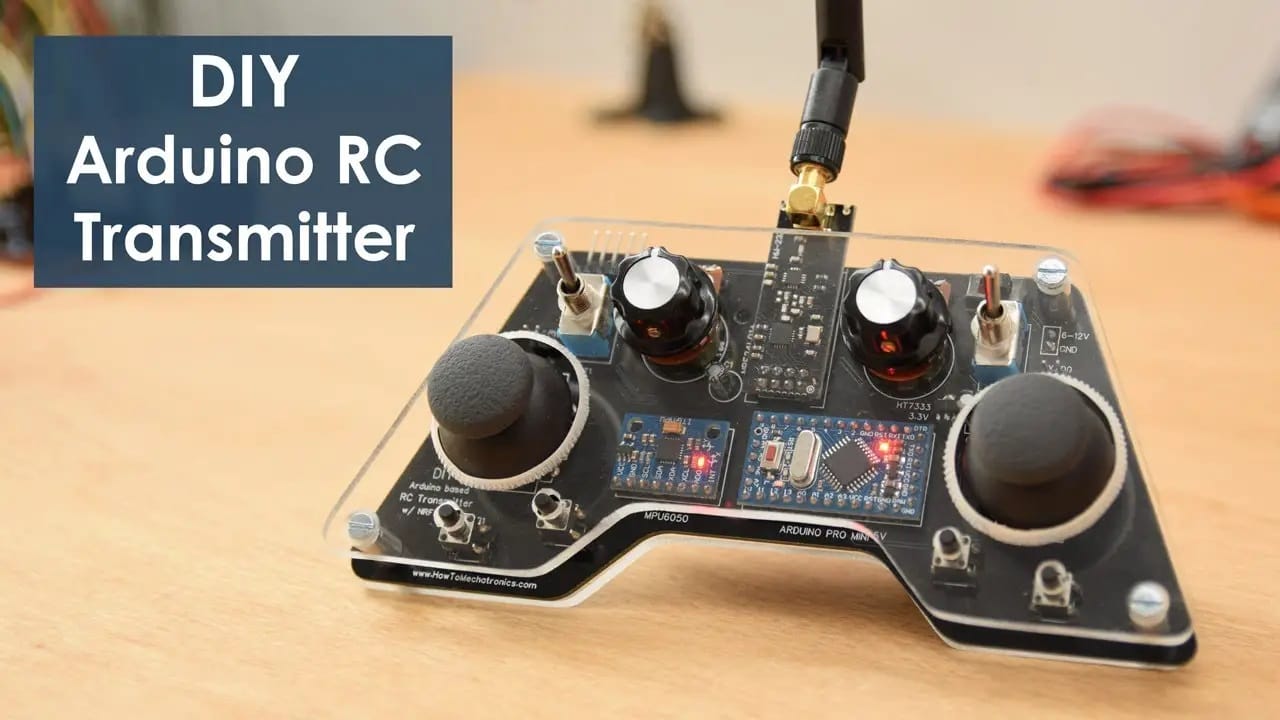
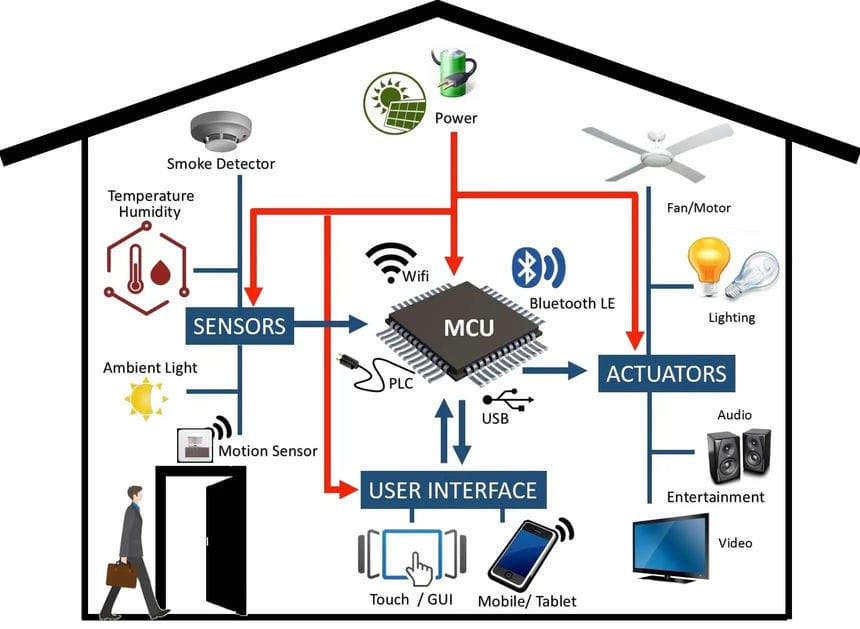
Using the nRF24L01 transceiver module effectively requires attention to various aspects of configuration, power management, and interference mitigation. Here are some usage tips to help you get the most out of the nRF24L01 module:
By following these usage tips, you can enhance the reliability and performance of the nRF24L01 transceiver module in your wireless communication projects.
The transmission range of the nRF24L01 module without an external antenna can vary based on several factors, including the power level, environmental conditions, and potential obstacles. Generally, without an external antenna, the range is limited compared to modules with external antennas.
Here are some rough estimates for the transmission range of the nRF24L01 module without an external antenna:
It's important to note that these are general estimates, and the actual range can be influenced by factors such as:
For applications where an extended range is required, or in environments with obstacles and interference, adding an external antenna to the nRF24L01 module is a common practice. An external antenna can significantly improve the module's range and overall performance. When using an external antenna, it's essential to consider proper matching and impedance matching for optimal results.
Interfacing an nRF24L01 transceiver module with a microcontroller involves connecting the module to the microcontroller's GPIO pins and configuring the microcontroller to communicate with the module using the SPI (Serial Peripheral Interface) protocol.
If you are using development boards that uses 5v as a power supply voltage, you can use 5 to 3.3v DC/DC converter module to supply the power of nRF24L01 modules.
You can read how to €œEstablishing a Wireless Connection with Arduino and NRF24l01€ and €œInterfacing NRF24L01 Wireless Transceiver Module with Arduino€ for more information.
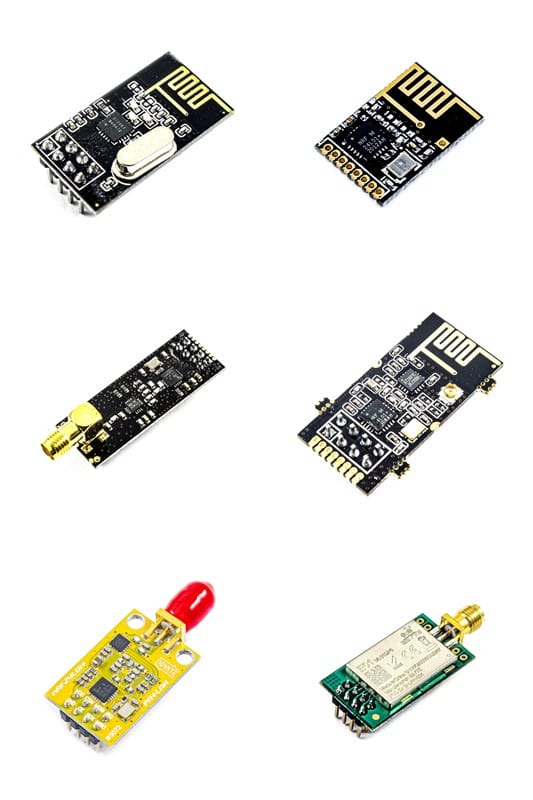
Before purchasing an nRF24 module, it is better to understand the differences between nRF24 modules available in the market. In this section, we introduce the major differences between different types of nRF24 modules, so that you can choose the right module based on your needs.
Power Amplification (PA) and Low Noise Amplification (LNA) capabilities: Some modules have Power Amplification (PA) and Low Noise Amplification (LNA) features that can increase the communication range. These modules are often labeled as "nRF24L01+PA+LNA". You can see one of these modules through this link.
The possibility of installing an external antenna: Different modules may have different antenna configurations. Some modules have an internal antenna, while others have an external antenna connection to increase range. You can see one of these modules through this link.
Voltage range: The working voltage range can be different among modules. Although most modules work in the 3.3 V range, it is necessary to pay attention to this parameter when choosing a module.
Data rate: The maximum data rate supported by the nRF24 module can vary. While the standard data rate is 250 kbps, some modules may support higher rates such as 1 Mbps or 2 Mbps.
Effective range: The effective range of communication can vary based on factors such as the presence of PA/LNA, antenna type, and environmental conditions. Some modules may have more range than others.
Cost: The cost of nRF24 modules can vary based on features and specifications. Modules with more features, such as external antennas or PA/LNA, may be more expensive than other modules.
Manufacturer and Brand: Various manufacturers produce nRF24 modules. The quality of the parts used in them is different and causes a change in the quality of sending and receiving data.
In the image below, you can see the types of modules available.
The effective range of the nRF24L01 module is influenced by factors like power supply voltage, antenna design, and environmental conditions. Typically, it can achieve reliable communication within a range of 20 to 100 meters.
Yes, the nRF24L01 modules support the use of multiple channels, allowing you to use multiple modules in the same vicinity without interference. You can configure each module to operate on a different channel.
Yes, there are various libraries and code examples available for popular microcontroller platforms like Arduino. These libraries simplify the process of configuring and using nRF24L01 modules in your projects.
You can learn more by reading €œEstablishing a Wireless Connection with Arduino and NRF24l01€ and €œInterfacing NRF24L01 Wireless Transceiver Module with Arduino€.
Yes, the nRF24L01 module is suitable for battery-powered devices due to its low power consumption. You can optimize power usage by adjusting parameters such as transmit power and data rate based on the specific requirements of your application.
In order to use Li-ion batteries, you can use modules like €œ18650 2S Lithium Battery Charging/Discharging Module - 5V Output€ or €œMH-CD42 5V2A Charging and Discharging Integrated Module€.
Also, you can use DC/DC converters to produce 5 or 3.3 volt power supply for your use.
helloxxxx

Please complete your information below to login.
Sign In
Create New Account