
Product added to cart

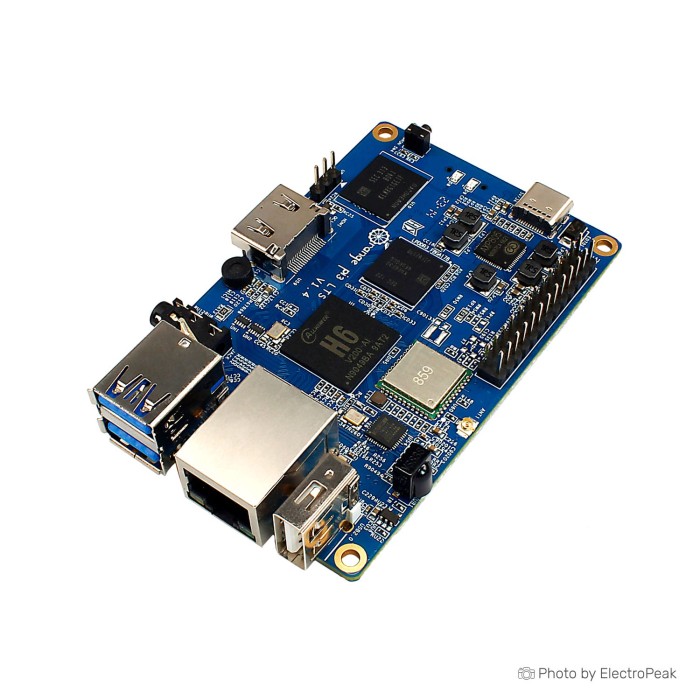
Orange Pi 3 LTS H6 Quad Core Development Board
$119.0000
In stock
SKU
MIN-02-032
Volume discounts:
- +5 2 % $116.2000
- +10 4 % $114.8000
- +25 5 % $113.4000
- +50 6 % $112.0000
- +100 7 % $110.6000
Ships in 2-3 business days, then:
Free delivery in 12-15 days by Tracked Economic Shipping
Free delivery in 7-10 days by Express Shipping on orders over $300.
More shipping info

Shop with confidence Learn More
 Orange Pi 4G-IOT Development Board Previous
Orange Pi 3 LTS H6 Review
The Orange Pi 3 LTS H6 is a compact Allwinner H6 single-board computer with 2GB of LPDDR3 RAM and 8GB of onboard eMMC storage, listed at $53.25. Built for experienced makers and software engineers, it places Gigabit Ethernet, Wi-Fi 5, Bluetooth 5.0, HDMI, USB connectivity, and low-level expansion pins on an 85 × 56 mm circuit board. It is best suited to lightweight headless services, command-line Linux appliances, testing environments, and dedicated GPIO hardware control—not desktop workstations or plug-and-play media centers.
Specifications of Orange Pi 3 LTS H6 Quad Core Development Board
- CPU: H6 Quad-core 64-bit 1.8GHZ ARM Cortex™-A53
- GPU: High-performance multi-core GPU Mali T720,OpenGL ES3.1/3.0/2.0/1.1,Microsoft DirectX 11 FL9_3,ASTC(Adaptive Scalable Texture Compression),Floating point operation greater than 70 GFLOPS
- Video Decoding: H265/HEVC Main/Main10 [email protected] High-tier ;4K@60fps, up to 6Kx4K@30fps, H264/AVC BP/MP/[email protected], MVC, 4K@30fps, VP9,Profile 0/2, 4K@30fps, AVS+/AVS JIZHUN profile@level 6.0, 1080P@60fps
- Memory+Onboard Storage: 2GB LPDDR3 (shared with GPU),8GB EMMC Flash,Micro SD card slot
- WiFi+BTChip: 859,IEEE 802.11 a/b/g/n/ac WiFi5,BT5.0
- Onboard Network: Chip: YT8531C,10/100M/1000M Ethernet RJ45
- Audio Input: Onboard MIC
- Audio Output: HDMI 2.0a,3.5 mm AV Jack
- Video Output: HDMI 2.0a,CVBS
- Power Source: Chip: AXP805,5V3A Type-C
- USB 2.0 Ports: 2*USB 2.0 Host
- USB 3.0 Ports: 1*USB 3.0 Host
- Low-level peripherals: 26pin connector with1* I2C, 1*SPI, 1*UART & Multiple GPIO Ports, 3pin Debug ports
- Debug serial port: UART-TX, UART-RX, GND
- LED: Power led, Status led
- IR receiver: Support IR Remote Control
- Key: Power(SW4)
- Supported OS: Android9.0, Ubuntu, Debian
- Dimension: 56mm,85mm
Orange Pi 3 LTS Specifications Explained
Each core specification on the Orange Pi 3 LTS translates into practical limits and capabilities for your project.
| Specification | Technical Value | Why It Matters |
|---|---|---|
| Processor (CPU) | Allwinner H6 Quad-core 64-bit ARM Cortex-A53 @ 1.8 GHz | Provides sufficient 64-bit compute power for background daemons, automation routines, and headless network utilities, but will throttle under continuous heavy computation without supplemental cooling. |
| System Memory | 2GB LPDDR3 (shared with GPU) | Supports light server stacks, basic containers, and microservices. Because RAM is shared directly with the Mali T720 GPU, complex multi-tab browsing, heavier database engines, and graphical multitasking will rapidly exhaust available memory. |
| Integrated Storage | 8GB eMMC Flash | Delivers fast, onboard storage for a minimal Linux operating system and critical system binaries without relying on external cards. However, 8GB leaves narrow headroom once package caches, system logs, and container images accumulate. |
| Removable Storage | MicroSD card slot | Provides essential OS provisioning, storage expansion, and firmware recovery. Pairing the board with a capable card such as the SanDisk Micro SD Memory Card - 32GB, 120MBps (class 10) is practical for log collection and initial image flashing. |
| Wired Network | Motorcomm YT8531C Gigabit Ethernet (10/100/1000M) | Provides full line-rate wired throughput suitable for local network gateways, lightweight file transfer nodes, and automation hubs requiring predictable network latency. |
| Wireless Interface | AW859A (listed as 859), IEEE 802.11 a/b/g/n/ac Wi-Fi 5, Bluetooth 5.0 | Enables dual-band wireless networking and local peripheral pairing without occupying external USB ports, though functional driver support depends heavily on your selected OS build. |
| Display Outputs | HDMI 2.0a and CVBS (3.5 mm AV jack) | Delivers display output options for basic visual consoles or legacy composite screens. Hardware codec decoding capabilities up to 4K or 6K describe silicon decoder limits rather than confirmed smooth playback under desktop Linux. |
| Expansion Header | 26-pin connector (I2C, SPI, UART, GPIO) + 3-pin debug port | Offers direct physical interfacing for sensors, relays, and serial buses. The 26-pin physical header follows an Orange Pi layout rather than the standard 40-pin header used on many other dev boards. |
| Dimensions | 85 × 56 mm | Matches the standard credit-card single-board computer form factor, making it easy to mount into custom enclosures and embedded fixtures. |
Need larger onboard storage from the start and a 40-pin header layout? The Orange Pi Plus 2E with H3 & 16GB eMMC provides double the eMMC capacity, though it uses an older 32-bit architecture without USB 3.0. You can also browse Orange Pi Boards to compare different processing platforms.
Orange Pi 3 LTS Linux, Networking and GPIO Compatibility
Official software listings specify Android 9.0, Ubuntu, and Debian support. The open-source community also maintains active Armbian builds for this board. Choose images built specifically for the Orange Pi 3 LTS rather than generic Allwinner H6 builds or images for the original non-LTS Orange Pi 3, because board-level hardware differences cause peripheral mismatches.
| Subsystem | Hardware Specification | Practical Compatibility & Driver Behavior |
|---|---|---|
| Operating Systems | Android 9.0, Ubuntu, Debian | Armbian and official Debian/Ubuntu server builds operate reliably for command-line utilities. Desktop environments can be launched, but hardware display acceleration remains uneven across various Linux distributions. |
| Wireless Networking | AW859A Wi-Fi 5 & Bluetooth 5.0 | While the hardware supports 802.11ac and Bluetooth 5.0, driver initialization is kernel-dependent. Some Linux and retro-gaming images have historically required kernel patching or firmware extraction to bring the wireless interfaces up. |
| Wired Networking | Motorcomm YT8531C Gigabit Ethernet | Recognized in mainstream releases, though certain custom distributions have experienced negotiation issues under specific mainline kernel revisions. |
| Expansion Header | 26-pin interface (1× I2C, 1× SPI, 1× UART, GPIOs) | Useful for embedded control and low-speed sensors. The pinout differs completely from Raspberry Pi 40-pin headers, meaning standard HAT add-on boards cannot be mounted without custom wiring. |
| Dedicated Serial Debug | 3-pin UART (TX, RX, GND) | Provides low-level bootloader console output via a 3.3V USB-to-TTL serial adapter, which is essential for diagnosing kernel crashes or headless boot failures. Standard RS-232 voltage levels will damage these pins. |
Official documentation does not provide specific electrical parameters, including maximum GPIO pin current, overall header current draw, and internal pull-up values. Test line voltages with a multimeter, and keep sensor signal lines matched to standard 3.3V logic levels before connecting active hardware. For breadboard prototyping, an Orange Pi 26P GPIO Extension Cable brings connections out safely without placing mechanical strain on the board. If your project specifically requires a standard 40-pin header and native camera input, consider the Orange Pi PC2 with H5 & 1GB RAM instead.
Orange Pi 3 LTS Limitations: Cooling, USB Roles and Linux Desktop Use
Before purchasing this board, weigh three primary constraints: thermal management, USB host topology, and graphical desktop performance.
Thermal dissipation needs attention under continuous workloads. In independent testing without a heatsink, the Allwinner H6 processor reached approximately 83 °C under heavy computational load. Elevated temperatures trigger internal thermal throttling, reducing CPU clock speeds to prevent damage. Passive aluminum heatsinks or small cooling fans are strongly advised for sustained container builds, CPU-bound computations, or continuous server tasks.
The USB port mapping has an important functional nuance. While the listing cites two USB 2.0 host ports and one USB 3.0 host port, official hardware schematics identify one USB 2.0 connection as having an OTG (On-The-Go) role. Depending on the kernel and device tree configuration, that port may not behave as a standard, transparent host port for every peripheral. Verify your peripheral arrangement before relying on three simultaneous external USB host devices.
Desktop and media playback also involve trade-offs. The Allwinner H6 silicon includes hardware decoding profiles for H.265 and VP9 at up to 4K@60fps or 6K@30fps and incorporates a Mali T720 GPU. Hardware codec support at the chip level does not translate into plug-and-play desktop video playback under Linux. Independent testing reveals noticeable graphical lag, missed frames during high-bitrate 4K playback, and frequent interface stuttering when navigating standard desktop distributions. The board excels as an energy-efficient headless system but falls short as a primary desktop workstation.
For projects that require a smooth desktop experience, dual 4K monitor outputs, 4GB of RAM, and a mature community package ecosystem, the Raspberry Pi 4 Model B 4GB offers a different SBC architecture for everyday desktop and educational use.
Orange Pi 3 LTS Setup Essentials and Accessories
Setting up the Orange Pi 3 LTS requires external accessories. The listing does not confirm an included power supply, heatsink, antenna, case, or pre-installed operating system image. Have the necessary bench equipment ready before powering the board for the first time.
Required Equipment
- 5V USB-C Power Supply: A dedicated, stable supply rated for 5V at up to 3A is necessary to prevent under-voltage reboots when peripherals connect. The 5V 3A Power Adapter (Orange Pi Compatible) meets the board's input requirements. Note that 5V/3A reflects the maximum required input delivery capacity rather than typical continuous power draw.
- MicroSD Storage Medium: An external flash card, such as the SanDisk Micro SD Memory Card - 32GB, 120MBps (class 10), is essential for writing the installation image and handling storage recovery.
- First-Boot Interface: Use either an HDMI monitor with a USB keyboard or a direct Ethernet patch cable to establish an SSH terminal session on your local network.
- Board-Specific OS Image: A downloadable OS build created specifically for the Orange Pi 3 LTS.
Recommended Equipment
- Processor Cooling: An adhesive aluminum or copper heatsink to suppress thermal throttling under continuous execution.
- Serial Debug Cable: A 3.3V USB-to-TTL UART adapter connected to the 3-pin serial pins for monitoring early boot-sequence messages.
- Header Breakout: An Orange Pi 26P GPIO Extension Cable for breadboard experiments.
First-Boot Verification Steps
- Download a verified Debian, Ubuntu, or Armbian image compiled specifically for Orange Pi 3 LTS and confirm its checksum.
- Flash the image onto your microSD card using a standard image writer utility.
- Insert the microSD card into the board's underside slot.
- Connect your network patch cable to the Gigabit Ethernet jack, or attach an HDMI monitor and USB keyboard.
- Plug the 5V 3A USB-C power adapter into the power port.
- Verify that the onboard power LED illuminates, followed by activity on the status LED.
- Log in through the local console, or locate the board's IP address on your network router and connect through SSH.
- Confirm whether the active root filesystem mounted from the microSD card or onboard eMMC, then systematically test peripheral interfaces (Ethernet, Wi-Fi, USB, and GPIO) under your chosen distribution.
Orange Pi 3 LTS Alternatives for Storage, GPIO and Expansion
If the 2GB memory ceiling, 8GB onboard eMMC size, lack of PCIe, or 26-pin header layout conflicts with your project architecture, several other single-board computers offer different hardware balances.
For installations that need double the onboard flash storage (16GB) and a standard 40-pin GPIO pinout, consider the Orange Pi Plus 2E with H3 & 16GB eMMC. It uses a 32-bit Allwinner H3 processor and lacks USB 3.0, which suits older home automation bridges or retro-emulation stacks that do not need 64-bit packages.
Physical camera input or a 40-pin header is the reason to consider the Orange Pi PC2 with H5 & 1GB RAM on a 64-bit platform. While it foregoes onboard eMMC and integrated Wi-Fi, it accommodates external CSI camera sensors directly.
For compact embedded processing that requires high-speed hardware bus expansion, the NanoPi NEO4 RK3399 takes a different hardware approach. Measuring just 60 × 45 mm, it pairs a dual Cortex-A72 and quad Cortex-A53 processor with an onboard PCIe x2 interface, though it provides 1GB of RAM and uses an external socket for optional eMMC modules rather than soldering storage directly to the board.
Orange Pi 3 LTS FAQ and Buying Checklist
Does the Orange Pi 3 LTS have 8GB of RAM?
No. The board has 2GB of LPDDR3 RAM and 8GB of onboard eMMC storage. The 8GB specification refers strictly to non-volatile flash storage for the operating system and files, not system operating memory.
Is this board identical to the original Orange Pi 3?
No. The LTS version differs from the original Orange Pi 3 in physical component layout, power management circuitry, wireless chipsets, and expansion interfaces. The LTS model omits the PCIe bus found on the original board and uses an 85 × 56 mm PCB layout. You must download OS images built specifically for the LTS model.
Does the package include a power adapter or heatsink?
No accessories are confirmed as included in the package. You will need to source an appropriate 5V 3A USB-C power source, such as the 5V 3A Power Adapter (Orange Pi Compatible), and install passive heatsinks for sustained computing tasks.
Can the board boot directly from onboard eMMC storage?
Yes. The board supports eMMC booting once a compatible operating system image is written to the flash chip. Because the exact pre-flash state of the eMMC can vary from the factory, keep a flashed card such as the SanDisk Micro SD Memory Card - 32GB, 120MBps (class 10) available for initial configuration and system recovery.
Will Wi-Fi and Bluetooth work across every Linux distribution?
No. Wireless hardware functionality depends on the specific Linux kernel and firmware packages bundled with your operating system image. While the board carries an AW859A Wi-Fi 5 and Bluetooth 5.0 module, custom or minimal distributions occasionally require manual driver compilation or non-free firmware loading.
Is the Ethernet port capable of true Gigabit speeds?
Yes. The board features a Motorcomm YT8531C Ethernet controller supporting 10/100/1000M speeds. It delivers gigabit throughput under current kernel distributions, though older custom builds occasionally exhibited link negotiation issues.
Are all three USB ports standard host ports?
The listing states one USB 3.0 host and two USB 2.0 host ports, but manufacturer schematics document one USB 2.0 port as an OTG interface. Depending on software configuration, that port may not function as a transparent host for all standard peripherals.
Can this board handle 4K video playback smoothly?
Linux media player support remains constrained, although the Allwinner H6 SoC supports hardware decoding for 4K and 6K video formats at the silicon level. Independent testing demonstrates dropped frames and high interface lag during 4K desktop playback.
Do standard Raspberry Pi HAT accessories fit the GPIO header?
No. The board uses a proprietary 26-pin header rather than the standard 40-pin layout used on Raspberry Pi boards. HAT boards designed for 40-pin headers cannot be directly mounted.
Does the Orange Pi 3 LTS offer PCIe or NVMe storage expansion?
No. This LTS model does not feature a PCIe interface or an M.2 NVMe slot. High-speed external storage must be connected using the USB 3.0 host port.
Can this board run Klipper 3D printer software?
Project comparisons show that the board can host Klipper alongside a web user interface. However, running Klipper requires setting up serial communication through USB or UART, providing sufficient board cooling, and ensuring a stable power supply.
Purchase Decision Summary
- Suitable for: Experienced Linux builders, headless server nodes, low-cost network appliances, lightweight automation bridges, and embedded projects benefiting from built-in eMMC and gigabit networking.
- Maybe for: Klipper 3D printer hosts, basic media decoders, or hobby development where you are comfortable troubleshooting distribution-specific driver packages and configuring serial connections.
- Avoid if: You expect a smooth desktop computer, require full Raspberry Pi 40-pin HAT compatibility, need more than 2GB of RAM, rely on plug-and-play Wi-Fi across every distribution, or require PCIe storage expansion.
Buying Checklist
- Confirm that 2GB of RAM meets your workload constraints, keeping in mind that the 8GB figure is eMMC flash storage.
- Verify that you have a dedicated 5V power supply capable of supplying 3A over a USB-C connection.
- Verify that your project does not require a standard 40-pin Raspberry Pi expansion header or camera serial interface.
- Confirm that your external storage plans do not rely on onboard PCIe or NVMe slots.
- Procure a heatsink or small 5V fan if you anticipate sustained CPU utilization.
- Ensure you have a reliable microSD card available for downloading and flashing board-specific LTS firmware images.
| Processor (SoC) | H6 Quad-core 64-bit |
|---|---|
| CPU | 1.8GHZ ARM Cortex™-A53 |
| Architecture | ARM Cortex-A53 |
| RAM | 2GB |
| RAM Type | LPDDR3 |
| Storage Support | microSD, eMMC |
| Storage Capacity | 8GB EMMC Flash |
| GPU/VPU | Mali T720 |
| Ethernet | 1 Gbps |
| Wi-Fi | WiFi 5 |
| Bluetooth | Bluetooth 5.0 |
| USB Ports | 2*USB 2.0 Host, 1*USB 3.0 Host |
| Video Output | HDMI |
| Hardware Interfaces | I2C, SPI, UART |
| GPIO Pins | 26 pin |
| Camera/Display | No |
| Power Input | 5V3A Type-C |
| PCIe | No |
| Dimensions (mm) | 56mm,85mm |
| OS Support | Ubuntu, Debian, Android |
| Video Decoding | H265/HEVC 4K@60fps (up to 6Kx4K@30fps), H264/AVC 4K@30fps, VP9 4K@30fps |
Write Your Own Review

Please complete your information below to login.
Sign In
Create New Account