
Product added to cart

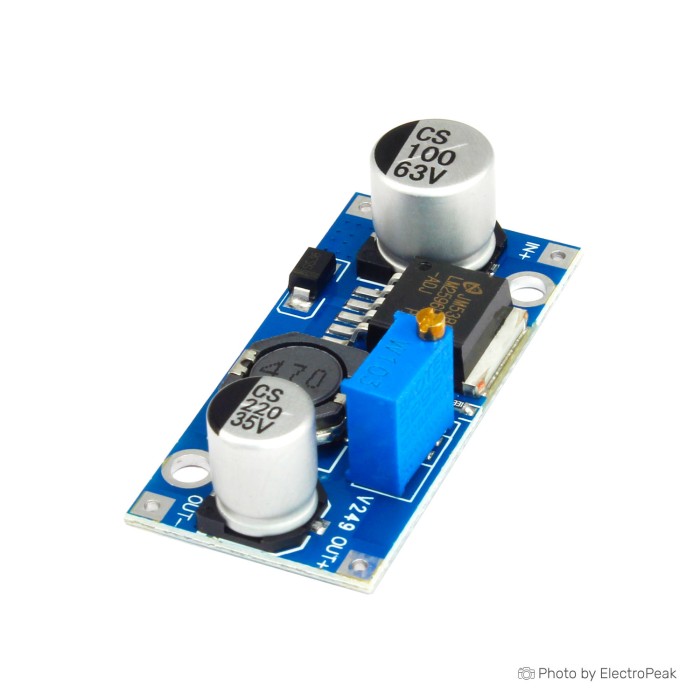
LM2596HVS 3A DC/DC Step-Down Regulator Module
$0.7500
In stock
SKU
BAT-02-106
Volume discounts:
- +50 4 % $0.7200
- +100 7 % $0.7000
- +300 8 % $0.6900
- +500 11 % $0.6700
- +1000 12 % $0.6600
Ships in 2-3 business days, then:
Free delivery in 12-15 days by Tracked Economic Shipping on orders over $100.
Free delivery in 7-10 days by Express Shipping on orders over $300.
More shipping info

Shop with confidence Learn More
 Lm2596S Step Down Constant Current Voltage Driver Module - 3A Previous
LM2596HVS Buck Module Review
The LM2596HVS 3A DC/DC Step-Down Regulator Module is an adjustable buck converter that reduces a DC supply from a 4.5V–53V input to a 3V–40V output rail. With pad connections, an onboard multiturn trimmer, and dedicated mounting holes, it is a practical option among DC-DC regulator modules for hobby benches and prototype builds. It suits supervised, low-to-moderate-power work where you can check the output with a multimeter before connecting sensitive electronics and monitor operating temperatures under load.
For applications requiring verified 48V transient surge immunity, low electrical noise, or guaranteed continuous high-current delivery without forced cooling, choose a more fully documented regulator module.
Specifications of LM2596HVS 3A DC/DC Step-Down Regulator Module
- Model: LM2596HVS
- Type: Step-Down Voltage Regulator Module
- Conversion Type: Step-Down (Buck)
- Input Voltage Range: 4.5V to 53V DC
- Output Voltage Range: 3V to 40V DC
- Maximum Output Current: 3A
- Output Current: 2A
- Output Power: 15W maximum
- Adjustable Output: Yes
- Efficiency: Typically 92% (depends on input/output voltage difference and load)
- Minimum Voltage Drop: 1.5V
- Switching Frequency: Typically 150 kHz
- Output Ripple: Typically 30mV
- Load Regulation: 0.5%
- Operating Temperature Range: -40°C to +85°C
- Connection: Pads for Input and Output
- Cooling Method: Natural convection (no built-in fan)
- Mounting: Screw holes for secure attachment
- Protection Features: Over-temperature, Over-current, Short Circuit Protection
- Size: 43mm x 21mm x 14mm
LM2596HVS Buck Module Specifications Explained
This board operates only as a step-down (buck) converter, reducing higher DC voltages to lower DC rails. It cannot increase voltage. For an application that must generate a higher voltage from a lower-voltage source, step-up boost conversion with the XL6009 Boost Converter Module is the appropriate approach.
| Specification | Value | Why It Matters |
|---|---|---|
| Conversion Type | Step-Down (Buck) | The input voltage must remain strictly above the target output voltage at all times during operation. |
| Input Voltage Range | 4.5V to 53V DC | Accommodates common supplies like 12V, 24V, and 36V, but operational headroom must be maintained against transient spikes when approaching 53V. |
| Output Voltage Range | 3V to 40V DC | Allows calibration to target logic levels or intermediate rails using the onboard multiturn potentiometer. |
| Minimum Voltage Drop | 1.5V | Specifies the required headroom between supply and load; higher output currents typically require more headroom than low-current loads. |
| Output Power Limit | 15W maximum | Governs the maximum safe current at higher output voltages; higher voltages force lower operational current limits. |
| Form Factor & Mounting | 43mm x 21mm x 14mm | Compact board dimensions allow tight integration, with corner screw holes providing mechanical stability under vibration. |
| Cooling Arrangement | Natural convection | Relies on ambient airflow; high voltage differences or sustained loads near the power ceiling demand auxiliary thermal management. |
The 15W maximum output power directly limits current as output voltage rises. At 12V output, maximum power is reached at 1.25A (15W / 12V). At 24V, continuous output is restricted to approximately 0.63A (15W / 24V). Drawing the module's 3A maximum current at these higher voltages exceeds the 15W limit and risks rapid overheating.
LM2596HVS 3A and 15W Limits
The technical specifications list an Output Current of 2A, a Maximum Output Current of 3A, and a 15W maximum output power limit. These ratings are boundary conditions, not simultaneously achievable operating points. You cannot draw 3A continuously across all voltage combinations. At lower output voltages, such as 5V, a 3A load equals 15W and operates directly at the listed power ceiling. As noted, higher output voltages reach the 15W ceiling at significantly lower currents.
Cooling relies entirely on natural convection. Under demanding conditions with large input-to-output voltage differentials or continuous loads above 1.5A to 2A, compact regulator boards of this type experience a steep thermal rise. An add-on heatsink or forced airflow helps dissipate heat, provided the heatsink does not bridge exposed component pads or solder joints.
For sustained current delivery up to 5A at 75W maximum, consider a higher-current buck module below 38V input, such as the XL4015 5A Step-Down Module.
The listed 92% efficiency rating depends on the input-to-output voltage ratio and load current. In high-drop scenarios, efficiency falls and more power is dissipated as heat on the board. The 30mV output ripple is also condition-dependent; generic switching regulators can exhibit significantly higher ripple under heavy loads. For noise-sensitive analog, audio, or precision RF circuitry, follow the buck stage with downstream LC filtering or an intermediate linear low-dropout regulator.
Integrated protections cover over-temperature, over-current, and output short circuits at the regulator level. They do not protect against reverse input polarity, sustained line surges, or overvoltage pass-through following an unmitigated board-level failure.
LM2596HVS Buck Module Compatibility and First Setup
The module uses four solder pads: IN+ and IN- for the DC supply, plus OUT+ and OUT- for the load. It does not accept AC input voltages and has no software, firmware, or digital communication interfaces. Stable operation depends on properly soldered, insulated, strain-relieved wiring rather than temporary friction clips.
Adjustable modules do not ship with a guaranteed factory preset voltage. Connecting a load immediately after unboxing risks exposing 3.3V or 5V components to higher voltages. For builds that benefit from real-time monitoring without external bench meters, the LM2596 Buck Converter with LED Display provides an integrated voltage display.
First-Power-Up Verification Sequence
- Inspect the board for clear pad markings and ensure no stray solder shorts exist between components.
- Verify that your input power supply matches the DC polarity markings on IN+ and IN-.
- Connect the DC input power source with the load completely disconnected. Use low-current prototype wiring only for initial bench checks, then move to appropriately rated gauge wire for actual loads.
- Place a multimeter across the OUT+ and OUT- pads in DC voltage mode.
- Rotate the brass screw on the multiturn potentiometer until the multimeter reads the desired target voltage.
- Disconnect power, wire the intended load to the output pads, reconnect power, and verify that the output remains stable and component temperatures stay within safe limits under operational load.
Because the module lacks onboard reverse-polarity and input-surge protection, incorporate an inline fuse on the positive input line and a reverse-polarity blocking diode in automotive, battery-backed, or industrial field installations.
LM2596HVS Buck Module Alternatives
Power-converter selection depends on input voltage range, required output current, channel count, and whether on-module monitoring hardware is needed. The comparison below highlights key differences among alternative regulator boards.
| Module | Input Voltage | Output Voltage | Max Current / Power | Key Features |
|---|---|---|---|---|
| LM2596HVS Buck Module | 4.5V–53V DC | 3V–40V DC | 3A max (2A rated) / 15W | High DC input ceiling; single adjustable output via pads. |
| LM2596 Buck Converter Module | 4.5V–40V DC | 1.5V–35V DC | 3A max / 15W | Standard 40V-input LM2596 module for general lower-voltage DC rails. |
| LM2596 with LED Display | 4.0V–40V DC | 1.25V–37V DC | 3A max / 15W | Built-in switchable 3-digit voltage display and screw terminals. |
| LM2596HV AC/DC Module | 5V–30V AC / 5V–50V DC | 3.3V–33V DC | 2.2A continuous (3A peak) | AC-input buck module with heat sink and onboard rectifier bridge. |
| XL4015 5A Step-Down Module | 4V–38V DC | 1.25V–36V DC | 5A max / 75W | High-current capacity for 12V/24V systems below 38V input. |
| LM2596 Dual-Channel Buck Converter | 5V–40V DC | 1.25V–35V DC (x2) | 2.5A continuous per rail | Two independently adjustable outputs with integrated heatsink. |
| LM2596 4-Way Step-Down Module | 5V–35V DC | Multiple fixed/adjustable | 5A total combined | Four independent outputs to power complex multi-rail assemblies. |
| XL6009 Boost Converter Module | 4V–32V DC | 5V–35V DC | 4A max switch current | Step-up topology to generate higher voltage from lower-voltage rails. |
LM2596HVS Buck Module FAQ
Can the LM2596HVS Buck Module convert 48V to 5V?
Yes. Stepping down from 48V to 5V falls within the specified 4.5V to 53V input and 3V to 40V output boundaries. However, nominal 48V battery systems can exceed 54V during charging, and power lines can exhibit voltage spikes beyond the 53V maximum rating. Validate source regulation and transient suppression before operating near 53V.
Can the LM2596HVS Buck Module increase 5V to 12V?
No, this is strictly a step-down buck regulator. The output voltage must remain lower than the input voltage by at least the 1.5V dropout requirement. To raise 5V to 12V, use the XL6009 Boost Converter Module instead.
Is the LM2596HVS 3A output continuous?
No, 3A is the peak maximum rating, not an unconditional continuous limit. Continuous current capacity depends on the input-to-output voltage drop, ambient temperature, airflow, and the 15W total power dissipation ceiling. In enclosed or unventilated spaces, continuous current without forced cooling is limited to 1.5A to 2A.
Why does the listing show both 2A and 3A?
The 2A figure indicates practical continuous current capability under standard natural convection, while 3A denotes the absolute maximum current the module can supply under ideal thermal conditions or for brief periods.
Can the LM2596HVS provide 3A at 12V with a 15W maximum?
No. At 12V, 3A equals 36W, which significantly exceeds the module's 15W power limit. At a 12V output, the 15W ceiling restricts maximum safe current to 1.25A.
Is the output already set to 5V?
No, there is no standardized factory setpoint. Adjust the potentiometer with a flathead screwdriver while monitoring the output pads with a multimeter before attaching your target circuitry.
Do I need a heatsink for the LM2596HVS Buck Module?
A heatsink is strongly advised if your application draws more than 1.5A continuously or operates with a large voltage difference between input and output. An aluminum add-on heatsink can be mounted to the main IC using thermally conductive tape, provided it does not contact surrounding component leads.
Can I use this module as a lithium battery charger?
No, this board is a constant-voltage power supply, not a battery charger. It lacks the constant-current regulation, automatic charge termination, cell balancing, and temperature-monitoring circuitry required to charge lithium chemistries safely.
Does the LM2596HVS Buck Module include reverse-polarity protection?
No, reverse-polarity protection is not included. Connecting your power source backward to IN+ and IN- will instantly damage the switching regulator and associated capacitors.
Is it suitable for low-noise audio, RF, or precision analogue circuits?
No, switching regulators generate high-frequency ripple and switching transients that can introduce audible noise or signal degradation into sensitive analog stages. For these applications, follow the output with an LC filter or a low-dropout linear regulator.
Does it include screw terminals?
No, the connection points are direct solder pads on the PCB edges. External wires must be soldered directly to the board.
LM2596HVS Buck Module Buying Checklist
Purchase Decision Summary
- Ideal for: Prototyping non-critical DC step-down rails from 12V, 24V, or stable 36V supplies where the required power is 15W or less, the user can solder pad connections, and output voltage is verified with a multimeter before use.
- Maybe for: Nominal 48V auxiliary circuits, provided the line is well-regulated, never exceeds 53V under transient or charging conditions, and load power stays well within thermal limits.
- Avoid if: You need an AC-to-DC converter, step-up boost conversion, lithium battery charging, guaranteed low-noise analog performance, reverse-polarity tolerance, or continuous high-current power exceeding 15W.
Pre-Purchase Verification
- Your power source delivers DC, not AC.
- Your required output rail is at least 1.5V lower than the minimum input voltage under load.
- Your DC source stays within 4.5V to 53V DC, accounting for battery float charging or line transients.
- Your planned power load does not exceed 15W (Volts x Amps ≤ 15W).
- You do not require 3A continuous output without auxiliary cooling or at higher output voltages.
- You have a multimeter ready to measure and calibrate the multiturn trimmer prior to connecting the load.
- You are comfortable soldering power wiring to the IN and OUT PCB pads.
- You have planned external fusing and reverse-polarity protection if operating from high-energy sources.
- Your system does not require multiple synchronized rails; for multi-rail designs, consider four independently adjustable rails on the LM2596 4-Way Step-Down Module.
- You have a suitable power source; for standard 12V bench prototypes, pair the setup with a 12V DC input supply.
For fixed-voltage boards, alternative configurations, or higher-current designs, see the complete range of DC-DC regulator modules.
Write Your Own Review

Please complete your information below to login.
Sign In
Create New Account