
Product added to cart

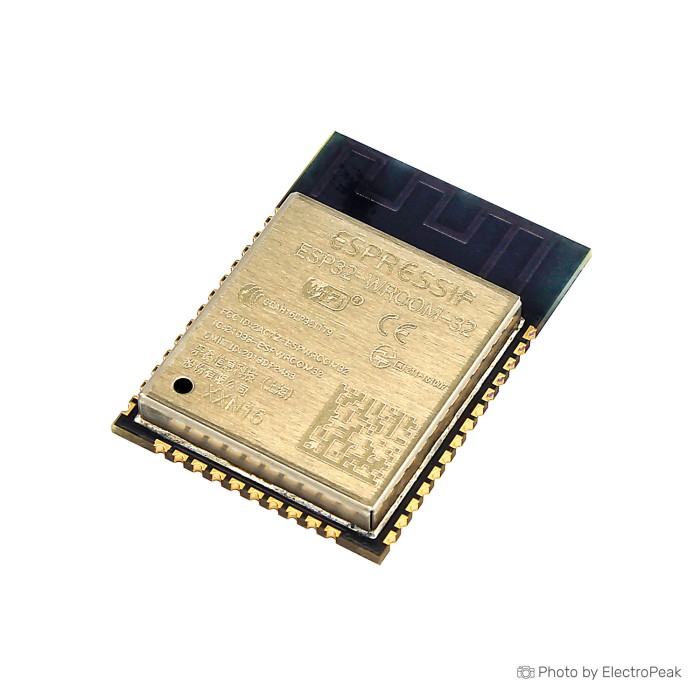
Espressif ESP32-WROOM-32 Module ( Wifi + Bluetooth)
SAVE
As low as $3.5000
In stock
Only %1 left
SKU
COM-03-093
Ships in 2-3 business days, then:
Free delivery in 12-15 days by Tracked Economic Shipping on orders over $100.
Free delivery in 7-10 days by Express Shipping on orders over $300.
More shipping info

Shop with confidence Learn More
 ESP-WROOM-32 ESP32 Development Board - CH340 Driver Previous
ESP32-WROOM-32 WiFi Bluetooth Module Review
The ESP32-WROOM-32 is a bare Espressif ESP32 module built around the ESP32-D0WD core, with 802.11 b/g/n Wi-Fi, Bluetooth v4.2 BR/EDR and BLE, and an onboard PCB antenna. It is designed for custom PCBs, matching adapter boards, and compact connected hardware—not direct USB use.
It suits Wi-Fi/Bluetooth sensor nodes, controllers, loggers, and home-automation hardware when you can provide the carrier, programming interface, and power circuitry. Verify the installed flash size before using flash-sensitive firmware layouts or committing a design to production.
Specifications of Espressif ESP32-WROOM-32 Module ( Wifi + Bluetooth)
- CPU: Two low-power Xtensa 32-bit LX6 microprocessors
- Core: ESP32-D0WD core
- External memory support: Supports multiple external QSPI flash and SRAM chips
- Flash Memory: 4Mbit, 8Mbit, 16Mbit (Optional)
- Crystal: 40MHz crystal
- Antenna: Onboard PCB antenna for ESP32-WROOM-32
- Power management: Advanced power-management technologies
- Wi-Fi protocol: 802.11 b/g/n (802.11n up to 150Mbps) Wi-Fi protocol
- Bluetooth: Bluetooth v4.2 BR/EDR and BLE
- Interfaces: SD card, UART, SPI, SDIO, I2C, LED PWM, Motor PWM, I2S, and IR module interfaces
- Sensor: Hall sensor
- Operating voltage supply: 2.7V to 3.6V operating voltage supply
- Average operating current: 80mA average operating current
- Operating temperature range: -40°C to 85°C operating temperature range
For another listed classic ESP32 bare-module option, see the ESP32-WROOM-32D with PCB Antenna. For prototype work, the ESP-32S Matching Adapter Board for ESP32-WROOM provides a practical way to mount the module.
Browse related ESP32 modules and development hardware for carrier boards and other ESP32-family options.
ESP32-WROOM-32 Specifications and Pin Planning
Two Xtensa LX6 processor cores allow firmware to split work across communication, timing, and application tasks. The CPU clock is adjustable from 80MHz to 240MHz, so a design can balance processing demand against its power profile.
The combined Wi-Fi, Bluetooth Classic, and BLE radios suit devices needing local wireless control alongside network connectivity. This includes sensor hubs, relay or lighting controllers, data loggers, audio prototypes, and custom interfaces for mobile-app-controlled equipment.
| Capability | Why it matters |
|---|---|
| 802.11 b/g/n Wi-Fi and Bluetooth v4.2 BR/EDR/BLE | One module supports Wi-Fi networking alongside Bluetooth Classic or BLE device communication. |
| UART, SPI, SDIO, I2C, I2S, SD card, PWM, and IR interfaces | These interfaces support common sensor buses, displays, storage, audio hardware, serial devices, motor-control circuitry, and infrared functions when the board is designed around them. |
| Onboard PCB antenna | The antenna is part of the module, so account for board placement and enclosure clearance early in the layout. |
| Hall sensor | A Hall sensor is stated, but it should not be treated as a dependable dedicated magnetic sensor for a critical function. |
| -40°C to 85°C operating temperature range | This is the stated operating-temperature range, but measured thermal behavior for this version is not specified. |
Plan pin use before routing a carrier board. On classic WROOM-32 modules, GPIO6 through GPIO11 connect to internal flash and are not suitable as ordinary GPIO. No full pinout, dimensions, footprint drawing, or recommended land pattern is specified for this board. Use the ESP32 pinout reference for safe GPIO choices as platform-level guidance, and verify the footprint before manufacturing.
For bench work, the ESP-32S Matching Adapter Board for ESP32-WROOM makes the module easier to connect while you test the pin plan.
ESP32-WROOM-32 Flash Size, Power and Limitations
Flash capacity is the main item to verify before purchase. The product title states “16M 128Mbit Flash,” while the feature list states “Flash Memory: 4Mbit, 8Mbit, 16Mbit (Optional).” Neither statement confirms the installed flash capacity, and the Mbit/MB wording needs verification.
Check the flash size reported in software before selecting a board definition, OTA layout, or partition table. Classic ESP32-WROOM-32 family documentation identifies 4MB as a common default configuration, with 8MB and 16MB custom variants, but that family context does not establish the flash fitted to this board.
The stated operating range is 2.7V to 3.6V, with 80mA average operating current. Design around a stable regulated 3.3V rail with appropriate local decoupling near the supply pins. The 80mA figure is an average, not a peak-current rating or a complete power-supply sizing specification.
The onboard PCB antenna has no stated external antenna connector. Keep its area clear of metal, ground obstructions, and enclosure features that could affect RF behavior. Measured range and enclosure performance are not specified. For buyers considering another listed classic bare-module option, the ESP32-WROOM-32U with U.FL Connector is also available.
The exact silicon revision is not confirmed. Base WROOM-32 and WROOM-32D family modules are identified as legacy or NRND in some distributor documentation, so new production hardware should confirm revision, flash size, certification requirements, and supply status before release. Later ESP32-WROOM-32E and ESP32-WROOM-32UE family revisions exist, but the exact revision of this board is not specified.
Component and batch variation can occur across ESP32 module supply channels. Inspect metal-shield markings and query the installed flash before standardizing a production design. Keep GPIO6 through GPIO11 out of regular I/O plans as well; the ESP32 pinout reference covers these GPIO restrictions in more detail.
ESP32-WROOM-32 vs ESP32-WROVER-IB and ESP32-C6-WROOM-1
This module suits classic ESP32 projects needing 802.11 b/g/n Wi-Fi plus Bluetooth v4.2 BR/EDR and BLE on an onboard PCB antenna. The alternatives below address requirements stated more clearly for their respective modules.
| Module | Wireless | Flash and antenna information | Processor | Choose it when |
|---|---|---|---|---|
| ESP32-WROOM-32 | 802.11 b/g/n Wi-Fi; Bluetooth v4.2 BR/EDR and BLE | Onboard PCB antenna; installed flash capacity requires verification | Two low-power Xtensa 32-bit LX6 microprocessors | You need a classic bare ESP32 module for a custom Wi-Fi and Bluetooth/BLE design. |
| ESP32-WROVER-IB with IPEX Connector | Wi-Fi and Bluetooth | 16MB integrated SPI flash; Ipex (U.FL) antenna connector | Not stated | You need stated 16MB integrated SPI flash and an Ipex (U.FL) antenna connection. |
| ESP32-C6-WROOM-1 with Wi-Fi 6 | Wi-Fi 6; Bluetooth 5 LE; Zigbee and Thread | 16MB flash memory | 32-bit RISC-V single-core CPU | You need Wi-Fi 6, Bluetooth 5 LE, Zigbee, or Thread support. |
Choose the ESP32-WROVER-IB when you require stated flash capacity and an Ipex connector. The ESP32-C6-WROOM-1 takes a different platform path for multiprotocol designs needing Wi-Fi 6 or Zigbee/Thread. You can also compare ESP32 module families across the wider range.
ESP32-WROOM-32 Setup and Programming Accessories
This ESP32-WROOM-32 WiFi Bluetooth module needs a compatible carrier or custom PCB, a regulated supply arrangement, and external USB-to-TTL programming hardware. It has no built-in USB programming, voltage regulator, headers, or boot buttons.
Required
- ESP-32S Matching Adapter Board for ESP32-WROOM: mounts the bare module for prototype wiring and testing.
- CH340G USB to TTL Converter: provides an external serial programming connection.
- CP2102 USB to TTL UART Serial Convertor Module: provides an alternative external serial programming connection.
- A regulated 3.3V power-supply design: required to power the module within its stated operating range.
Recommended
- 400 Points Half Size Breadboard - 5.5x8.5cm: useful for early adapter-board and serial-programming tests.
- Breadboard Jumper Wire Kit - 140 Pieces: supports serial, power, boot, and prototype connections.
- Local decoupling capacitors near the supply pins: recommended for a stable supply arrangement.
- 3.3V-compatible sensors and actuators: recommended when peripheral devices share the module’s logic environment.
Optional
- An RF-friendly enclosure design that preserves PCB-antenna clearance.
- An external antenna is not an accessory path for this board because no external antenna connector is stated.
First power-up and upload check
- Mount the module on a matching adapter board or custom carrier circuit.
- Power it from a stable regulated 3.3V supply within the stated 2.7V to 3.6V operating range.
- Connect a CH340G or CP2102 interface through the required serial and boot connections, including TX/RX crossover, ground, enable, and boot-mode wiring.
- Install an ESP32-supported environment such as ESP-IDF, Arduino-ESP32, or MicroPython, then select the ESP32 board target.
- Verify the actual flash size before choosing flash-size and partition settings.
- Upload a basic serial-output, blink, or Wi-Fi-scan test. A successful test uploads correctly, shows boot output on the serial port, or detects nearby Wi-Fi networks.
For Arduino work, use the guide to install the ESP32 board package in Arduino IDE. Driver installation applies to the selected external CH340G or CP2102 converter if the computer does not enumerate it.
Common first-time problems include selecting a 16MB flash setting before verification, using an unstable supply, missing boot mode, reversing TX/RX, lacking the USB-to-TTL converter driver, and assigning GPIO6 through GPIO11 as normal I/O.
ESP32-WROOM-32 WiFi Bluetooth Module FAQ
Is this ESP32-WROOM-32 module 4MB or 16MB flash?
The installed flash capacity is not confirmed. The product title says “16M 128Mbit Flash,” while the feature list says “4Mbit, 8Mbit, 16Mbit (Optional),” so check the module in software before selecting flash and partition settings.
Does the ESP32-WROOM-32 include USB programming hardware?
No. This is a bare module, so use a matching adapter board or custom PCB with an external USB-to-TTL interface such as the CP2102 USB to TTL UART Serial Convertor Module.
Can I use GPIO6 through GPIO11 as normal ESP32-WROOM-32 pins?
No. GPIO6 through GPIO11 connect to internal flash on classic WROOM-32 modules and are not regular GPIO choices. Check the ESP32 GPIO restrictions and pin-selection guide before finalizing a custom pin assignment.
What power supply does the ESP32-WROOM-32 module need?
The specified operating range is 2.7V to 3.6V, and a stable regulated 3.3V rail is the practical design target. The stated 80mA value is average operating current; peak-current requirements for this board are not specified.
Does this ESP32-WROOM-32 module support an external antenna?
No external antenna connector is stated for this board. It uses an onboard PCB antenna. If you require a stated Ipex (U.FL) connector and 16MB integrated SPI flash, the ESP32-WROVER-IB with IPEX Connector is a better fit.
Is the ESP32-WROOM-32 Hall sensor suitable for a magnetic-sensing project?
Not for a critical dedicated magnetic-sensing function. A Hall sensor is stated, but its practical utility is limited for designs that depend on reliable magnetic measurement.
Should I choose ESP32-WROOM-32, ESP32-WROVER-IB, ESP32-C6-WROOM-1, or ESP32-H2-MINI-1?
Choose this module for classic ESP32 Wi-Fi plus Bluetooth/BLE projects using an onboard PCB antenna. Choose ESP32-WROVER-IB for stated 16MB integrated SPI flash and an Ipex connector, or ESP32-C6-WROOM-1 for Wi-Fi 6, Bluetooth 5 LE, Zigbee, or Thread. The ESP32-H2-MINI-1 Bluetooth/Zigbee Module suits BLE, Zigbee 3.0, Matter, or Thread designs that do not require Wi-Fi.
ESP32-WROOM-32 Buying Guide
Ideal for
Makers and engineers building compact custom Wi-Fi and Bluetooth/BLE sensors, controllers, loggers, home-automation nodes, and connected-device hardware with a compatible carrier, external programmer, and regulated 3.3V supply.
Maybe for
Existing classic ESP32 designs using the WROOM footprint, provided the actual flash capacity and shipped silicon revision are verified before firmware and production hardware are finalized.
Avoid if
You need a USB-ready development board, confirmed 16MB flash, an external antenna connector, a fully specified current-generation production module, dependable dedicated Hall sensing, or Wi-Fi 6, Zigbee, or Thread support.
Pre-purchase checklist
- ✓ I understand that this is a bare module, not a USB development board.
- ✓ I have a matching adapter board or a custom PCB with a suitable footprint.
- ✓ I have a regulated 3.3V supply design.
- ✓ I have an external USB-to-TTL programming interface.
- ✓ I will verify actual flash capacity before choosing an IDE flash-size setting or partition layout.
- ✓ My project works with 802.11 b/g/n Wi-Fi and Bluetooth v4.2 BR/EDR/BLE.
- ✓ My antenna plan works with an onboard PCB antenna.
- ✓ I will keep GPIO6 through GPIO11 out of my regular I/O plan.
- ✓ I do not depend on the Hall sensor for a critical sensing function.
- ✓ I have confirmed the exact module revision, flash size, certification requirements, and supply status before production use.
For Wi-Fi-only projects that do not need Bluetooth, an ESP-12E ESP8266 Module or ESP-12S ESP8266 Module is an alternative approach. Browse ESP32 modules and development hardware if your design needs a different wireless platform or carrier format.
| MCU/SoC | ESP32-D0WD |
|---|---|
| Product Family | ESP32 |
| Architecture | Tensilica Xtensa LX6 |
| CPU Cores | Dual-core |
| Clock Speed (MHz) | 240 MHz |
| Flash | 4MB,16MB |
| SRAM | 520 KB |
| External Memory | QSPI |
| GPIO Pins | 34 |
| SPI interface Pins | 3 |
| I2C interface Pins | 2 |
| UART interface Pins | 3 |
| CAN Bus Support | Yes (TWAI) |
| Ethernet Support | Yes |
| ADC Channels | 18 |
| DAC Channels | 2 |
| PWM Channels | LED PWM, Motor PWM |
| Timers Count | 4 x 64-bit |
| Operating Voltage (V) | 2.7V - 3.6V |
| GPIO Voltage (V) | 3.3V |
| GPIO Current (mA) | 12mA |
| Active Current (mA) | 80mA |
| Sleep Current (µA) | 10uA (Deep Sleep) |
| Wireless | Bluetooth, Wi-Fi |
| Form Factor | Module |
| IDE Support | Arduino IDE, MicroPython, Espressif IoT Development Framework (ESP-IDF) |
| Input Voltage (V) | 2.7V - 3.6V |
| Antenna Type | Internal Antenna |
| Bluetooth Ver. | 4.2 |
| Operating Temp (°C) | -40°C to +85°C |
| Wireless Protocol | 802.11 b/g/n (802.11n up to 150Mbps) |
Write Your Own Review

Please complete your information below to login.
Sign In
Create New Account