
Product added to cart

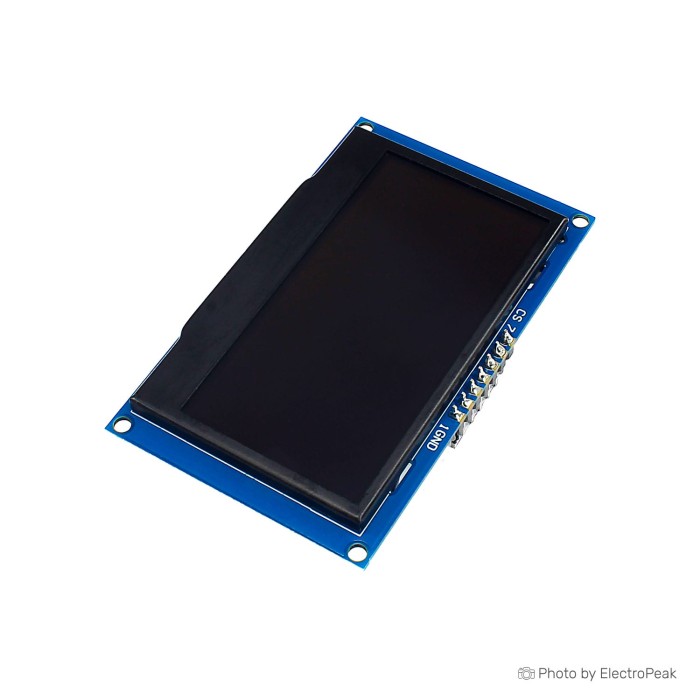
2.42inch 128x64 I2C/SPI OLED Display Module - One Color
$10.2500
In stock
SKU
LCD-01-104
Volume discounts:
- +25 4 % $9.8400
- +50 6 % $9.6400
- +100 8 % $9.4400
- +300 10 % $9.2400
- +500 12 % $9.0300
Ships in 2-3 business days, then:
Free delivery in 12-15 days by Tracked Economic Shipping on orders over $100.
Free delivery in 7-10 days by Express Shipping on orders over $300.
More shipping info

Shop with confidence Learn More
 0.95inch 128x64 I2C/SPI OLED Display Module - Full Color Previous
2.42 inch OLED module review
This 2.42 inch, 128x64 mono-color OLED module is built around the SSD1309 driver chip. It provides a crisp, high-contrast monochrome screen for project dashboards, status monitors, and multi-tier menus where viewing angles matter. Its passive-matrix OLED panel uses self-emitting pixels, so it does not need an edge or rear backlight.
This 2.42 inch OLED module is most straightforward to drive over a hardware SPI connection. Optional I2C communication is supported, but switching to I2C typically requires a hardware configuration step on the board. An external host such as an Arduino controller board also needs software that explicitly supports the SSD1309 rather than default SSD1306 configurations. For space-constrained builds that need a simple, dedicated four-pin connection from the start, consider a compact four-pin I2C OLED.
Specifications of 2.42inch 128x64 I2C/SPI OLED Display Module - One Color
- Display size: 2.42 inch
- Resolution: 128x64 pixels
- Supply voltage: 3.3V / 5.0V
- Viewing angle: >160°
- Driver chip: SSD1309
- Display mode: Passive matrix
- Optics: Wide viewing angle
- Overall dimensions: 71.0x43.5x6.0 mm
- Active area dimensions: 55.01x27.5 mm
- Pixel pitch: 0.43x0.43 mm
- Operating temperature: -40°C to +70°C
- Pin count: 7 pin
- Interface: SPI and optional I2C
- Compatibility: Arduino / 51 series / STM32 / MSP430 series / CSR chip
Browse other display technologies and form factors in the LCD and display modules category.
SSD1309 OLED specifications explained
Putting the electrical and mechanical figures into practical terms helps prevent fit and rendering issues later in development.
| Specification | Value | Why it matters |
|---|---|---|
| Resolution | 128x64 pixels | Suits readable text lines, custom icons, telemetry graphs, and simple animations without placing heavy buffer demands on microcontroller RAM. |
| Active Area | 55.01x27.5 mm | Provides roughly four times the readable surface of common 0.96-inch screens, keeping numbers legible from several feet away on an equipment bench. |
| Overall Dimensions | 71.0x43.5x6.0 mm | Defines the physical cutout and bezel mounting clearance needed inside an enclosure or front panel. |
| Pixel Pitch | 0.43x0.43 mm | Larger individual pixels increase readability at a distance compared to densely packed mini-displays. |
| Viewing Angle | >160° | Maintains consistent contrast and legibility when viewed off-axis, making it dependable for rack units or handheld gear. |
| Driver Chip | SSD1309 | Dictates initialization commands, command-byte structure, and graphics library constructor choices. |
| Operating Temperature | -40°C to +70°C | Handles wide thermal swings in unconditioned field boxes or garage enclosures without sluggish liquid crystal refresh rates. |
Projects that need higher horizontal density in a similar footprint can consider a display with 256x64 OLED resolution.
2.42 inch OLED SPI and I2C setup compatibility
Connecting this 7-pin module means matching your host system's hardware pins and communication settings. The module is documented for Arduino, 51-series, STM32, MSP430, and CSR-chip systems. SPI is the default out-of-the-box communication method and supports fast frame updates for real-time readings or animations.
| Parameter | Compatibility and Configuration Details |
|---|---|
| Supported Platforms | Arduino, STM32, 51 series, MSP430 series, CSR chip |
| Supply Voltage | 3.3V / 5.0V input rail support |
| Default Protocol | SPI (uses 7-pin header for CS, DC, CLK, MOSI, and Reset) |
| Optional Protocol | I2C (commonly requires surface-mount 0Ω resistor reconfiguration on the board) |
| Recommended Software | u8g2 library or dedicated SSD1309 drivers |
| Software Caveats | Generic Adafruit SSD1306 examples will not reliably initialize the SSD1309 controller |
The board accepts a 3.3V or 5.0V supply rail, but the SSD1309 core is 3.3V-centric. Verify pin-level logic requirements on your specific board to avoid logic-level mismatches on 5V microcontrollers. For prototyping, reliable display jumper-wire connections help route lines cleanly between the 7-pin header and development boards.
For a project that strictly requires a two-wire bus without altering hardware jumpers, a dedicated I2C OLED module removes the need for manual resistor reconfiguration.
SSD1309 OLED limitations and troubleshooting
Monochrome OLED troubleshooting usually comes down to wiring errors or library mismatches rather than damaged hardware. A completely blank screen on first boot points to one of several specific factors:
- Controller mismatch: Using an SSD1306 code library directly. The SSD1309 requires its own initialization sequence, available in libraries like u8g2.
- Constructor configuration: Selecting incorrect clock, data, or reset pins in the software constructor call.
- SPI signal wiring: Inverting Data (MOSI) and Clock (SCK), or failing to connect the Chip Select (CS) and Data/Command (DC) pins.
- Interface mode state: Attempting to send I2C data signals while the board hardware remains strapped for SPI communication.
This module uses emissive organic LEDs intended for indoor conditions, laboratory environments, and enclosed devices. Because SKU-specific brightness and contrast measurements are not supplied, do not rely on it for direct sunlight readability. Generic board production runs may also use varying silkscreen labels for CS, DC, or jumper positions, so inspect the physical PCB markings on your unit.
For industrial integration requiring flat ribbon cabling and multi-bus support, consider a 24-pin OLED with parallel interface or a green 24-pin SSD1309 OLED. Both provide flexible connection headers alongside 8-bit parallel, SPI, and I2C modes.
2.42 inch OLED display alternatives
Different physical constraints, interface requirements, and visual goals can point to another display format:
| Display Model | Display Type | Resolution | Primary Interface | Key Trade-Off / Focus |
|---|---|---|---|---|
| 2.42" SSD1309 OLED | Mono OLED | 128x64 | SPI (Optional I2C) | Large monochrome reading area; requires SPI or board modification for I2C. |
| 1.3" SH1106 OLED | Mono OLED | 128x64 | I2C | Compact physical footprint with fixed 4-pin I2C wiring. |
| 2.08" SSD1307 OLED | Mono OLED | 128x32 | SPI / I2C / Parallel | Wide-aspect form factor suited to narrow horizontal panels. |
| 2.08" SH1122 OLED | Mono OLED | 256x64 | SPI / I2C / Parallel | Higher pixel density for detailed status dashboards. |
| 2.2" TFT LCD | Full-Color LCD | 240x320 | SPI | Rich color rendering and SD card slot; requires 3.3V logic and backlight power. |
Where vertical mounting space is limited, a 128x32 OLED display format provides an elongated screen structure. For color data visualizations or onboard file storage, a full-color TFT display approach is more practical than a single-color OLED panel.
2.42 inch OLED accessories and first test
For a quick bench test before final installation, have the required prototyping gear ready.
- Required: A programmable development board, such as an Arduino controller board, to supply power and send graphical data.
- Required: Connection leads, such as standard display jumper-wire connections, to link the 7-pin header to microcontroller headers.
- Required: An SSD1309-compatible software library, such as u8g2, installed in your IDE.
- Recommended: A sturdy breadboard prototype setup to secure connections and keep pins stable during initial testing.
- Recommended: Basic soldering equipment if you plan to reconfigure surface-mount resistors for optional I2C use.
- Optional: Logic-level shifters if your host microcontroller uses strict 5V logic lines and your assembly requires isolation.
For the initial test, wire the display over SPI according to your board's silkscreen labels. Supply 3.3V or 5.0V to VCC, ground the GND pin, and connect the clock, data, chip select, reset, and data/command lines to your microcontroller's digital pins. Open a clean SSD1309 sample sketch from your graphics library, verify that the constructor pin assignments match your wiring, and upload the code. A working setup immediately renders text or test patterns across the 128x64 display grid. For step-by-step code structures, consult this Arduino SPI/I2C OLED interfacing guide.
2.42 inch OLED FAQ and buying checklist
Is this a 2.42 inch SSD1306 OLED display?
No. This display uses an SSD1309 driver chip. While the command structures are similar, code written strictly for SSD1306 displays will frequently fail or leave the screen blank without an SSD1309-compatible library constructor.
Can this 2.42 inch OLED run from 5V?
Yes, the module is rated for a 3.3V to 5.0V supply voltage on its power pin. However, the driver IC operates on 3.3V logic, so verify logic-level tolerance with your specific microcontroller implementation.
Does the optional I2C interface work without changing the module?
No. Out of the box, the module is set up for SPI. Enabling optional I2C communication typically requires moving surface-mount 0Ω configuration resistors on the back of the PCB.
What is the I2C address of this SSD1309 OLED?
The listing does not specify a factory-fixed I2C address for this board. Common hardware designs in this class toggle between 0x3C and 0x3D based on address jumper resistors, which should be verified on your physical board.
Why does a 2.42 inch SSD1309 OLED show a black screen?
A black screen most commonly results from an SSD1306 software mismatch, incorrect pin mapping in the library constructor, inverted SPI data lines, or I2C wiring while the hardware remains configured for SPI.
Does this OLED module include a backlight?
No backlight is required or included. Because this is a passive-matrix OLED screen, each individual pixel emits its own light directly.
What color does the display show?
The unit is a mono-color display, and the listing cites white, yellow, green, or blue optional text colors. Check the current variant selection on the order page to verify which single color is selected.
Is this a good choice for color graphics or sunlight-readable screens?
No. This module is strictly a monochrome 128x64 display suited for indoor environments. High-ambient sunlight use and multi-color diagrams require a different display approach, such as a backlit TFT panel.
Purchase Decision Summary
- Ideal for: Makers building instruments, bench tools, audio visualizers, and control panels that need a large, readable monochrome display with wide viewing angles over SPI.
- Maybe for: Projects using I2C where you have the soldering tools and confidence to reconfigure small SMD jumpers on the PCB.
- Avoid if: You need plug-and-play four-wire I2C without hardware changes, direct sunlight legibility, full-color imaging, or an ultracompact sub-1.5-inch module.
Pre-Purchase Checklist
- Confirm that the 71.0x43.5x6.0 mm outer module dimensions fit your enclosure.
- Verify that your software environment supports SSD1309 driver initialization.
- Check that you have sufficient digital pins available for a 7-pin SPI connection.
- Confirm the monochrome display color selected before completing your order.
- Have jumper wires and a development board ready for initial bench testing.
| Platform | STM32, Arduino, 51 Series, CSR Chip, MSP430 Series |
|---|---|
| Display Size | 2.42 inch |
| Display Size Range | 2 inch to 3.49 inch |
| Display Resolution | 128x64 pixels |
| Display Driver | SSD1309 |
| Display Interface | SPI, I2C |
| Panle Type | PM OLED |
| Display Color Type | Monochrome |
| Touchscreen Type | None |
| Backlight Type | None |
| Viewing Angle (°) | >160° |
| Operating Temp (°C) | -40°C to +70°C |
| Operating Voltage (V) | 3.3V / 5.0V |
| Pins | 7 |
| Dimensions (mm) | 71.0x43.5x6.0 mm; 55.01x27.5 mm |
| Pixel Pitch | 0.43x0.43 mm |
Write Your Own Review

Please complete your information below to login.
Sign In
Create New Account