
Product added to cart

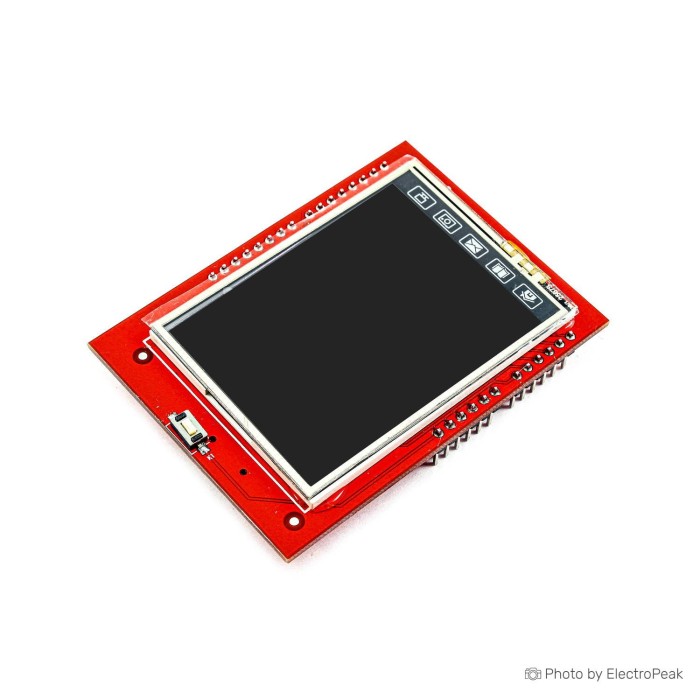
2.4 inch Touch TFT LCD Display Shield for Arduino UNO/Mega
$4.6800
In stock
SKU
LCD-01-024
Volume discounts:
- +25 4 % $4.4900
- +100 6 % $4.3900
- +300 8 % $4.2900
- +500 10 % $4.2000
- +1000 12 % $4.1000
Ships in 2-3 business days, then:
Free delivery in 12-15 days by Tracked Economic Shipping on orders over $100.
Free delivery in 7-10 days by Express Shipping on orders over $300.
More shipping info

Shop with confidence Learn More
 Arduino GIGA (R1 WIFI) Display Shield with Touch - ASX00039 Previous
2.4 inch Arduino Touch TFT LCD Shield review
This 2.4-inch TFT shield adds a 240x320 color display, resistive touch input, and a built-in microSD card connection to Arduino UNO/Mega-style projects. It suits makers building compact dashboards, touch menus, image-display experiments, and simple graphical interfaces where the remaining pin budget is enough.
Like many generic Arduino display shields, first use can involve controller identification, library selection, and touch calibration. It is a practical shield-format option for makers prepared to upload diagnostic sketches rather than expecting a fixed-controller, no-adjustment setup.
Specifications of 2.4 inch Touch TFT LCD Display Shield for Arduino UNO/Mega
- Display: 2.4³ diagonal Touch LCD TFT display
- Resolution and color: 240x320 resolution, 18-bit (262,000) color
- Display interface: 8 bit digital interface, plus 4 control lines
- Pin use: Uses digital pins 5-13 and analog 0-3. That means you can use digital pins 2, 3 and analog 4 and 5. Pin 12 is available if not using the microSD
- Board compatibility: Works with any Arduino UNO and MEGA compatible boards
- Logic compatibility: 5V compatible. Use with 3.3V or 5V logic
- Regulator: Onboard 3.3V 300mA LDO regulator
- Working temperature: -30°C ~ 70°C.
- Display power pin: 5V: Power supply voltage.
- Display ground pin: GND: Ground connection.
- Display chip-select pin: LCD_CS: Selects the TFT display.
- Display reset pin: LCD_RST: Reset signal for the display.
- Display write pin: LCD_WR: This pin is responsible for enabling the write operation.
- Display read pin: LCD_RD: This pin is responsible for enabling the read operation.
- Display data/command pin: DC/RS (Data/Command): Selects between data and command input.
- Touchscreen interface pins: LCD_D0,D1,RD,WR: Touchscreen interface pins.
2.4 inch Touch TFT LCD Shield specifications explained
The 240x320 display gives an Arduino project room for menus, live values, simple graphs, and touch targets that would not fit comfortably on a text-only character LCD. Its 2.4-inch diagonal keeps the shield compact. Exact mechanical dimensions and enclosure clearances are not specified.
| Specification | Why it matters |
|---|---|
| 8 bit digital interface, plus 4 control lines | This parallel shield connection avoids separate display wiring for the core display interface, but it uses a substantial part of the Arduino pinout. |
| Digital pins 5-13 and analog pins 0-3 used | Plan connected sensors, buttons, and modules around those occupied pins. Digital pins 2 and 3 plus analog pins 4 and 5 remain available. |
| Pin 12 available without microSD use | Pin 12 is only available when the microSD function is not in use, so it cannot be treated as free in projects that need SD storage. |
| 3.3V or 5V logic support | The shield can be used with either 3.3V or 5V logic environments. It also includes an onboard 3.3V 300mA LDO regulator. |
| Attached resistive touchscreen | Resistive touch detects press location for on-screen controls and simple menus. It is intended for single-point press input rather than multi-touch interaction. |
| 18-bit (262,000) color | The panel capability is 18-bit color, while many Arduino library workflows use 16-bit 5-6-5 color packing. That library format is a normal practical consideration when preparing graphics and colors. |
2.4 inch Arduino touch shield compatibility and setup
The shield works with Arduino UNO and MEGA compatible boards. Named compatible boards include Arduino UNO R3, Arduino Uno R4 WiFi, Arduino Uno R4 Minima, Arduino Mega, Arduino DUE, and similar pinout boards.
It installs as an Arduino add-on shield, so the core display connection does not require point-to-point wiring. Pin conflicts still matter. The shield uses digital pins 5-13 and analog pins 0-3, while microSD use affects pin 12 availability.
What you need
- Required: One compatible host board: an Arduino UNO-compatible host board or an Arduino Mega-compatible host board.
- Required for UNO/Mega programming and power: A USB cable for UNO/Mega programming.
- Recommended: A stylus or fine-tip tool helps when testing small on-screen controls.
- Recommended: A magnifier and multimeter help inspect solder joints, connectors, and power-related issues after arrival.
- Optional: A microSD card is needed for image-storage and microSD examples.
- Optional: Stacking headers or header sockets can help with additional shield stacking where pin conflicts permit.
- Optional: An external 3.3V supply may be useful for projects affected by 3.3V rail sensitivity reported in the generic shield family.
First-use verification
- Seat the shield on a compatible Arduino UNO/Mega-style board with the headers aligned correctly.
- Connect the host board to a computer with the appropriate USB cable.
- Install the Arduino IDE and the MCUFRIEND_kbv, Adafruit_GFX, and TouchScreen libraries.
- Upload a controller-ID sketch such as LCD_ID_readreg.ino.
- Select or enable support for the detected controller in the display library if required.
- Upload a graphics test such as graphictest_kbv.ino. A working test shows color shapes or text rather than a blank white display.
- Run a touch-calibration or paint example. Touch input should align with the displayed touch location.
- Add a microSD card only when testing image or SD-card examples.
The full reference for 2.4-inch TFT shield wiring, libraries, calibration, and example code covers the display, touch, microSD image workflow, and sample sketches. Some generic shield-family boards need controller-specific library support or touch-pin adjustments, so verify the display before building the rest of the project around it.
2.4 TFT white screen, touch calibration and limitations
A white screen can result from an unsupported or incorrectly selected controller driver. Run a controller-ID sketch first, then use MCUFRIEND_kbv support for the detected controller instead of treating a white screen as proof that the display is defective.
Do not assume this is an ILI9341 shield. The controller is not specified, and visually similar generic MCUFRIEND-style shields have used multiple controller variants, including ILI9341, SPFD5408, HX8347, ILI9325/9328, and ST7781 family examples.
Touch behavior may require calibration, axis inversion, or changes to the YP, XM, YM, and XP definitions when a generic shield batch uses a different touch mapping. Incorrect or offset touch coordinates do not automatically mean the touch panel has failed.
Arduino libraries may use 16-bit 5-6-5 color packing even though the display specification is 18-bit (262,000) color. Some generic-family reports also describe color-shift fixes, so check library configuration if colors do not appear as expected.
Inspect screen alignment, the touch flex cable, solder joints, and the microSD connector after arrival. Generic shield-family buyer reports include variation in these areas. Choose a documented-controller display approach when the project requires predictable setup, stable hardware revisions, accurate color, or production-grade reliability.
2.4 inch Arduino touch shield vs 2.8 inch and 3.5 inch TFT shields
Choose this 2.4-inch shield when a 240x320 touch display and the stated UNO/Mega shield compatibility fit the project. It suits compact graphical interfaces where the available D2, D3, A4, and A5 pins are sufficient.
| Shield | Supplied specifications | When it fits |
|---|---|---|
| 2.4 inch Touch TFT LCD Shield | 2.4-inch display, 240x320 resolution, resistive touch, built-in microSD card connection | Compact UNO/Mega-style touch interfaces and microSD image-display experiments. |
| 2.8-inch Arduino touch shield | 2.8-inch 320x240 screen, XPT2046 resistive touch controller, programmable backlight adjustment, Micro SD storage | A better fit when those 2.8-inch-screen, touch-controller, backlight-adjustment, and Micro SD requirements match the project. |
| 3.5-inch Arduino TFT shield | 3.5-inch 320x480 screen, ILI9486 driver chip, 8-bit data bus interface | A better fit when the project needs a larger 3.5-inch screen, 320x480 resolution, and a stated ILI9486 driver chip. |
The 3.5-inch shield has an always-on backlight and requires careful handling because of static sensitivity. Price, free-pin allocation, library setup effort, dimensions, and power-consumption comparisons are not supplied for these variants.
2.4 inch TFT LCD Shield projects and FAQ
This shield suits color GUI demonstrations, simple instrument dashboards, menu-driven controllers, touch paint examples, and microSD image-display experiments. MCUFRIEND-style shield-family examples also include graphics tests, color demonstrations, and simple data-logger dashboards with touch input.
Portable measurement displays with simple menus, status indicators, and graph views are technically suitable uses. Small robot or home-automation touch panels can also fit when the remaining pin budget is sufficient. The supplied beginner TFT LCD guide covers graphics, fonts, and display examples; image presentation, high-frame-rate graphics, and safety-critical HMI work are not strong fits.
Will this 2.4 inch Touch TFT LCD Shield work with Arduino UNO and Mega boards?
Yes. It works with Arduino UNO and MEGA compatible boards, and named compatible boards include Arduino UNO R3, Arduino Uno R4 WiFi, Arduino Uno R4 Minima, Arduino Mega, Arduino DUE, and similar pinout boards. Some generic-family boards still need controller-specific libraries or additional setup.
Is this an ILI9341 2.4 inch Arduino touch shield?
No fixed controller model is identified. Use a controller-ID sketch before selecting a library or copying an ILI9341-specific example.
Why does a 2.4 TFT shield show a white screen?
A white screen commonly indicates an unsupported or incorrectly selected display driver. Read the controller ID, use MCUFRIEND_kbv, and enable support for the detected controller when required.
How many Arduino pins remain free with this 2.4 inch TFT shield?
Digital pins 2 and 3 plus analog pins 4 and 5 remain available. The shield uses digital pins 5-13 and analog pins 0-3, while pin 12 is available only when microSD is not used.
Does the touchscreen need calibration?
Yes, touch calibration may be required. The supplied calibration guide addresses the normal workflow, while generic-family boards can also need axis inversion or touch pin-definition changes.
Can this 2.4 inch Arduino touch shield display images from a microSD card?
Yes. Images stored on a microSD card can be displayed through the supplied interfacing tutorial. A microSD card is needed for this use and is not stated as included.
Does 18-bit color mean every Arduino sketch displays 262,000 colors?
No. The display is specified as 18-bit (262,000) color, but many Arduino libraries use 16-bit 5-6-5 color packing. Some shield and library combinations may need color-packing adjustments.
What is included with the TFT shield?
Package contents are not stated. Do not assume that an Arduino board, USB cable, microSD card, or stylus is included.
2.4 inch Arduino Touch TFT LCD Shield buying checklist
Choose this shield for an Arduino UNO/Mega-style project that needs a compact color touch interface, a microSD connection, and enough remaining pins for D2, D3, A4, and A5. It is less suitable when the project needs a fixed known controller, many free pins, assured color accuracy, a larger screen, or a no-adjustment first-use experience.
For text-only status information and physical navigation buttons, a text-only Arduino display with physical buttons takes a different approach. For a project already based on Arduino GIGA R1 WiFi that needs a 3.97-inch 480x800 display, five-point touch, microphone, IMU, or camera connector, the Arduino GIGA R1 WiFi multimedia touch display is the relevant alternative approach.
Buying checklist
- ✓ Confirm that the project uses an Arduino UNO/Mega-compatible board or another board named in the compatibility list.
- ✓ Confirm that using digital pins 5-13 and analog pins 0-3 leaves enough I/O for the rest of the project.
- ✓ Confirm whether pin 12 must remain free; it is only available when microSD is not used.
- ✓ Confirm whether the project needs a microSD card for image storage.
- ✓ Confirm that a 240x320 display is sufficient rather than a larger 2.8-inch or 3.5-inch option.
- ✓ Confirm that resistive touch suits the intended interface.
- ✓ Confirm willingness to run a controller-ID sketch, use MCUFRIEND_kbv, and calibrate touch if needed.
- ✓ Confirm that enclosure work can wait until exact dimensions and connector clearances are measured.
- ✓ Confirm that an Arduino board and USB cable are already available, since package contents are not stated.
- ✓ Confirm that the project does not require a guaranteed ILI9341 controller or a fixed touch-pin mapping.
Purchase decision summary
- Ideal for: Arduino UNO/Mega-style projects that need a 240x320 color screen, resistive touch input, microSD connection, and compact shield-style installation.
- Maybe for: Beginners willing to follow an interfacing guide, upload diagnostic sketches, identify a display controller, and calibrate touch.
- Avoid if: The project needs a confirmed fixed controller, guaranteed plug-and-play examples, many free pins, precise color output, large-screen graphics, multi-touch input, or documented production reliability.
| Platform | Arduino Mega, Arduino Uno |
|---|---|
| Display Size | 2.4 |
| Display Size Range | 2 inch to 3.49 inch |
| Display Resolution | 240x320 |
| Display Interface | Parallel, Shield |
| Panle Type | TFT |
| Display Color Type | Full Color |
| Touchscreen Type | Resistive |
| Backlight Type | White LED |
| Operating Temp (°C) | -30°C to 70°C |
| Operating Voltage (V) | 3.3V, 5V |
Write Your Own Review

Please complete your information below to login.
Sign In
Create New Account