
Product added to cart

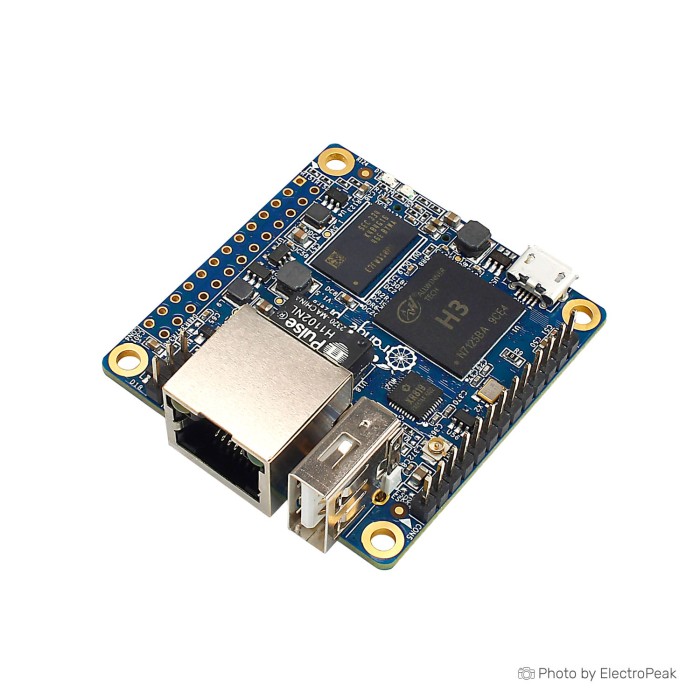
Orange Pi Zero LTS H3 Quad Core Development Board
$28.9500
In stock
SKU
MIN-02-031
Volume discounts:
- +10 3 % $28.0600
- +25 5 % $27.6100
- +50 6 % $27.1600
- +100 8 % $26.7100
- +300 9 % $26.2700
Ships in 2-3 business days, then:
Free delivery in 12-15 days by Tracked Economic Shipping on orders over $100.
Free delivery in 7-10 days by Express Shipping on orders over $300.
More shipping info

Shop with confidence Learn More
 Orange Pi Zero 2 H616 Quad Core Development Board Previous
Orange Pi Zero LTS H3 review
The Orange Pi Zero LTS H3 is a compact single-board computer built around an Allwinner H3 quad-core processor, with 10/100M Ethernet, integrated WiFi, hardware GPIO access, and USB OTG power. It provides a functional Linux environment in a footprint barely larger than an SD card, making it suitable for dedicated headless micro-server tasks. It is aimed at compact wired Linux and maker projects, but ongoing driver quirks with the onboard XR819 wireless chip, sensitive thermal limits under sustained CPU load, and the lack of native HDMI output require specific hardware planning before deployment across the wider Orange Pi board family.
Specifications of Orange Pi Zero LTS H3 Quad Core Development Board
- CPU: H3 Quad-core Cortex-A7 H.265/HEVC 1080P.
- GPU: Mali400MP2 GPU @600MHz Supports OpenGL ES 2.0
- Memory (SDRAM): 256MB/512MB DDR3 SDRAM(Share with GPU)(256MB version is Standard version)
- Onboard Storage: TF card (Max. 32GB)/ 2MB Spi Flash
- Onboard Network: 10/100M Ethernet RJ45 POE is default off.
- Onboard WiFi: XR819, IEEE 802.11 b/g/n
- Audio Input: MIC(via 13 pins external board )
- Video Outputs: AV OUT(via 13 pins external board)
- Power Source: USB OTG can supply power
- Low-level peripherals: • 26 Pins Header,13 Pins Header, with 2x USB, IR pin, AUDIO(MIC, AV)
- LED: Power led & Status led
- Supported OS: Android, Lubuntu, Debian
Orange Pi Zero LTS H3 specifications and compatibility
The board is offered in two memory configurations: a standard 256MB DDR3 version and a 512MB version. Because the DDR3 memory is shared dynamically with the Mali400MP2 GPU, available system RAM is strictly limited. The 256MB configuration suits single-purpose embedded tasks such as reading serial sensors or forwarding basic network telemetry. Choose the 512MB version for lightweight background services, small local web servers, or multiple background daemons; it provides necessary headroom against out-of-memory kernel panics.
The technical specification lists Android, Lubuntu, and Debian, while general product documentation also names Ubuntu. In community use, Armbian provides actively maintained, lightweight Linux distributions that strip out unnecessary graphical components. Boot assets and file systems reside on a TF card supporting up to 32GB, alongside an onboard 2MB SPI flash chip often used for network bootloaders or initial bootstrap code.
Expansion uses two distinct headers: a 26-pin low-level header and a 13-pin functional header. The 26-pin header mirrors the pin assignments of early 26-pin single-board computers and carries UART, I2C, SPI, and GPIO signals, though its physical orientation on the PCB differs. For routing these lines into standard breadboards without mechanical conflicts, an Orange Pi 26P GPIO extension cable provides a clean, flexible connection. The secondary 13-pin header breaks out analog audio input, composite AV video output, an infrared receiver pin, and two additional USB channels. Projects that depend on these lines require a dedicated external interface board.
Native display hardware is strictly limited to composite video; the board has no onboard HDMI. If your deployment requires direct digital video, integrated high-speed flash, or a dedicated camera interface, review HDMI, CSI camera, and eMMC requirements on the Orange Pi Zero Plus 2. For complex Linux software stacks that need expanded memory capacity, the higher-memory Orange Pi Zero option offers up to 4GB of LPDDR4 memory with modern video connectivity.
| Subsystem | Specification | Practical Considerations |
|---|---|---|
| Processor & GPU | Allwinner H3 Quad-core Cortex-A7, Mali400MP2 | 32-bit architecture capable of 1080p H.265 decoding; needs passive cooling under continuous compute loads. |
| System Memory | 256MB (Standard) or 512MB DDR3 | Shared with GPU. 256MB is suited for minimal daemons; 512MB is recommended for multitasking and logging. |
| Primary Storage | MicroSD / TF card (Max. 32GB) + 2MB SPI flash | Official limit is 32GB. Requires a dependable high-endurance Class 10 card to prevent filesystem corruption. |
| Networking | 10/100M RJ45 Ethernet, XR819 802.11 b/g/n WiFi | Ethernet provides reliable plug-and-play operation; onboard WiFi stability depends heavily on kernel driver maturity. |
| Video & Audio | AV Out, Mic In (via 13-pin external breakout) | No HDMI output onboard. Analog video and microphone signals require the auxiliary 13-pin breakout board. |
| Expansion Headers | 26-pin low-level header, 13-pin auxiliary header | Exposes 2x USB, IR, audio, I2C, SPI, and UART; physical layout differs from standard 40-pin footprints. |
Orange Pi Zero LTS WiFi, power and thermal limitations
Network reliability on the Orange Pi Zero LTS centers on its dual-interface configuration. The 10/100M Ethernet port provides predictable, stable throughput for headless networking, while the onboard XR819 802.11 b/g/n wireless chip has documented stability issues. On various mainline Linux kernels, users frequently encounter dropped associations, high packet latency, or fluctuating MAC addresses across system reboots. Start with the wired Ethernet jack for initial configuration, then test wireless stability under your chosen kernel version.
Power is delivered through the micro-USB OTG port. It is convenient, but powering micro-servers from arbitrary smartphone wall adapters frequently introduces intermittent brownouts, sudden reboots, and storage corruption during peak processor bursts. Community deployments consistently show that a dedicated, stable 5V/2A power supply prevents voltage sags when the CPU cores ramp up.
Thermal dissipation needs proactive planning. The H3 quad-core architecture concentrates heat quickly in small spaces. During ongoing background tasks, network routing, or heavy logging, running the board bare can lead to thermal throttling. A small aluminum heatsink attached to the SoC helps maintain consistent clock speeds and hardware longevity.
The onboard Ethernet jack states "POE is default off." This does not mean the board supports standard IEEE 802.3af or 802.3at active Power over Ethernet. It uses an unpopulated passive 5V PoE circuit that requires physical soldering modifications on the PCB and an external 5V passive injector. Connecting this board directly to an active 48V commercial PoE network switch will cause immediate hardware damage.
Plan around these fundamental constraints:
- No onboard HDMI or digital display output exists.
- This model provides no integrated Bluetooth hardware.
- The standard package includes no power supply, storage card, or heatsink.
- Power over Ethernet requires physical soldering modifications and passive 5V equipment.
For built-in 5GHz networking, peripheral Bluetooth pairing, and integrated 4K video out, review modern WiFi, Bluetooth, and HDMI requirements on the Orange Pi Zero 2 as a more integrated starting point.
Orange Pi Zero LTS H3 accessories and setup
Reliable operation requires a few external components. At minimum, booting needs a dedicated power source and an operating-system card. A high-speed 32GB Class 10 microSD card matches the official storage limit and provides the read/write throughput needed for dependable Linux root filesystems. Pair it with a compatible 5V 2A power adapter. Together, they address the two most common initial-boot failures: low input voltage and storage timeouts.
Choose hardware accessories according to the installation:
- Required: Use a 5V/2A micro-USB power adapter and a compatible Class 10 microSD card (up to 32GB).
- Recommended: Add a dedicated SoC heatsink for thermal dissipation under continuous compute loads, an external u.FL/IPEX WiFi antenna to stabilize the XR819 wireless link, and an Orange Pi 26P GPIO extension cable for wiring clearance.
- Optional: Use a 13-pin expansion breakout board for composite AV out, microphone input, IR control, and additional USB ports; add passive 5V PoE injector hardware only after soldering board bridge pads; and use bidirectional logic-level shifters when interfacing with 5V sensors.
Use this initial verification sequence to establish a clean working environment:
- Download a verified Linux server image, such as an Armbian minimal build or official Debian release.
- Write the image to your microSD card with a dependable flashing utility, then insert the card into the board's TF slot.
- Connect a standard Ethernet patch cable directly from your network switch to the RJ45 port.
- Connect the 5V/2A power supply to the USB OTG connector.
- Observe the onboard Power and Status LEDs to confirm boot-sequence initiation.
- Find the board's assigned IP address on your local network router and open an SSH connection.
- Monitor CPU temperature through the terminal during initial operations before moving to headless or enclosed setups.
Orange Pi Zero LTS vs Zero 2 and Zero 3
The Orange Pi compact series spans several processor generations. Comparing the LTS H3 model with later revisions helps clarify which board fits your compute and I/O requirements.
| Feature | Orange Pi Zero LTS | Orange Pi Zero 2 | Orange Pi Zero 3 |
|---|---|---|---|
| Processor | Allwinner H3 (32-bit Quad Cortex-A7) | Allwinner H616 (64-bit Quad Cortex-A53) | Allwinner H618 (64-bit Quad Cortex-A53 @ 1.5GHz) |
| RAM | 256MB or 512MB DDR3 | 512MB or 1GB DDR3 | 1GB, 1.5GB, 2GB, or 4GB LPDDR4 |
| Ethernet | 10/100M RJ45 | 10/100/1000M Gigabit RJ45 | 10/100/1000M Gigabit RJ45 |
| Wireless | XR819 802.11 b/g/n (2.4GHz) | Dual-band 802.11ac + Bluetooth 5.0 | Wi-Fi 5 + Bluetooth 5.0 |
| Video Output | AV Out (via 13-pin external header) | Micro HDMI 2.0a (4K@60fps) | Micro HDMI 2.0a (4K@60fps) |
| Power Input | Micro-USB OTG (5V/2A recommended) | USB Type-C (5V/3A required) | USB Type-C (5V/3A required) |
Hardware variations address distinct engineering priorities:
- For 64-bit compute, integrated 4K video, and gigabit wired networking, the Orange Pi Zero 2 (Allwinner H616) adds upgraded network and media pipelines.
- Larger application stacks or containers that demand up to 4GB RAM point to the Orange Pi Zero 3 (Allwinner H618 / LPDDR4), with higher memory bandwidth and modern wireless.
- For onboard embedded storage and native camera input, the Orange Pi Zero Plus 2 (H5 / 8GB eMMC) includes integrated eMMC flash alongside a CSI connector.
- The Orange Pi Zero H2+ 512MB option is an established micro-architecture alternative for users specifically seeking a dedicated 512MB Cortex-A7 board.
- Need another purchasing channel for this exact specification? The identical Orange Pi Zero H3 listing has the same physical board layout and features.
Orange Pi Zero LTS H3 FAQ
Does Orange Pi Zero LTS H3 WiFi work on Armbian?
Yes, but wireless stability depends heavily on the specific Linux kernel release. The onboard XR819 802.11 b/g/n module works best on legacy or vendor-supported kernel branches, while mainline kernel builds occasionally suffer packet drops, high latency, or transient MAC address assignments. Use wired Ethernet for initial setup to establish a stable environment while verifying wireless driver performance on your preferred image.
Does the Orange Pi Zero LTS H3 have HDMI output?
No, this board has no onboard HDMI port. Visual display output is limited to analog composite video (AV OUT) through the unpopulated 13-pin expansion header, requiring a matching breakout board and an analog-compatible monitor or converter.
Is Orange Pi Zero LTS PoE plug-and-play?
No, Power over Ethernet is disabled by default and is not standard 48V IEEE 802.3af/at PoE. Ethernet power requires manual soldering modifications across designated PCB bridge pads and must only be used with an external 5V passive injector. Connecting this board directly to standard commercial PoE switches will damage the hardware.
Is 256MB enough for Orange Pi Zero LTS server projects?
A 256MB RAM capacity is sufficient only for dedicated, minimal headless tasks such as a small Mosquitto MQTT broker, basic GPIO sensor forwarding, or tiny UART bridge scripts. Because system RAM is shared with the GPU, multitasking environments, container runtimes, or modern web frameworks quickly exhaust memory. The 512MB version is far more practical for multi-service servers.
Can I use a 64GB or 128GB microSD card with Orange Pi Zero LTS H3?
The official hardware specification lists 32GB as the maximum supported TF card capacity. Some community users have successfully partitioned and booted larger high-capacity cards under specific modern operating-system images, but 32GB remains the verified limit for reliable initialization and filesystem integrity.
Can I use Raspberry Pi HATs with Orange Pi Zero LTS H3?
Electrically, the 26-pin low-level header shares similar logical signal definitions with early 26-pin standard boards, but its physical location and mechanical orientation on the PCB differ. Rigid add-on shields and HATs cannot plug directly into the header without mechanical interference. An Orange Pi 26P GPIO extension cable resolves the physical alignment gap and allows clean breadboard or shield integration.
What power supply does Orange Pi Zero LTS H3 need?
The board is powered through its micro-USB OTG port and operates stably on a clean 5V DC line capable of delivering at least 2A. Standard low-current computer USB ports or basic smartphone chargers often drop voltage during peak CPU clock shifts, triggering unexpected reboots or corrupted flash storage.
What should I choose if I need Mini HDMI, a camera connector, or the Raspberry Pi ecosystem?
For projects that rely on native digital video, ribbon-cable camera modules, or a standardized 40-pin header layout, the Raspberry Pi Zero 2 W is an adjacent alternative platform. If you strictly need an ultra-compact, headless wired Linux controller without display circuitry or integrated wireless chips, the NanoPi NEO H3 (512MB) offers a minimal alternative footprint within the wider realm of miniature computing.
Orange Pi Zero LTS H3 buying decision
The Orange Pi Zero LTS H3 fills a specific role in embedded Linux development: an economical, ultra-compact board for wired network tasks, hardware sensor interfaces, and lightweight micro-servers. Retail research cites $8–12 for the 512MB version, placing it among the most accessible entry points for dedicated Linux compute nodes.
- Ideal for: Fixed Ethernet IoT nodes, dedicated MQTT brokers, small DNS filtering experiments, UART-to-network bridges, and retro composite-video projects with an auxiliary breakout board.
- Maybe for: Wireless projects where you can test and pin specific legacy Linux kernels for XR819 stability, or projects needing passive 5V PoE where you are comfortable modifying PCB jumper pads.
- Consider another option if: You need digital HDMI video, dependable dual-band WiFi out of the box, integrated Bluetooth, more than 512MB RAM, gigabit network speeds, or standard plug-and-play active PoE.
Before completing your order, check your project requirements against this pre-purchase list:
- Verify whether your order configuration specifies the standard 256MB or the upgraded 512MB DDR3 memory layout.
- Ensure your deployment plan uses 10/100M wired Ethernet, or confirm that your OS image includes verified XR819 wireless support.
- Confirm that composite video meets your display needs, since no HDMI output is present.
- Add a dedicated, regulated 5V 2A power adapter to avoid brownout reboots.
- Include a compatible, high-speed 32GB Class 10 microSD card for operating-system storage.
- Plan for a passive aluminum heatsink if the Allwinner H3 processor will run under continuous compute loads.
- Source an auxiliary 13-pin interface board if your project requires analog audio in, AV video out, IR control, or extra USB ports.
- Verify physical header clearances when interfacing with external shields.
For higher processing throughput, modern networking, or direct digital display capabilities, review the expanded alternatives across the broader Orange Pi board family.
| Processor (SoC) | Allwinner H2 |
|---|---|
| CPU | Allwinner H2 Quad-core Cortex-A7 |
| Architecture | ARM Cortex-A7 |
| RAM | 512MB |
| RAM Type | DDR3 |
| Storage Support | microSD |
| Storage Capacity | TF card (Max 32GB), 2MB NOR flash |
| GPU/VPU | Mali400MP2 |
| Ethernet | 100 Mbps |
| Wi-Fi | WiFi 4 |
| Bluetooth | No |
| USB Ports | 1× USB 2.0 HOST, 1× USB 2.0 OTG |
| Video Output | No |
| Hardware Interfaces | I2C, SPI, UART |
| GPIO Pins | 26-pin |
| Camera/Display | No |
| Power Input | USB OTG or integrated POE |
| PCIe | No |
| Dimensions (mm) | 45 × 48mm |
| OS Support | Ubuntu, Raspberry Pi OS, Debian, Android |
| Weight (g) | 30g |
Write Your Own Review

Please complete your information below to login.
Sign In
Create New Account