
Product added to cart

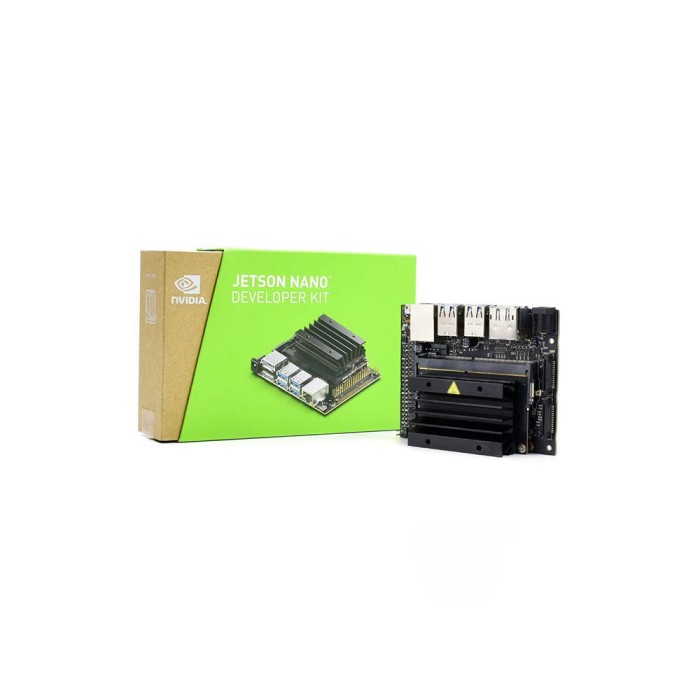
NVIDIA Jetson Nano B01 AI Developer Kit
$349.0000
In stock
SKU
MIN-08-002
Volume discounts:
- +5 3 % $337.9700
- +10 5 % $332.4500
- +25 6 % $326.9300
- +50 8 % $321.4100
- +100 9 % $315.9000
Ships in 2-3 business days, then:
Free delivery in 12-15 days by Tracked Economic Shipping
Free delivery in 7-10 days by Express Shipping
More shipping info

Shop with confidence Learn More

Jetson Nano B01 AI Developer Kit Review
The NVIDIA Jetson Nano B01 AI Developer Kit is a compact platform for learning CUDA, building TensorRT pipelines, and developing edge-AI prototypes. Built around an NVIDIA Maxwell architecture GPU and a quad-core ARM processor, it provides hardware acceleration for computer vision, robotics, and lightweight neural network inference. It remains functional for education and legacy workflows, but it is not suited to modern deployments requiring current JetPack releases, updated Python frameworks, or production lifecycle guarantees. For buyers comparing options in this architecture, NVIDIA development-board alternatives include both legacy and current-generation hardware.
Specifications of NVIDIA Jetson Nano B01 AI Developer Kit
- AI Performance: 472 GFLOPS
- GPU: 128-core NVIDIA Maxwell™ architecture GPU
- GPU Max Frequency: 921MHz
- CPU: Quad-core ARM® Cortex®-A57 MPCore processor
- CPU Max Frequency: 1.43GHz
- Memory: 4GB 64-bit LPDDR4 25.6GB/s
- Storage:16GB eMMC 5.1
- Video Encode: 1x 4K30 (H.265) 2x 1080p60 (H.265)
- Video Decode: 1x 4K60 (H.265) 4x 1080p60 (H.265)
- CSI Camera: Up to 4 cameras ,12 lanes MIPI CSI-2 ,D-PHY 1.1 (up to 18 Gbps)
- PCIe : 1 x4 (PCIe Gen2)
- USB: 1x USB 3.0 (5 Gbps) 3x USB 2.0
- Networking : 1x GbE
- Display: 2 multi-mode DP 1.2/eDP 1.4/HDMI 2.0 1 x2 DSI (1.5Gbps/lane)
- Othe: r I/O3x UART, 2x SPI, 2x I2S, 4x I2C, GPIOs
- Power: 5W - 10W
- Mechanical: 69.6mm x 45mm 260-pin SO-DIMM connector
Jetson Nano B01 Specifications Explained
These specifications show how the platform fits real-world edge-AI and embedded workloads, helping you determine whether it meets your processing requirements.
| Specification | Technical Value | Why It Matters |
|---|---|---|
| GPU | 128-core NVIDIA Maxwell architecture @ 921MHz | Provides hardware acceleration for CUDA, TensorRT, and cuDNN workloads. It enables real-time inferencing on lightweight vision models, though throughput is bounded by Maxwell-generation compute capability. |
| Compute Performance | 472 GFLOPS | Represents floating-point compute throughput. Because the measurement precision and workload are not specified, this figure cannot be compared directly with integer-based TOPS metrics found on modern processors. |
| CPU | Quad-core ARM Cortex-A57 MPCore @ 1.43GHz | Handles system orchestration, pre-processing, and general Linux operating system tasks. It provides adequate processing for multi-threaded sensor acquisition and local device management. |
| System Memory | 4GB 64-bit LPDDR4 @ 25.6GB/s | Shared unified memory architecture between the CPU and GPU. Allocating 4GB across the operating system desktop, camera frame buffers, and neural network models requires careful memory management during execution. |
| Hardware Video Codecs | Encode: 1x 4K30, 2x 1080p60 (H.265) Decode: 1x 4K60, 4x 1080p60 (H.265) |
Dedicated hardware encoding and decoding blocks offload video streams directly, keeping CPU and GPU resources free to run model inference on incoming camera feeds. |
| Power Modes | 5W – 10W configurable | Enables switching between a low-power 5W budget for mobile battery robotics and a 10W mode that allows CPU and GPU cores to operate at full clock frequencies. |
| Form Factor | 69.6mm x 45mm 260-pin SO-DIMM | Reflects the dimensions of the core compute module itself, which plugs into the larger carrier board where the physical power, camera, and display interfaces reside. |
For demanding robotics or enterprise analytics that require higher memory bandwidth and modern compute architectures, higher-memory, higher-performance Jetson development platforms provide 275 TOPS of AI processing, 64GB of LPDDR5 memory, and high-speed networking.
Jetson Nano B01 Setup, Power and Storage Requirements
Reliable operation starts with storage and power planning. Standard B01 developer kits boot from a separately flashed UHS-1 microSD card rather than relying on onboard storage. Although the technical specifications list 16GB eMMC 5.1 storage, official developer kit workflows require an external card for operating system installation. A required boot media card with at least 32GB provides space for the Linux environment, swap files, and container images.
Power stability matters on the Jetson Nano. When the GPU and CPU run inference simultaneously, transient current spikes can trigger undervoltage lockouts or reboot loops when the power supply lacks sufficient headroom. Basic operation and light desktop tasks run from a 5V⎓2A micro-USB connection. For higher workloads, dual-camera setups, or connected USB 3.0 peripherals, official guidance specifies a 5V⎓4A barrel jack supply (2.1mm inner, 5.5mm outer diameter, center-positive).
The J48 jumper header controls power routing directly. With the J48 pins open, input current routes through the micro-USB connector. Installing a standard 2.54mm jumper across the J48 pins disables micro-USB power and routes current from the barrel jack. Boot failures and unexpected resets often trace back to long, high-resistance USB cables or a mismatched J48 jumper position. The full official setup procedure covers the complete setup process.
Need native solid-state storage over high-speed buses rather than microSD media? A newer Jetson development path provides integrated M.2 NVMe slots and expandable memory configurations.
Jetson Nano B01 Software Support and Compatibility
Software lifecycle is a central consideration when choosing the Jetson Nano B01. The platform is restricted to the JetPack 4 branch, running Linux for Tegra (L4T) R32. JetPack 4.6.6 is the final official production release identified for the Nano. JetPack 5 and JetPack 6 do not support the Jetson Nano hardware architecture.
JetPack 4 relies on an Ubuntu 18.04 LTS user space. Modern package repositories, recent Python 3.10+ wheels, and current PyTorch or TensorFlow releases will not run without compiling from source or maintaining older container versions. Supported-component details are available in the JetPack 4.6.6 software support documentation.
| Software Layer | Supported Architecture | Status & Compatibility Notes |
|---|---|---|
| JetPack SDK | JetPack 4.x only (JetPack 4.6.6 final) | JetPack 4 is end-of-life. JetPack 5 and later are incompatible with Jetson Nano. |
| Base Operating System | Linux for Tegra R32 (Ubuntu 18.04 LTS base) | Standard Canonical support for Ubuntu 18.04 has transitioned to legacy status. |
| CUDA & TensorRT | CUDA 10.2, TensorRT 8.2, cuDNN 8.2 | Tied to JetPack 4.6.x builds. Models must be converted using compatible operator sets. |
| Computer Vision & Multimedia | VPI 1.2, OpenCV 4.1.1 (L4T accelerated), DeepStream 6.0.1 | GStreamer hardware pipelines operate reliably within these specific release tags. |
| Python & Frameworks | Python 3.6 native (PyTorch 1.10 max official wheels) | Modern machine learning libraries require backporting or legacy version pinning. |
| Containers | NVIDIA Container Runtime on Docker | Only historical L4T R32 containers pull cleanly without architecture conflicts. |
For modern ROS 2 Humble/Iron environments, contemporary Python packages, and ongoing security updates, choose a newer Jetson development path that works within active JetPack releases.
Jetson Nano B01 Camera, USB and Expansion Interfaces
The B01 carrier board provides dedicated connectivity for edge sensing, visual inspection, and embedded peripheral control. Module-level specifications reference broad lane allocations, while the physical carrier board implements a specific set of ports.
For camera integration, the carrier board has two physical 15-pin MIPI CSI-2 connectors. They accept Raspberry Pi Camera Module V2 (IMX219) ribbons and compatible sensor modules directly, supporting stereo vision or dual-angle capture. Module-level documentation outlines up to 12 CSI lanes, but the standard developer kit exposes two physical interfaces.
Peripheral connectivity includes four physical USB 3.0 Type-A ports and a Micro-B USB 2.0 port used primarily for device-mode flashing and headless serial recovery. Standard full-size HDMI 2.0 and DisplayPort connectors handle display output. Hardware documentation specifies that passive HDMI-to-DVI adapters are unsupported; connect native HDMI or DisplayPort monitors directly.
Embedded sensors and motor drivers connect through a 40-pin expansion header providing GPIO, I2C, SPI, UART, and I2S signaling at 3.3V logic levels. An onboard 4-pin fan header supports 5V PWM cooling fans. An RJ45 port provides Gigabit Ethernet. Wireless connectivity is not built into the reference board, but you can add it through an M.2 Key E slot beneath the module or by adding Wi-Fi with a compact USB network card.
For automation projects centered on standard computing, multi-screen setups, and general Linux tasks without NVIDIA CUDA acceleration, a general-purpose SBC alternative with dual 4Kp60 video output offers a modern software ecosystem.
Jetson Nano B01 Limitations and Lifecycle
Deploying the Jetson Nano B01 involves several clear operational trade-offs:
- End-of-Life Status: NVIDIA lists the Jetson Nano Developer Kit as end-of-life. No further software branches beyond JetPack 4 will be produced.
- Legacy Software Stack: Ubuntu 18.04 limits access to modern community wheels, modern ROS 2 distributions, and recent compiler toolchains.
- Thermal Throttling: Under sustained 10W operation with both the Maxwell GPU and all four CPU cores fully engaged, the passive heatsink can saturate. Without active forced airflow across the fins, internal registers will scale down core clocks to protect the silicon.
- Storage Performance Bottlenecks: MicroSD card interfaces introduce random I/O limits during heavy database writes, package installations, or simultaneous video stream logging.
- Developer Kit Production Limits: Developer kits are designed for laboratory prototyping and testing. NVIDIA explicitly distinguishes them from production-grade System-on-Modules, which incorporate verified industrial endurance ratings and dedicated lifecycle support.
- Variant Inconsistencies: System images, pin mappings, and tutorials developed for the earlier A02 carrier revision or the stripped-down Jetson Nano 2GB are not fully interchangeable with the 4GB B01 board.
Before ordering, confirm that the inventory is genuine NVIDIA reference hardware carrying carrier board marking P3449 B01 or kit part number 945-13450-0000-100. Also confirm stock condition (new versus surplus stock), included accessories, and warranty coverage with the seller.
For projects focused on dual-network routing and local data throughput rather than the Jetson ecosystem, a network-oriented edge-computing alternative with dual 2.5G Ethernet interfaces and onboard eMMC offers an efficient path.
Jetson Nano B01 vs Jetson Orin Nano Developer Kit
The Jetson Nano B01 and its direct successor show the gap between legacy and current Jetson architectures.
| Feature | Jetson Nano B01 | Jetson Orin Nano Developer Kit |
|---|---|---|
| AI Performance | 472 GFLOPS (Maxwell architecture) | 40 TOPS (Ampere architecture) |
| GPU Architecture | 128 CUDA cores @ 921MHz | 1024 CUDA cores + 32 Tensor Cores |
| CPU Complex | Quad-core ARM Cortex-A57 @ 1.43GHz | 6-core ARM Cortex-A78AE @ 1.5GHz |
| Memory Configurations | 4GB 64-bit LPDDR4 @ 25.6GB/s | 4GB or 8GB 128-bit LPDDR5 @ 68GB/s |
| Primary Storage | External microSD slot (16GB eMMC listed) | External NVMe M.2 SSD slot & SD slot |
| Software Support | JetPack 4.x only (L4T R32 / Ubuntu 18.04) | JetPack 5 and JetPack 6 supported |
| Video Encoding | Hardware H.264/H.265 encoder block | CPU-based software encoding |
| Power Envelope | 5W – 10W | 7W – 15W |
The decision centers on software compatibility and compute density. The Jetson Nano B01 remains practical for existing laboratory courseware, legacy JetBot assemblies, and historical codebases pinned to JetPack 4. For new computer vision pipelines, transformer-based edge models, and active software maintenance, a newer Jetson development path avoids the obsolescence constraints of the Maxwell platform.
Jetson Nano B01 Projects and Buying Checklist
The Jetson Nano B01 remains widely documented in educational and maker robotics communities. Verified real-world project categories include:
- JetBot Educational Robotics: Differential-drive mobile robots using CSI cameras for line tracking, collision avoidance, and automated object following.
- Edge Object Detection: Video analytics using SSD-MobileNet, Tiny-YOLO, or custom TensorRT-optimized models processing 720p feeds at practical frame rates.
- Interactive Machine Learning Education: Teaching CUDA programming, deep neural network inference concepts, and OpenCV pipeline optimization.
- Sensor Gateways: Aggregating industrial sensors over I2C, SPI, and UART while executing local vision verification on incoming parts.
For connected mobile field prototypes that need telemetry, cellular connectivity, and positioning without standard network wiring, pair the board with a cellular-connected Jetson Nano projects expansion board for global 4G/3G/2G communication and GNSS tracking.
For projects requiring broad multi-OS platform support outside the Jetson software stack, a multi-OS moderate-AI alternative provides an onboard 6 TOPS NPU alongside Android, Debian, and Ubuntu desktop builds.
Purchase Decision Summary
- Ideal for: Students learning CUDA and TensorRT basics, builders maintaining established JetBot platforms, and engineers servicing deployed JetPack 4 systems.
- Maybe for: Makers who require hardware video decoders on a budget and can provide steady 5V⎓4A barrel power along with dedicated cooling.
- Avoid if: You need JetPack 5 or JetPack 6, current Python libraries, native PCIe x4 expansions, guaranteed industrial supply chains, or high-throughput generative AI.
Jetson Nano B01 FAQ and Buying Checklist
Does the Jetson Nano B01 include 16GB eMMC storage?
The technical specifications list 16GB eMMC 5.1 storage, but official B01 developer kit documentation specifies booting directly from an external microSD card. Prepare a flashed card unless the supplier specifically confirms an alternative hardware carrier bundle.
Does the kit include a power supply, microSD card, or display cables?
Standard developer kit packaging contains only the core module, reference carrier board, small paper stand, and quick-start literature. You must supply a power supply, micro-USB or barrel cables, monitor cables, input peripherals, and required boot media separately.
Is this the 4GB Jetson Nano or the 2GB model?
This unit features 4GB 64-bit LPDDR4 memory. The 2GB Jetson Nano uses a different carrier board with fewer physical ports, half the RAM, and distinct software image requirements.
What power supply does the Jetson Nano B01 require?
The board operates on 5V DC. Basic setups can run on a 5V⎓2A micro-USB adapter, but intensive GPU workloads, camera feeds, and USB accessories require a 5V⎓4A barrel supply with the J48 jumper installed.
Can the Jetson Nano run JetPack 5 or JetPack 6?
No. Hardware architectural limits restrict the Jetson Nano to JetPack 4.x (L4T R32). JetPack 4.6.6 is the final production release, and later versions will not install.
How many USB ports and CSI cameras connect to the B01 carrier?
The B01 carrier board provides four physical USB 3.0 Type-A ports, one Micro-B USB port, and two physical 15-pin MIPI CSI-2 camera connectors. Module-level references to wider lane allocations do not add physical headers to this carrier.
Does the Jetson Nano B01 have built-in Wi-Fi?
No onboard Wi-Fi or Bluetooth silicon exists on the reference board. Connectivity is provided through the Gigabit Ethernet jack, an optional M.2 Key E wireless module, or a compatible USB wireless dongle.
Is the Jetson Nano B01 suitable for commercial manufacturing?
No. NVIDIA specifies developer kits for testing, education, and prototyping. Commercial production hardware requires production-rated System-on-Modules supported by industrial lifecycles.
Is the Jetson Nano B01 still practical to purchase?
It remains practical for teaching CUDA fundamentals, maintaining existing JetPack 4 installations, or running well-documented educational robotics projects. For new greenfield projects, modern NVIDIA development-board alternatives provide active software support and higher compute margins.
Pre-Purchase Verification Checklist
- Confirm that the hardware revision indicates carrier board P3449 B01.
- Ensure your software application runs on JetPack 4.6.6 and Ubuntu 18.04.
- Secure a high-quality Class 10 UHS-1 microSD card of 32GB or larger.
- Procure a regulated 5V⎓4A barrel supply if you plan to utilize active cooling, cameras, or USB peripherals.
- Verify that your monitor accepts native HDMI or DisplayPort connections without passive DVI converters.
- Budget for a 5V PWM fan if running sustained continuous inference workloads.
- Confirm warranty coverage and return conditions with the supplier prior to ordering.
| Processor (SoC) | NVIDIA Jetson Nano B01 SoM |
|---|---|
| CPU | Quad-core ARM® Cortex®-A57 MPCore processor, 1.43GHz |
| RAM | 4GB |
| RAM Type | LPDDR4 |
| Storage Support | microSD, eMMC |
| Storage Capacity | 16GB eMMC 5.1 |
| GPU/VPU | 128-core NVIDIA Maxwell™ architecture GPU |
| Ethernet | 1 Gbps |
| Wi-Fi | No |
| Bluetooth | No |
| USB Ports | 1x USB 3.0 (5 Gbps) 3x USB 2.0 |
| Video Output | HDMI, DisplayPort |
| Hardware Interfaces | CSI (Camera), I2C, SPI, UART, DSI (Display) |
| GPIO Pins | 40-pin expansion header |
| Camera/Display | CSI (Camera), DSI (Display) |
| Power Input | 5V via Micro-USB or DC Barrel Jack |
| PCIe | PCIe 2.0 |
| Dimensions (mm) | 69.6mm x 45mm |
| OS Support | Linux, Ubuntu |
| Power Consumption | 5W - 10W |
| Video Decoding | 1x 4K60 (H.265), 4x 1080p60 (H.265) |
Write Your Own Review

Please complete your information below to login.
Sign In
Create New Account