
Product added to cart

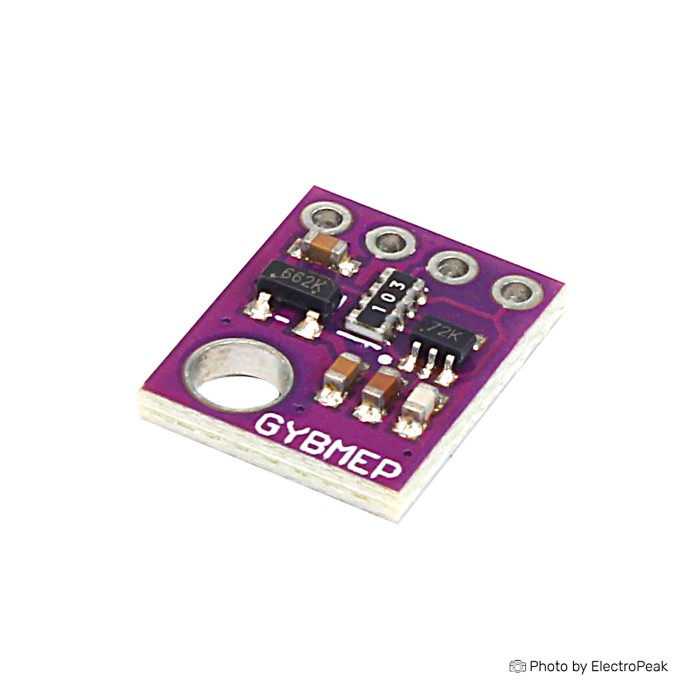
GY-BME280 Temperature, Humidity and Atmospheric Pressure Sensor Module
$2.7500
In stock
SKU
SEN-10-054
Volume discounts:
- +25 4 % $2.6500
- +100 6 % $2.5900
- +300 8 % $2.5400
- +500 9 % $2.4900
- +1000 11 % $2.4400
Ships in 2-3 business days, then:
Free delivery in 12-15 days by Tracked Economic Shipping on orders over $100.
Free delivery in 7-10 days by Express Shipping on orders over $300.
More shipping info

Shop with confidence Learn More
 GY-21P SI7021+BMP280 Temperature, Humidity, Barometric Pressure Sensor Module Previous
GY-BME280 Sensor Module Review and Specifications
The GY-BME280 is a compact environmental breakout board that combines temperature, humidity, and atmospheric-pressure sensing on a single miniature PCB. Designed for microcontroller and robotics projects, it communicates over standard I2C or SPI digital buses to reduce external wiring. For hobby weather stations, terrarium monitors, and indoor climate loggers, three distinct environmental data channels on one module keep breadboards tidy and simplify enclosure layout.
Generic GY-style BME280 breakouts generally sell in the $3 to $6 range, compared with $10 to $20 for branded enthusiast boards, but manufacturing variance is the trade-off. Physical module dimensions, onboard regulator circuits, logic-level handling, and header layouts can differ across production runs. Before integrating this board into a finished enclosure or relying on SPI communication, verify the pin header configuration and onboard components on the hardware you receive. If your design only requires barometric readings, our broader selection of pressure and altitude sensors includes dedicated altimeter and pressure-only options.
Specifications of GY-BME280 Temperature, Humidity and Atmospheric Pressure Sensor Module
- Working voltage: 3.3V
- Communication interfaces: I2C and SPI
- Supply voltage: 1.8 to 5V DC
- I2C interface speed: up to 3.4MHz
- SPI interface speed: up to 10MHz
- Temperature range: -40 to +85 degrees Celsius
- Humidity range: 0 to 100 percent
- Pressure range: 300 to 1100 hectopascals
- Temperature accuracy: ±1°C
- Humidity accuracy: ±3%
- Pressure accuracy: ±1Pa
- Dimensions: 13x11x1 mm
- Weight: 1 g
GY-BME280 I2C and SPI Compatibility
The sensor supports both I2C, with clock speeds up to 3.4 MHz, and SPI, with clock speeds up to 10 MHz. Most microcontrollers use I2C because it needs only two data lines—SDA and SCL—plus power and ground. The BME280 family uses two 7-bit I2C addresses: 0x76 and 0x77. Address selection depends on how the sensor's SDO pin is tied: internally pulled down to ground on most generic boards for 0x76, or pulled high to VCC for 0x77. Only two addresses are available. Connecting three or more BME280 sensors to the same I2C bus requires an external I2C multiplexer.
Operating specifications cover an environmental range from -40°C to +85°C, 0% to 100% relative humidity, and 300 to 1100 hPa barometric pressure. The stated ±1°C temperature and ±3% relative-humidity tolerances suit everyday climate logging, indoor heating/cooling monitoring, and home weather tracking. However, these figures represent typical room-temperature performance rather than calibrated guarantees across harsh thermal extremes.
| Parameter | Specification | Design and Integration Note |
|---|---|---|
| Working Voltage | 3.3V | The internal Bosch sensor core operates at 3.3V logic. |
| Supply Voltage | 1.8 to 5V DC | VCC accepts up to 5V only when an onboard low-dropout (LDO) regulator is populated. |
| Logic Tolerance | Unspecified | Do not assume SDA, SCL, or SPI pins are 5V-tolerant without checking for onboard level-shifting FETs. Use a bidirectional logic shifter when pairing with 5V boards like standard Uno microcontrollers. |
| I2C Bus Support | Up to 3.4 MHz | Standard 100 kHz and 400 kHz fast modes work reliably across Arduino, ESP32, and Raspberry Pi platforms. |
| SPI Support | Up to 10 MHz (3-wire / 4-wire) | SPI requires CS, SCK, SDI, and SDO pin access. If your board features only a 4-pin header (VCC, GND, SCL, SDA), it is hardwired for I2C only. |
For autonomous vehicles, drones, or balancing robots that need inertial tracking alongside barometric altitude, the motion tracking plus pressure sensing GY-91 combines an IMU with pressure measurement on one board.
GY-BME280 Limitations and BMP280 Identification
A common issue in generic electronics supply chains is BMP280 substitution for BME280. The two sensors look similar in small metal-lid packages, but the BMP280 measures only temperature and barometric pressure; it lacks a humidity sensor. Verify the chip programmatically by reading the hardware chip ID register at address 0xD0. A genuine BME280 returns 0x60, while a BMP280 returns 0x58. If your sensor initializes in code but reports 0% relative humidity continuously, it is almost certainly a BMP280 or is reading from an unconfigured register.
Module-level engineering factors also affect measurement quality:
- Self-Heating: Continuous high-rate sampling warms the sensor die. This internal dissipation can cause the reported temperature to sit 1°C to 2°C above actual ambient air. Using forced measurement mode or inserting sleep intervals between readings lets the package settle to ambient temperature.
- Humidity Response Lag: The internal capacitive humidity cell responds through a small vent hole in the metal package. It responds to gradual indoor changes but exhibits settling delays during rapid transitions.
- Pressure Accuracy Specification: The catalog listing cites a pressure accuracy of ±1 Pa. Bosch BME280 family engineering documentation rates absolute atmospheric-pressure accuracy at ±1 hPa (100 Pa), while ±1 Pa corresponds to fine relative noise resolution. Do not rely on ±1 Pa as an absolute calibration benchmark for mission-critical altimetry.
- Environmental Protection: The board contains an exposed vent hole. Liquid water, condensation, airborne grease, or corrosive chemicals will degrade or permanently damage the sensing element.
Where barometric data is not required but tighter, verified factory calibration is, dedicated options such as the higher-accuracy temperature and humidity sensing SHT31 provide ±0.3°C and ±2% RH precision across wider industrial thresholds.
GY-BME280 Weather Station and Environmental Sensor Uses
For DIY weather monitoring and connected smart-home nodes, three metrics in one breakout reduce power requirements and bus routing by half. Common functional setups include:
- ESP32 Low-Power Weather Stations: Reading the BME280 once every ten minutes before putting the ESP32 into deep sleep enables battery-powered operation lasting months on small cells, with output to e-paper displays or local dashboards.
- Home Automation Nodes: Integration with ESPHome or Home Assistant supports tracking indoor dew points, absolute humidity, and heating performance across different living zones.
- Barometric Pressure Trend Loggers: Monitoring the rate of change in atmospheric pressure over three-hour intervals provides localized short-term weather forecasting, indicating incoming storms or clear high-pressure fronts.
- Terrarium and Greenhouse Monitoring: Enclosed plant-growth systems benefit from simultaneous temperature and humidity tracking, provided the sensor is shielded from direct misting and irrigation runoff.
Outdoor deployments require the module to sit inside a vented radiation shield or louvered Stevenson screen. Direct sunlight on the metal sensor case distorts temperature data, while rain ingress ruins the humidity film. This module does not monitor indoor air quality. For projects requiring volatile organic compound detection alongside temperature, humidity, and barometric data, the MCU-680 offers environmental monitoring with gas/VOC sensing on a separate platform.
GY-BME280 Arduino Setup and Breadboard Wiring
Connecting the GY-BME280 to an Arduino, ESP32, or Raspberry Pi requires a functional 4-wire connection for I2C communication. Before permanent soldering, build the circuit on an 830 points Breadboard with flexible sensor jumper wires to confirm chip detection and pin mappings.
- Wiring: Connect GND to the microcontroller ground rail. Connect VCC to the 3.3V power output, or to the 5V rail if your module includes an onboard voltage regulator. Connect SDA to your board's I2C data pin (A4 on standard Uno; GPIO 21 on ESP32) and SCL to the I2C clock pin (A5 on standard Uno; GPIO 22 on ESP32).
- Address Scanning: Upload an I2C scanner sketch to your microcontroller. Verify that a device responds at either
0x76or0x77. If no device appears, check for reversed SDA/SCL lines or loose breadboard pins. - Library Installation: Install a standard community BME280 sensor library through your IDE library manager. Ensure the initialization function points to the address identified in your scan.
- Readout Verification: Run a basic read example. The serial monitor should report temperature, relative humidity, and pressure. If initialization reports chip ID
0x58instead of0x60, the installed chip is a BMP280 and will not output humidity.
Step-by-step code examples and wiring schematics for beginners are available in our Arduino BME280 setup guide and specialized BME280 barometric pressure Arduino guide.
GY-BME280 Sensor Module FAQ
Does the GY-BME280 measure humidity as well as temperature and pressure?
Yes. Genuine BME280 hardware includes an internal capacitive humidity sensor alongside temperature and piezoresistive pressure sensors. When queried over I2C, it outputs all three streams simultaneously.
What is the difference between BME280 and BMP280?
The BME280 measures temperature, relative humidity, and barometric pressure, while the BMP280 measures only temperature and pressure. The BME280 reports a chip ID of 0x60 from register 0xD0; the BMP280 returns 0x58.
Can the GY-BME280 connect directly to an Arduino or ESP32?
Yes, both microcontrollers support the sensor over standard I2C buses. On 3.3V boards such as the ESP32 or Raspberry Pi, communication connects directly to native GPIOs. When wiring to 5V boards such as an Arduino Uno, verify that your specific breakout board contains onboard logic-level shifting circuits or add external level shifting.
What I2C address does the BME280 use?
The sensor responds to either 0x76 or 0x77. On most generic GY-style breakouts, the SDO pin is tied low to set 0x76 as the default address, while pulling SDO high changes it to 0x77.
Does this GY-BME280 module support SPI?
SPI support depends on the physical pin count of the delivered breakout. The core sensor supports 3-wire and 4-wire SPI, but modules fitted with only a 4-pin header expose only I2C lines. Breakouts with 6 or more pins expose CS, SCK, SDI, and SDO for SPI operation.
Can I power the GY-BME280 from a 5V supply?
The underlying Bosch sensor operates at 3.3V, but the module specifications state an input supply range of 1.8V to 5V DC. Powering from 5V requires an onboard low-dropout voltage regulator on the PCB. Verify the presence of this regulator component before feeding 5V into VCC.
Why does my temperature reading read higher than actual room temperature?
Sensor self-heating occurs when the sensor is polled continuously at high frequencies without sleep intervals. Running the chip in forced mode, sampling less frequently, and keeping the board physically separated from hot microcontrollers or display backlights resolves this offset.
Are jumper wires and a breadboard included?
No accessories are bundled. Connecting and evaluating the sensor requires your own microcontroller, hookup wiring, and a development breadboard.
Should I choose BME280, SHT31, or DHT11?
Select the BME280 when barometric pressure is needed alongside temperature and humidity on a single bus address. If pressure data is unnecessary and tighter measurement accuracy is required, the SHT31 is the superior choice. For rough readings in an introductory school project, a low-cost simple temperature and humidity sensing DHT11 module provides basic functionality over a single-wire interface.
GY-BME280 Sensor Module Buying Checklist
| Evaluation Category | Project Fit and Recommendation |
|---|---|
| Ideal For |
|
| Maybe For |
|
| Avoid If |
|
- Confirm that your project requires all three readings: temperature, humidity, and barometric pressure.
- Determine whether you are using I2C or whether your application strictly mandates SPI wiring.
- Verify that your microcontroller platform provides 3.3V logic or that you have logic level converters available.
- Ensure you have prototyping jumper cables and a breadboard ready for testing.
- Plan to run an I2C address scanner upon arrival to confirm whether the device operates at
0x76or0x77. - Verify that register
0xD0returns chip ID0x60to validate genuine BME280 humidity functionality. - Design your physical enclosure to prevent sensor self-heating and protect the vent hole from condensation.
| Interface Type | I2C, SPI |
|---|---|
| Operating Voltage (V) | 3.3V |
| Operating Temp (°C) | -40 to 85 |
| Dimensions (mm) | 13x11x1 mm |
| Mounting Type | THT |
| IP Rating | None |
| Output Type | Digital |
| Accuracy | ±1°C, ±3%, ±1Pa |
| Measurement Range | 30kPa to 110kPa, 0 to 100%, 300 to 1100 hPa |
| Environmental Parameter | Temperature, Humidity, Pressure |
| Probe Type | Surface Mount |
| Weight (g) | 1 |
| Chipset | BME280 |
| Humidity Range | 0 to 100% |
| Relay Output | No |
| Humidity Accuracy | ±3% |
| Protocols | I2C, SPI |
| Temp Accuracy | ±1°C |
Write Your Own Review

Please complete your information below to login.
Sign In
Create New Account