
Product added to cart

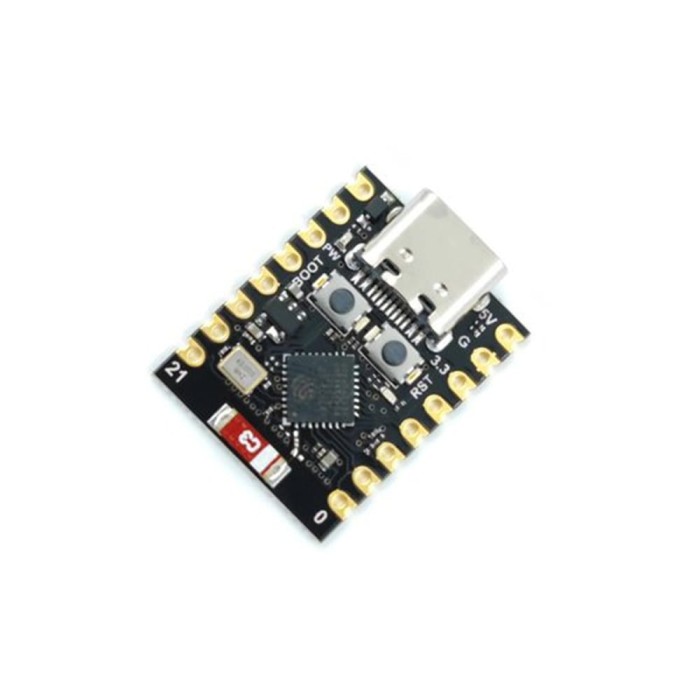
ESP32-C3 development board Mini
$2.2500
In stock
SKU
DEV-02-003
Volume discounts:
- +50 4 % $2.1600
- +100 6 % $2.1200
- +300 8 % $2.0700
- +500 10 % $2.0300
- +1000 12 % $1.9800
Ships in 2-3 business days, then:
Free delivery in 12-15 days by Tracked Economic Shipping on orders over $100.
Free delivery in 7-10 days by Express Shipping on orders over $300.
More shipping info

Shop with confidence Learn More
 Espressif ESPC2-12 ESP8684 Development Board Previous
ESP32-C3 development board Mini specifications and buying notes
This ESP32-C3 development board Mini is a compact board for small wireless builds, quick prototypes, and general IoT work. It brings 2.4 GHz Wi-Fi and Bluetooth 5.0 to a small footprint, which suits sensor nodes, BLE devices, and low-cost embedded experiments.
The main trade-off is board-level certainty. The ESP32-C3 platform itself is familiar and well supported, but this board makes the most sense for buyers who are comfortable checking pinout, flash details, and USB behavior after it arrives. No exact price is supplied here. If you want a same-family option with a more explicit listing, compare the ESP32-C3-MINI Board. For broader platform context, see our ESP32 boards and the guide to getting started with the ESP32 Development Board.
Specifications of ESP32-C3 development board Mini
- Compact and powerful development board
- ESP32-C3 chipset for stable and efficient performance
- CPU: RISC-V 32-bit single-core processor, Main frequency: 160MHz
- Ultra-Low Power Coprocessor (ULP)): N/A
- SRAM 400kB
- ROM: 384kB
- On-chip Flash: None 4MB different specifications
- External Flash: Maximum support 16MB
- External PSRAM support: N/A
- Wi-Fi: 802.11 b/g/n, 2.4 GHz
- Bluetooth: Bluetooth 5.0
- ADC: 2*12-bit SAR ADC, 6 channels
- Various interfaces
- User-friendly and easy-to-use design
- 32-bit RISC-V processor
- Built-in WiFi and Bluetooth capabilities
- Fast processing speeds
- Affordable price
- Suitable for beginners and professionals
- Endless possibilities for IoT and WiFi development.
- Peripherals
- DAC:N/A
- Timer: 2*54-bit general timer 3Watchdog timer
- Temperature Sensor:1
- Touch sensor:N/A
- Hall sensor:N/A
- GPIO:22
- SPI:3
- UART:2
- I2C:1
- I2S:1
- Camera:N/A
- RMT (infrared remote control): 1*4 channels
- LED PWM: 1*6 channels
- MCPWM:
- USB OTG:N/A
- TWAI:
- SD/SDIO/MMC host 1: N/A
- SDIO slave:
- EthernetMAC: N/A
- USB serial port:1
ESP32-C3 Mini flash, GPIO, and USB details that matter before you buy
A few of the listed specifications need careful reading before you treat this as a drop-in board for a finished design. The chip family is clear. Several board-specific details are not.
The flash wording is the first thing to check: “On-chip Flash: None 4MB different specifications”. That does not clearly confirm how flash is configured on this board, so if your project depends on known firmware storage headroom, OTA partition planning, or a guaranteed 4MB layout, treat flash as a pre-purchase unknown rather than an assured feature.
GPIO needs the same caution. The specification lists GPIO:22, which matches the ESP32-C3 chip family, but that does not mean 22 convenient header pins are available on the PCB. Small ESP32-C3 boards often expose fewer usable pins than the chip total, and the exact pinout for this board is not supplied.
USB is another unknown that matters early. The board is listed with USB serial port:1, but the connector type and the actual USB implementation are not stated. In practice, first-use behavior may depend on whether this version uses a USB bridge or a native USB path. If you want a same-family board with a clearer USB arrangement, the ESP32-C3 with Dual USB is the more explicit option.
Bluetooth also needs one expectation check. The specification lists Bluetooth 5.0, which is useful for BLE devices and control links, but this is not the board to buy for classic Bluetooth needs such as Bluetooth audio or classic serial profiles.
Several practical details are also not supplied:
- Dimensions are not stated.
- The connector type is not stated.
- The actual pinout is not stated.
- Onboard LED details are not stated.
- Package contents are not stated.
That is manageable for prototyping, but not ideal when your enclosure, wiring plan, or production test process depends on confirmed board data. For first connection, start with a known good USB-A to USB Type-C Data Power Cable. If you are setting up the software environment from scratch, our guide to installing the ESP32 board package in Arduino IDE covers the usual steps.
ESP32-C3 Mini specifications explained for real projects
The listed specs point to a board that fits compact wireless control and sensor work better than high-I/O or display-heavy builds. That distinction matters more than the raw numbers.
| Specification | What it means in practice |
|---|---|
| RISC-V 32-bit single-core processor, 160MHz | This is enough for web-connected sensors, MQTT clients, BLE peripherals, serial gateways, and general embedded logic. It is a modern ESP32-C3 platform, but still a single-core part, so it is a better fit for focused control tasks than for heavier multitasking designs. |
| SRAM 400kB and ROM 384kB | That gives workable headroom for typical IoT firmware, networking stacks, and moderate peripheral handling. It is less comfortable for graphics, large buffers, or memory-hungry libraries than boards with extra PSRAM. |
| Wi-Fi: 802.11 b/g/n, 2.4 GHz | This suits common home and lab IoT networks, local web interfaces, and cloud-connected telemetry. It is the expected Wi-Fi range for sensor nodes and control endpoints, but there is no 5 GHz support. |
| Bluetooth: Bluetooth 5.0 | Useful for BLE beacons, provisioning, short-range sensors, and phone-to-device control. If your project needs classic Bluetooth, this is the wrong family to buy for that job. |
| ADC: 2*12-bit SAR ADC, 6 channels | Enough for reading analog sensors, battery monitoring, or simple knob and voltage inputs. For many practical builds, the exact usable analog channels still depend on the board pinout that is actually broken out. |
| SPI:3, UART:2, I2C:1, I2S:1 | This is a flexible peripheral mix for displays, sensors, serial modules, and digital audio-style interfaces. The chip can support a good range of buses, but the usefulness on this board depends on which pins are accessible and how many are left after power, boot, and USB-related functions. |
| LED PWM: 1*6 channels and RMT (infrared remote control): 1*4 channels | These features help with LED dimming, pulse timing, and signal-generation jobs such as IR-style control. They are useful for compact automation and interface tasks without adding external timing hardware. |
| External PSRAM support: N/A | No PSRAM means less breathing room for camera buffering, large display framebuffers, or AI-style workloads. That keeps this board in the compact controller category rather than the multimedia category. |
| USB OTG:N/A | You should not plan around USB host or OTG-style expansion from the listed specs. Treat the USB side as programming and serial access unless the board itself clearly states more. |
Taken together, these specs line up well with Wi-Fi sensor nodes, BLE presence devices, MQTT endpoints, and small learning projects. They make less sense if you want a board to drive a built-in display, expose many known pins, or reduce uncertainty during integration.
For first prototyping, a small 400 Points Half Size Breadboard - 5.5x8.5cm is a practical match. Need more stated digital I/O in a compact board? The ESP32-S2 Mini V1.0 is the better fit. If you already know you want a built-in screen instead of wiring one separately, the ESP32-C3 PyClock with 1.5" LCD is the cleaner path. You can also browse related ESP32 boards if you are still comparing options.
ESP32-C3 Mini limitations, quirks, and common buying mistakes
The main limitation is not the ESP32-C3 chip itself. It is the lack of confirmed board-level detail around this particular mini board.
The first common mistake is reading GPIO:22 as 22 easy-to-use header pins. On mini boards, usable pins are often fewer once you account for the actual breakout, power pins, boot-related behavior, and any pins reserved by the board layout.
The second is treating the flash wording as settled. It is not. If your design depends on a known flash size and partition scheme before the board arrives, this version asks for more assumption than many buyers want.
USB setup is another place where generic boards differ. Two boards built around the same ESP32-C3 chip can behave differently at first connection because the USB bridge, reset circuitry, and port layout vary between versions. Buyers who want explicitly stated USB and debugging hardware may be better served by the ESP32-C3-MINI Board or, when radio needs change entirely, the Waveshare ESP32-C6-Pico for Zigbee, Thread, and IEEE 802.15.4 work.
Bluetooth assumptions also cause wrong orders. This board is fine for BLE-oriented projects, but not for classic Bluetooth audio or classic serial expectations.
One more practical caution: buyers often treat all ESP32-C3 mini boards, SuperMini boards, and tutorial boards as interchangeable. They are not. Pinout, LED mapping, USB behavior, and even RF behavior can differ across related mini-family variants. Some nearby SuperMini-style boards have drawn RF-layout criticism in user reports, but that should be treated as a family-level caution, not as a confirmed defect of this board.
ESP32-C3 Mini setup, drivers, and first power-on check
Getting started is straightforward if you begin with the basics and do not assume every ESP32-C3 mini board behaves the same way. The safest first test is a serial upload and simple output check, not an LED blink alone, because the onboard LED pin is not supplied for this board.
Quick start
- Connect the board with a data-capable USB cable.
- Install Arduino IDE support for ESP32 boards.
- Select an ESP32-C3 board profile such as ESP32C3 Dev Module if needed.
- Install a USB serial driver if the board is not detected and this batch uses CH340 or CP210x.
- Upload a basic test sketch to confirm communication.
- If upload fails, retry with the correct port, correct board profile, and any required BOOT/RESET sequence.
A known data cable matters here. A charge-only cable is one of the most common reasons a new board appears dead. For first connection, use the USB-A to USB Type-C Data Power Cable.
On the software side, Arduino IDE with the ESP32 board package is the simplest starting point. ESP-IDF is still a valid option for advanced users, but it is not the easiest first-power-on route. If you need the board package setup steps, start with Installing the ESP32 Board in Arduino IDE. A broader bring-up overview is also in Getting Started with the ESP32 Development Board.
If the board is not detected, the missing piece may be a driver. This version does not state whether it uses CH340, CP210x, or another USB path, so driver needs can vary by batch. That uncertainty is exactly why some buyers prefer the ESP32-C3 with Dual USB, which explicitly states its USB/debugging hardware.
For initial wiring and test hookups, a Breadboard Jumper Wire Kit - 140 Pieces is useful even before you connect sensors. If an upload fails, the usual causes are the wrong cable, wrong board profile, wrong serial port, a missing bridge driver, or instructions copied from a different ESP32-C3 mini variant.
ESP32-C3 Mini alternatives: dual USB, more integration, or a different platform
If this board is close to what you need but the unknowns are a problem, there are better-defined options in the same general range.
- For explicitly stated USB and debugging hardware, the ESP32-C3 with Dual USB is the more direct fit. It is still an ESP32-C3 board, but with clearly stated dual USB Type-C connectors and an onboard CH340 debugging port.
- Want a compact ESP32-C3 board with a built-in screen? The ESP32-C3 PyClock with 1.5" LCD saves you from adding a separate display and related wiring.
- For a same-family option with a more explicitly described listing, the ESP32-C3-MINI Board is the closest variant to compare.
- If your project needs more stated digital I/O in a compact board, the ESP32-S2 Mini V1.0 is the need-based alternative. It is a different ESP32 family member, not a direct substitute, and it is positioned around compact prototyping with 27 digital I/O pins.
- If your wireless roadmap includes Zigbee, Thread, or Matter-oriented work rather than only Wi-Fi and BLE, the Waveshare ESP32-C6-Pico is the more appropriate board family.
- For simple Wi-Fi on an older platform, the NodeMCU ESP8266 with CP2102 or the NodeMCU ESP8266 V3 with CH340G are adjacent alternatives. They are not direct ESP32-C3 substitutes, but they still make sense for basic Wi-Fi endpoints.
The practical choice comes down to how much uncertainty you can tolerate. If you are comfortable validating a generic mini board when it arrives, this board remains a reasonable low-cost prototype option. If you need clearer USB details, known integration features, or a different wireless stack, one of the alternatives above will save time.
ESP32-C3 Mini accessories and compatibility checklist
Before checkout, it helps to separate what you must have from what simply makes bring-up easier. This board is easiest to use on the bench when you plan the cable, breadboard space, and 3.3V logic side up front.
Compatibility notes
| Area | What to expect |
|---|---|
| Hardware logic level | Plan around 3.3V logic. Do not assume 5V-tolerant GPIO. |
| Wireless | Supports 802.11 b/g/n 2.4 GHz Wi-Fi and Bluetooth 5.0, with BLE-oriented expectations. |
| Development environments | Arduino IDE with the ESP32 board package is the usual starting point; ESP-IDF suits more advanced work. |
| Driver situation | A driver may be needed if the board uses a CH340 or CP210x USB bridge. |
| USB connection | USB serial is listed, but the connector type is not supplied. |
| Serial/programming | USB serial programming is supported, though exact flashing workflow can vary with the USB implementation. |
| Breadboard prototyping | Suitable in principle, but check the board photo if breadboard fit is critical for your layout. |
| Power | Typical USB-powered development-board use makes sense here, but exact supported input range is not supplied. |
| Bluetooth compatibility | Good for BLE projects; do not plan on classic Bluetooth features. |
| Pin-sensitive boot behavior | Normal ESP32-C3 pin caution applies, but the exact board pinout is not supplied. |
Accessories
Required
- USB-A to USB Type-C Data Power Cable for first power-up and programming.
- USB driver if your board version uses CH340 or CP210x and your operating system does not already recognize it.
Recommended
- 400 Points Half Size Breadboard - 5.5x8.5cm for first tests and solderless prototyping.
- Breadboard Jumper Wire Kit - 140 Pieces for GPIO, power, and serial-style connections.
- Breadboard Power Supply Module - 3.3V/5V if you want bench power convenience away from direct USB power.
- 3.3V logic interfacing if the rest of your project uses 5V devices.
Optional
- I2C displays or sensors for common ESP32-C3 starter builds.
- An external antenna option if RF is weak and the board supports it.
- A logic analyzer for bus debugging.
FAQ
Does the ESP32-C3 development board Mini have built-in flash?
The flash configuration is not clearly confirmed. The specification says “On-chip Flash: None 4MB different specifications”, which is ambiguous, so it is best to treat flash setup as an unknown until you can verify the board directly.
Does GPIO:22 mean 22 usable pins on the board?
No, not necessarily. The 22 figure matches the ESP32-C3 chip family, but mini boards often break out fewer usable pins, and the exact pinout for this board is not supplied.
Does this board support classic Bluetooth?
No—plan on BLE-oriented use, not classic Bluetooth. The board lists Bluetooth 5.0, but it should not be chosen for Bluetooth audio or classic serial profile needs.
Do I need a driver to use the board?
Maybe. The board lists one USB serial port, but the exact USB implementation is not stated, so CH340 or CP210x drivers may be needed if this version uses an external USB bridge.
Is this the same as an ESP32-C3 SuperMini?
No. This is a generic ESP32-C3-based mini board, and SuperMini is a related but separate board style with its own pinout, size, and variant-specific behavior.
Is this board good for beginners?
Yes, for basic ESP32-C3 learning it can be. The catch is that beginners should be ready for some verification around pinout, drivers, and flash details, because those board-level specifics are not fully stated here.
What can I realistically build with this board?
Good matches include Wi-Fi sensor nodes, BLE presence devices, MQTT-connected IoT endpoints, and small embedded prototypes. Those are the natural fits for the ESP32-C3 family and this compact board style.
Purchase decision summary
Ideal for: compact Wi-Fi + BLE IoT builds, ESP32-C3 learning, and small wireless prototypes where you are comfortable checking pinout, drivers, and flash details on arrival.
Maybe for: beginners following generic ESP32-C3 tutorials, space-constrained prototypes, and low-cost deployments where some board-level ambiguity is acceptable.
Consider another option if: you need guaranteed 22-pin breakout, clearly confirmed flash size before ordering, classic Bluetooth, explicitly described USB/debug hardware, or stronger confidence in board-level documentation and RF certainty.
Buying checklist
- ✓ Confirm that BLE-only is acceptable for your project.
- ✓ Check whether your project really fits a mini board with limited known pinout.
- ✓ Make sure you have a data-capable USB cable, not just a charging cable.
- ✓ Plan for possible CH340/CP210x driver installation.
- ✓ If your design needs many GPIOs, compare with a larger or better-described variant first.
- ✓ If you need an integrated display, choose a board that already includes one.
- ✓ If you need Zigbee, Thread, or Matter-oriented radio support, use a different board family.
- ✓ If board-level documentation is important, this generic listing is not the safest choice.
If you are comparing platforms more broadly, our ESP32 category is the right place to line this board up against better-defined variants before you order.
| MCU/SoC | ESP32-C3 |
|---|---|
| Product Family | ESP32 |
| Architecture | RISC-V |
| CPU Cores | single-core |
| Clock Speed (MHz) | 160MHz |
| Flash | 4MB |
| SRAM | 400kB |
| External Memory | Maximum support 16MB |
| GPIO Pins | 22 |
| SPI interface Pins | 3 |
| I2C interface Pins | 1 |
| UART interface Pins | 2 |
| USB Ports | 1 |
| Ethernet Support | No |
| ADC Channels | 6 |
| DAC Channels | No |
| PWM Channels | 6 |
| Timers Count | 2*54-bit general timer, 3 Watchdog timer |
| Operating Voltage (V) | 5V |
| GPIO Voltage (V) | 3.3V |
| Wireless | Bluetooth, WiFi |
| Form Factor | Mini |
| Antenna Type | Internal Antenna |
| Bluetooth Ver. | 5 |
| Wireless Protocol | 802.11 b/g/n, 2.4 GHz |
Write Your Own Review

Please complete your information below to login.
Sign In
Create New Account