
Product added to cart

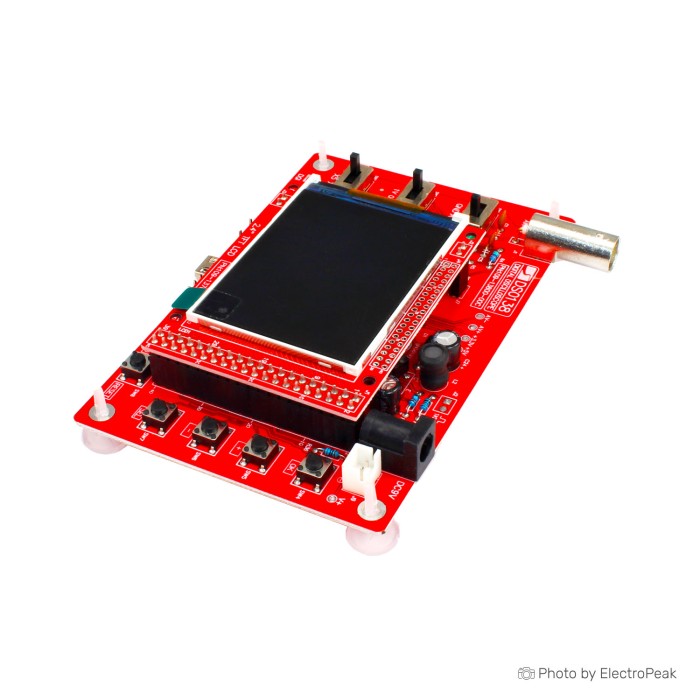
DSO138 Digital Oscilloscope With TFT 2.4" Display
$16.9500
In stock
SKU
TLS-10-002
Volume discounts:
- +25 4 % $16.2700
- +50 6 % $15.9300
- +100 8 % $15.5900
- +300 10 % $15.2500
- +500 12 % $14.9100
Ships in 2-3 business days, then:
Free delivery in 12-15 days by Tracked Economic Shipping on orders over $100.
Free delivery in 7-10 days by Express Shipping on orders over $300.
More shipping info

Shop with confidence Learn More

DSO138 Oscilloscope Kit Review
A digital storage oscilloscope samples an incoming electrical voltage, converts it into numerical data, and reconstructs the waveform on a display for visual analysis. The DSO138 is a single-channel DIY digital oscilloscope kit built around an ARM Cortex-M3 (STM32F103C8) microcontroller, combining onboard signal processing with an integrated color TFT screen for standalone waveform viewing. It is a hands-on soldering project that becomes a functional instrument for examining slow, low-voltage signals without a tethered personal computer.
This kit suits electronics students, makers, and hobbyists who want to understand oscilloscope hardware from the ground up while building a bench tool for basic audio-frequency signals, low-speed sensor outputs, or simple microcontroller pulse-width modulation (PWM). It is not designed for fast digital signals, high-frequency power-supply switching noise, two-signal timing comparisons, or mains electrical measurements. The main printed circuit board arrives semi-populated: surface-mount parts are factory soldered, while all through-hole components require manual assembly. If you prefer a ready-to-use instrument with an enclosure rather than an assembly project, the pre-assembled oscilloscope with case offers similar low-frequency bench capability out of the box. For a broader selection, compare options in the oscilloscope category.
Specifications of DSO138 Digital Oscilloscope With TFT 2.4" Display
- MCU: ARM Cortex-M3 (STM32F103C8 )
- Number of Channels: 1 Channel
- Analog Bandwidth: 0 ~ 200KHz
- Sensitivity: 10mV/Div ~ 5V/Div
- Input Impedance: 1M
- Accuracy: < 5%
- Resolution: 12 bit
- Maximum Measuring Voltage: 50Vpp (1: 1 probe), 400Vpp (10: 1 probe)
- Coupling: DC, AC, GND
- Max Real-time Sampling Rate: 1Msps
- Time-base: 10us/Div ~ 500s/Div
- Record Length: 1024
- Trigger Modes: Auto, Normal, Single
- Trigger Types: Rising/falling edge
- Trigger Position: 1/2 of buffer size fixed
- Display:4-inch color TFT LCD with 320 x 240 resolution
- Input Voltage: 8V ~ 12V
- Recommended Input Voltage: 9V
- Input Current: 120mA
- Size: 117mm x 76mm x 15mm
DSO138 Oscilloscope Specifications Explained
Evaluating an entry-level instrument means looking beyond the headline figures to see how its hardware parameters set real measurement limits. The specifications define the boundaries of what this single-channel platform can capture accurately.
| Specification | Listed Value | Why It Matters in Practice |
|---|---|---|
| Analog Bandwidth | 0 ~ 200KHz | Defines the highest continuous frequency the analog front-end passes before signal amplitude attenuates by 3 dB. While adequate for acoustic-range signals and slow sensors, high-frequency harmonics of square waves roll off well before 200 kHz. |
| Real-Time Sampling Rate | 1Msps | The analog-to-digital converter takes up to one million samples per second. At 200 kHz, this provides only five sample points per cycle, which is sufficient to detect signal presence but will distort rapid edges and transient peaks. |
| Analog Channels | 1 Channel | Restricts testing to a single circuit node at a time. It cannot correlate input-to-output propagation delay, serial clock-and-data alignment, or phase relationships between two active signals. |
| Record Length | 1024 points | Determines the number of raw sample points stored in memory per acquisition. A short 1024-point buffer requires balancing horizontal time-span against waveform resolution; zooming in after capture is limited. |
| Vertical Sensitivity | 10mV/Div ~ 5V/Div | Provides scale adjustments across common transistor and logic levels. Coupled with 12-bit ADC resolution, it gives reasonable voltage granularity for general qualitative troubleshooting. |
| Input Coupling | DC, AC, GND | Allows isolation of AC ripple from an established DC voltage level or grounding of the input stage to establish a baseline 0V trace reference on screen. |
| Trigger Modes & Types | Auto, Normal, Single; Rising/Falling Edge | Auto provides continuous screen refreshing for live signals, Normal updates only when an event crosses the threshold, and Single freezes a one-off transient event into the display buffer. |
| Input Rating | 50Vpp (1:1), 400Vpp (10:1) | Maximum operational input thresholds. These figures denote electronic component limits, not a safety category rating; the input must never be exposed to mains or high-energy transients. |
| Board Dimensions | 117mm x 76mm x 15mm | Reflects the compact footprint of the bare circuit board. Total assembly depth increases slightly when mounting an external case or front-panel switches. |
For multi-line microcontroller buses such as SPI, I2C, or asynchronous serial, an analog oscilloscope is less effective than a dedicated logic tool. For embedded communication tracing, a device intended for digital protocol and logic analysis provides simultaneous multichannel capture and protocol decoding that a single-channel analog scope cannot replicate.
DSO138 Oscilloscope Kit Assembly and First Power-On
The DSO138 is supplied as a DIY electronics kit with a semi-populated board. All surface-mount components, including the STM32F103C8 microcontroller and passive support networks, come pre-soldered to the PCB. Builders must populate all through-hole parts, including input slide switches, pushbuttons, test pins, pin headers, electrolytic capacitors, and the BNC probe connector. This places the kit at the higher end of through-hole soldering difficulty. Careful heat control, neat solder joints, and component verification are needed before trimming leads.
Power requires an external, regulated DC supply providing between 8V and 12V, with 9V at 120mA recommended for optimal thermal stability on the onboard linear regulators. No power supply is included in the package. You must provide a 9V DC adapter and confirm the connector barrel size and center-pin polarity before applying voltage. Once soldering is complete, use this disciplined initial verification sequence:
- Inspect all through-hole solder joints under good lighting with magnification, verifying that no solder bridges span adjacent IC header pins or switch terminals.
- Confirm polarity on all electrolytic capacitors, diodes, and power connectors according to the provided assembly drawing and user manual.
- Seat the TFT display module firmly into its designated header socket without bending mounting pins.
- Connect the external 9V DC supply. The screen should illuminate, display initial boot text, and transition to a horizontal sweep baseline across the graticule.
- Connect the included probe lead to the input terminal and attach the clip to the onboard square-wave test terminal.
- Adjust vertical sensitivity, horizontal time-base, and trigger level to confirm that the display shows a stable, repeating square wave that freezes cleanly when pressing the HOLD button.
The PCB includes header positions for UART and ICSP, along with a mini-USB connector. These interfaces connect to the STM32 hardware lines for advanced users consulting the firmware-upgrade guide, but they do not make the board a streaming USB PC oscilloscope. The mini-USB port is not intended for regular computer-based waveform capture. Once soldering is verified, a DSO138 protective shell adds physical stability and helps protect the assembled board from accidental benchtop shorts or static contact.
DSO138 Oscilloscope Limitations and Safety
Realistic boundaries help ensure the DSO138 is used only where it can perform reliably. Its 200 kHz analog bandwidth and 1Msps sampling rate limit it to low-frequency, qualitative observation. Square waves above 20 kHz begin to show rounded corners and rising-edge degradation because the higher harmonic frequencies needed to shape square edges exceed the front-end analog bandwidth and sample rate. High-frequency noise, power-supply switching spikes, and fast clock lines cannot be viewed with diagnostic confidence.
The single-channel input architecture prevents simultaneous timing analysis. A project that requires monitoring both a gate-drive input and a power-stage response, or comparing input versus output phase on an operational amplifier, cannot be handled by one channel. The 1024-point capture memory also permits only brief waveform snapshots, making the unit unsuitable for tracing deep memory sequences or sporadic bus dropouts over extended intervals.
From an electrical safety standpoint, the DSO138 carries no certified Measurement Category (CAT) safety rating. The listed limits of 50Vpp (with a 1:1 probe) and 400Vpp (with a 10:1 probe) are electronic threshold limits on the board's attenuator circuitry, not protection ratings against mains transients. Never connect this device to mains AC power, switch-mode wall outlets, high-voltage motor drivers, or automotive primary ignition coils. It is strictly limited to low-voltage, ground-referenced direct-current electronic projects. Where bench work requires high-voltage tolerance and simultaneous multi-signal tracking, a fully isolated dual-channel portable scope provides the necessary front-end isolation and sampling depth.
DSO138 vs DSO150 and DSO138 Pro
The DSO138 shares a lineage with other low-cost portable scopes, which can make selection confusing. These listings have similar names but different formats for the bench.
| Feature / Parameter | DSO138 Kit | DSO150 | DSO138 Pro |
|---|---|---|---|
| Product Format | DIY kit (semi-populated PCB, through-hole soldering required) | Pre-assembled standalone unit | Pre-assembled handheld unit |
| Enclosure | Exposed bare board (case sold separately) | Molded protective case included | Molded protective case included |
| Analog Bandwidth | 0 ~ 200KHz | 200 kHz | 200 kHz |
| Max Real-Time Sampling | 1Msps | 1Msps | 2.5MS/s |
| ADC Resolution | 12 bit | 12 bit | 8 bit |
| Channels | 1 Channel | 1 Channel | 1 Channel |
| Power Supply | External 8V ~ 12V DC (9V recommended) | External 9V DC (8–10V, 5.5/2.1mm center-positive) | External power required (battery circuit not populated in this version) |
Choose the DSO138 kit when the educational value of assembling and testing your own test gear matters. The pre-assembled DSO150 is the direct alternative if you want the same bandwidth tier, no soldering, and an enclosed instrument ready to use. The separately listed DSO138 Pro configuration has a higher 2.5MS/s sampling rate in a compact cased shell, though it also runs from external DC power.
DSO138 Oscilloscope Accessories and Case Options
Completing and using the DSO138 requires several complementary items that are not bundled with the bare kit package.
Required Accessories
- Regulated 9V DC Power Supply: The board requires 8V to 12V DC power (120mA) to operate, with 9V recommended for standard thermal dissipation. A compatible external AC-to-DC wall adapter with the correct barrel connector size and polarity must be sourced separately.
- Soldering Station & Hand Tools: Assembly requires a fine-tipped soldering iron, leaded or lead-free solder, diagonal flush cutters, and desoldering braid or a solder pump for clearing solder bridges.
- Digital Multimeter: Essential for checking resistance values, verifying supply rail voltages, and diagnosing open or shorted traces before initial power-up.
Recommended Accessories
- Protective Enclosure: The bare PCB leaves exposed solder points and switch contacts vulnerable on the bench. A laser-cut acrylic DSO138 protective shell adds mechanical rigidity and helps prevent accidental shorts against stray component leads.
- Compensated 10:1 Oscilloscope Probe: The included clip cable provides simple connectivity for low frequencies, but a standard 10:1 passive probe with adjustable trimmer capacitance reduces capacitive loading on sensitive test circuits.
- Signal Generator: The board features an onboard square-wave test output, but an external variable-frequency signal source is useful for exploring filter responses and triggering behavior across diverse frequencies.
Optional Accessories
- USB-to-UART Programmer or ST-Link: Required only for advanced users modifying the STM32 firmware or reflashing custom open-source codebases.
- Rework Tweezers: Helpful if any factory surface-mount components require alignment or solder reflow during troubleshooting.
DSO138 Oscilloscope Kit FAQ
Is the DSO138 a genuine JYE Tech model or a compatible board?
The hardware follows the established JYE Tech open-architecture design, though production runs across the market include both original manufacturing and third-party compatible assemblies. Reference the supplied schematic and boot-screen version data when planning firmware modifications.
Does this DSO138 feature a 2.4-inch or 4-inch display?
The physical screen is a 2.4-inch color TFT display with a resolution of 320 x 240 pixels. Although catalog listings occasionally note alternate dimensions in descriptive headers, the standard modular display board packaged with this family measures 2.4 inches diagonally.
Is the real-time sample rate 1Msps or 5M samples per second?
The maximum real-time sampling rate is 1Msps. Top-level promotional summaries occasionally reference theoretical burst limits, but the STM32F103 internal ADC operational rate under standard firmware achieves 1Msps, yielding one million voltage conversions per second.
Does the DSO138 arrive pre-assembled?
No. This product is an unassembled through-hole DIY electronics kit. Surface-mount components arrive pre-soldered on the circuit board, but all switches, connectors, and passive through-hole components must be soldered by the user.
What kind of power supply does the board require?
It requires an external 8V to 12V DC power source delivering at least 120mA, with a clean, regulated 9V DC supply strongly recommended. No power adapter or battery clip is included in the package.
Can the DSO138 inspect Arduino PWM and audio signals?
Yes. It works well for low-voltage, ground-referenced waveforms within the acoustic spectrum and standard Arduino PWM frequencies (typically 490 Hz or 980 Hz). For multi-line communications, a dedicated tool for digital protocol and logic analysis provides the required multi-channel bus tracing.
Can I use the DSO138 to test household mains voltage?
No, never connect this device to mains circuits. The DSO138 carries no CAT safety classification, lacks galvanic high-voltage isolation, and poses severe shock and equipment-damage hazards if exposed to line power.
Does the mini-USB port allow it to work as a PC oscilloscope?
No. The mini-USB connector is wired for firmware programming on supported board revisions. It does not stream real-time waveform data to desktop operating software.
What are the main differences between the DSO138, DSO150, and DSO-TC2?
The DSO138 is a through-hole build kit for educational soldering, the DSO150 is a factory-assembled equivalent with a molded case, and the portable oscilloscope and LCR tester combines a 200 kHz waveform viewer with automated component identification and an internal rechargeable battery.
Purchase Decision Summary
Ideal for:
- Makers and electronics students wanting a structured soldering project that finishes as a working bench instrument.
- Hobbyists observing low-voltage DC signals, basic sensor behaviors, audio-frequency waves, and slow microcontoller PWM.
- Users seeking a standalone waveform display that operates independently without connecting to a computer.
Maybe for:
- Occasional bench testing where qualitative presence of a signal matters more than precise rise-time fidelity.
- Builders willing to fabricate or purchase an aftermarket enclosure to secure bare board traces.
Consider another option if:
- You need two or more simultaneous channels to compare timing, phase, or input/output relationships.
- You intend to test high-speed digital buses, fast transients, or switching power supplies operating above 20 kHz.
- You require a tool approved for high-voltage circuits or AC mains power.
- You want a ready-to-use instrument immediately out of the box without any soldering.
Buying Checklist
- I am comfortable assembling a higher-difficulty through-hole soldering kit with fine pin spacing.
- I have an external, regulated 9V DC power supply with the correct barrel connector and polarity.
- My intended test signals are strictly low-voltage and safely ground-referenced.
- I understand that nominal 200 kHz bandwidth is suitable for audio and slow signals, not high-speed digital analysis.
- I only require a single channel and do not need to measure two signals at the same time.
- I have confirmed whether I need the optional DSO138 protective shell to enclose the exposed circuit board.
- I understand that the onboard USB connector is for firmware flashing on supported hardware, not live PC streaming.
Write Your Own Review

Please complete your information below to login.
Sign In
Create New Account