
Product added to cart

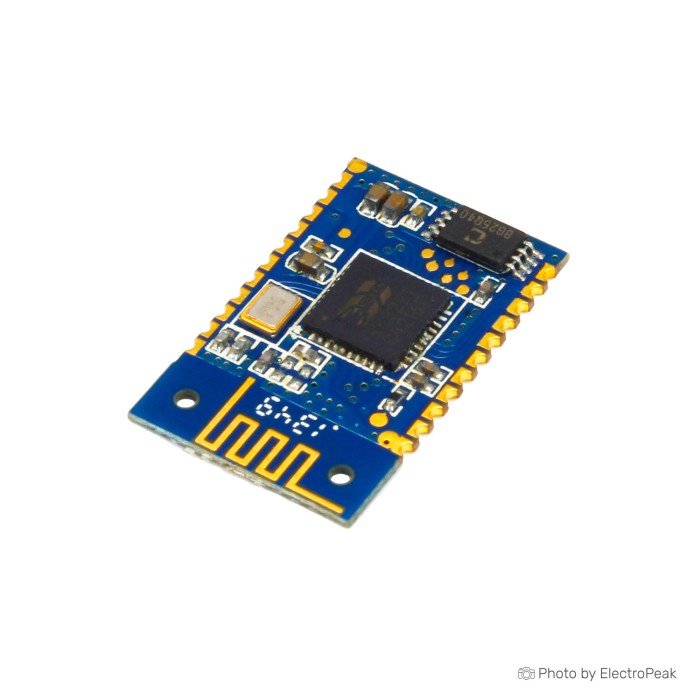
BK3221 Bluetooth Stereo Audio Module
$0.7500
In stock
SKU
MOD-04-031
Volume discounts:
- +50 4 % $0.7200
- +100 5 % $0.7100
- +300 8 % $0.6900
- +500 9 % $0.6800
- +1000 12 % $0.6600
Ships in 2-3 business days, then:
Free delivery in 12-15 days by Tracked Economic Shipping on orders over $100.
Free delivery in 7-10 days by Express Shipping on orders over $300.
More shipping info

Shop with confidence Learn More
 M180 TDA7850 4-Channel-50W Power Amplifier Module Previous
BK3221 Bluetooth Stereo Audio Module Review
The BK3221 Bluetooth Stereo Audio Module is a compact, bare Bluetooth stereo audio receiver for embedded wireless-audio integration. At US$0.66–0.71 in volume and €2.61 for a single unit, it suits experienced hardware builders with a regulated 3.3V power source and an existing amplifier circuit. This is not an all-in-one receiver board with pre-soldered jacks or direct speaker drive; it is a dedicated component for custom installations rather than a plug-and-play music breakout. If you are comparing Bluetooth audio modules and sound-player boards, account for the difference between bare modules and consumer breakout boards before planning the build.
Specifications of BK3221 Bluetooth Stereo Audio Module
- Bluetooth Version: V2.1 + EDR
- Supported Protocols: HFPV1.5, A2DPV1.2, AVRCPV1.0
- Operating Voltage: 3.3V
- Operating Current: ≤ 60mA
- Standby Current: < 500μA
- Operating Temperature: -40°C to +85°C
- Transmission Range: More than 10 meters
- Transmission Power: CLASS2, 3dB
- Sensitivity: -80kHz (<0.1% BER)
- Frequency Range: 2.4GHz–2.480GHz
- Interfaces: I2C, SPI, UART
- Audio Performance: SBC decoding
- Signal-to-Noise Ratio: ≥ 60dB
- Dimensions: 25x13.5x1.8mm
The BK3221 has no onboard audio amplifier or 5V regulator. Builds requiring direct speaker drive need dedicated support circuitry or a fully integrated alternative, detailed below.
BK3221 Bluetooth Module Wiring, Compatibility and Accessories
The BK3221 Bluetooth module requires close attention to operating voltage and output-stage topology. It operates strictly at 3.3V, drawing up to 60mA during active streaming and under 500μA in standby. The board has no onboard 5V regulator, so connecting it directly to a 5V USB line or an unregulated 3.7V lithium-ion cell risks damaging it. Supply power from a clean, dedicated 3.3V regulated rail.
This module provides differential line-level audio outputs: L+, L−, R+, and R−. These outputs are intended for an external amplifier input or a differential-to-single-ended audio stage. Do not connect the L− or R− audio pads to system ground. Grounding these pins distorts the output and can damage the internal output stage. The BK3221 also cannot drive speakers or headphones directly. Wiring passive drivers directly to the differential lines produces faint, heavily distorted sound or overcurrent faults.
For wireless-source compatibility, the module connects reliably to smartphones, computers, and dedicated transmitters using the standard A2DPV1.2 stereo audio profile. AVRCPV1.0 provides basic remote-control signalling when hardware button lines are routed. Although HFPV1.5 (Hands-Free Profile) appears in the specifications, microphone-input routing on this exact board layout is unconfirmed. Do not select this board for plug-and-play hands-free voice calls without first testing the received board revision.
Physical integration means soldering directly to the bare castellated edge pads. Projects requiring sound from passive speakers must use an external amplification stage.
Required Accessories
- Regulated 3.3V power supply: Use a stable 3.3V voltage source capable of delivering at least 60mA. Unregulated 5V or battery lines must be stepped down externally.
- External stereo amplifier: A dedicated amplifier board such as the PAM8403 amplifier board is required to accept the differential line-level outputs and drive speakers.
- Soldering equipment and hookup wire: Use fine-gauge wire and a temperature-controlled iron to connect to the module's edge pads.
- Differential audio wiring: Route L+/L− and R+/R− directly to your amplifier's inputs, with no common-ground ties.
Recommended Accessories
- Power rail filtering: Fit low-ESR decoupling capacitors on the 3.3V line near the module to isolate digital RF noise from the analog audio path.
- Status LED: Use a standard LED with a current-limiting resistor to monitor connection state if the received PCB layout exposes it.
- Tactile buttons: Connect momentary switches to pull-up or pull-down control pads for playback commands where those pads are exposed.
Optional Accessories
- Speakers: Use a compact speaker pair rated for your amplifier's output, such as 8 Ohm, 1W drivers driven through the PAM8403.
Cannot accommodate a two-board setup with an external amplifier and bare-pad soldering? The MH-M38 receiver-amplifier is an all-in-one direct-speaker alternative with a dual 5W speaker driver and onboard battery management.
BK3221 Bluetooth Module Limitations and Audio Expectations
The BK3221 uses the legacy Bluetooth V2.1 + EDR standard and exclusively relies on the standard Subband Codec (SBC). It does not support modern high-bitrate codecs such as AAC, aptX, aptX-HD, or LDAC, and it does not implement Bluetooth Low Energy (BLE) or Bluetooth 5.x features. Its listed signal-to-noise ratio (SNR) of ≥ 60dB suits utility playback, background audio, and retrofitting older equipment. Do not choose it for high-resolution listening.
Wireless range is rated at Class 2 power (3dB) for more than 10 meters under open conditions. The listing gives RF sensitivity as "-80kHz (<0.1% BER)"; in standard RF engineering, this parameter represents receiver sensitivity commonly measured around -80 dBm, while the kHz notation appears to be a typographical listing error. Actual range depends heavily on chassis material, enclosure layout, and ground-plane clearance around the onboard PCB trace antenna.
The hardware lists I2C, SPI, and UART digital interfaces, but no public AT-command set, register map, or documented software library is available for this module. Treat the BK3221 as a self-contained, autonomous analog Bluetooth receiver. You cannot reliably configure pairing names, interrogate connection status, or stream digital audio to an MCU through software commands.
Audio-path isolation also needs consideration. In shared-supply setups, where the Bluetooth module and amplifier share one power source without galvanic isolation, switching ripple and RF switching can introduce noticeable hum or buzz into the speakers. Clean power regulation and ground-plane separation are necessary to prevent noise coupling. Physical board dimensions can also vary slightly across multi-factory production batches: some boards measure 25x13.5mm, while others measure 23x14.5mm. One individual review also reported occasional resets during initial connection handshakes.
Where these constraints conflict with project goals, consider these upgrade paths:
- Multi-watt speaker enclosures needing a modern-codec receiver with integrated amplification can use the QCC3034 amplifier board, which provides Bluetooth 5.1, onboard 2x15W output, and aptX-HD decoding.
- For a standalone preamplifier with USB-drive playback and app-controlled decoder functions, the ZK-PT2 decoder offers complete media handling alongside wireless streaming.
- High-spec embedded OEM audio products requiring active noise cancellation and a 24-bit DSP path can use the SJR-BTM525 module, which provides an industrial Qualcomm QCC5125 foundation.
BK3221 Bluetooth Audio Module Projects and Uses
With its minimal 25x13.5x1.8mm footprint and low standby current consumption of < 500μA, the BK3221 suits embedded audio retrofits where internal space is tight.
Common real-world projects include:
- Auxiliary Input Upgrades for Car Head Units: Add wireless streaming to legacy automotive stereos with an internal differential or line-in amplifier stage, powered through an isolated 3.3V step-down converter.
- Vintage Radio and Boombox Conversions: Fit a miniature wireless receiver inside a classic chassis and route the differential output through a separate amplifier stage to drive the original drivers.
- Embedded Commercial Audio Products: Use the underlying Beken BK3221 silicon architecture for voice-prompt reproduction, small smart toys, or fixed-function wireless speakers.
- Active Monitor Conversions: Integrate Bluetooth inside powered desktop monitors that already contain pre-amplified volume and tone controls.
Do not select this module for microcontroller-directed projects requiring runtime volume changes through UART. It is also unsuitable for direct USB sound-card output or plug-and-play battery builds without added circuitry. For a small portable build that needs a simple, low-power self-contained solution, a compact integrated receiver-amplifier approach such as the 2x3W Bluetooth 4.0 board eliminates the need for separate boards.
BK3221 Bluetooth Module vs MH-M18 Receiver Boards
Builders seeking a miniature Bluetooth receiver often cross-shop the BK3221 with breakout boards such as the MH-M18 Bluetooth receiver board. Both add wireless streaming to audio systems, but their integration approaches differ substantially.
The BK3221 is a bare surface-mount module that operates from a strict 3.3V rail and provides raw differential outputs. It requires direct soldering to castellated pads, external voltage step-down, and careful output-grounding consideration. The unlinked MH-M18 module, by contrast, is typically configured as a breakout board with through-hole pads, native 5V/USB power handling, and a shared common ground for left and right audio channels.
One individual buyer report preferred the BK3221's audio clarity to typical low-cost MH-M18 boards, but this is a single observational account rather than a universal standard. The practical decision comes down to physical requirements. Choose the BK3221 when you are assembling a custom PCB or enclosure with 3.3V power and balanced amplifier inputs. Choose an MH-M18-style board when you need quick 5V wiring and straightforward single-ended connections.
BK3221 Bluetooth Module First-Power-Up Check
Before mounting the module permanently in an enclosure, run a bench check for power delivery, pairing behavior, and audio transmission.
- Verify Connections: Solder leads to the 3.3V power, ground, and differential audio output pads (L+, L−, R+, R−). Confirm that neither L− nor R− connects to power ground.
- Connect External Amplifier: Route the differential audio leads directly into an amplifier circuit, such as a PAM8403, with the amplifier output wired to speakers.
- Supply Regulated Power: Apply 3.3V DC to the module. If your board revision includes an onboard or external status LED pad, confirm that the LED illuminates or flashes to indicate active power.
- Scan and Pair: Open Bluetooth settings on a phone or PC. Scan for discoverable devices and select the advertised device name, typically reported as
BM-3221. - Verify Playback: Stream an audio track and check for clear stereo separation across both channels.
If the module fails to pair, confirm that the power supply maintains 3.3V under load without drooping. Severe audio distortion or immediate shutdown points to differential negative leads that are not fully isolated from system ground.
BK3221 Bluetooth Module FAQ and Buying Checklist
Can I power the BK3221 Bluetooth module from 5V USB?
No. Do not connect 5V USB directly to this board. The specified operating voltage is 3.3V, and the PCB does not include an onboard 5V drop-down regulator. Applying 5V exceeds the module's absolute limits and can destroy the chip. Use a step-down regulator to deliver 3.3V.
Can I connect a 3.7V Li-ion battery directly to the BK3221 Bluetooth module?
No, direct connection to a 3.7V lithium-ion cell is not recommended. A fully charged lithium-ion battery reaches 4.2V, exceeding the board's listed 3.3V operating voltage. Place an efficient 3.3V regulator between the battery and the module.
Can the BK3221 Bluetooth Stereo Audio Module drive speakers or headphones directly?
No. The module outputs low-level differential line signals designed for amplifier stages. It lacks the current drive needed to power passive speakers or low-impedance headphones. Feeding these outputs into a separate amplifier board is mandatory.
Can I connect L− and R− to audio ground?
No. L− and R− are active differential signal legs, not passive return lines. Connecting them to ground shorts half of the internal output bridge, causing heavy distortion, overheating, and potential hardware failure. Route them directly into balanced amplifier inputs or through an isolating circuit.
Does the BK3221 Bluetooth module support AAC or aptX?
No. The BK3221 uses SBC decoding under the Bluetooth V2.1 + EDR standard. It does not support AAC, aptX, aptX-HD, or other advanced codecs.
Can I control the BK3221 from an Arduino or ESP32 through UART AT commands?
No. No public AT-command set or register documentation is available for the UART, I2C, or SPI interfaces on this module. It is intended to function strictly as a standalone audio receiver without host microcontroller commands.
Does HFPV1.5 mean I can add a microphone and make phone calls?
No confirmed microphone connection is available from HFPV1.5 alone. While the internal silicon supports HFPV1.5, microphone-pad availability and routing on this bare PCB layout are unconfirmed. Do not purchase this board for two-way voice or speakerphone projects unless you are prepared to probe and verify the pinout manually.
What is the BK3221 Bluetooth module range?
The transmission range is specified as more than 10 meters under line-of-sight conditions at Class 2 power levels (3dB). Range inside an enclosure depends on antenna placement and nearby metal shielding.
Why might a BK3221 Bluetooth audio module produce hum or buzzing?
Audio hum or high-frequency buzz usually comes from a shared ground loop or noisy digital switching lines when the module shares an unfiltered power source with an amplifier. Powering the BK3221 through an isolated regulator or installing dedicated RC filtering on the power rail will generally eliminate the noise.
Is this a Broadcom Bluetooth module?
No. This board is built on Beken BK3221 silicon. References to "Broadcom" in third-party marketplace listings are translation errors.
For a pre-built breakout board with a standard USB port, consider the Type-C-powered Bluetooth receiver board (MH-M28), which incorporates Bluetooth 5.1, direct 5V input, and single-ended audio pads.
Purchase Decision Summary
- Ideal for: Experienced hardware builders who need an ultra-compact, low-cost bare module for 3.3V systems equipped with an external amplifier stage.
- Maybe for: Automotive and vintage audio retrofits where the builder is comfortable adding voltage regulation and low-noise supply filtering.
- Consider another option if: You need direct 5V power, direct speaker drive, high-definition codecs (aptX/AAC), documented UART micro-controller control, or pre-soldered 3.5mm jacks.
Buying Checklist
- ✓ I have a regulated 3.3V DC power source ready (not 5V USB or bare Li-ion).
- ✓ I have a separate stereo amplifier to drive my speakers or headphones.
- ✓ I understand that L− and R− audio pins must never be wired to ground.
- ✓ I am equipped to solder fine-pitch castellated surface-mount pads.
- ✓ SBC Bluetooth V2.1 + EDR meets my audio resolution requirements.
- ✓ I do not require AT-command microcontroller communication over UART.
- ✓ I have planned power supply filtering to avoid audio ground loops.
| Interface Type | UART, I2C, SPI |
|---|---|
| Operating Voltage (V) | 3.3V |
| Operating Current (mA) | 60 |
| Operating Temp (°C) | -40 to 85 |
| Dimensions (mm) | 25 x 13.5 x 1.8 |
| Mounting Type | SMD (Surface Mount) |
| Audio Function | Audio Player |
| Audio Formats | SBC |
| Bluetooth Ver. | 2.1 |
| Output Type | Analog |
| Channels | 2-channel |
| Chipset | BK3221 |
| Signal-to-Noise Ratio (SNR) | ≥ 60dB |
| Frequency Response | 2.4GHz–2.480GHz |
Write Your Own Review

Please complete your information below to login.
Sign In
Create New Account