
Product added to cart

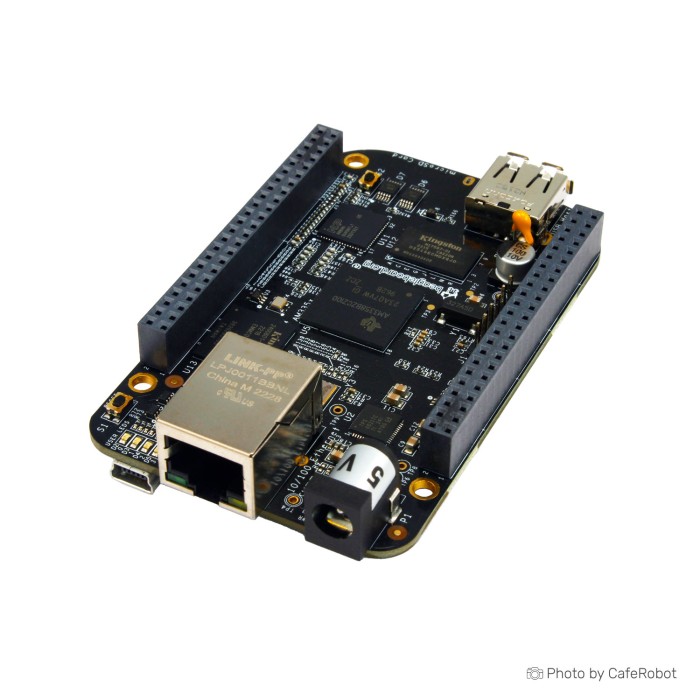
BeagleBone Black Rev C Development Board - 4GB RAM
$86.2500
In stock
SKU
MIN-04-001
Volume discounts:
- +5 3 % $83.5700
- +10 5 % $82.2200
- +25 6 % $80.8800
- +50 8 % $79.5400
- +100 9 % $78.2000
Ships in 2-3 business days, then:
Free delivery in 12-15 days by Tracked Economic Shipping on orders over $100.
Free delivery in 7-10 days by Express Shipping on orders over $300.
More shipping info

Shop with confidence Learn More

BeagleBone Black Rev C Development Board Review
The BeagleBone Black Rev C is an AM3358-based development board for embedded Linux prototyping, wired networking, and hardware interface expansion. Built around a 1GHz ARM Cortex-A8 core, 512MB DDR3 SDRAM, and 4GB onboard eMMC storage, it provides a dedicated platform for running Debian and low-level control code without requiring an external memory card for the base operating system.
Direct access to hardware buses, analog inputs, and real-time processing cores makes the board practical for industrial controllers, networked gateways, and sensor monitoring. It is not suitable for setups requiring direct 5V GPIO logic, integrated Wi-Fi or Bluetooth, Gigabit Ethernet throughput, or extensive local flash storage for heavy containers and media libraries. Pricing details are not currently provided.
Specifications of BeagleBone Black Rev C Development Board - 4GB RAM
- Processor: AM3358
- ARM Cortex-A8 core speed: 1GHz
- Memory: 4GB eMMC flash storage
- Memory: 512MB DDR3 SDRAM
- HDMI interface: Type D
- LCD interface: Listed
- Ethernet interface: 10/100M
- USB 2.0 OTG interface: Listed
- USB 2.0 host interface: Listed
- TF card slot: Listed
- Serial debug interface: 3-line
- JTAG interface: Listed
- ADC interface: Listed
- I2C interface: Listed
- SPI interface: Listed
- PWM interface: Listed
- Power supply: 5V/0.35A
- Dimensions: 54.61x86.36 mm
- Operating temperature: 0 ~ 70℃
- Operating humidity: 20% ~ 90% (non-condensing)
- Boot select button: Listed
- Power button: Listed
- Reset button: Listed
- Power LED: Listed
- 4 user LEDs: Listed
See related options in the Beagle Bone development boards catalog.
BeagleBone Black Rev C Specifications Explained
An embedded platform needs to balance compute capacity, memory headroom, interface bandwidth, and input/output control. The table below shows how each hardware specification affects software performance and deployment planning.
| Specification | Technical Value | Why It Matters |
|---|---|---|
| Processor Core | AM3358 (1GHz ARM Cortex-A8) | Provides sufficient processing capacity for embedded Linux builds, headless automation services, and native compilation of control software. |
| System Memory | 512MB DDR3 SDRAM | Supports standard Linux system processes, networking stacks, and embedded scripting, though memory-heavy graphical stacks and large runtimes will face constraints. |
| Onboard Storage | 4GB eMMC Flash | Houses the core operating system and base development packages directly on the board. The 4GB capacity provides a functional working baseline compared to earlier 2GB revisions, though high-volume logging requires external storage. |
| Real-Time Processing | 2x PRU Cores | Two 32-bit Programmable Real-Time Units operate independently of the main ARM core. They handle microsecond-level timing, custom bit-banging, and deterministic signal generation that standard Linux kernels cannot guarantee. |
| Video & Audio | Type D HDMI (Micro-HDMI) | Delivers digital video and audio output for desktop displays or local diagnostic monitors, requiring a micro-HDMI adapter or cable. |
| Wired Network | 10/100M Ethernet | Enables reliable wired communication for SSH terminal sessions, MQTT telemetry, and industrial bus bridging, though throughput is bounded below Gigabit rates. |
| USB Connectivity | USB 2.0 Host & USB 2.0 OTG | The host port accepts standard peripherals such as storage drives or network dongles, while the OTG client port enables direct tethered configuration and network bridging to a PC. |
| Storage Expansion | TF / MicroSD Card Slot | Accepts removable media for booting alternative Linux distributions, loading evaluation kernels, or flashing the onboard eMMC storage. For secondary boot environments, media such as the SanDisk 16GB Micro SD card can be used. |
| Hardware Interfaces | ADC, I2C, SPI, PWM, LCD | Allows direct integration with analog transducers, serial sensors, motor drivers, and character or graphical displays without requiring a companion microcontroller. |
| Debugging Support | 3-Line Serial Debug & JTAG Footprint | A dedicated 3.3V UART header provides immediate low-level bootloader console output. The board also includes an unpopulated footprint for hardware-level JTAG probe attachment. |
| Form Factor | 54.61 x 86.36 mm | Compact credit-card outline designed to mount into standard electronics enclosures and industrial sub-assemblies. |
| Environmental Ratings | 0 ~ 70℃, 20% ~ 90% RH | Specifies reliable operation across standard commercial ambient conditions in dry, non-condensing environments. |
| Board Controls & Status | Boot, Reset, Power Buttons & 5 LEDs | Hardware buttons facilitate force-booting and clean reboots, while the onboard LEDs provide immediate visual feedback for power delivery, heartbeat, and storage access. |
BeagleBone Black Rev C Compatibility and Power Requirements
System stability depends heavily on adequate electrical power and on respecting the voltage tolerances of the onboard AM3358 processor.
The listed 5V/0.35A electrical specification represents an idle or minimally loaded board. Active Ethernet, display output, cape expansion boards, or attached USB hardware increase power demand significantly. Manufacturer documentation and real-world implementation standards recommend 5V DC at 1A as an operating minimum, and 5V DC at 2A when driving capes or USB peripherals. A dedicated 2.1mm barrel jack supply provides far greater stability for peripheral-heavy configurations than a PC USB port.
| Interface / Domain | Compatibility Rule | Implementation Notes |
|---|---|---|
| Operating System | Debian Linux preinstalled | Debian is the established default platform image on Rev C eMMC storage. Third-party distributions including Ubuntu, Buildroot, and older Ångström images can run via microSD media. |
| Digital I/O Logic | 3.3V strictly enforced | The processor pins do not tolerate 5V signals. Interfacing with 5V sensors, legacy Arduino modules, or 5V logic lines requires bidirectional level-shifting hardware. |
| Display Output | Type D Micro-HDMI | Standard monitor cables will not plug into the board directly. A micro-HDMI-to-HDMI cable or passive adapter is required to connect HDMI monitors or TVs. |
| USB Host Current | 500mA maximum limit | The onboard USB host port adheres to standard USB 2.0 current budgets. Wi-Fi dongles, external hard drives, or multiple accessories require a self-powered external USB hub. |
| Network Port | Fast Ethernet (10/100 Mbps) | Compatible with standard RJ45 infrastructure. Does not support Gigabit line rates, making it unsuitable for high-bandwidth file servers. |
| Hardware Expansion | BeagleBone Cape standard | Expansion headers accommodate standard capes. Pin multiplexing and power consumption on the 3.3V and 5V rails must be cross-checked before stacking boards. |
| Hardware Debugging | Unpopulated JTAG footprint | The board provides physical solder pads for a JTAG connection, but the physical pin header is not installed by default and must be soldered manually. |
For standalone Linux tasks where deterministic real-time I/O is not a priority, the Raspberry Pi 3 Model B (Element 14) takes a different single-board-computer approach, with 1GB RAM and standard microSD-card storage management.
Required, Recommended, and Optional Accessories
- Required: Use a regulated 5V DC external power supply rated for 1A minimum, or 2A for peripheral loads.
- Required: Add a micro-HDMI to full-size HDMI cable or adapter when using a local graphical monitor.
- Required: Use a standard Cat5e/Cat6 RJ45 Ethernet patch cable for networked communication.
- Required: Install logic-level shifters whenever wiring to 5V digital devices or sensors.
- Recommended: Use high-speed microSD storage, such as the SanDisk 32GB Micro SD card, to test experimental operating systems or flash the eMMC.
- Recommended: A powered external USB 2.0 hub supports keyboards, mice, and wireless network adapters simultaneously.
- Recommended: A 3.3V USB-to-TTL serial console cable supports kernel boot monitoring through the 3-line debug pins.
- Optional: A standard 20-pin JTAG header supports hardware-level debugging probes.
- Optional: Application-specific plug-on expansion capes and protective enclosures are available. Standard micro-USB cables will not fit the mini-USB client port on this board.
BeagleBone Black Rev C Limitations and Common Mistakes
Successful work with the BeagleBone Black Rev C depends on avoiding several common hardware and architectural assumptions.
- Direct 5V GPIO Connection: The AM3358 processor uses 3.3V I/O lines. Connecting 5V signals directly to any digital or analog expansion pin will destroy the corresponding processor domain. Always install bidirectional logic-level converters between the board and 5V hardware.
- Relying on Idle Power Ratings: The listed 5V/0.35A figure reflects a minimal idle state. Powering the board from an unpowered PC USB port or an undersized phone charger frequently causes brownouts, kernel panics, and eMMC read errors when USB devices or capes draw power.
- Micro-HDMI Cable Mismatch: The board uses a compact Type D micro-HDMI connector. A standard Type A HDMI cable will not plug into the port without an adapter. Display cables are not included with the bare board.
- USB Host Overload: The onboard host port provides up to 500mA. High-gain Wi-Fi adapters, mechanical external drives, and multi-port hubs without external power supplies will cause USB bus drops and system instability.
- High-Throughput Network Expectations: The network controller is limited to 10/100M speeds. It will not saturate Gigabit networks and is ill-suited to heavy network-attached storage or high-bandwidth video distribution.
- Local Flash Exhaustion: The 4GB onboard eMMC holds the default Debian install with moderate free space. Large package builds, Docker containers, or continuous high-frequency database logging will rapidly exhaust the flash or cause premature write wear.
- Unsoldered JTAG Header: Developers needing boundary scan or hardware breakpoint debugging should note that the JTAG footprint is bare. A compatible header must be sourced and soldered manually before connecting a hardware probe.
- Hardware Quirks & SD Boot: Isolated batch reports note occasional cold-solder issues on the microSD card detect switch. Running an OS from external media also requires holding the boot switch during power application if the onboard eMMC contains a valid bootloader.
For robotics work requiring onboard motor drivers, IMU tracking, and servo outputs, consider the BeagleBone Blue, which integrates those motion components directly onto the board.
BeagleBone Black Rev C Projects and Robotics Uses
The BeagleBone Black architecture is strongest in tasks that combine high-level Linux networking with tight, deterministic hardware control.
Standard Linux kernels cannot guarantee microsecond-level timing under CPU load. For advanced I/O, the two onboard PRU (Programmable Real-Time Unit) 32-bit microcontrollers become essential. These coprocessors access the board's physical pins directly without kernel overhead, making the platform effective for:
- Custom Signal Generation: Drive complex multi-channel PWM outputs, step-and-direction motor pulses, and software-defined serial interfaces.
- Deterministic Encoders & Timing: Read high-speed quadrature encoder pulses and timing-critical sensor protocols without jitter.
- Industrial Gateways: Bridge field sensors connected via SPI, I2C, UART, or the onboard ADC directly to MQTT brokers and cloud endpoints over wired Ethernet.
- Cape-Based Modular Hardware: Stack industrial relay boards, isolated RS-485 transceivers, or LCD driver hardware using standard expansion headers.
- Embedded Linux Education: Use the board as a practical target for learning kernel driver development, device-tree overlays, and real-time Linux operating principles.
The board can handle lightweight local web hosting, monitoring dashboards, and serial protocol conversion, but projects with heavy network throughput or multi-axis robotics needs may require external hardware. For integrated motion and spatial sensing without stacking capes, the BeagleBone Blue is an integrated robotics alternative. More mini-computing options appear under Beagle Bone development boards.
BeagleBone Black Rev C Setup Checklist and First Boot
A systematic initial power-up routine helps confirm hardware operation and prevents interface errors.
- Power Supply Preparation: Ensure a regulated 5V DC power source capable of delivering at least 1A, or 2A if peripherals are connected, is ready.
- Interface Connections: Connect an RJ45 Ethernet patch cable to a local router or switch. For a visual desktop, connect a micro-HDMI-to-HDMI cable between the board and your monitor before applying power.
- GPIO Verification: Confirm that no connected sensors or expansion capes supply voltages above 3.3V.
- Apply Power: Plug in the 5V DC barrel jack or USB power source. The blue power LED should illuminate immediately.
- Observe User LEDs: Within several seconds, the four onboard blue user LEDs will begin flashing. By default, one LED pulses in a heartbeat pattern to indicate active kernel execution, while others signal eMMC access.
- Verify Operating System: Access the preinstalled Debian Linux environment over the network via SSH, or observe the graphical desktop login prompt if an HDMI monitor is connected.
- MicroSD Boot Workflow: When booting a secondary distribution from a card such as the SanDisk 16GB Micro SD card, insert the card while unpowered, press and hold the onboard Boot Select button, apply 5V power, and hold the button until the user LEDs light up.
If the board fails to boot, check external power capacity first. Unstable USB supplies are the primary cause of boot failure, blinking errors, or spontaneous reboots during network negotiation.
BeagleBone Black Rev C FAQ
Does the BeagleBone Black Rev C include an operating system?
Yes. The Rev C platform comes with Debian Linux preinstalled on its internal 4GB eMMC storage. The board can boot directly into a working Linux environment without requiring a microSD card.
What power supply does the BeagleBone Black Rev C need?
Basic idle operation is specified at 5V/0.35A, but reliable real-world performance requires a 5V DC supply rated for at least 1A. With USB peripherals, expansion capes, or HDMI displays connected, a 5V DC, 2A power supply using the 2.1mm barrel jack is strongly recommended.
Can the BeagleBone Black Rev C run from a standard USB phone charger?
It can power up from a USB port for basic terminal configuration, but mini-USB client power provides limited headroom. Configurations using external USB adapters, expansion capes, or intensive computing loads will experience brownouts unless powered by a dedicated 5V barrel-jack supply.
Do I need a special HDMI cable for the BeagleBone Black Rev C?
Yes. The board has a Type D micro-HDMI port rather than a full-sized connector. Connecting to a standard TV or desktop monitor requires a micro-HDMI-to-HDMI cable or appropriate adapter.
Are the BeagleBone Black Rev C GPIO pins 5V tolerant?
No. All GPIO and analog pins operate strictly at 3.3V logic levels. Connecting 5V signals directly from 5V microcontrollers, sensors, or power rails will permanently damage the AM3358 processor.
Why might a USB Wi-Fi adapter or external hub fail on the board?
The onboard USB host port has a standard 500mA current limit. Wi-Fi dongles with high transmission draws or bus-powered hubs exceeding this threshold will reset the USB bus unless connected through an externally powered USB hub.
Can the BeagleBone Black Rev C boot from a microSD card?
Yes. The onboard TF card slot supports booting alternative operating systems or flashing disk images with cards such as the SanDisk 32GB Micro SD card. To boot from the card instead of the internal eMMC, hold down the Boot Select button while applying power.
Is the JTAG header included and ready for hardware debugging?
No. The physical pin header is not installed on the board. The printed circuit board includes the necessary solder pads, but developers must source and solder a compatible connector before attaching a JTAG probe.
What is the primary difference between Rev C and older BeagleBone Black boards?
Rev C features 4GB of onboard eMMC flash storage and ships with Debian Linux by default. Older Rev B models included 2GB of eMMC storage and originally shipped with the Ångström distribution.
Is the BeagleBone Black Rev C suitable for a NAS or media server?
It is not recommended for high-performance network storage or media transcoding. The onboard Ethernet interface operates at 10/100M speeds, USB throughput is limited to USB 2.0, and the 4GB eMMC storage provides insufficient volume for media libraries.
When should I choose BeagleBone Blue instead?
Select the BeagleBone Blue when your build needs built-in H-bridge DC motor drivers, servo outputs, a 9-axis IMU, and a barometer on one board. The standard BeagleBone Black Rev C is the better choice when you need wired Ethernet, micro-HDMI output, standard expansion headers, and general-purpose Linux interfacing.
How does this board differ from a general-purpose Linux computer like the Raspberry Pi 3?
For general software projects that prioritize extra RAM and media playback, the Raspberry Pi 3 Model B (Element 14) provides 1GB of memory and microSD-based storage. The BeagleBone Black Rev C instead targets industrial and control applications, with dual real-time PRU coprocessors, extensive ADC and PWM hardware channels, and onboard eMMC flash.
Purchase Decision Summary
| Evaluation Category | Recommendation Profile |
|---|---|
| Ideal For | Embedded Linux students and engineers, industrial IoT gateways, hardware-in-the-loop testing, cape-based modular control systems, and timing-sensitive applications requiring PRU deterministic coprocessing. |
| Maybe For | Headless home automation hubs, lightweight field loggers, and mobile robotics systems willing to incorporate external motor drivers and sensor breakout boards. |
| Consider Another Option If | Your project requires 5V direct logic compatibility, native Wi-Fi or Bluetooth without external dongles, Gigabit networking throughput, plug-and-play full-size HDMI cabling, or high-capacity onboard storage for heavy media or container workloads. |
Buying Checklist
- Confirm that 512MB RAM and 4GB eMMC storage meet the memory and storage footprints of your target operating system and software stack.
- Ensure that 10/100M wired Ethernet throughput is sufficient for your network data requirements.
- Verify that all sensors, actuators, and external modules use 3.3V logic, or add bidirectional level shifters for 5V devices.
- Procure a regulated 5V DC power supply (5V/1A minimum, 5V/2A recommended for peripheral and cape support).
- Obtain a Type D micro-HDMI to standard HDMI adapter or cable if connecting a local monitor.
- Add a high-speed microSD card if you plan to flash the eMMC or evaluate custom kernel builds.
- Plan for a self-powered external USB hub if using multiple or high-draw USB accessories.
- Check whether your robotics application requires integrated motor drivers and motion sensors; if so, consider the BeagleBone Blue.
- Verify whether hardware-level JTAG debugging is required, and ensure you have the tools to solder the missing header pins.
- Review mechanical dimensions (54.61 x 86.36 mm) and port orientations to ensure adequate clearance inside your chosen enclosure.
| Processor (SoC) | AM3358 |
|---|---|
| CPU | 1GHz ARM Cortex™-A8 |
| Architecture | ARM Cortex-A8 |
| RAM | 512MB |
| RAM Type | DDR3 |
| Storage Support | microSD, eMMC |
| Storage Capacity | 4GB |
| GPU/VPU | SGX530 |
| Ethernet | 100 Mbps |
| Wi-Fi | No |
| Bluetooth | No |
| USB Ports | USB 2.0 OTG, USB 2.0 |
| Video Output | micro HDMI |
| Hardware Interfaces | I2C, SPI, UART |
| GPIO Pins | 92 |
| Camera/Display | No |
| Power Input | 5V/0.35A |
| PCIe | No |
| Dimensions (mm) | 54.61x86.36 mm |
| OS Support | Linux, Ubuntu, Debian, Android |
| Operating Temp (°C) | 0 ~ 70℃ |
Write Your Own Review

Please complete your information below to login.
Sign In
Create New Account