
Product added to cart

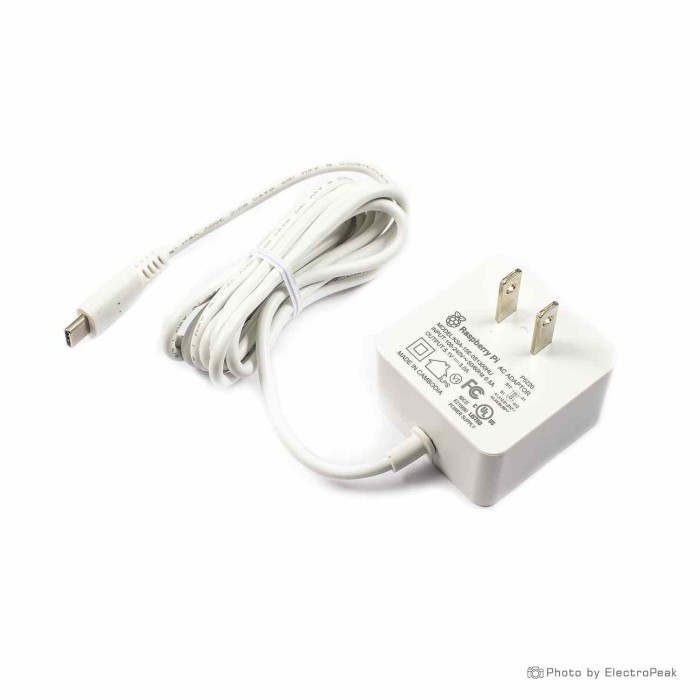
Official Raspberry Pi 4 Power Adapter - 5V, 3A
SAVE
As low as $11.9500
In stock
Only %1 left
SKU
MIN-01-127
Product Variations: View out of stock variants


Ships in 2-3 business days, then:
Free delivery in 12-15 days by Tracked Economic Shipping on orders over $100.
Free delivery in 7-10 days by Express Shipping on orders over $300.
More shipping info

Shop with confidence Learn More
 15V 1A DC Power Supply Adapter Previous
Official Raspberry Pi 4 Power Adapter Review
This official Raspberry Pi USB-C power supply is designed for Raspberry Pi 4 and provides a nominal 5.1V, 3A output through a 1.5 meter 18AWG cable. Its stated 15.3W output and direct USB-C connection make it a dedicated Pi 4 power solution rather than a general USB-C Power Delivery charger.
The adapter is supplied with a stated 2-pin plug. Confirm that the actual plug standard matches your local mains socket before ordering.
Specifications of Official Raspberry Pi 4 Power Adapter - 5V, 3A
- Input voltage range: 96-264V AC
- Working voltage: 5.1V
- Working current: 3A
- Output power: 15.3W
- Connection type: USB-C
- Cable type: 18AWG
- Designed for: Raspberry Pi 4
- Cable length: 1.5 meter
- Plug type: 2-pin plug
You will also need a Raspberry Pi board. Browse compatible Raspberry Pi power adapters if you need a different plug format, output rating, or switching arrangement.
Official Raspberry Pi 4 Power Adapter Specifications Explained
A Raspberry Pi 4 needs stable input voltage at its USB-C power port. The 5.1V, 3A rating aligns with the Pi 4 power requirement and leaves less margin for voltage loss than an undersized phone charger or light-duty USB supply.
The 1.5 meter 18AWG cable matters because thicker conductors have lower resistance than thin charging leads. This helps reduce cable-related voltage drop, although total system load and every added connector still affect the voltage reaching the board.
| Specification | Why it matters |
|---|---|
| 5.1V, 3A output | Provides the Pi-specific input rating needed for Raspberry Pi 4 operation. USB-C connector fit alone does not confirm that another charger provides the same output. |
| 18AWG, 1.5 meter cable | Helps limit cable resistance across the supplied length. Extensions, inline switches, adapters, and poor connectors can add resistance back into the power path. |
| 15.3W stated output | 15.3W is the arithmetic result of 5.1V multiplied by 3A. Raspberry Pi rates the current 15W USB-C power-supply family at 15W. |
| 96-264V AC input range | This is the stated operating range. The official power-supply family documentation distinguishes a 100–240 Vac rated input range from a 96–264 Vac operating range. |
The official 15W USB-C power-supply family includes short-circuit, overcurrent, and over-temperature protection. Its stated ambient operating range is 0–40°C, so keep the adapter dry and ventilated rather than enclosing it with heat-producing equipment.
A 3A adapter does not make peripheral power unlimited. USB storage, hubs, displays, inline switches, extensions, and extra USB-C connectors can increase demand or reduce voltage at the Pi. For explicitly light-load Pi 4 or general-electronics work where a separate cable is acceptable, the variant Motorola 5.2V 2A Power Adapter is another option, but its 2A output may be insufficient for high-load Raspberry Pi configurations.
Raspberry Pi 4 Power Adapter Compatibility and Limitations
This Raspberry Pi 4 Power Adapter connects directly to the USB-C power port on Raspberry Pi 4. The official 15W power-supply family also supports Raspberry Pi 400.
| Area | Compatibility or requirement | Buyer implication |
|---|---|---|
| Intended board | Raspberry Pi 4 | Designed for direct power connection to Raspberry Pi 4. |
| Official family compatibility | Raspberry Pi 4 Model B and Raspberry Pi 400 | Suitable for Pi 400 as part of the same official supply family. |
| Raspberry Pi 5 | Not recommended for demanding Pi 5 configurations | Choose a higher-capacity Pi 5 supply for high-current accessories or heavy peripheral loads. |
| Output connector | USB-C | Connect directly to the Raspberry Pi power input. |
| Output | Fixed 5.1V, 3A | Not a multi-voltage USB-PD charger. |
| Cable | 1.5 meter, 18AWG | Official family documentation describes the cable as captive; it is not a detachable replacement-cable arrangement. |
| Mains plug | 2-pin plug stated | The exact Type A, C, G, I, or D plug standard is not identified. Confirm socket compatibility before purchase. |
| Software and drivers | None required for the adapter | No driver, library, IDE, firmware, or board-selection step is needed for the power adapter itself. |
Plan cable routing before purchase. The official-family captive USB-C lead cannot be treated as a detachable cable that can be replaced, repaired, or extended without considering the added resistance and possible voltage drop.
This is a fixed 5.1V supply, not a multi-profile USB-PD charger for laptops, phones, or fast-charging devices. A Raspberry Pi 4 with demanding drives, hubs, displays, or several high-current USB devices can still show a low-voltage warning if system demand is high or added connections reduce voltage at the board. A higher-rated wall adapter alone does not remove the Raspberry Pi 4 board’s own USB peripheral-current limits.
If an integrated cable switch is the actual requirement, choose the exact-tier Raspberry Pi 4 Power Supply with On/Off Switch to switch power without unplugging the cable.
Where source traceability or regional compliance matters, inspect the physical adapter for Raspberry Pi branding, the KSA-15E-051300H* regional model code, the supplied plug type, box or product number, and applicable approval markings. These details should match the regional unit being purchased.
Official Raspberry Pi 4 Power Adapter vs Raspberry Pi Power Supplies
The right supply depends on the board, peripheral load, plug requirement, and whether you need an integrated switch. This 5.1V, 3A model is intended for Raspberry Pi 4 and Raspberry Pi 400 use.
| Power supply | Use it when | Key consideration |
|---|---|---|
| Official Raspberry Pi 4 Power Adapter | You need dedicated fixed 5.1V, 3A power for Raspberry Pi 4 or Raspberry Pi 400. | It has a fixed 1.5 meter cable and a stated 2-pin plug whose exact regional standard must be confirmed. |
| Raspberry Pi 4 Power Supply with On/Off Switch | You need an integrated on/off switch in the Pi 4 power cable. | This exact-tier option addresses switching convenience rather than providing a superior electrical specification. |
| Motorola 5.2V 2A Power Adapter | You have a light-load Pi 4 or general-electronics setup and can use a separate USB cable. | Its USB-A output and 2A rating may not suit high-load Raspberry Pi configurations. |
| Official Raspberry Pi 5 27W USB-C Power Supply | You are powering Raspberry Pi 5 with high-current or power-hungry peripherals. | Provides 5.1V at 5A and supports 9V/3A, 12V/2.25A, and 15V/1.8A. This supplied version has an EU Standard plug. |
Purchase decision summary
- Ideal for: Raspberry Pi 4 Model B owners who need a dedicated USB-C supply with a 5.1V, 3A rating and integrated 1.5 meter 18AWG cable, plus Raspberry Pi 400 owners using the same official supply family.
- Maybe for: Typical Pi 4 systems with USB peripherals after confirming plug compatibility, cable routing, and total peripheral demand.
- Consider another option if: You need a confirmed local plug type, detachable cable, integrated switching, USB-PD charging, or a Raspberry Pi 5 supply for high-current accessories.
Raspberry Pi 4 Power Adapter Accessories and Required Hardware
This adapter powers a compatible Raspberry Pi computer; it is not a complete Pi setup. You need a Raspberry Pi 4 Model B or Raspberry Pi 400 and a local mains socket that matches the supplied plug variant.
Required
- Host computer: Choose a Raspberry Pi 4 Model B - 2G RAM, Raspberry Pi 4 Model B - 4G RAM, or Raspberry Pi 4 Model B - 8G RAM. RAM capacity does not change power-adapter compatibility.
- Mains connection: A compatible local mains socket for the exact supplied plug variant.
Recommended
- Pi operating setup: Boot media, an operating system, enclosure, and any display or peripheral hardware required for the intended Pi project. These are not included with the adapter.
- High-current peripheral support: A powered USB hub or separately powered storage and peripheral arrangement for demanding USB devices.
- Direct cable routing: Use the supplied captive cable directly to the Pi where possible. Avoid unnecessary extensions, inline switches, and extra adapters.
Optional
- Power troubleshooting: A USB-C power meter or multimeter for checking voltage under load.
- Portable or resilient operation: A suitable UPS or power bank that provides appropriate output.
A USB-to-Type-C switched cable is not an additive accessory for this adapter because the power supply already has an integrated USB-C lead. Use a switched power-supply option when switching is required.
Raspberry Pi 4 Power Adapter Setup and Low-Voltage Check
Connection is straightforward, but check the plug and system load before assuming that a power issue is caused by the board. The adapter itself needs no driver, software, library, IDE, firmware, or board-selection step.
- Confirm that the supplied plug fits the local mains socket. Check the adapter label for Raspberry Pi branding and expected regional model information where available.
- Place the adapter in a dry, ventilated location.
- Connect the captive USB-C plug directly to the Raspberry Pi 4 power port.
- Connect the mains plug and boot the Raspberry Pi with separately purchased boot media and an operating system.
- Check for a low-voltage lightning-bolt warning or an undervoltage system message.
- If a warning appears, remove high-current USB devices, hubs, extension leads, inline switches, and unnecessary adapters. Retest with a direct connection.
A Raspberry Pi 4 connected directly with the supplied cable should power on and boot without a low-voltage warning under the tested system load. Persistent warnings justify checking plug fit, connections, product identity, and voltage under load.
Common first-time mistakes include choosing the wrong regional plug, assuming the cable is detachable, expecting USB-PD charging, adding an extension or inline switch, connecting high-current peripherals without separate power, and assuming boot media or an operating system is included. Compare suitable Raspberry Pi power adapters if your setup needs a different arrangement.
Official Raspberry Pi 4 Power Adapter FAQ and Buying Checklist
Does this power adapter work with Raspberry Pi 4 Model B?
Yes. It is designed for Raspberry Pi 4 and provides 5.1V, 3A through USB-C.
Does the Official Raspberry Pi 4 Power Adapter work with Raspberry Pi 400?
Yes. Raspberry Pi documentation identifies Raspberry Pi 400 as an intended device for the official 15W power-supply family.
Is the output 5V or 5.1V?
The nominal stated output is 5.1V. “5V 3A” is common shorthand, but 5.1V is the specification to use when comparing Pi-specific supplies.
Is this a 15W or 15.3W Raspberry Pi power supply?
The stated output is 15.3W, while Raspberry Pi rates the current official supply family at 15W. The 15.3W figure comes from multiplying 5.1V by 3A.
Which 2-pin plug comes with this Raspberry Pi 4 power adapter?
The exact plug standard is not identified. Confirm the supplied plug type, regional model suffix, and local mains compatibility before ordering.
Is the USB-C cable detachable?
No. Official product-family documentation describes a captive 1.5 meter USB-C cable rather than a separate charger-and-cable arrangement.
Can this power Raspberry Pi 5?
It may provide basic 5V-class power, but it is not the recommended supply for demanding Raspberry Pi 5 configurations. For Pi 5 applications requiring high current or power-hungry peripherals, use the variant Official Raspberry Pi 5 27W USB-C Power Supply.
Will this power a USB SSD or hard drive connected to Raspberry Pi 4?
It can power a Pi 4 at its recommended input rating, but the result depends on the drive, enclosure, other peripherals, and cable and connector resistance. Demanding storage loads may need a powered USB hub or separate peripheral power.
Does this USB-C adapter support USB Power Delivery or laptop charging?
No. This is a fixed 5.1V Raspberry Pi power supply, not a multi-voltage USB-PD charger.
Why is my Raspberry Pi 4 showing a lightning-bolt low-voltage warning?
Check peripheral load, hubs, extension cables, inline switches, connectors, plug fit, and product identity first. Retest with the adapter connected directly to the Pi and unnecessary peripherals removed before diagnosing the board.
Buying checklist
- ✓ My board is a Raspberry Pi 4 Model B or Raspberry Pi 400.
- ✓ I have confirmed what the stated 2-pin plug means for this exact unit and my local socket.
- ✓ A fixed 1.5 meter cable suits my installation and routing.
- ✓ I understand that the cable is captive rather than detachable.
- ✓ I need fixed 5.1V power for a Pi, not USB-PD profiles for a laptop or phone.
- ✓ My Pi 4 peripherals do not require separate power, or I have planned separate power for demanding USB devices.
- ✓ I will connect the adapter directly where possible rather than adding extension leads, inline switches, or extra connectors.
- ✓ If authenticity or regional compliance is critical, I will verify the physical label, model suffix, plug, and approval markings.
If you still need the host computer, choose a Raspberry Pi 4 Model B - 2G RAM, Raspberry Pi 4 Model B - 4G RAM, or Raspberry Pi 4 Model B - 8G RAM to pair with this supply.
Write Your Own Review

Please complete your information below to login.
Sign In
Create New Account