
Product added to cart

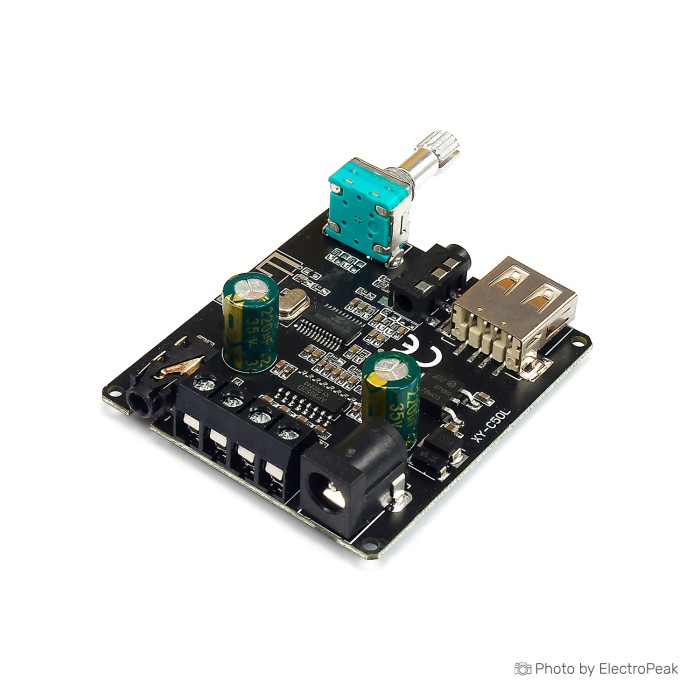
XY-C50L Bluetooth Digital Power Amplifier Board - 2x50W
$5.9500
In stock
SKU
SEN-17-121
Volume discounts:
- +25 4 % $5.7100
- +50 6 % $5.5900
- +100 8 % $5.4800
- +300 10 % $5.3600
- +500 12 % $5.2400
Ships in 2-3 business days, then:
Free delivery in 12-15 days by Tracked Economic Shipping on orders over $100.
Free delivery in 7-10 days by Express Shipping on orders over $300.
More shipping info

Shop with confidence Learn More

XY-C50L Bluetooth Amplifier Board Review
The XY-C50L is a two-channel stereo audio amplifier board for DIY passive-speaker projects, combining Bluetooth wireless streaming, a 3.5mm auxiliary input, and USB flash drive playback in one compact module. It provides a straightforward audio front end for custom bookshelf speakers, desktop systems, and portable enclosures when paired with an adequate external DC power source. This is strictly a 2.0 stereo amplifier: it has no dedicated subwoofer channel or digital optical inputs, and reaching its nominal 50W per channel rating requires specific operating voltages and speaker loads.
For builders considering compact options in our sound-player and audio-module category, this board provides a self-contained Class-D foundation with an acrylic protective shell, heat sink, and volume knob assembly.
Specifications of XY-C50L Bluetooth Digital Power Amplifier Board - 2x50W
- Input voltage: DC5-24V
- Bluetooth Version:0
- Output impedance: 4~16ohm Speaker
- For Speakers: 10W~200W
- Output power: 50W*2
- Audio input: Bluetooth, AUX, USB
- Number of channels: two channels
XY-C50L Power, Speaker and Input Specifications Explained
Choose the power source and speakers carefully when integrating the XY-C50L into an enclosure. Although the board accepts a broad input range, its real-world acoustic output and thermal stability depend entirely on supply voltage, available current, and speaker impedance.
| Specification | Published Value | Why It Matters in Practice |
|---|---|---|
| Input Voltage | DC5-24V | Operating at 5V yields minimal output volume suitable only for low-power tests. Practical bench testing shows that 12V to 24V is required for usable room-level listening, with 24V needed to approach the full output rating. |
| Output Power | 50W*2 | The 50W per channel rating represents peak output under ideal conditions (a regulated 24V supply driving 4Ω loads with low-impedance wiring). At 12V or when driving 8Ω speakers, clean continuous power is significantly lower. |
| Speaker Impedance | 4~16ohm Speaker | Matches standard passive drivers. Driving loads below 4Ω risks over-current shutdown or thermal damage, while 8Ω or 16Ω drivers operate cleanly with reduced total wattage. |
| Speaker Compatibility | 10W~200W | Indicates recommended driver thermal ratings. Small 10W drivers require careful volume management to avoid over-excursion, while larger 100W–200W drivers can be driven safely within moderate volume boundaries. |
| Audio Inputs | Bluetooth, AUX, USB | Enables wireless streaming from mobile phones, direct 3.5mm line-level connection from personal computers or televisions, and offline playback of digital audio files from flash storage. |
| Bluetooth Version | 0 | The published specification records Bluetooth Version:0, representing an unverified data field that requires physical batch verification, though standard hardware across this design family typically integrates Bluetooth 5.0 wireless receivers. |
| Channels | Two channels | Delivers discrete Left and Right stereo output. It cannot drive a separate passive subwoofer driver without an external active crossover and dedicated sub-amplifier. |
For dependable playback without sudden brownouts, use a dedicated 12V DC power supply capable of supplying at least 3A to 5A of continuous current. Need twice the output headroom and native mobile app equalization? The higher-power stereo amplifier board provides an alternative Class-D platform configured for 2x100W operation.
XY-C50L Bluetooth Amplifier Board Limitations
The XY-C50L is an economical option for custom stereo builds, but several hardware constraints should shape the system design.
Audio dropouts—periodic "hiccuping" or complete muting during bass peaks—are the most frequent issue encountered in the field. They are almost always caused by an undersized power supply falling below the operating voltage threshold under transient loads, or by internal thermal protection engaging when 4Ω speakers are driven at sustained high volume without airflow.
USB playback has strict format limits. The onboard decoder supports standard USB flash drives formatted in FAT32 up to 32GB and containing MP3 or WAV audio tracks. It does not recognize exFAT or NTFS partitions, multi-terabyte external mechanical hard drives requiring significant bus power, or uncompressed FLAC files.
Bench testing on single-unit samples from specific production batches, including GAOHOU-branded variants, has recorded total harmonic distortion plus noise (THD+N) around 0.1% alongside modest stereo crosstalk separation. Treat this generic module as an everyday utility audio driver rather than an instrument-grade audiophile component. Optical (TOSLINK) inputs and dedicated subwoofer filtering are also absent.
If your project specifications exceed what the XY-C50L provides, consider these alternative approaches:
- Higher stereo headroom: For 100W per channel at 24V into 4Ω loads with app-based adjustments, choose the Sinilink XY-AP100H 2x100W.
- Streamlined wireless-only output: The ZK-1002L 2x100W with Knob removes AUX and USB circuitry to focus purely on high-output Bluetooth streaming.
- Minimalist low-power desktop builds: Compact personal monitors suit the lower-power Bluetooth amplifier board, which offers a smaller 10W–20W footprint.
- Fixed installations without controls: The 120W Bluetooth amplifier board supplies dual 60W channels via Bluetooth without onboard potentiometers or mode switches.
- Modular wireless mono pairs: A mono TWS amplifier approach links two independent amplifier boards wirelessly over Bluetooth 5.2 for wide physical channel separation.
- Micro-power portable audio: For miniature builds, the low-power battery Bluetooth receiver runs directly from a 3.7V lithium cell or 5V USB source and outputs 2x5W.
XY-C50L vs XY-C50H Bluetooth Amplifier Board
Builders comparing 2x50W boards often weigh the XY-C50L against the XY-C50H. Both share identical theoretical power-output tiers and basic input selections, but their physical layouts differ across manufacturing runs.
The XY-C50H typically has a compact footprint around 52×58mm, while XY-C50L board dimensions vary among OEM productions. Terminal spacing, DC barrel orientation, and mounting-hole positions are not universally interchangeable between the two designations. Circuit-board tracings, component sourcing, and discrete output filtering also vary by supplier batch, so neither board has an established advantage in measurable audio fidelity or overall reliability. Base your choice on verified physical dimensions, port alignment for your custom enclosure, and the hardware accessories provided by your specific distributor.
XY-C50L Setup, Accessories and First Audio Test
The XY-C50L includes the core hardware for mechanical protection: upper and lower acrylic case plates, brass standoffs, assembly screws, a rotary volume knob, a mini screwdriver, a self-adhesive heat sink, and a terminal adapter that bridges bare power wires to a DC barrel socket.
Required Accessories
- DC Power Source: Use a regulated supply delivering 12V to 24V with at least 3A–5A capacity. The 12V DC power supply provides an accessible, stable benchtop source.
- Passive Speakers: Connect a pair of 4Ω to 16Ω drivers. The passive 8ohm speaker is a dependable bench-testing driver within safe thermal boundaries.
- Speaker & Power Wiring: Use standard two-conductor copper wire (18 AWG to 22 AWG), stripped cleanly so it seats securely in the screw terminals.
Recommended Accessories
- Enclosure Airflow: Provide free ambient convection or slotted vents around the installed heat sink to prevent thermal throttling at higher volume.
- USB Flash Storage: Use a USB thumb drive formatted strictly as FAT32, partitioned to 32GB or less, and loaded with standard MP3 or WAV audio tracks.
- Shielded 3.5mm AUX Cable: A male-to-male stereo cable connects line-level outputs from external audio DACs, personal computers, or mobile devices.
Optional Accessories
- Chassis DC Connector: Add a panel-mount DC jack connection to route power through external cabinet walls.
- Antenna Clearance: Keep the onboard trace antenna outside fully shielded metallic enclosures to avoid reducing Bluetooth reception range.
Initial Audio Verification Sequence
- Firmly adhere the included heat sink onto the main IC before applying power. Assemble the acrylic protection plates using the provided standoffs and screws.
- Connect the left and right passive speakers to the labeled screw terminals, ensuring that no loose wire strands bridge the positive and negative outputs.
- Rotate the potentiometer counter-clockwise to set the volume to minimum.
- Connect the 12V–24V power supply through the DC barrel input, or via the screw-type converter. Power on the source.
- Pair a smartphone or computer over Bluetooth, or connect a 3.5mm AUX line.
- Start audio playback at low volume, then slowly rotate the knob clockwise to confirm balanced, undistorted stereo performance across both channels.
- For USB playback, insert a compatible FAT32 drive containing MP3 files to verify automatic media indexing and audio playback.
XY-C50L Bluetooth Amplifier Board FAQ
What power supply does the XY-C50L need?
The board accepts DC5-24V, but reliable operation requires a regulated 12V to 24V power adapter rated for at least 3A to 5A. A weak 5V USB charger restricts volume and causes distortion, while an adapter such as our 12V DC power supply supports stable desktop listening.
Is the XY-C50L really 50W per channel?
The 50W*2 figure is maximum peak power under optimal laboratory conditions with a 24V supply driving 4Ω speakers. With a 12V supply or standard 8Ω speakers, actual continuous clean output is substantially lower.
Can the XY-C50L drive 8ohm speakers?
Yes. 8Ω speakers fall within the board's rated 4~16ohm output impedance window. The amplifier operates cooler with 8Ω loads, though total acoustic wattage is lower than with equivalent 4Ω drivers.
Does the XY-C50L have a subwoofer output?
No, this board is strictly a two-channel 2.0 stereo amplifier. A build requiring a dedicated low-frequency channel for a 2.1 system needs a specialized subwoofer amplifier board.
Can I connect the XY-C50L to a TV?
Yes, provided the television has an analog 3.5mm headphone jack or RCA line output that can be adapted to the board's AUX input. The XY-C50L has no optical TOSLINK or digital coaxial input.
Will any USB flash drive work with the XY-C50L?
No. The drive must use a FAT32 file system, have a capacity of 32GB or smaller, and contain MP3 or WAV audio tracks. NTFS or exFAT partitions, along with external mechanical hard drives, will not load.
Why does the XY-C50L cut out at high volume?
High-volume cutouts occur when the power supply cannot deliver enough instantaneous current during dynamic bass peaks, causing voltage to fall below the operating limit. Thermal protection can also trigger dropouts when the board lacks adequate ventilation.
What Bluetooth version does the XY-C50L use?
The product specification lists Bluetooth Version:0 as an unresolved placeholder entry. Standard boards across this design family typically incorporate Bluetooth 5.0 hardware, but this field remains open pending individual supplier batch verification.
What is included with the XY-C50L board?
The package contains the assembled circuit board, acrylic top and bottom case panels, mounting spacers, screws, an adjustment screwdriver, an aluminum heat sink, a volume knob, and a DC barrel-to-terminal converter. A power brick, speaker wire, speakers, and AUX cords are sold separately.
Purchase Decision Summary
- Ideal for: Compact DIY stereo bookshelf speakers, portable Bluetooth boomboxes, and desktop passive-speaker setups requiring wireless streaming, AUX, and USB playback in one module.
- Maybe for: Connecting to television analog outputs or running from 12V mobile battery systems where moderate acoustic output is sufficient and adequate airflow is provided.
- Consider another option if: You need a dedicated 2.1 subwoofer channel, optical digital input, uncompressed FLAC or high-capacity hard drive playback, or verified lab-grade audiophile distortion measurements. For projects demanding higher output, the Sinilink XY-AP100H 2x100W is a stronger fit, while lower-draw micro builds benefit from the Sinilink XY-AP15H 20W.
Buying Checklist
- Channel Count: Confirm that your build needs a two-channel stereo setup, not a 2.1 system with a dedicated subwoofer.
- Speaker Impedance: Verify that your passive speakers measure between 4Ω and 16Ω.
- DC Power Supply: Ensure you have a 12V to 24V DC power supply capable of delivering 3A to 5A of current.
- Audio Input Types: Check that your sources output through Bluetooth, standard 3.5mm analog line-out, or FAT32 USB storage.
- No Optical Support: Verify that you do not require a TOSLINK or S/PDIF digital optical connection.
- USB Formatting: Confirm that your music collection is loaded as MP3 or WAV files on a FAT32 USB drive of 32GB or less.
- Thermal Planning: Allow physical clearance around the heatsink for adequate cooling inside your enclosure.
- Cabling and Hardware: Source your own speaker hookup wire, 3.5mm auxiliary patch cable, and external power brick.
| Interface Type | Analog, USB, Wireless |
|---|---|
| Operating Voltage (V) | 5-24V DC |
| Mounting Type | Screw holes |
| Audio Function | Amplifier |
| Output Power | 2x50W |
| Speaker Impedance (Ω) | 4Ω, 8Ω, 16Ω |
| Input Types | AUX, Bluetooth, USB |
| Bluetooth Ver. | 5 |
| Output Type | Analog |
| Channels | 2-channel |
Write Your Own Review

Please complete your information below to login.
Sign In
Create New Account