
Product added to cart

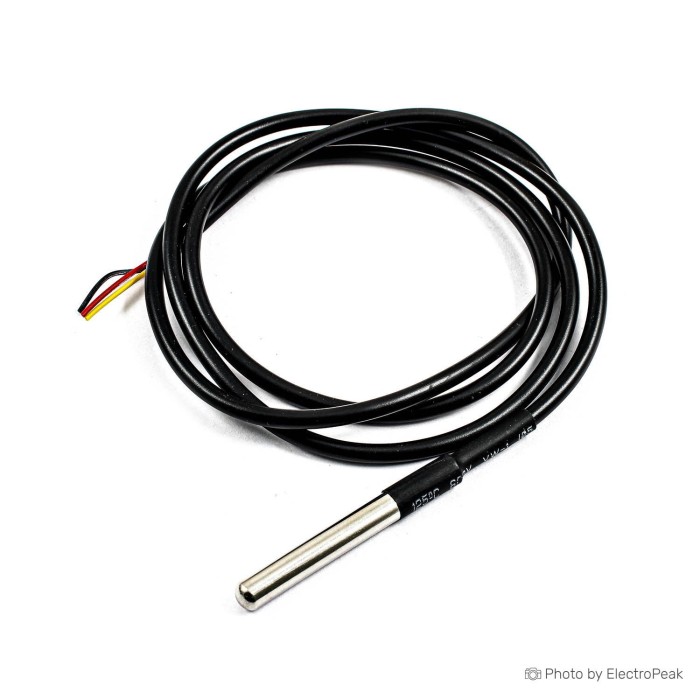
DS18B20 Temperature Sensor - Waterproof Probe, 1m
$0.8100
In stock
SKU
SEN-10-011
Volume discounts:
- +50 5 % $0.7700
- +100 7 % $0.7500
- +300 11 % $0.7200
- +500 14 % $0.7000
- +1000 16 % $0.6800
Ships in 2-3 business days, then:
Free delivery in 12-15 days by Tracked Economic Shipping on orders over $100.
Free delivery in 7-10 days by Express Shipping on orders over $300.
More shipping info

Shop with confidence Learn More
 AOSONG DHT22 Temperature Humidity Sensor Previous
DS18B20 Waterproof Temperature Sensor Review
This 1-meter DS18B20 waterproof temperature sensor provides digital temperature monitoring for Arduino, ESP32, Raspberry Pi, and other microcontroller platforms. Its sensor is enclosed in a stainless steel tube, allowing measurements in liquids and damp environments without leaving bare electronics exposed. It communicates over a 1-Wire digital bus from a 3.0V to 5.5V DC supply, so it fits easily into existing low-voltage systems. For builds needing certified continuous submersion, known connector standards, traceable calibration, or sustained high-temperature exposure, additional verification or alternative hardware is necessary.
Specifications of DS18B20 Temperature Sensor - Waterproof Probe, 1m
- Type: DS18B20 Digital Temperature Sensor
- Probe Type: Waterproof Stainless Steel Probe
- Cable Length: 1 meter
- Temperature Range: -55°C to +125°C (-67°F to +257°F)
- Temperature Resolution: 9 to 12 bits user-selectable
- Accuracy: ±0.5°C (from -10°C to +85°C)
- Interface: 1-Wire digital interface
- Power Supply: 3.0V to 5.5V DC
- Operating Current: 1mA (max)
- Dimensions (Probe): Typically 6mm in diameter
- Connector: 3-pin, with red (VCC), yellow (data), and black (ground) wires
Makers comparing parts across temperature and humidity sensors choose this probe for liquid tanks, compost piles, and home-automation enclosures where an unprotected sensor board cannot withstand direct moisture contact.
DS18B20 Waterproof Sensor Specifications Explained
Digital sensor selection means separating reporting increments from absolute measurement limits. The table below shows how each core parameter affects circuit design and measurement expectations.
| Specification | Stated Value | Why It Matters |
|---|---|---|
| Temperature Range | -55°C to +125°C (-67°F to +257°F) | This range represents the silicon operating capabilities of the internal DS18B20 integrated circuit. The complete probe assembly—including the outer cable jacket and sealing potting—does not carry a documented continuous rating up to +125°C, where flexible PVC insulation generally softens. |
| Measurement Accuracy | ±0.5°C (from -10°C to +85°C) | The sensor maintains its tightest factory error band across this central span. Outside -10°C to +85°C, acceptable error expands according to standard Dallas 1-Wire characteristics (up to ±2°C at range extremes). |
| User-Selectable Resolution | 9 to 12 bits | Configuring resolution sets the reporting increment: 9-bit provides 0.5°C steps, 10-bit provides 0.25°C, 11-bit provides 0.125°C, and 12-bit provides 0.0625°C. Higher bit depth increases reading granularity, not absolute accuracy. |
| Conversion Time | Up to 750 ms (at 12-bit) | Reading at full 12-bit resolution requires allowing up to 750 ms for the sensor to complete an analog-to-digital cycle. Fast control loops must either drop to 9-bit resolution (roughly 93.75 ms) or use non-blocking request routines. |
| Bus Interface | 1-Wire digital interface | A single microcontroller GPIO can manage one or multiple sensors. Each genuine DS18B20 contains a unique factory 64-bit ROM code, allowing parallel bus topology on a shared line. |
| Operating Voltage | 3.0V to 5.5V DC | The logic and power thresholds directly match both 3.3V systems (like ESP32 or Raspberry Pi) and 5V systems (such as Arduino Uno) without requiring logic-level shifters. |
| Operating Current | 1mA (max) | Specifies peak active current during temperature conversion. Standby draw between conversions is substantially lower, though specific mode-by-mode power consumption figures are not provided. |
For industrial logging that requires certified laboratory calibration or platinum resistance, use a dedicated PT100/PT1000 RTD measurement setup rather than a standard digital probe. Comparing sensing methods across the maker ecosystem? Our Arduino temperature sensor comparison guide covers the trade-offs among thermocouples, thermistors, and digital ICs.
DS18B20 Waterproof Probe Wiring, Compatibility and Quick Start
This probe needs three electrical connections: VCC, Ground, and a bidirectional digital data line. Because the 1-Wire protocol uses an open-drain architecture, the data line needs an external pull-up resistor of approximately 4.7 kΩ between data (DQ) and VCC. Without it, the bus floats and the microcontroller will not register the device.
| Wire Color | Function | Connection Target |
|---|---|---|
| Red | VCC (Power) | 3.0V to 5.5V DC supply on microcontroller |
| Yellow | Data (DQ) | Microcontroller digital I/O pin (with 4.7 kΩ pull-up to VCC) |
| Black | GND (Ground) | System Ground (GND) |
The assembly ends in a 3-pin connector. Connector housing types, pin order, and keying standards can vary across production batches, so verify your specific connector pinout and wire order before applying power. For bench testing, connect it through breadboard prototyping hardware and use jumper wires for sensor wiring to run directly to your development board. Prefer a pre-soldered board with pin headers instead of a wired probe? The DS18B20 breakout module is the alternate packaging format.
Microcontroller Compatibility
- Arduino (Uno, Nano, Mega, etc.): Fully supported through the standard OneWire and DallasTemperature software libraries. It operates reliably on both 5V and 3.3V pins. See our detailed Arduino DS18B20 wiring guide for step-by-step code implementations.
- ESP32 & ESP8266: Fully supported on 3.3V GPIO pins with OneWire and DallasTemperature in the Arduino framework, or with native drivers in ESP-IDF and MicroPython.
- Raspberry Pi: Supported natively through the Linux kernel
w1-gpiooverlay. Addingdtoverlay=w1-gpioto/boot/config.txtmaps the 1-Wire bus to GPIO4 (Pin 7) by default.
Quick Start Verification Sequence
- Inspect the cable termination to determine whether the attached 3-pin shell mates with your board or whether bare leads must be exposed.
- Connect red to 3.3V or 5V, black to ground, and yellow to your chosen digital GPIO.
- Insert an external 4.7 kΩ resistor between the yellow data wire and the red power wire.
- Open your development environment and install the OneWire and DallasTemperature libraries.
- Upload an address-scanner sketch to detect the sensor's unique 64-bit ROM code.
- Issue a conversion request command and allow up to 750 ms for a full 12-bit calculation.
- Read and print the temperature in Celsius or Fahrenheit to the serial monitor.
- Warm the stainless probe between your fingers to confirm dynamic temperature response.
If the serial monitor outputs -127°C, the microcontroller cannot communicate with the sensor. This indicates a physical connection problem, not extreme cold. Check that the 4.7 kΩ pull-up resistor is seated correctly, confirm a shared ground between the power supply and microcontroller, and ensure the correct GPIO pin is assigned in your code. For builders testing board-style versions alongside this cable probe, our companion DS18B20 module Arduino guide covers board-mounted troubleshooting.
DS18B20 Waterproof Probe Limitations and Reliability
The product description specifies a waterproof stainless steel probe, but the assembly has no ingress protection rating such as IP67 or IP68. No submersion depth, pressure limit, or continuous underwater-duration rating is documented. The stainless steel housing protects the internal sensor from mechanical damage and incidental liquid contact, but the seal where the flexible cable enters the steel tube is the main failure point over extended periods. In aquariums, hydroponics reservoirs, or outdoor tanks, liquid can gradually penetrate generic potted heat-shrink seals during continuous underwater submersion. Continuous immersion in pressurized systems or chemically aggressive fluids is not supported.
Temperature operation has a similar boundary. The internal DS18B20 integrated circuit can measure up to +125°C, but standard flexible PVC cable jackets and heat-shrink tubings degrade or soften when held near these upper limits. Keep the cable and junction outside intense heat zones, exposing only the metal tip to elevated process temperatures. For exhaust pipes, kilns, or boiler monitoring, move to K-type thermocouple measurement for higher temperatures.
Consider these additional technical boundaries during system design:
- Connector Documentation: The exact connector model, pitch, and keying are unspecified. Inspect the received termination or replace it with screw terminals or standard 2.54 mm pin headers.
- Market Provenance: Generic DS18B20 probes come from diverse manufacturing sources. Internal silicon variations can affect parasite power timing, EEPROM behavior, and register quirks. For high-reliability designs, standard three-wire powering (VCC, GND, DQ) is strongly advised over parasite-power mode.
- Measurement Latency: A 12-bit conversion requires up to 750 ms, making this probe unsuitable for capturing rapid thermal transients.
- No Ingress or Food Certifications: The assembly lacks food-grade, potable water, or chemical-compatibility testing documentation.
See our broader Arduino temperature sensor comparison guide if your installation environment falls outside these parameters.
DS18B20 Waterproof Temperature Sensor Alternatives
Different monitoring tasks call for different physical formats, electrical protocols, and thermal ranges. The table below compares this probe with alternative sensing options.
| Product | Sensor Type | Interface | Temperature Range | Key Physical Characteristic |
|---|---|---|---|---|
| DS18B20 Waterproof Probe (This Product) | Digital IC (DS18B20) | 1-Wire digital | -55°C to +125°C | Waterproof stainless steel probe, 1 m cable |
| Bare three-lead DS18B20 format | Digital IC (DS18B20) | 1-Wire digital | -55°C to +125°C | Bare through-hole component package (TO-92 style) |
| DS18B20 breakout module | Digital IC (DS18B20) | 1-Wire digital | -55°C to +125°C | Pre-assembled 20x13 mm PCB with 3-pin header |
| Waterproof NTC thermistor probe | Analog Thermistor (10K NTC) | Analog resistance | -20°C to +125°C | Waterproof stainless probe, 0.5 m lead |
| PT100/PT1000 RTD measurement setup | RTD Digitizer (MAX31865) | SPI digital | Sensor dependent | Interface converter board (requires external probe) |
| K-type thermocouple measurement for higher temperatures | Thermocouple Digitizer (MAX6675) | SPI digital | 0°C to +1024°C | Digitizer module (requires external K-type probe) |
| Analog Kelvin temperature sensor | Analog Zener IC (LM335) | Analog (10 mV/°K) | -40°C to +100°C | Bare through-hole IC for dry circuit boards |
| Analog Celsius temperature sensor | Analog IC (LM35DZ) | Analog (10 mV/°C) | -55°C to +150°C | Bare TO-92 IC for ambient air measurement |
Match the sensor to your processor architecture and environment. Choose the waterproof NTC thermistor probe when your controller has spare analog inputs and you prefer simple voltage dividers to 1-Wire libraries. For dry indoor monitors, bare parts such as the analog Celsius temperature sensor and analog Kelvin temperature sensor remove the bulk of a steel probe.
DS18B20 Waterproof Sensor Accessories and Installation Needs
This sensor needs several external components, depending on whether you are prototyping on a breadboard or building a permanent installation.
Required Hardware
- 1-Wire Host Controller: An Arduino, ESP32, ESP8266, Raspberry Pi, or other programmable system capable of digital GPIO manipulation.
- Power and Ground Wiring: A stable 3.0V to 5.5V DC supply rail shared with your microcontroller.
- Pull-Up Resistor: An approximately 4.7 kΩ resistor placed between the yellow data wire and the positive power wire. The probe does not include this resistor internally.
- Termination Adapter: Depending on the received 3-pin connector, you may need 2.54 mm Dupont leads, terminal blocks, or a matching receptacle to interface with your host.
Recommended Hardware
- Prototyping Board: An breadboard prototyping platform (such as an 830-point board) simplifies placement of the pull-up resistor alongside host connections.
- Interconnect Cables: A pack of jumper wires for sensor wiring supports rapid patching to microcontroller headers.
- Known Reference Thermometer: A calibrated instrument lets you verify baseline accuracy and offset under actual operating conditions.
- Drip Loop and Mechanical Strain Relief: Route the 1-meter cable with a downward bend to prevent condensing moisture from tracking along the jacket directly into terminal enclosures.
Optional Accessories
- Additional Sensors: Multiple bare three-lead DS18B20 format devices can share the same data bus when you are expanding to multi-zone monitoring.
- External Protective Sleeves: An aftermarket enclosure such as the 6x50mm sensor case compatibility exists for bare ICs, but fit with this fully assembled 6 mm probe cannot be confirmed because internal sleeve dimensions and potted probe lengths vary.
DS18B20 Waterproof Sensor FAQ and Buying Checklist
Does this DS18B20 waterproof sensor work with Arduino, ESP32, and Raspberry Pi?
Yes. It operates across 3.0V to 5.5V DC and communicates over 1-Wire, which all three platforms support. Arduino and ESP32 use the community OneWire and DallasTemperature libraries, while Raspberry Pi supports 1-Wire natively through its w1-gpio kernel overlay. Detailed configuration appears in our Arduino DS18B20 wiring guide.
Do I need a 4.7k resistor for a DS18B20 waterproof probe?
Yes. A pull-up resistor of approximately 4.7 kΩ between the data line and VCC is necessary for reliable communication. The probe does not contain an internal pull-up resistor, and the 1-Wire bus needs one to hold the data line high during idle states.
Which DS18B20 waterproof probe wire is data?
The yellow wire is the data line. Red connects to positive supply (VCC), and black connects to ground (GND). Because connector housings can vary, always confirm wire positions against your controller pinout before powering up.
Is 12-bit resolution the same as ±0.0625°C accuracy?
No. Resolution is the smallest increment the sensor can report, while accuracy describes measurement truth. At 12-bit resolution, the sensor reports in 0.0625°C steps, but rated absolute accuracy remains ±0.5°C over the span of -10°C to +85°C.
How fast does a DS18B20 waterproof sensor update?
A full 12-bit conversion takes up to 750 ms. If your system needs faster reading rates, configure the sensor in software for 9-bit resolution, reducing conversion time to roughly 93.75 ms at the expense of step granularity.
Can several DS18B20 probes use one Arduino or ESP32 pin?
Yes. Multiple DS18B20 sensors can share a single microcontroller data pin. Each sensor has an individual 64-bit factory address, allowing the microcontroller to query every device independently on the shared 1-Wire bus.
Can this waterproof probe stay underwater permanently?
Long-term permanent submersion is not recommended because the assembly has no formal IP rating, pressure specification, or submersion-endurance rating. During extended continuous immersion, moisture can eventually migrate past the potting seal where the cable enters the steel capsule.
Can the complete DS18B20 probe operate continuously at 125°C?
No. Sustained operation at +125°C should be avoided for the cable and seal. Although the internal silicon die is rated up to +125°C, the PVC cable jacket and sealing materials soften and degrade under continuous exposure to extreme heat.
Is this an original Analog Devices or Maxim DS18B20?
The product is a generic DS18B20-compatible assembly without documented semiconductor lot provenance. Functional compatibility with standard 1-Wire commands is maintained, but projects requiring certified original Maxim/Analog Devices silicon should seek traceable component listings.
Why does my Arduino DS18B20 sketch show -127°C?
A reading of -127°C indicates a communication failure on the 1-Wire bus, not an environmental measurement. Missing pull-up resistors, broken wire connections, disconnected grounds, or misassigned digital GPIO numbers in code can cause this result.
Can this DS18B20 waterproof sensor measure humidity?
No. This probe measures temperature only. If your project also needs atmospheric moisture data, browse our temperature and humidity sensors. For unsealed dry monitoring, you can also use an analog Celsius temperature sensor alongside a dedicated humidity module.
Purchase Decision Summary
- Ideal for: Maker and hobbyist microcontroller projects requiring straightforward liquid or remote temperature monitoring through a single GPIO pin over a 1-meter lead.
- Maybe for: Non-critical home brewing, soil-adjacent, hydroponics, or aquarium setups where the probe is accessible for maintenance and verified before permanent mounting.
- Consider another option if: You need certified permanent immersion, sanitary food-contact compliance, sustained high-temperature measurement above +85°C, fast millisecond response times, or documented industrial silicon traceability.
Buying Checklist
- Confirm your microcontroller board provides an available digital I/O pin capable of 1-Wire communication.
- Ensure you have an external 4.7 kΩ resistor on hand for the data line pull-up.
- Verify that your host system provides a regulated power source between 3.0V and 5.5V DC.
- Check that a 1-meter cable length reaches from your controller enclosure to the measurement location.
- Verify that the expected environment does not require formal IP68 ratings or continuous deep submersion.
- Confirm that the update rate of up to 750 ms fits your control loop or data logging intervals.
| Platform | Arduino Mega,Arduino Nano,Arduino Uno,Raspberry Pi 3,Raspberry Pi 4,Raspberry Pi 5 |
|---|---|
| Interface Type | Digital |
| Operating Voltage (V) | 3.0V to 5.5V DC |
| Operating Current (mA) | 1mA (max) |
| Dimensions (mm) | 6mm (diameter) |
| Mounting Type | Wire |
| IP Rating | Waterproof |
| Output Type | Digital |
| Accuracy | ±0.5°C (from -10°C to +85°C) |
| Resolution | 9 to 12 bits user-selectable |
| Response Time | 750 ms |
| Measurement Range | -55°C to +125°C |
| Environmental Parameter | Temperature |
| Probe Type | Waterproof temperature sensor |
| Chipset | DS18B20 |
| Relay Output | No |
| Protocols | 1-Wire |
| Temp Accuracy | ±0.5°C (from -10°C to +85°C) |
Write Your Own Review

Please complete your information below to login.
Sign In
Create New Account