
Product added to cart

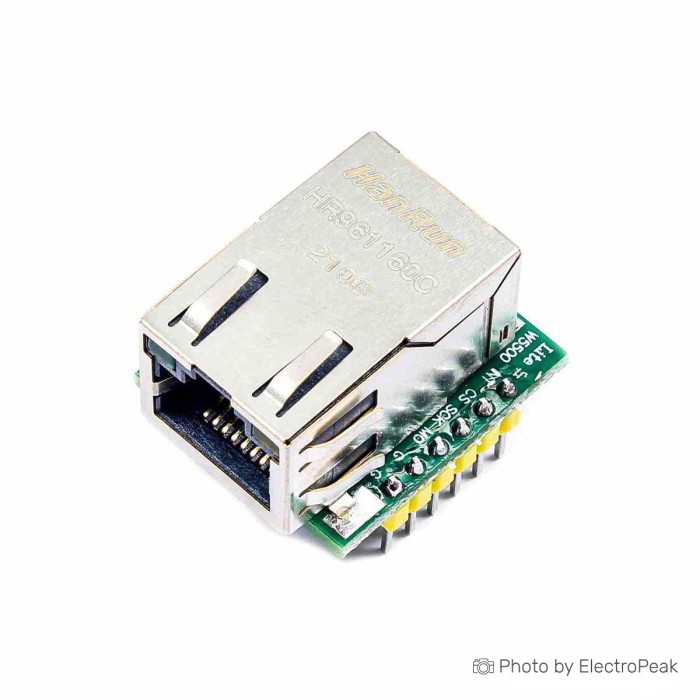
W5500 TCP/IP Ethernet Module (WIZ820IO Compatible)
$3.9500
In stock
SKU
COM-04-008
Volume discounts:
- +25 4 % $3.8000
- +100 6 % $3.7300
- +300 7 % $3.6600
- +500 9 % $3.5800
- +1000 11 % $3.5100
Ships in 2-3 business days, then:
Free delivery in 12-15 days by Tracked Economic Shipping on orders over $100.
Free delivery in 7-10 days by Express Shipping on orders over $300.
More shipping info

Shop with confidence Learn More
 LAN8720 Ethernet Network Module - RMII Interface Previous
W5500 Ethernet Module Overview and Specifications
This compact W5500 Ethernet module gives embedded systems hardwired 10/100 Fast Ethernet through a standard Serial Peripheral Interface (SPI). The WIZnet W5500 controller handles TCP, UDP, IPv4, ICMP, ARP, IGMP, and PPPoE in dedicated hardware, so your microcontroller does not need to run an in-memory network stack. It suits microcontrollers with an available SPI bus and a clean, regulated 3.3V rail when local networking requires up to 8 concurrent sockets.
This module is not intended for Gigabit networks, designs requiring Power over Ethernet (PoE) without supplementary circuitry, or network architectures that depend on IP packet fragmentation. It is a compact 23 × 25 mm dual-row pin breakout, not an Arduino shield, so it requires wire or backplane integration rather than socketing onto standard development headers. Browse our Internet and network hardware range for related options, or see the identical W5500 Ethernet module listing for the same hardware under an alternative listing.
Specifications of W5500 TCP/IP Ethernet Module (WIZ820IO Compatible)
- Built-in hardware TCPIP protocol stack: users need almost no knowledge of complex network protocols
- Supported protocols: TCP,UDP,ICMP,IPv4,ARP,IGMP,PPPoE protocol
- Data link layer: Integrated
- Physical layer: Integrated
- Power-down wake up: Supported
- SPI support: high-speed serial peripheral interface (SPI mode 0-3)
- Internal buffer: 32K byte send and receive buffer
- Ethernet PHY: Embedded 10BaseT/100BaseTX Ethernet Physical Layer (PHY)
- Auto-negotiation: 10/100-Based full/half duplex
- IP fragmentation: Not supported
- Working voltage: 3.3V
- I/O signal port: 5V withstand voltage
- LED status display: full duplex / half duplex,network connection,network speed,active status
- Package: Ultra-small pin package for easy embedded applications
- Application routines: Provide C application routines
- Power supply mode: 3.3V external power supply,current should be greater than 200mA
- Control interface form: 3.3V TTL level,SPI interface; 2* single row pin
- PCB size (MM): 23 * 25 mm
- Mechanical dimensions: length * width * height
- Socket connections: Support up to 8 Socket connections
- SPI interface speed: 80MHz high speed SPI interface
W5500 SPI Ethernet Module Compatibility and Setup
This module requires an external, regulated 3.3V supply capable of delivering more than 200mA. Its digital I/O lines tolerate 5V signals, allowing direct SPI logic connections to 5V microcontrollers such as an ATmega328P. That tolerance applies only to signal pins; applying 5V directly to the 3.3V power input pin will damage the W5500 controller.
Host communication uses four primary SPI lines: MOSI, MISO, SCK, and a dedicated Chip Select (CS). The module also exposes interrupt (INT) and hardware reset (RST) connections. Depending on the firmware library, the RST pin may need to be driven low by a host GPIO during startup to guarantee clean power-on initialization. For breadboard prototypes, flexible SPI jumper wiring helps maintain solid connections between the module's 2-millimeter or 2.54-millimeter pitch header rows and standard breakout boards.
| Platform / Component | Support Level | Implementation Notes |
|---|---|---|
| AVR / Standard Arduino | Supported | Compatible via standard W5500-enabled Ethernet or Ethernet2 libraries. |
| ESP32 Core 3.x | Supported | Supported through the native ETH.h driver class configured for SPI. |
| STM32 & General ARM | Supported | Integrates through WIZnet ioLibrary_Driver or standard CMSIS SPI drivers. |
| Supply Rail | 3.3V DC Required | Requires external 3.3V source rated >200mA; do not power via 5V rail. |
| Network Link Type | Switch / Hub Preferred | Lacks internal auto MDI-X; direct PC links require a direct device-to-device Ethernet wiring cable. |
For microcontrollers with an internal Ethernet Media Access Controller (MAC), such as certain ESP32 or STM32 variants, an SPI-based controller is not always necessary. If your target microcontroller provides an internal MAC and exposed RMII pins, a dedicated RMII Ethernet PHY for MCU-integrated MAC hardware avoids SPI bus bottlenecking and leaves the SPI bus available for other peripherals.
W5500 Ethernet Module Specifications Explained
Choosing an embedded Ethernet controller means balancing protocol-processing workloads against available bus bandwidth and RAM constraints. The table below shows how the published technical characteristics affect practical embedded firmware development.
| Specification | Technical Value | Why It Matters to Your Design |
|---|---|---|
| TCP/IP Processing | Hardware Logic Offload | Runs transport and network layers on silicon. Frees host flash and SRAM while preventing MCU lockups during heavy packet traffic. |
| Concurrent Sockets | Up to 8 Sockets | Allows simultaneous local network functions, such as running a local web server, an MQTT client, and an NTP time sync routine concurrently. |
| Internal Memory | 32 KB Tx/Rx Buffer | Allocated dynamically among active sockets (up to 16 KB per socket) to prevent dropped packets during SPI transfer delays. |
| Physical Layer (PHY) | 10/100BaseTX Embedded | Negotiates standard Fast Ethernet speeds automatically with conventional routers and network switches. |
| Duplex Handling | Auto-negotiation Full/Half | Ensures automatic detection of maximum network link speeds without requiring manual register configuration. |
| Host Bus Speed | 80 MHz SPI (Rated Max) | Supports high data throughput on capable host MCUs, though physical wiring limits practical breadboard speeds to lower rates. |
| Fragmentation Support | Not Supported | Incoming IP packets that exceed the Maximum Transmission Unit (MTU) will be dropped rather than reassembled. |
| Visual Feedback | Integrated Status LEDs | Provides instant hardware validation for physical link state, transmission activity, network speed, and duplex configuration. |
If your project does not require 8 concurrent sockets and would benefit from more host-bus connection options, consider the standalone Ethernet module with fewer sockets and wider host-bus options. This older-generation module provides 4 independent sockets and supports SPI plus parallel direct or indirect bus interfacing on a larger footprint.
W5500 Ethernet Module Limitations and Troubleshooting
The hardware offload engine simplifies standard socket communication, but several operational constraints still need attention during circuit design and software integration.
- Supply Rail Regulation: The module requires steady 3.3V power exceeding 200mA. Powering it from low-capacity on-chip MCU regulators often causes sudden brownouts, spontaneous SPI drops, or failure to acquire a DHCP lease.
- IP Fragmentation: Packets split across multiple frames cannot be reconstructed by the internal hardware stack. Network communication should enforce an MTU compatible with local subnet standards to prevent dropped payloads.
- SPI Clock Integrity: Although the chip controller specifies an 80MHz theoretical bus limit, standard flying leads and breadboard tracks introduce significant capacitance. Practical jumper-wire prototyping often requires throttling SPI clock speeds down to 10–20MHz to prevent silent data corruption.
- Reset Requirements: Generic module revisions occasionally suffer from sluggish power-on reset rise times. Connecting the RST pin to a microcontroller GPIO and issuing an active-low pulse (minimum 500 microseconds) before SPI bus initialization ensures the chip enters an operational state.
- Library Misconfigurations: Initializing code with legacy libraries intended for earlier chips can produce a perpetual "hardware not detected" status. Verify that your active software defines the correct W5500 chip family and CS pin assignment.
- Cabling for Peer Connections: The integrated PHY does not include internal auto MDI-X crossover logic. When linking directly to a PC or single-board computer instead of a standard auto-switching port, use a dedicated direct Ethernet connection without a switch.
If your software architecture already includes an optimized TCP/IP network stack, such as lwIP, running directly inside a high-performance host MCU, dedicated hardware protocol offload may be unnecessary. For basic local communication where lower throughput is acceptable, a host-managed Ethernet networking module provides simple MAC-level Ethernet bridging over SPI at 10Mbps.
W5500 vs W5100 Ethernet Module and Shield
The choice between the W5500 and W5100 hardware formats comes down to physical form factor, the number of parallel socket connections required, and whether you need integrated peripheral expansion such as SD card storage or PoE delivery.
| Feature | W5500 Breakout (This Module) | W5100 Standalone Module | W5100 Shield with SD Slot | W5100 R3 Shield with PoE |
|---|---|---|---|---|
| Simultaneous Sockets | 8 Hardware Sockets | 4 Hardware Sockets | 4 Hardware Sockets | 4 Hardware Sockets |
| Internal Buffer | 32 KB (Shared) | 16 KB (Shared) | 16 KB (Shared) | 16 KB (Shared) |
| Form Factor | Compact Breakout (23 × 25 mm) | Breakout Board (51.7 × 30 mm) | Standard Arduino Shield | Standard Arduino R3 Shield |
| Host Bus Options | SPI Only | SPI, Direct & Indirect Bus | SPI (via ICSP Header) | SPI (via ICSP Header) |
| Onboard Storage | None | None | Full-Size SD Slot | Micro-SD Slot |
| Power Over Ethernet | Not Supported | Not Supported | Not Supported | IEEE 802.3af (36–57V Input) |
For custom embedded designs with limited PCB space, this 23 × 25 mm breakout provides the highest socket count in the smallest footprint shown here. For Uno or Mega applications that require onboard datalogging, choose a shield format such as the Arduino Ethernet projects with SD storage board. The Arduino Ethernet projects with micro-SD or stated PoE-standard input support shield suits installations requiring single-cable power and data feeds inside commercial equipment. It incorporates dedicated power-regulation stages, though its SPI lines must be shared between the storage card and Ethernet controller. For an equivalent module breakout under an alternate catalog listing, refer to the identical W5500 Ethernet module listing.
W5500 Ethernet Module Projects and Integration Needs
With autonomous transport processing, this module works well in embedded applications where network stability is essential. Confirmed production architectures include:
- ESP32 Edge Gateways: Bridge local Modbus or RS-485 sensors to MQTT brokers and cloud endpoints over wired Ethernet to avoid wireless congestion.
- Arduino Web Servers: Host responsive internal HTML interfaces and REST API endpoints where 8 concurrent sockets prevent connection starvation.
- STM32 Telemetry Nodes: Stream continuous sensor readings through UDP sockets while maintaining an active TCP service connection using the official WIZnet ioLibrary.
- Wake-on-LAN Infrastructure: Monitor low-power network states to issue remote magic-packet triggers to sleeping workstations.
Beyond these proven platforms, the module is well suited to industrial telemetry bridges, remote relay controllers, and smart building interfaces that require wired reliability over wireless solutions.
Required Hardware
- SPI-capable host microcontroller (ESP32, STM32, Arduino, RP2040, or similar).
- Regulated 3.3V power source providing at least 200mA continuous current.
- Connecting leads, such as standard SPI jumper wiring, to interface the dual-row pin headers.
- Standard network cable, such as this Ethernet cable for module testing, to attach to a local router or switch.
Recommended Prototyping Gear
- Solderless breadboard: A breadboard Ethernet prototype platform simplifies early bus and power wiring.
- Active reset line: A dedicated host GPIO configured to pull the reset line low during initialization.
- Decoupling capacitors: A 100nF ceramic capacitor placed adjacent to the module supply pins on custom carrier boards.
Optional Accessories
- Direct interconnect cable: A direct Ethernet connection without a switch for testing communication directly with a PC network interface.
- Bulk installation hardware: An custom Ethernet cable assembly plug for assembling field-terminated network drops.
W5500 Ethernet Module FAQ and Buying Checklist
Can I power the W5500 Ethernet Module directly from 5V?
No. The module must be powered from a 3.3V external supply rated above 200mA. Although the digital I/O lines are 5V-tolerant to accommodate 5V logic from older microcontrollers, feeding 5V into the module's 3.3V power pin will damage the internal controller.
Does this W5500 Ethernet module work with Arduino, ESP32, and STM32?
Yes, provided the host device exposes a standard SPI interface. AVR architectures use the standard Arduino Ethernet library with W5500 configuration enabled, ESP32 uses the native SPI-based ETH.h driver, and STM32 chips interface through the official WIZnet ioLibrary framework.
How many Ethernet connections can the W5500 module handle?
The module supports up to 8 independent hardware sockets simultaneously. Those sockets share an internal 32KB transmission and reception buffer, which can be allocated in dynamic blocks based on firmware requirements.
Is this the same as a WIZ820io or WIZ850io module?
No. This generic module shares a similar compact pin arrangement. The original WIZ820io uses the older W5200 controller, which requires different register drivers, while the WIZ850io is an official WIZnet product. Check pin assignments and driver support before attempting a drop-in replacement on an existing circuit board.
Why does a W5500 module show no link LED or fail DHCP?
This issue usually stems from inadequate 3.3V current, floating reset lines, or incorrect SPI bus speeds. Ensure the power rail can sustain 200mA spikes, throttle high SPI bus speeds down below 20MHz on breadboards, and confirm that an active-low reset pulse is sent at startup.
Does this module include an Ethernet cable, Arduino board, power supply, or carrier board?
No accessories are included. You must provide a separate microcontroller, a 3.3V regulated power feed, hookup wires, and an Ethernet cable for module testing. To order this module from an alternative listing, see the identical W5500 Ethernet module listing.
Does the W5500 Ethernet module support IP fragmentation?
No, hardware IP fragmentation is not supported. Inbound packets larger than the standard local network Maximum Transmission Unit will not be reassembled and will be discarded by the on-chip protocol engine.
Purchase Decision Summary
- Ideal for: Compact embedded projects requiring reliable, wired 10/100 Ethernet via an SPI bus, where offloading network processing frees up host MCU memory and up to 8 sockets are required.
- Maybe for: General Arduino, ESP32, and STM32 prototyping, provided you have an external 3.3V power rail capable of 200mA and are comfortable managing SPI jumper wiring and startup reset routines.
- Consider another option if: You need native Power over Ethernet hardware onboard, require Gigabit line rates, rely on an Arduino shield form factor, or need an RMII transceiver for an integrated MAC.
Pre-Purchase Buying Checklist
- Verify that your host microcontroller provides an accessible SPI bus (MOSI, MISO, SCK, CS).
- Confirm that your circuit delivers an external 3.3V power rail with current capacity above 200mA.
- Ensure your physical installation accommodates a 23 × 25 mm footprint with dual-row pin headers.
- Confirm your software environment supports the W5500 controller rather than older ENC28J60 drivers.
- Check that your project does not require more than 8 simultaneous socket connections.
- Verify that your network environment does not require handling fragmented IP packets.
- Ensure you have patch cables, hookup wires, and an SPI-capable controller on hand.
- Check our wider collection of Internet and network hardware if your build requires direct shield mounting or integrated storage.
| Platform | Arduino, WIZ820io |
|---|---|
| Interface Type | SPI, Ethernet |
| Operating Voltage (V) | 3.3V |
| Operating Current (mA) | > 200mA |
| Operating Temp (°C) | -40 to 85 |
| Dimensions (mm) | 23 * 25 mm |
| Mounting Type | THT |
| Network Protocol | TCP/IP, UDP |
| Data transmission rate | 10/100 Mbps Ethernet, 80MHz SPI interface |
| Standard | IEEE 802.3 |
| Voltage Levels | 3.3V TTL, 5V DC |
| Chipset | W5500 |
| Pins | 8 |
| Indicator LEDs | Active status, Full duplex / half duplex, Network connection, Network speed |
Write Your Own Review

Please complete your information below to login.
Sign In
Create New Account