
Product added to cart

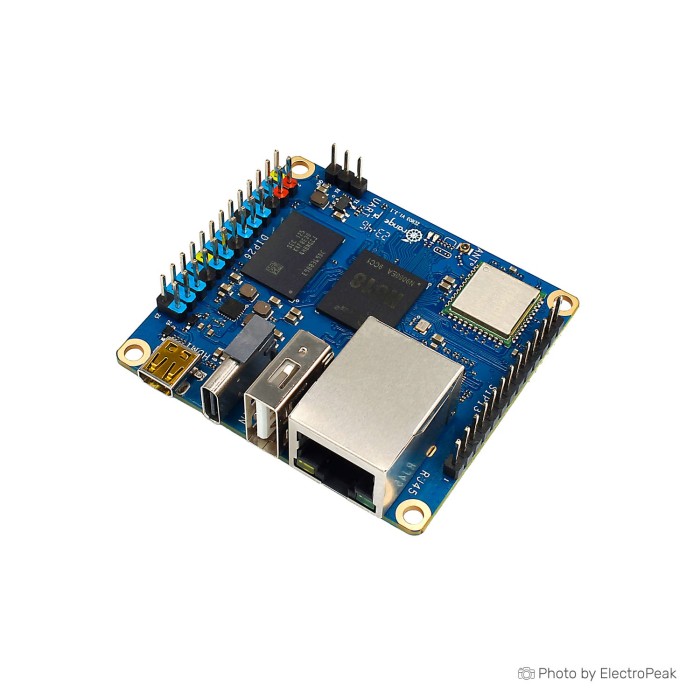
Orange Pi Zero 3 H618 Quad Core Development Board
$47.5000
In stock
SKU
MIN-02-035
Volume discounts:
- +10 6 % $44.6600
- +25 7 % $44.0100
- +50 9 % $43.3600
- +100 10 % $42.7100
- +300 11 % $42.0700
Ships in 2-3 business days, then:
Free delivery in 12-15 days by Tracked Economic Shipping on orders over $100.
Free delivery in 7-10 days by Express Shipping on orders over $300.
More shipping info

Shop with confidence Learn More
 Orange Pi Zero LTS H3 Quad Core Development Board Previous
Orange Pi Zero 3 H618 review: compact SBC for technical Linux projects
The Orange Pi Zero 3 H618 is a 50 mm × 55 mm single-board computer built around the Allwinner H618 quad-core Cortex-A53 processor. It integrates Gigabit Ethernet, dual-band Wi-Fi 5, Bluetooth 5.0, micro-HDMI output, a 26-pin GPIO header, and a 13-pin expansion interface in an ultra-compact footprint. It suits technical makers and developers building headless network services, compact servers, IoT gateways, and low-level embedded hardware interfaces.
This board is for builders comfortable selecting board-specific operating system images, preparing storage media, and handling low-level hardware configuration. If your project needs beginner-level setup simplicity, out-of-the-box software compatibility from the Raspberry Pi ecosystem, multiple standard USB Type-A ports, or turnkey Linux media acceleration, another platform from the wider range of Orange Pi single-board computers or other SBC families is a better fit.
Specifications of Orange Pi Zero 3 H618 Quad Core Development Board
- CPU: Allwinner H618 Quad-core Cortex-A53 processor 1.5GHz
- GPU: Mali G31 MP2,Supports OpenGL ES 1.0/2.0/3.2,Supports OpenCL 2.0,Supports Vulkan 1.1
- Memory (LPDDR4): 1GB,1.5GB,2GB,4GB
- Onboard Storage: TF card slot,16MB SPI Flash
- Onboard Network: Support 1000M/100M/10M Ethernet
- Onboard WiFi+BT: Support IEEE 802.11 a/b/g/n/ac WiFi5,Support BT5.0
- Video Outputs: Micro HDMI 2.0a up to 4K@60fps,TV CVBS output, Support PAL/NTSC(Via 13pin interface board)
- Audio output: 3.5mm audio port (2-ch output 1-ch input, Via 13pin interface board)
- Power Source: Type-C interface 5V3A input,Power management: AXP313A
- USB 2.0 Ports: 3*USB 2.0 HOST(Two of them are via 13pin interface board)
- Low-level peripherals: 26pin header with I2C, SPI, UART and multiple GPIO ports,13pin header with 2*USB Host, IR pin, Tv-out AUDIO,3pin Debug ports
- Debug serial port: UART-TX,UART-RX,GND
- LED: Power led,Status led
- IR receiver: Support IR remote control (via 13pin interface board)
- Supported OS: Android 12 TV,Debian11,Debian12,Ubuntu22.04,Ubuntu20.04
- Dimension: 50mm,55mm
Orange Pi Zero 3 H618 specifications explained
For a compact board, the practical question is whether its silicon and interface layout match your compute, storage, and networking requirements. The Allwinner H618 quad-core Cortex-A53 CPU running at 1.5 GHz provides sufficient throughput for headless servers, lightweight automation stacks, local database logging, and network utilities. An AXP313A power management unit supports the platform.
| Specification | Hardware value | Why it matters |
|---|---|---|
| Processor (SoC) | Allwinner H618 Quad-core Cortex-A53 @ 1.5GHz | Delivers steady 64-bit ARM compute for background utilities, lightweight server tasks, and automation daemons without the overhead of desktop-class chips. |
| Graphics (GPU) | Mali G31 MP2 (OpenGL ES 1.0–3.2, OpenCL 2.0, Vulkan 1.1) | Provides hardware API support for rendering interfaces, though functional desktop or browser acceleration in Linux depends on distribution support. |
| System Memory | LPDDR4 options: 1GB, 1.5GB, 2GB, 4GB | Memory sizing determines container workload capacity, background service limits, and compile headroom. The exact capacity supplied under this listing is unstated and must be verified. |
| Boot & Storage | TF card slot, 16MB SPI Flash | The TF card (microSD card) slot handles normal operating system images and user storage. The 16MB SPI flash holds bootloader firmware, not user file systems. |
| Wired Network | 10/100/1000M Gigabit Ethernet | Provides high-throughput, low-latency wired connectivity, making the board effective as a local DNS sinkhole, VPN node, or edge gateway. |
| Wireless & Bluetooth | Wi-Fi 5 (802.11 a/b/g/n/ac) & Bluetooth 5.0 | Enables dual-band wireless networking and Bluetooth peripheral integration for wireless sensor polling or local IoT bridges. |
| Display Output | Micro-HDMI 2.0a (up to 4K @ 60 fps) | Physical interface supports high-resolution monitor output for digital signage, terminal displays, or Android TV media setups. |
| Hardware Interfaces | 26-pin GPIO header & 13-pin expansion header | The 26-pin header breaks out I2C, SPI, UART, and GPIO lines. Prototyping off-board is simplified with an Orange Pi 26P GPIO Extension Cable. The 13-pin header carries auxiliary signals. |
| Dimensions | 50 mm × 55 mm | Extremely compact board footprint enables integration into tight custom enclosures, embedded monitoring boxes, and modular electronics bays. |
Need integrated, high-reliability storage or onboard camera input? The Orange Pi Zero Plus 2 (H5) provides 8GB of onboard eMMC flash and a dedicated CSI camera connector. You can also compare form factors and platform generations across the wider Orange Pi single-board computers catalog.
Orange Pi Zero 3 H618 limitations: Linux setup, USB access, and 1.5 GB RAM
The Orange Pi Zero 3 has meaningful hardware trade-offs that can create problems during assembly and deployment. Its compact 50 mm × 55 mm footprint comes with distinct physical and architectural compromises.
- Exact supplied RAM is unspecified: The platform architecture supports 1GB, 1.5GB, 2GB, and 4GB LPDDR4 memory configurations, but the listing does not identify the capacity supplied under this board variant. Confirm the memory capacity before ordering to ensure it fits your computational needs.
- 1.5 GB RAM software caveat: If you receive or operate the 1.5 GB RAM variant, note its documented memory-detection issue in certain U-Boot and Linux software paths. The memory controller can misidentify the pool as 2 GB, resulting in memory allocation faults. Users seeking uncomplicated Linux setup should confirm that their board uses a 1GB, 2GB, or 4GB configuration, or verify that their distribution's bootloader carries the explicit memory patch.
- Image specificity: Operating system images built for the Orange Pi Zero 2 (Allwinner H616) are not directly compatible with the Orange Pi Zero 3 (Allwinner H618). Write an image explicitly prepared for the Orange Pi Zero 3 H618 to ensure proper device-tree loading and power configuration.
- Physical USB host availability: Although the SoC supports three USB 2.0 host interfaces, only one USB 2.0 Type-A host port is directly accessible on the base PCB. The remaining two USB host connections route exclusively to the 13-pin expansion header and require auxiliary breakout hardware for standard USB cables.
- Auxiliary media interfaces require expansion hardware: The board does not include an onboard 3.5 mm audio jack, composite video jack, or infrared sensor. The 3.5 mm stereo output/input, TV CVBS (PAL/NTSC) analog output, and IR receiver interface are available only through the unpopulated 13-pin expansion interface.
- Linux graphics and 4K playback expectations: The physical micro-HDMI 2.0a port is rated for output up to 4K @ 60 fps. Smooth 4K desktop use, in-browser video playback, and hardware-accelerated decoding under Linux depend heavily on custom kernel and display driver configurations. Do not purchase it expecting turnkey desktop media-center performance under standard Linux distributions.
- LED control and thermal design: The board has power and status LEDs, but their illumination and blinking behavior can vary with kernel driver initialization and GPIO configuration. The board also ships without documented sustained-load thermal figures or long-term component reliability data; sustained heavy compute operations require active cooling considerations.
For projects that need an Allwinner H616 platform baseline with verified micro-HDMI 4K@60 support, dual-band wireless, and Gigabit networking, the Orange Pi Zero 2 H616 is an established family variant.
Orange Pi Zero 3 H618 setup: microSD boot and first hardware check
Bring up the Orange Pi Zero 3 H618 methodically. Verify base hardware integrity on the first boot before deploying production software.
- Confirm board details: Check the physical marking to verify that your board is an Orange Pi Zero 3 H618, then confirm the RAM capacity configuration.
- Acquire board-specific firmware: Download an official or community Linux distribution, such as Debian 11/12, Ubuntu 20.04/22.04, or Armbian, or an Android 12 TV image built explicitly for the Orange Pi Zero 3 H618 platform.
- Flash your boot media: Write the downloaded image to a reliable, high-speed card such as the SanDisk Micro SD Memory Card - 32GB. Avoid low-grade or unverified cards, as write-speed bottlenecks and read errors can mimic boot failures.
- Connect communication interfaces: Insert the prepared microSD card into the TF card slot. Connect an RJ45 cable to the Gigabit Ethernet port for headless setup, or attach a display with a micro-HDMI cable. For serial-console debugging, connect a 3.3V voltage-compatible USB-to-TTL adapter to the 3-pin debug header (UART-TX, UART-RX, GND). Never connect a 5V serial adapter directly to these pins.
- Apply power: Connect a dedicated, stable USB-C power supply rated for 5V at 3A. Inadequate power supplies or high-resistance charging cables are common causes of boot-looping and filesystem corruption under load.
- Verify initial boot: Observe the power and status LEDs. A successful boot initializes the network interface, assigns an IP address via DHCP, or presents a login prompt on the micro-HDMI display or serial-console terminal.
- Test subsystems sequentially: Once logged in, verify Gigabit Ethernet link speed, Wi-Fi 5 connection stability, Bluetooth device scanning, the single onboard USB host port, and GPIO functionality before installing the board in an enclosure.
For sustained background workloads, automated compilation tasks, or high-throughput network routing, add an aftermarket heatsink and ensure adequate enclosure airflow. This is strongly advisable to prevent thermal throttling.
Orange Pi Zero 3 H618 accessories and requirements
The Orange Pi Zero 3 H618 ships as a bare development board without included peripherals. Several supporting items are required before it can operate.
Required accessories
- Boot storage: A reliable Class 10 or UHS-1 card such as the SanDisk Micro SD Memory Card - 32GB is strictly necessary to run the operating system and hold application data, as the onboard 16MB SPI flash cannot be used for user storage.
- Stable 5V 3A USB-C power supply: Use a quality, regulated power adapter capable of meeting the board's listed 5V/3A specification through its Type-C interface input without voltage sag under burst loads.
- High-current USB-C cable: Choose a low-resistance USB-C cable capable of delivering 3A continuously without dropping input voltage at the board's power management IC.
- Board-specific OS image: Use a freshly flashed operating system build compiled specifically with Orange Pi Zero 3 H618 device-tree support.
Recommended accessories
- GPIO connection cable: An Orange Pi 26P GPIO Extension Cable makes it easier to connect sensors, breadboards, and external circuitry without crowding the board's headers.
- Micro-HDMI adapter or cable: Essential for direct monitor output, console viewing, or Android TV interface navigation.
- 13-pin expansion interface board: Required when your deployment needs more than one standard USB peripheral, composite TV-out, 3.5 mm analog audio, or the IR receiver.
- Passive heatsink and fan: Recommended for sustained CPU computing, high ambient environments, or continuous network gateway routing to keep the H618 processor operating within optimal thermal limits.
- USB-to-TTL serial adapter: Highly recommended for debugging kernel boot stages, analyzing u-boot output, or troubleshooting headless installations without a network connection.
Optional accessories
- Powered USB 2.0 hub: Adds connections for multiple external drives, keyboards, and input peripherals through the single onboard USB host port.
- Ventilated protective enclosure: Protects PCB traces and low-level headers while maintaining sufficient airflow over the processor.
- Secondary backup microSD card: Supports rapid operating-system rollbacks and field maintenance without rebuilding system configurations.
Orange Pi Zero 3 H618 vs Orange Pi Zero 2 H616 and Raspberry Pi Zero 2 W
Match the board's hardware layout and software ecosystem to the exact demands of your build.
| Feature / Parameter | Orange Pi Zero 3 H618 | Orange Pi Zero 2 H616 | Raspberry Pi Zero 2 W |
|---|---|---|---|
| Processor (SoC) | Allwinner H618 (Quad-core Cortex-A53 @ 1.5GHz) | Allwinner H616 (Quad-core Cortex-A53) | Broadcom BCM2710A1 (Quad-core Cortex-A53 @ 1GHz) |
| System Memory | 1GB, 1.5GB, 2GB, or 4GB LPDDR4 (unspecified for this listing) | Platform capacity not specified in supplied baseline data | 512MB LPDDR2 (integrated in package) |
| Wired Ethernet | 10/100/1000M Gigabit RJ45 onboard | 10/100/1000M Gigabit RJ45 onboard | None onboard (requires USB adapter) |
| Wireless Networking | Wi-Fi 5 (802.11ac) & Bluetooth 5.0 | Wi-Fi 5 (802.11ac) & Bluetooth 5.0 | 2.4GHz 802.11b/g/n Wi-Fi & Bluetooth 4.2 |
| Display Output | Micro-HDMI 2.0a (up to 4K @ 60 fps) | Micro-HDMI 2.0a (up to 4K @ 60 fps) | Mini-HDMI (up to 1080p) |
| Direct USB Ports | 1× USB 2.0 Type-A host (2× via 13-pin header) | 1× USB 2.0 Type-A host (extra via 13-pin header) | 1× Micro-USB OTG port |
| Camera Interface | None | None | CSI-2 camera connector |
| GPIO Header | 26-pin header (I2C, SPI, UART, GPIO) | 26-pin header | 40-pin unpopulated HAT-compatible footprint |
The Orange Pi Zero 2 H616 is an established variant alternative with Gigabit Ethernet, dual-band Wi-Fi 5, Bluetooth 5.0, and micro-HDMI output capabilities. The H618 and H616 share extensive architectural similarities, but operating system builds are not interchangeable between the two boards.
Projects that depend heavily on Raspberry Pi OS libraries, camera sensors, and community-maintained HAT hardware may be better served by the Raspberry Pi Zero 2 W. It lacks native Ethernet and has lower memory ceilings, but its mature documentation and plug-and-play GPIO software ecosystem may help less experienced users.
Where integrated non-volatile storage matters more than external cards, the Orange Pi Zero Plus 2 (H5) provides onboard 8GB eMMC flash and a CSI camera connector.
Orange Pi Zero 3 H618 FAQ: RAM, power, USB, and compatibility
Which RAM version does this Orange Pi Zero 3 listing include?
The Orange Pi Zero 3 platform supports 1GB, 1.5GB, 2GB, and 4GB LPDDR4 options, but the capacity supplied under this listing is not stated. Confirm the exact hardware variant with customer support before ordering if your software stack requires a specific memory threshold.
Does the Orange Pi Zero 3 have three onboard USB ports?
No. The board provides only one directly accessible USB 2.0 Type-A host port on the base PCB. Although the Allwinner H618 SoC provides three USB host lines, the other two route exclusively through the unpopulated 13-pin expansion header.
Does the board include a 3.5 mm audio jack?
No, there is no physical 3.5 mm audio jack mounted on the base board. Analog stereo audio output and microphone input route through the 13-pin expansion interface and require an expansion board or custom wiring.
What power supply does Orange Pi Zero 3 H618 need?
The board requires a stable 5V 3A power source through its USB Type-C connector. Standard low-current phone chargers or inadequate USB cables can cause sudden freezes, boot failure, or card corruption during CPU frequency scaling.
Can I use an Orange Pi Zero 2 image?
No. Images created for the Orange Pi Zero 2 H616 generally fail to boot or configure onboard hardware properly. Always download an operating system image explicitly designated for the Orange Pi Zero 3 H618.
Does micro-HDMI 4K@60 mean guaranteed smooth 4K Linux playback?
No. The 4K@60 specification denotes physical HDMI 2.0a transmitter bandwidth. Real-world video decoding, desktop fluidity, and browser playback under Linux rely on distribution-specific graphics drivers and software configuration, so turnkey 4K playback should not be expected.
Do I need a microSD card?
Yes. Running an operating system requires a bootable microSD card such as the SanDisk Micro SD Memory Card - 32GB. The onboard 16MB SPI flash memory is designed to hold bootloader code and cannot host user operating system installations.
Is the 1.5 GB version safe for Linux use?
The 1.5 GB RAM model has a documented memory-sizing bug in unpatched U-Boot versions that misidentifies memory as 2 GB, leading to boot errors or runtime crashes. If using this version, ensure your chosen Linux distribution contains the specific device-tree patch addressing this behavior.
Is a heatsink required?
A heatsink is not strictly mandatory for idle states or brief light tasks, but it is strongly advised for sustained CPU loads, compiling, or warm enclosures to prevent performance throttling.
Will Raspberry Pi GPIO projects work unchanged?
No. The 26-pin header has its own distinct pinout, electrical characteristics, and register maps. Software scripts written specifically for the Raspberry Pi RPi.GPIO library require modification or porting to work with Orange Pi GPIO utilities.
Does the package include a power supply, microSD card, heatsink, or expansion board?
No, package contents are not stated to include accessories. Assume that only the bare single-board computer is supplied unless you purchase an explicit bundle listing.
For buyers who need an even more compact, headless Linux system with 10/100M Ethernet and a smaller 40 mm × 40 mm footprint, the NanoPi NEO H3 is another approach. You can also compare Orange Pi boards to find the balance of size, storage, and processing power required for your deployment.
Purchase decision summary
- Ideal for: Technical developers and experienced makers building compact ARM Linux servers, wired Gigabit network appliances, headless IoT gateways, home automation nodes, or low-level GPIO hardware controllers.
- Maybe for: Android TV experimentation, lightweight terminal displays, or compact container nodes, provided that cooling, power delivery, memory capacity, and OS images are properly validated.
- Consider another option if: You are a beginner seeking plug-and-play tutorials, need native Raspberry Pi OS/HAT compatibility, require multiple direct USB Type-A ports without breakout boards, require built-in analog audio jacks, or require out-of-the-box hardware-accelerated 4K Linux media playback.
Buying checklist
- Confirm the exact RAM variant (1GB, 1.5GB, 2GB, or 4GB) supplied under this listing before checkout.
- Ensure you are purchasing the Orange Pi Zero 3 H618 and not an older Zero 2, Zero H3, or Zero 2W board.
- Verify that your order includes or accounts for a Class 10 or UHS-1 microSD card for OS installation.
- Acquire a regulated 5V 3A USB-C power adapter and a verified low-resistance cable.
- Determine if your project requires an external micro-HDMI adapter or the 13-pin expansion board for analog audio, TV-out, and extra USB host ports.
- Check that an official or community Linux distribution built specifically for the Orange Pi Zero 3 H618 is available for your software stack.
- Review 3.3V logic compatibility and pinmux assignments before interfacing external sensors with the 26-pin GPIO header.
| Processor (SoC) | Allwinner H618 |
|---|---|
| CPU | Quad-core Cortex-A53 1.5GHz |
| Architecture | ARM Cortex-A53 |
| RAM | 1GB |
| RAM Type | LPDDR4 |
| Storage Support | microSD |
| Storage Capacity | 16MB SPI Flash |
| GPU/VPU | Mali G31 MP2 |
| Ethernet | 1 Gbps |
| Wi-Fi | WiFi 5 |
| Bluetooth | Bluetooth 5.0 |
| USB Ports | 3*USB 2.0 HOST |
| Video Output | micro HDMI |
| Hardware Interfaces | I2C, SPI, UART |
| GPIO Pins | multiple GPIO ports |
| Power Input | Type-C interface 5V3A |
| PCIe | No |
| Dimensions (mm) | 50mm x 55mm |
| OS Support | Linux, Ubuntu, Debian, Android |
Write Your Own Review

Please complete your information below to login.
Sign In
Create New Account