
Product added to cart

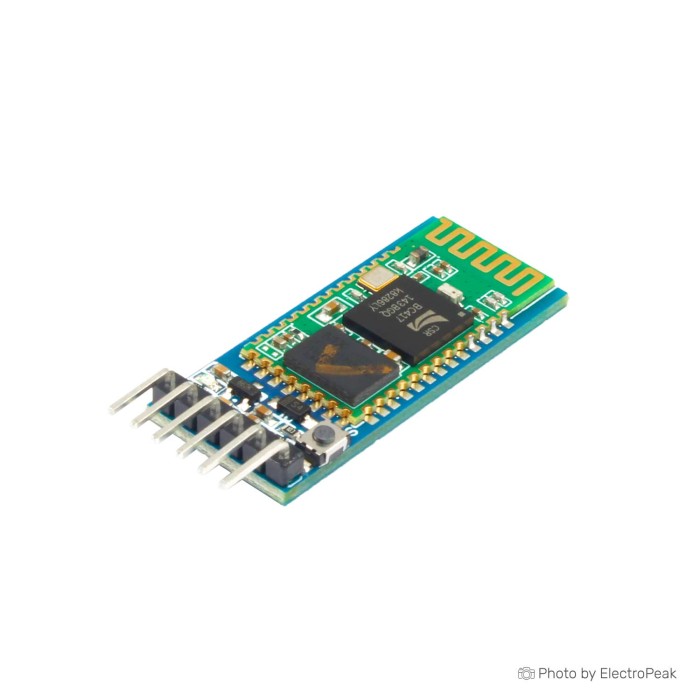
HC-05 Bluetooth Serial Wireless Module
$5.9500
In stock
SKU
COM-02-006
Volume discounts:
- +25 4 % $5.7000
- +50 6 % $5.5800
- +100 8 % $5.4500
- +300 10 % $5.3300
- +500 13 % $5.2000
Ships in 2-3 business days, then:
Free delivery in 12-15 days by Tracked Economic Shipping on orders over $100.
Free delivery in 7-10 days by Express Shipping on orders over $300.
More shipping info

Shop with confidence Learn More
 RT-MWK08 Mini Wireless Keyboard with AA Battery (Black) Previous
HC-05 Bluetooth Serial Module Review
The HC-05 Bluetooth Serial Wireless Module is a Bluetooth Classic v2.0+EDR UART bridge for transparent serial data between microcontrollers, computers, and Android devices. Configurable master and slave modes make it practical for wireless sensor telemetry, remote robotics control, and microcontroller-to-microcontroller links. Bluetooth Classic is the key limitation: it does not support Bluetooth Low Energy (BLE) and will not communicate with iOS devices such as iPhones or iPads. Category pricing sits around $3 to $6 per module, though exact pricing for this board is not stated. If your hardware setup requires modern low-energy connectivity, consider alternative Bluetooth communication modules before finalizing a design.
Specifications of HC-05 Bluetooth Serial Wireless Module
- Bluetooth Protocol: Bluetooth Specification v2.0+EDR
- Frequency:4GHz ISM band
- Modulation: GFSK (Gaussian Frequency Shift Keying)
- Transmit Power: ≤ 4dBm, Class 2
- Sensitivity: ≤ -84dBm at 0.1% BER
- Operating Voltage: 3V - 5V DC
- Current Consumption: Active: <40mA, Standby: <1mA
- Operating Temperature: -20°C to +75°C
- Dimensions: 43x16mm
- Interface: UART (Universal Asynchronous Receiver-Transmitter) for serial communication.
- Configuration: Supports standard AT commands for easy setup and customization.
- Compatibility: Works with a wide range of microcontrollers and devices supporting UART communication.
- Range: Effective communication range varies depending on environmental factors but typically up to several meters.
- Security: Basic security features provided by Bluetooth 2.0+EDR protocol.
- Certification: CE and FCC certified for compliance with regulatory standards.
- VIN: Module power supply (3.6 to 6V)
- GND: Ground
- STATE: Connection status
- EN: Enabling the AT Command Configuration
- RX: Receiving data (serial protocol)
- TX: Transmitting data (serial protocol)
HC-05 Bluetooth Module Specifications Explained
Understanding how these specifications translate to real hardware design helps prevent integration errors and damaged components.
| Specification | Stated Value | Why It Matters to Your Project |
|---|---|---|
| Bluetooth Protocol | Bluetooth Specification v2.0+EDR | Establishes a legacy Serial Port Profile (SPP) connection. It connects smoothly to Android terminal apps and PC serial ports, but it is incompatible with Bluetooth Low Energy (BLE) central devices such as iPhones and iPads. |
| Operating Role | Master/Slave Configurable | Unlike slave-only alternatives, this module can initiate connections to other Bluetooth devices when set to master mode, enabling direct module-to-module links without an external host computer. |
| Host Interface | UART (TX/RX) | Transfers data through standard asynchronous serial communication. Any microcontroller with a hardware or software serial port can communicate with the module without custom protocol stacks. |
| Transmit Power & Sensitivity | ≤ 4dBm (Class 2), ≤ -84dBm | Defines radio performance for short-range communication. It suits bench testing and clear indoor spaces, but physical walls, enclosures, and 2.4 GHz interference reduce effective distance. |
| Breakout Dimensions | 43x16mm | Reflects the footprint of the breakout board including the six-pin header. It fits neatly onto standard breadboards, occupying seven rows across the center divider. |
| Current Consumption | Active: <40mA, Standby: <1mA | Active current draw fluctuates between 30mA and 40mA during pairing searches and settles near 10mA once paired. This draw is acceptable for USB-powered systems but quickly drains small coin-cell batteries. |
| Configuration Interface | Standard AT Commands | Allows modification of baud rates, module name, pairing PIN, and operating roles (master vs. slave) through simple serial text commands before deployment. |
Projects requiring newer wireless standards or lower sleep currents need Bluetooth communication modules based on modern protocols.
HC-05 Bluetooth Module Voltage, UART, and Device Compatibility
Safe wiring depends on separating the power supply input from the signal-line logic levels. The breakout board includes an on-board low-dropout voltage regulator that accepts 3.6V to 6V on the VIN pin. The core Bluetooth radio processor, however, operates strictly at 3.3V logic. The TX pin outputs a 3.3V signal, which standard 5V microcontrollers such as the Arduino Uno reliably recognize as a digital HIGH. The module RX pin is not 5V tolerant. Feeding a direct 5V TX signal from an Arduino Uno or Mega into the module RX pin risks degrading or destroying the radio chip over time.
For a safe connection between a 5V microcontroller and the HC-05, add a simple resistor voltage divider to the module RX line. Run the host TX signal through a 1kΩ resistor to the HC-05 RX pin, then connect a 2kΩ resistor from the HC-05 RX pin to common ground. This steps 5V logic down to an acceptable 3.3V. An active bidirectional logic-level shifter is another option. Microcontrollers operating natively at 3.3V logic, such as the Raspberry Pi Pico or STM32 boards, connect directly to both TX and RX lines without level shifting.
The module breakout exposes six pins for hardware integration:
- VIN: Power supply input, accepting 3.6V to 6V DC.
- GND: Common system ground.
- TX: Serial data output (3.3V logic level), connecting to the microcontroller RX pin.
- RX: Serial data input (3.3V logic level only), connecting to the microcontroller TX pin via a voltage divider on 5V systems.
- EN: Enables AT command configuration mode when pulled HIGH or driven via the onboard push button during power-up.
- STATE: Outputs a digital signal indicating Bluetooth connection status, useful for driving external microcontroller status interrupts.
Reliable breadboard prototypes need quality jumper-wire connections to prevent intermittent data drops or power resets. For direct PC configuration before wiring to a microcontroller, a dedicated USB-to-TTL UART adapter provides serial access. For a detailed step-by-step wiring breakdown with code examples, refer to the Arduino HC-05 setup guide. For a 5V system where you prefer to avoid external resistor dividers, the BLE serial module with level shifting incorporates onboard logic translation alongside modern BLE connectivity.
HC-05 AT Commands and First Connection Check
Confirm module operation by verifying basic communication in serial data mode, then entering AT command mode for parameter customization. The HC-05 does not require custom USB drivers on host computers; once paired over Bluetooth, the operating system creates a standard virtual COM port.
- Wire the hardware: Connect VIN to 5V, GND to common ground, module TX to microcontroller RX, and microcontroller TX to module RX through a 1kΩ/2kΩ voltage divider.
- Power up in data mode: Apply power. The onboard LED blinks rapidly (approximately several times per second), indicating that the module is unpaired and discoverable.
- Pair with a host device: Open Bluetooth settings on an Android phone or PC. Scan for devices, select the module (typically named "HC-05"), and enter the default pairing PIN (usually
1234or0000). Once connected, the LED blink rate slows to a brief double-pulse every few seconds. - Verify serial pass-through: Open a Bluetooth serial terminal app on your phone and a serial monitor on your microcontroller. Characters typed into the terminal should immediately print to the serial monitor and vice versa.
- Enter AT configuration mode: Disconnect power, hold down the small push button located near the EN/KEY pin (or tie the EN pin directly to 3.3V), and reapply power. The LED blinks slowly (once every two seconds), indicating AT command mode.
- Test command response: Connect the module to a computer using a CP2102 USB to TTL UART serial converter module or a CH340G USB to TTL converter. Open a serial terminal set to 38400 baud with "Both NL & CR" line endings enabled. Send
AT; the module should respond withOK.
If serial communication fails during first-time testing, check these frequent setup errors:
- Unmatched baud rates: While AT command mode almost universally operates at 38400 baud, data-mode factory defaults vary across manufacturing batches. If 9600 baud fails to communicate in data mode, test 38400 baud.
- Uncrossed serial lines: Ensure host TX connects to module RX, and host RX connects to module TX.
- Missing line endings: AT commands require carriage return and line feed characters (CR+LF). Commands sent without them will not trigger a response.
- Floating or improperly wired EN pin: If the module fails to enter AT mode, verify that the push button is held continuously during power-on until the slow LED flash pattern appears.
For custom setups, consult the official HC-05 AT command set to adjust roles, names, and speeds. Advanced users who want to flash microcontroller sketches wirelessly can follow the wireless Arduino programming guide.
HC-05 Bluetooth Module Limitations and Batch Differences
The HC-05 is a standard component in electronics labs, but its hardware architecture has clear constraints that need consideration before you specify it in a project.
- Logic-Level Fragility: The RX input connects directly to the core CMOS radio processor without an internal clamping diode or level shifter. Direct exposure to 5V UART signals causes gradual gate breakdown and premature module failure.
- Power Supply Transients: The module is sensitive to power supply fluctuations. If it shares a power rail with DC motors, servos, or high-current relays, inductive voltage dips trigger brownout resets and unexpected Bluetooth disconnects. Supplying the module from stable regulated breadboard power and placing a 10µF to 100µF electrolytic capacitor across VIN and GND near noisy loads mitigates supply dips.
- Firmware and Default Inconsistencies: Various manufacturers produce HC-05 breakout boards, so internal firmware builds differ across production batches. Default data-mode baud rates, exact pinout labeling (KEY vs. EN), and responses to specific secondary AT commands can vary. Always verify a new batch's default settings via AT mode before soldering.
- Fixed Firmware: The onboard firmware cannot be upgraded in the field. What comes flashed on the internal ROM is permanent.
- Realistic Operational Range: The documentation specifies range as up to several meters. In practice, line-of-sight range in open air typically reaches roughly 10 meters. Solid obstacles, metal enclosures, and heavy 2.4 GHz Wi-Fi traffic degrade transmission distance significantly.
- Certification Traceability: Although the specification states CE and FCC certification, traceable certificate numbers, test reports, and lab documentation are not supplied. If your product requires formal regulatory declarations for commercial distribution, you will need to perform qualification testing independently.
Projects needing longer range or simultaneous support for modern mobile apps and legacy systems can use dual-mode SPP and BLE serial connectivity as an alternative approach.
HC-05 vs BLE Bluetooth Modules
The choice between Bluetooth Classic and Bluetooth Low Energy depends on host platform support, connection topology, and data throughput requirements.
| Feature / Parameter | HC-05 Breakout Module | AT-09 (CC2541) Module | DX-BT18 Dual-Mode Module |
|---|---|---|---|
| Bluetooth Standard | Bluetooth v2.0+EDR (Classic) | Bluetooth v4.0 (BLE) | Dual-Mode (SPP 2.0 + BLE 4.0) |
| Protocol Support | Serial Port Profile (SPP) | GATT Attributes / BLE Serial | SPP and GATT simultaneously |
| Apple iOS Support | No (Classic SPP restricted) | Yes (Standard BLE GATT) | Yes (Via BLE 4.0 channel) |
| Operating Voltage | 3.6V - 6V VIN (3.3V UART) | 3.6V - 6V (Built-in level shifter) | 3.0V - 3.6V strict DC supply |
| Master / Central Role | Yes (Master and Slave modes) | Limited / Peripheral focused | Slave / Peripheral focused |
| Claimed Outdoor Range | Several meters (~10m line-of-sight) | Up to several meters | 30 to 40 meters |
| Best Application | PC/Android wireless UART links | iOS/Android smartphone control | Mixed-ecosystem hardware networks |
The HC-05 is the practical choice for bidirectional wireless communication between two microcontrollers using master/slave modes, or for direct interfacing with desktop PC software and Android serial terminals. It cannot communicate with an iPhone or iPad because of iOS restrictions on Bluetooth Classic SPP devices. For mobile-centric builds across both operating systems, the AT-09 CC2541 BLE 4.0 module provides integrated 3.3V/5V logic translation. Industrial equipment requiring legacy SPP connections and modern smartphone integration can use the DX-BT18 dual-mode SPP2.0/BLE4.0 module, provided the system supplies a strictly regulated 3.0V to 3.6V power rail. To compare broader options, browse the complete selection of Bluetooth communication modules.
HC-05 Bluetooth Module Buying Checklist and FAQ
Purchase Decision Summary
- Ideal for: Arduino and microcontroller projects needing transparent serial data transmission, Android or PC control interfaces, benchtop prototyping, and direct microcontroller-to-microcontroller links using master/slave roles.
- Maybe for: Battery-powered prototypes where active currents around 10mA to 40mA fit the power budget, provided the system incorporates proper voltage regulation and decoupling.
- Consider another option if: You are building an app for iPhones or iPads, require microamp-level sleep currents for coin-cell operation, need direct long-range building penetration, stream real-time audio, or require formal, traceable compliance documentation for commercial release.
Companion Hardware & Accessories
Plan for the following companion hardware to integrate this module cleanly into a project:
- Required: A 1kΩ and 2kΩ resistor divider (or dedicated logic-level converter) to protect the RX pin when connecting to 5V microcontrollers like the Arduino Uno.
- Required: High-flexibility Male/Female Jumper Wires for routing power and UART signals to your development board.
- Required: A dedicated Breadboard Power Supply Module - 3.3V/5V to isolate module power from noisy inductive loads.
- Recommended: A standard MB-102 Breadboard for stable component layout and resistor placement.
- Recommended: A CP2102 USB to TTL UART serial converter module or CH340G USB to TTL converter for direct AT-mode configuration from a computer.
- Recommended: Local 10µF–100µF decoupling capacitors if the circuit powers motors, relays, or solenoids.
- Alternative approach: If your build requires a completely standalone programmable wireless processor rather than a fixed serial bridge, the standalone wireless controller approach based on the NRF51822 provides direct ARM Cortex-M0 execution alongside 2.4 GHz radio hardware.
Frequently Asked Questions
Can I use the HC-05 Bluetooth module with an iPhone or iPad?
No. The HC-05 uses Bluetooth Classic v2.0+EDR and the Serial Port Profile (SPP), which Apple devices do not support for general serial data without proprietary authentication. Projects communicating with iOS hardware must use a Bluetooth Low Energy (BLE) module such as the AT-09.
Do I need a voltage divider for the HC-05 RX pin?
Yes, whenever you interface with a 5V microcontroller such as an Arduino Uno or Mega. While the module VIN pin accepts up to 6V DC to feed the onboard regulator, the RX pin connects directly to the 3.3V radio processor and will degrade or fail if exposed to unattenuated 5V logic.
What is the HC-05 default baud rate?
Data-mode communication is typically configured for 9600 baud from the factory, but batch variations exist where 38400 baud is the default. When entering AT command mode using the onboard push button, the communication speed is standardized at 38400 baud.
Does the HC-05 support master and slave modes?
Yes. The HC-05 can be configured via AT commands to act as a slave, accepting connections from other devices, or as a master, initiating connections to other Bluetooth modules. This distinguishes it from the HC-06, which operates strictly in slave mode.
How far does the HC-05 Bluetooth module reach?
The module provides reliable communication over several meters, with typical open-air, line-of-sight performance reaching roughly 10 meters. Walls, human bodies, metal project enclosures, and radio interference from 2.4 GHz Wi-Fi networks reduce the usable operational distance.
Can I change the HC-05 name, PIN, baud rate, or role?
Yes. Putting the module into AT command mode lets you modify the broadcast name, security pairing PIN, serial baud rate, and master/slave role by issuing standard AT commands through a serial monitor.
Can HC-05 firmware be updated?
No. The onboard firmware is permanently flashed onto the module during manufacturing and cannot be updated or modified in the field.
Can I use multiple HC-05 modules in the same area?
Yes. Multiple modules can run in the same room without channel conflict because Bluetooth uses frequency-hopping spread spectrum across the 2.4 GHz band. To prevent accidental cross-connections, assign a unique device name and security PIN to each module using AT commands.
Why does the HC-05 reset or disconnect near a motor or servo?
Motors and servos create severe inductive noise and transient voltage drops on shared power rails. When voltage dips below the module regulator threshold, the HC-05 browns out and drops the Bluetooth link. Use separate power supplies or isolate the logic supply with decoupling capacitors.
Is an HC-06 the same as an HC-05?
No. Although they share a similar physical form factor, the HC-06 is a slave-only device with a simplified AT command set that can only be issued before pairing. The HC-05 supports full master and slave roles, dedicated AT pin controls, and comprehensive configuration options.
Pre-Purchase Buying Checklist
- Your host software or mobile device supports Bluetooth Classic SPP (Android, PC, Mac, Linux) and does not rely on iOS BLE.
- You require serial UART data transmission rather than real-time audio streaming or beacon broadcasting.
- You have verified whether your project requires a master module (initiator) or slave module (listener).
- You have a 1kΩ and 2kΩ resistor pair (or level shifter) ready if your host MCU runs at 5V logic.
- Your power supply provides a steady 3.6V to 6V DC without brownout spikes from motors or actuators.
- The 43x16mm physical footprint fits comfortably inside your planned project enclosure.
- You do not require formal, traceable FCC/CE compliance documentation for regulated commercial sales.
For wiring guidance or alternate wireless options, consult the Arduino HC-05 setup guide or browse the full catalog of Bluetooth communication modules.
| Platform | Arduino Uno |
|---|---|
| Interface Type | UART |
| Operating Voltage (V) | 3.3V - 5V DC |
| Operating Current (mA) | < 40mA (Active), < 1mA (Sleep) |
| Operating Temp (°C) | -20 to 75 |
| Dimensions (mm) | 43x16x2.2 mm |
| Mounting Type | THT |
| Connector | Pin Header |
| Wireless Protocol | Bluetooth Classic |
| Frequency Band | 2.4GHz |
| Data transmission rate | 1Mbps / 2.1Mbps |
| RF Modulation | GFSK |
| TX Power (dBm) | 4dBm |
| Range (m) | 10m |
| SIM Slots | 0 |
| Chipset | HC-05 (CSR BlueCore) |
| Modes | Master, Slave |
| Input Voltage (V) | 3.6V - 6V |
| Antenna Type | Internal Antenna |
| Application | DIY Projects, Internet of Things (IoT) systems, remote control, wireless sensing |
| Receiver Sensitivity | ≤ -84dBm at 0.1% BER |
Write Your Own Review

Please complete your information below to login.
Sign In
Create New Account