
Product added to cart

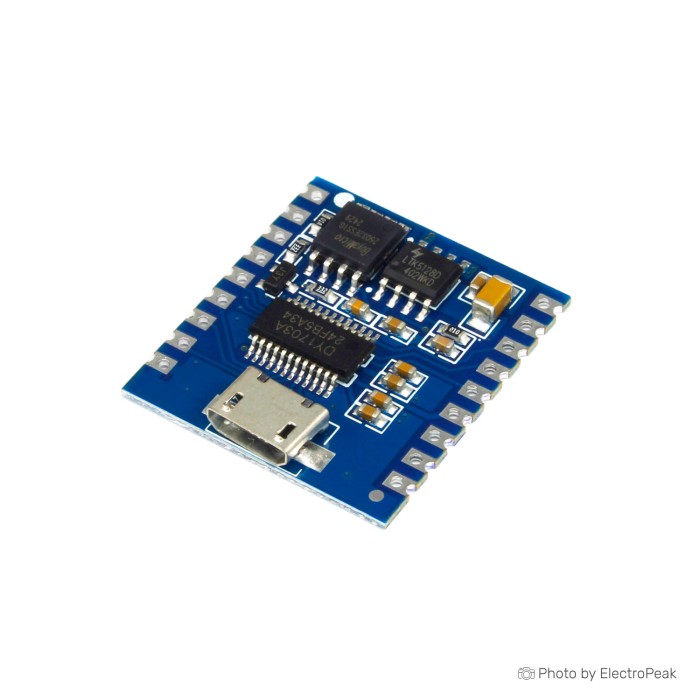
DY-SV17F Mini MP3 Player Audio Module - IO Trigger USB Download, 4MB Flash
SAVE $0.0900
$1.9500 $2.0400
In stock
SKU
SEN-17-096
Volume discounts:
- +100 1 % $1.9400
- +300 3 % $1.9000
- +500 4 % $1.8700
- +1000 6 % $1.8400
Ships in 2-3 business days, then:
Free delivery in 12-15 days by Tracked Economic Shipping on orders over $100.
Free delivery in 7-10 days by Express Shipping on orders over $300.
More shipping info

Shop with confidence Learn More
 CJMCU PAM8302 Audio Amplifier Module - 2.5W 1-Channel Previous
DY-SV17F MP3 Module Review
The DY-SV17F is a compact MP3/WAV playback module with 4MB internal flash, USB file loading, IO trigger and serial control, and a built-in amplifier for a 4Ω, 3–5W speaker. It suits short voice prompts, button-triggered effects, announcements, doorbells, and compact interactive projects where audio remains on the board.
The main trade-off is storage. Internal flash is convenient for small sound sets, but it is not expandable and is not intended for long music libraries, audiobooks, or large playlists. For more audio playback modules, choose a storage approach that matches your audio library size.
Specifications of DY-SV17F Mini MP3 Player Audio Module
- Input Modes: Supports multiple input modes, including IO Trigger and Serial
- USB Download: Allows for easy file transfer via USB
- Flash Memory: Equipped with 4MB of Flash memory for storing audio files
- Size: Compact dimensions, 26mm x 23mm x 3.2mm (Length x Width x Height)
- Supported Audio Formats: MP3 and WAV
- Supported Sampling Frequency: Supports a wide range of sampling frequencies (KHz) including 8, 11.025, 12, 16, 22.05, 24, 32, 44.1, and 48 KHz.
- DAC Output: Features a 24-bit DAC (Digital-to-Analog Converter) with a dynamic range of up to 90dB and Signal-to-Noise Ratio (SNR) support of up to 85dB.
- Song Selection: Can support the largest selection of 65,535 songs in serial mode and 255 songs in IO mode.
- Working Modes: Offers seven working modes to suit various applications.
- Amplifier: Built-in 5W Class D amplifier circuit capable of driving 4-ohm, 3 to 5W speakers directly.
- Power Supply: Requires a 3.7V to 5V DC power supply.
DY-SV17F Specifications and Limitations
The 4MB internal flash keeps this board self-contained. Load short clips over USB, then install it in a prop, panel, or enclosure without a separate card. As a rough guide, 4MB holds approximately four minutes of 128kbps audio, though actual duration depends on encoding and file size.
IO trigger mode is the practical choice for direct buttons, switches, and fixed sound actions, supporting up to 255 songs. Serial control suits microcontrollers that need command-driven playback, track selection, or volume control; it supports up to 65,535 songs.
| Specification | Why it matters |
|---|---|
| MP3 and WAV support | Existing clips can be used when they are encoded as MP3 or WAV. Supported sampling frequencies range from 8 KHz through 48 KHz at the listed values. |
| 24-bit DAC output | The DAC provides a separate audio path for projects that need an external amplifier instead of the onboard speaker output. |
| 5W Class D amplifier | The stated direct-drive configuration is a 4Ω, 3–5W speaker. Choose that load when wiring directly to the speaker terminals. |
| 26mm x 23mm x 3.2mm board | The small footprint fits compact enclosures, control panels, toys, and embedded displays. |
| Seven working modes | Control behavior and file preparation depend on the selected mode, so configuration is part of the build rather than an optional detail. |
Limitations to plan for
- The DY-SV17F uses 4MB built-in flash and has no MicroSD card slot. Choose an SD/TF-based module if removable or expandable storage is essential.
- File naming depends on the mode. Do not assume that a five-digit naming pattern applies to every working mode.
- Playback order can depend on the active mode and the sequence in which files were copied. Re-copy files sequentially if an ordered prompt sequence behaves incorrectly.
- The specified supply range is 3.7V to 5V DC, but stable 5V is the practical target for reliable playback and speaker output.
Need TF-card storage, 32Mbit internal flash, or external-audio mixing? The JQ8900-16P with Audio Mixing is a better fit. For a DAC output feeding a separate amplified path, pair it with a PAM8403 Mini Digital Amplifier Board - 2x3W Class D.
DY-SV17F Audio Projects and Compatibility
At 26mm x 23mm x 3.2mm, the DY-SV17F fits compact props, interactive displays, doorbell housings, and embedded voice-prompt projects. It is compatible with popular microcontrollers such as Arduino, making it useful for sensor alerts and command-driven sound effects in Arduino-compatible microcontroller projects.
A controller is optional for basic playback. Standalone IO-trigger modes let buttons or switches activate stored clips directly, while serial control gives an Arduino or another controller a command interface for playback functions.
| Connection area | Requirement | Practical takeaway |
|---|---|---|
| Control | IO Trigger or Serial input modes | Set the required CON-pin mode before wiring buttons, triggers, or serial connections. |
| Speaker output | SPK+ and SPK- | Use a 4Ω, 3–5W speaker for the stated direct-drive configuration. |
| External audio | 24-bit DAC output | Use this output with an external amplifier when the project needs a different audio-output arrangement. |
| Power and ground | Stable 5V and shared ground | Connect the module, controller, and supply to a clean shared ground, and avoid ground loops. |
Suitable project types
- Confirmed use: Arduino-controlled voice prompts for sensor alerts, interactive displays, and simple embedded notifications.
- Confirmed use: Prop triggers for animatronics, museum-style exhibits, and event or Halloween effects.
- Confirmed use: Custom doorbell chimes using short stored sounds.
- Confirmed use: One-line control systems where simplified serial wiring is useful.
- Technically suitable use: Educational demonstrations of UART commands, IO trigger inputs, speaker wiring, and audio-file handling.
- Technically suitable use: Short looping product-demo or point-of-sale audio when the full library fits in internal flash.
- Technically suitable use: IoT audio feedback for short local notifications.
For breadboard prototypes, buttons, trigger inputs, and serial wiring, add a Breadboard Jumper Wire Kit - 140 Pieces. The optional Speaker - 8 Ohm, 1W, 36mm Diameter may suit a separate audio design, but it is not the specified 4Ω, 3–5W direct-drive match for this board.
For WMA support alongside MP3 and WAV, choose the DY-SV20F 5W High Power.
DY-SV17F Setup and USB Audio Loading
First use is straightforward when the working mode, file preparation, supply, and speaker load are planned together. USB loading transfers compatible MP3 or WAV files directly to the internal flash, but operating-system driver requirements are not confirmed.
- Connect the module to a computer with a data-capable Micro USB cable.
- Load compatible MP3 or WAV files through USB.
- Configure the required working mode using the CON pins.
- Connect stable 5V power and a 4Ω, 3–5W speaker to SPK+ and SPK-.
- Test playback through the selected IO trigger or serial-control method.
Use a USB to Micro USB Cable - 30cm and a Switching Power Supply Module - 5V, 1A for the cable and supply. A charge-only cable cannot transfer audio files.
First checks
- Use a data cable, not a charge-only cable.
- Confirm the CON-pin working mode before testing triggers or serial commands.
- For a speaker-driven build, use stable 5V rather than an unstable low-voltage source.
- Check speaker wiring at SPK+ and SPK- and use the specified 4Ω, 3–5W load.
- Follow the selected mode’s file-naming guidance rather than applying one naming rule to all modes.
- If clips play out of order, re-copy files sequentially and check the active mode.
Arduino users should disconnect serial connections during code upload if they create a serial conflict. An isolated community report links use of CON3/BUSY to audible noise in some setups, so verify that status output in the finished circuit rather than treating it as universally trouble-free.
Use the DY-SV17F Arduino wiring and mode guide for mode configuration, wiring, and serial-control setup. Projects that specifically need direct SPI Flash updates from a computer plus TF-card audio management through serial commands are better served by the JQ6500 MP3 Module.
DY-SV17F MP3 Module Alternatives
The DY-SV17F Mini MP3 Player is the compact option for short MP3/WAV clips stored in 4MB internal flash, with USB file loading, IO trigger or serial control, and a built-in 5W Class D amplifier. Projects with larger libraries, removable media, or different format requirements need another storage or playback approach.
| Module | Storage and formats | Audio and control approach | Choose it when |
|---|---|---|---|
| DY-SV17F | 4MB internal flash; MP3 and WAV | USB file loading, IO trigger or serial control, built-in 5W Class D amplifier | Short, self-contained audio clips are enough. |
| JQ8900-16P with Audio Mixing | 32Mbit internal flash with TF-card support | External audio input mixing with MP3 playback | TF-card storage or mixed external audio is required. |
| DY-SV20F 5W High Power | MP3, WAV, and WMA | 5W output | WMA compatibility is required. |
| DFPlayer with MicroSD Slot | MicroSD storage up to 32GB | Serial audio player with 30 volume levels | A removable large audio library is required. |
| DFPlayer Pro with 128MB Storage | 128MB onboard high-speed storage | Type-C, dual-channel 3W amplification, PC/Raspberry Pi sound-card use | A larger onboard-storage audio module or sound-card use is needed. |
For removable MicroSD storage up to 32GB, consider the DFPlayer with MicroSD Slot. The 128MB onboard-storage audio module is another approach for projects needing more internal capacity, Type-C, dual-channel 3W amplification, or PC/Raspberry Pi sound-card use.
DY-SV17F FAQ and Buying Checklist
Does the DY-SV17F have an SD card slot?
No. The DY-SV17F uses 4MB built-in flash and has no MicroSD card slot. Choose an SD/TF-based alternative if removable or expandable storage is necessary.
How much audio can the DY-SV17F store?
It stores audio in 4MB of flash memory. As a rough estimate, that is approximately four minutes at 128kbps; actual duration varies with encoding and file size.
What voltage should I use for the DY-SV17F?
Use stable 5V for the most reliable practical setup, especially with a directly connected speaker. The specified supply range is 3.7V to 5V DC.
Can I use the DY-SV17F without Arduino or another microcontroller?
Yes. Buttons or switches connected to the control pins can provide standalone playback. A microcontroller adds serial-command flexibility for projects that need it.
Why do my files not play in the expected order?
Playback order can depend on copy sequence and the active working mode’s naming convention. Re-copy files sequentially and follow the file-naming guidance for the selected mode.
What speaker should I use with the DY-SV17F?
Use a 4Ω, 3–5W speaker for direct connection to the built-in amplifier. Use the DAC output with an external amplifier when another audio-output arrangement is required.
Do I need a special USB cable to load audio files?
You need a data-capable Micro USB cable. A charge-only cable will not transfer files to the module.
What should I choose if I need more storage?
Choose the JQ8900-16P with Audio Mixing for 32Mbit internal flash plus TF-card support, or the DFPlayer with MicroSD Slot for removable MicroSD storage up to 32GB. For larger onboard storage without an SD card, the DFPlayer Pro with 128MB Storage is the appropriate alternative approach.
Purchase decision summary
- Ideal for: Compact Arduino or standalone projects using short MP3/WAV voice prompts, sound effects, doorbells, prop triggers, interactive displays, and USB audio loading.
- Maybe for: Small battery projects with a regulated 5V supply, users willing to configure modes and follow file-naming guidance, and builds needing either IO trigger or serial control.
- Consider another option if: You need SD/TF storage, long music playback, audiobooks, large sound libraries, verified measured audio performance, guaranteed batch consistency, or a setup with no mode or file-management work.
Before ordering
- ✓ Confirm that 4MB internal flash is enough for every required audio clip.
- ✓ Confirm that the project does not require removable or expandable SD/TF storage.
- ✓ Confirm that stable 5V power is available; a Switching Power Supply Module - 5V, 1A is suitable for this need.
- ✓ Confirm that a 4Ω, 3–5W speaker is available for the specified direct-drive output.
- ✓ Confirm that a data-capable Micro USB cable is available for file loading.
- ✓ Choose IO trigger, serial control, or standalone playback before wiring.
- ✓ Plan to configure the CON pins for the selected working mode.
- ✓ Check the selected mode’s file-naming rules before preparing audio files.
- ✓ Convert audio to supported MP3 or WAV formats and the listed sampling frequencies.
- ✓ Use the Arduino guide for serial control or mode-specific wiring.
Browse other sound player modules if this board’s short-audio internal-flash design does not match the project.
| Interface Type | USB, UART |
|---|---|
| Operating Voltage (V) | 3.7V - 5V |
| Operating Temp (°C) | -20 to 85 |
| Dimensions (mm) | 26 x 23 x 3.2 mm |
| Mounting Type | SMD (Surface Mount) |
| Audio Function | Audio Player |
| Output Power | 5W |
| Speaker Impedance (Ω) | 4Ω |
| Sampling Rate (Hz) | 8/11.025/12/16/22.05/24/32/44.1/48 kHz |
| Memory Expansion | TF card |
| Audio Formats | MP3, WAV |
| Input Types | IO Trigger, Serial |
| Bluetooth Ver. | No |
| Output Type | Analog |
| Channels | 1-channel |
| Chipset | DY-SV17F |
| Humidity Range | 0% to 95% RH |
Write Your Own Review

Please complete your information below to login.
Sign In
Create New Account